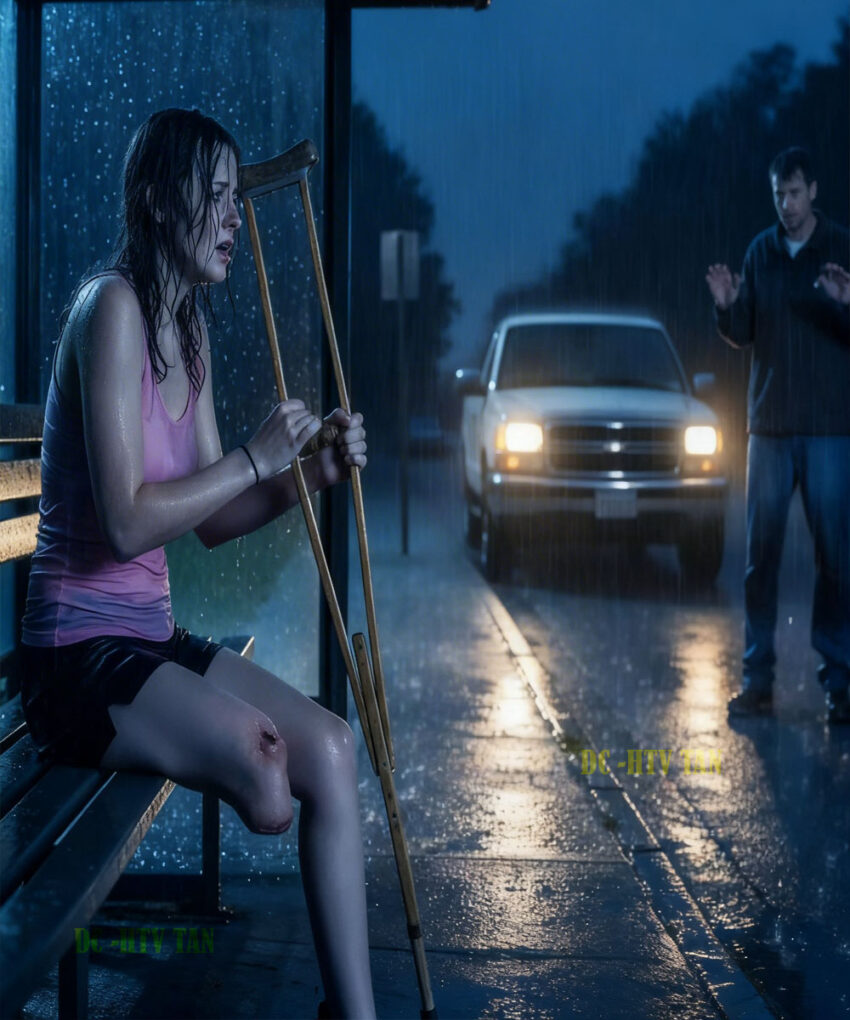
A single father. A rainy midnight in November. A young woman abandoned at a bus stop with nothing but a broken crutch, a pink top, and black shorts. Shivering alone, left to freeze by the only family she had left. Trevor Walsh thought he was just saving a stranger’s life that night. But when a mysterious black luxury car started appearing outside his apartment when a well-dressed stranger knocked on his door months later, the truth he discovered left him absolutely stunned.
This is the story of how one desperate night in the rain unraveled a secret that would change everything. Stay with me. The rain hammered relentlessly against the windshield as Trevor Walsh gripped the steering wheel of his aging pickup truck. It was nearly midnight on a Thursday in November, and the streets of Cedar Falls, Ohio, were completely deserted.
The rhythmic squeaking of the worn out wipers was the only sound accompanying his exhausted thoughts. Trevor rubbed his burning eyes. Another 12-hour shift at the textile factory. Another day of barely making ends meet. Another night coming home late to his seven-year-old daughter, Sophia, who was learning far too young what it meant to have only one parent.
His wife, Emma, had died two years ago from a sudden heart attack. One moment she was laughing at breakfast. The next she was gone. Just like that. Trevor had been struggling ever since, balancing work, bills, and trying to be both mother and father to a little girl who still asked when mommy was coming home. He turned onto Maple Street, his mind already on tomorrow’s shift when his headlights caught something that made his foot slam hard on the brake pedal.
The truck skidded slightly on the wet pavement. Through the sheets of rain, huddled against the bus stop shelter, was a figure, small, trembling, barely visible through the downpour. Trevor squinted, his heart suddenly pounding. It was a young woman soaked completely through, shivering so violently he could see it even from inside his truck.
Without a second thought, he pulled over and jumped out into the freezing rain. As he approached, the scene became clearer and more heartbreaking. She wore a thin pink top that clung to her small frame, completely drenched. Black shorts that offered no protection from the cold. Her long, dark hair was plastered against her pale face.
Her bare arms were covered in goosebumps, and her teeth were chattering so hard he could hear them clicking. But what stopped Trevor’s breath was the worn wooden crutch gripped desperately in her right hand, wedged under her arm, and the way her left leg ended just below the knee. She was sitting on the cold metal bench, her one leg pulled close to her chest, trying to conserve warmth.
The crutch looked ancient, splintered in places, held together by what seemed like sheer willpower. “Miss,” Trevor called out gently, keeping his distance so he wouldn’t frighten her. “Are you okay?” The young woman’s head snapped up. Her eyes were wide with fear, red from crying, shadowed with exhaustion, and something deeper, hopelessness.
She stared at him, her whole body trembling, her knuckles white from gripping that broken crutch. “I’m not going to hurt you,” Trevor said, raising his hands slowly. Rain poured down his face. “My name is Trevor. You’re going to freeze to death out here. Please let me help you.
” For a long, terrible moment, she just stared. Trevor could see her mind working, weighing the danger of a stranger against the certainty of hypothermia. Finally, almost imperceptibly, she nodded. Trevor moved carefully. “Can you stand?” she tried, using the crutch to push herself up, but her body was shaking so badly she nearly fell. Trevor caught her arm gently.
“Easy. I’ve got you.” Together, they made their way slowly to the truck. She leaned heavily on the crutch, each step clearly painful. Trevor opened the passenger door and helped her climb in, his heart breaking at how light she felt, how fragile. He took the wet crutch from her trembling hands and placed it carefully in the back seat.
Inside the truck, he cranked the heat to maximum and grabbed an old blanket from behind the seat, wrapping it around her shaking shoulders. “What’s your name?” he asked softly. “Celeste,” she managed through chattering teeth. Her lips were turning blue. “Celeste, I’m Trevor. Where do you live? Can I take you home?” And that’s when the tears came.
Not just a few, a flood of them streaming down her face, mixing with the rainwater, accompanied by sobs that shook her entire body. I don’t I don’t have anywhere, she choked out. My stepbrother, he left me here. He said I was worthless, that I couldn’t work, couldn’t contribute. He called me a and said he was done taking care of dead weight.
Trevor felt anger surge through his chest, hot and fierce. How long have you been out here? Celeste’s voice was barely a whisper. since yesterday morning. Yesterday? Trevor’s voice rose despite himself. You’ve been sitting in the rain for over 24 hours. She nodded, fresh tears spilling. I thought maybe he’d come back. We were just going to the store.
That’s what he said. That’s why I’m dressed like this. It was warm inside. I only grabbed my crutch as he was pushing me out of the car. I didn’t even have time to get shoes that fit properly or a jacket or my phone. He just drove away. Trevor looked at her inadequate clothing with new horror. She’d been dressed for a quick errand in a heated car, not abandoned in a November rainstorm.
“You’re coming with me,” he said firmly. “We’ll get you warm and fed. Tomorrow, we’ll figure out what to do. But tonight, you’re safe. Okay.” Celeste looked at him like she couldn’t quite believe he was real. Then she nodded, and for the first time, Trevor saw a tiny flicker of hope in her eyes. When Trevor pulled up to his modest apartment building 20 minutes later, he helped Celeste out carefully, retrieving her crutch from the back.
She moved slowly, clearly exhausted, leaning heavily on the wooden support. “Inside, Mrs. Patterson, the elderly babysitter, looked up from her knitting and gasped.” “Trevor, good heavens, what happened?” “I found her at a bus stop on Maple Street,” Trevor said quietly, helping Celeste to the couch. “She’s been out in the rain for over a day.
Can you find some warm clothes while I make some tea?” Mrs. Patterson immediately sprang into action, disappearing into Trevor’s bedroom. She returned with thick sweatpants, a warm sweater, and wool socks. “Come on, dear,” she said gently to Celeste. “Let’s get you out of those wet things.” While Mrs. Patterson helped Celeste change in the bathroom, Trevor made hot tea and threw together a simple meal.
Soup and bread, nothing fancy, but warm and filling. A small voice came from the hallway. “Daddy!” Sophia appeared, rubbing sleep from her eyes, her stuffed rabbit dragging on the floor. Her brown hair was messy from sleep, and she wore her favorite pajamas with stars on them. “Hey, baby girl, what are you doing up? I heard voices.” Her eyes went wide when she saw Celeste emerge from the bathroom in dry clothes, Mrs.
Patterson carrying her wet things to the dryer. Celeste’s crutch was now leaning against the wall next to the couch. Who’s that? This is Celeste, sweetheart. She needs our help tonight. She’s going to stay with us. Sophia tilted her head, studying Celeste with the unfiltered curiosity of a seven-year-old. How come you only have one leg, Sophia? Trevor started, but Celeste held up a hand.
It’s okay, she managed a small smile. I had an accident at work a few years ago. But I’m okay. See? She gestured to her crutch. I can still get around. Does it hurt? Sometimes, but not as much as being cold and alone. Sophia seemed to process this. Then she walked over and held out her stuffed rabbit. Mr. Whiskers always makes me feel better when I’m sad.
You can hold him if you want. Celeste’s eyes filled with tears again, but these were different, softer, warmer. Thank you, sweetie. That’s very kind. After Mrs. Patterson left, Trevor sat with Celeste while she ate. Sophia had finally gone back to bed, but not before making Celeste promise she’d still be there in the morning.
“You don’t have to tell me everything tonight,” Trevor said gently. “But I need to know. Are you in danger? Is someone looking for you?” Celeste shook her head. “No one’s looking for me. That’s the problem. No one cares enough to look. And slowly, painfully, the story came out. Her mother, Margaret, had died from complications of a severe stroke when Celeste was 16.
Her father had remarried quickly, too quickly, to a woman named Patricia, who had a son from a previous marriage, a son named Ryan. “My dad tried,” Celeste said quietly. “He really did. But Patricia never wanted me around. I was a reminder that he’d had a whole other life before her.” When Celeste was 19, she’d been working at a warehouse trying to save money for college.
One day, a forklift operator made a mistake. Pallets came crashing down. Celeste’s leg was crushed beyond repair. I was in the hospital for weeks. Multiple surgeries. They tried to save it, but she gestured to where her leg ended. Eventually, they had to amputate below the knee. During her recovery, her father had a massive heart attack.
He died before the ambulance arrived. Patricia came to the hospital the day after the funeral. She told me I had one week to get my things and get out. I was still learning to use crutches. I couldn’t even walk properly yet. Celeste’s voice dropped to almost a whisper. Ryan took me in, but he never let me forget it was charity.
Every day he’d remind me that I was costing him money, taking up space, that I was useless with one leg. For 2 years, she’d endured his verbal abuse, his resentment, his constant reminders that she was a burden. She’d tried to find work, but with no car, limited mobility, and no support system, opportunities were scarce.
3 days ago, he just snapped. I was sitting on the couch in my pink top and black shorts because it was warm inside. He came home from work already angry about something, started yelling about how he was done, how I was dead weight, how I’d never amount to anything. Celeste’s hands trembled as she held the warm mug of tea.
He grabbed my arm and dragged me to the car. I managed to grab my crutch. I can’t walk without it, but he wouldn’t let me get anything else. Not a jacket, not my phone, not my documents, nothing. He drove across town. I kept asking where we were going. He wouldn’t answer. Then he pulled up to that bus stop, told me to get out.
When I hesitated, he shoved me. I stumbled out with just my crutch and he drove away. I stood there watching his tail lights disappear, holding this broken crutch, wearing summer clothes in November. Trevor’s jaw clenched. You waited there for a whole day. I didn’t know what else to do. I thought maybe it was a mistake that he’d cool down and come back.
As it got dark, I knew. But by then, I was too cold, too tired to figure out where to go. The crutch hurts my arm after a while. It’s old and the padding is worn through. I tried to walk to find help, but I couldn’t go far. She looked down. I tried using a pay phone to call shelters, but they were all full. I had no money, no identification, no phone.
Ryan kept all my documents of his place. I didn’t even know where I was. I just sat there waiting for anything, anyone. Trevor felt as heartbreaking. This young woman, barely in her 20s, had lost everything. her mother, her father, her leg, her home, her dignity. And when she needed help most, she’d been thrown away like trash.
“You’re staying here,” he said firmly. “At least until we figure something out. I can’t ask you to. You’re not asking. I’m telling you.” Trevor’s voice was gentle, but firm. I have a spare room. It’s small, but it’s warm, and it’s safe. You’ve been through enough. The next morning, Trevor called social services. A case worker named Mr.
Harrison arrived that afternoon, a middle-aged man with tired eyes at a worn briefcase. “Mr. Walsh, what you did was very compassionate,” Mr. Harrison said, sitting across from Trevor in the small living room. Celeste sat nearby, her crutch leaning against the arm of the chair. “But Miss Harper is an adult.
Our services for adults are quite limited. I can provide information about shelters and assistance programs, but honestly, most have waiting lists of several months.” “Ms,” Trevor repeated. Mr. Harrison sighed. “We’re underfunded and overwhelmed. I wish I could offer more, but that’s the reality.” Celeste stared down at her hands. “It’s okay.
I’ll figure something out. I always do.” But Trevor looked at this young woman who’d been abandoned in the freezing rain with nothing but a broken crutch and clothes meant for a summer day. He thought about Sophia, who’d already asked that morning when Miss Celeste would teach her to braid hair like she’d promised.
“What if she stayed here temporarily?” Trevor asked. “I have that spare room. It’s not much, but it’s warm and safe. Mr. Harrison raised his eyebrows. That’s very generous, Mr. Walsh, but you should know there’s no financial assistance for informal arrangements like this. Trevor nodded slowly. I understand. After Mr. Harrison left, Celeste turned to Trevor with tears in her eyes. You can’t do this.
You’re already struggling. I’ve seen the bills on your counter. You work 12-hour shifts. You can barely afford. Stop, Trevor said gently. Yes, money is tight. Yes, I work long hours, but I have a roof over my head, food in my fridge, and a daughter who needs to see that we help people when they need it.
You need help, so you’re staying. End of discussion. If this story is touching your heart, let me know in the comments below. Over the next few weeks, Trevor’s small apartment became something it hadn’t been in 2 years, a home. Celeste was terrified of being a burden. She’d wake up before Trevor, moving quietly through the apartment with her crutch, cleaning everything in sight.
She’d prepare breakfast with whatever ingredients were available, learning to balance on one leg while holding on to counters, always keeping her crutch within arms reach. She’d pack lunches for both Trevor and Sophia. She’d do laundry. She’d have dinner ready when Trevor came home from his shift, exhausted and covered in lint from the textile factory.
“You don’t have to do all this,” Trevor told her one evening, finding her scrubbing the bathroom floor while balancing on her crutch. “I need to contribute somehow,” Celeste replied, not meeting his eyes. You’ve given me so much. This is all I can offer. You’re not a maid, Celeste. You’re a person who deserves rest and recovery.
But Celeste couldn’t stop. Her entire life, she’d been told she was worthless, a burden, dead weight. The only way she knew to prove her value was through service. One Saturday morning, Trevor made an announcement. Get ready. We’re going shopping. Shopping? Celeste looked confused. For what? For you. You need more than one outfit.
Trevor, I can’t let you spend money on not asking,” he said with a smile. “Let’s go.” At the thrift store, Trevor helped Celeste pick out several outfits: jeans, shirts, a warm jacket, but he also grabbed something else. A pink top and black shorts similar to what she’d been wearing that rainy night. Celeste stared at them.
“Why would you buy me those?” Trevor looked at her seriously. “Because those clothes don’t have to be a bad memory. You can make new memories in them. on a warm summer day. Wearing these by choice, not because you were abandoned in them. That’s taking your power back. Celeste’s eyes filled with tears. But Trevor wasn’t done. At a medical supply store, he purchased a proper adjustable crutch with comfortable padding and a sturdy rubber tip.
“This one won’t hurt your arm,” he said, showing her the cushioned grip. “And it’s adjustable, so it’ll fit you perfectly.” Celeste held the new crutch, testing its weight. It was so much better than the splintered wooden one. No one has ever No one has ever cared about things like this for me. Well, someone does now, Trevor said simply. Sophia became utterly devoted to Celeste.
The seven-year-old had found someone who had infinite patience for her endless questions, her games, her stories about school. Celeste would help with homework, sitting at the kitchen table with Sophia, her crutch leaning nearby, explaining math problems with kindness. Even when Sophia got frustrated, she’d braid Sophia’s hair in the mornings before school, creating elaborate designs that made the little girl beam with pride.
She’d tell stories at bedtime when Trevor worked late shifts. Tales of brave princesses and kind dragons, nothing like the harsh reality she’d lived. One night, Trevor came home to find Sophia asleep on the couch, her head in Celeste’s lap. Celeste was stroking the girl’s hair gently, her crutch on the floor beside them.
She was waiting up for you, Celeste whispered. Finally dozed off about 20 minutes ago. Trevor felt his throat tighten. This scene, this simple, domestic, beautiful scene, felt like family. Meanwhile, Trevor helped Celeste navigate the bureaucratic nightmare of replacing her documents. Birth certificate, social security card, state ID, all still at Ryan’s place.
All refused when Celeste tried to contact him. We’ll get new ones, Trevor promised. It’ll take time, but we’ll get them. He drove her to the Social Security office on his day off, waited in line for three hours, helped her fill out forms. He took her to the disability services office where they applied for assistance and got information about prosthetics clinics.
There’s a clinic about 40 minutes from here. The counselor said they work on a sliding scale. With your situation, you might qualify for a donated prosthetic. Celeste’s face lit up with hope. Really? I could walk without a crutch eventually? Yes. It takes time to adjust, but yes, Trevor drove her to appointments, waited in lobbies, asked questions when Celeste was too overwhelmed to speak.
Slowly, painfully, Celeste began to rebuild. She enrolled in online college courses, accounting, something she’d always been good with numbers for. She found part-time remote work doing data entry, just a few hours a week, but it was income, her own income. “I got paid today,” she told Trevor one evening, her voice trembling with emotion.
She held up her phone showing the direct deposit notification. It’s not much, but it’s mine. I earned it. Trevor smiled. I’m proud of you. 3 months after that rainy night, Celeste got fitted for a prosthetic leg. The first time she stood on it, she cried. The first time she took steps without her crutch, she sobbed.
But she kept both crutches, the broken wooden one from that terrible night and the good one Trevor bought her in her closet. reminders of where she’d been and who’ helped her rise. Life settled into a rhythm. Trevor worked. Celeste studied and worked remotely. Sophia thrived with two adults who loved her. They were becoming something neither Trevor nor Celeste had expected, a family.
But then something strange began to happen. Trevor first noticed it on a Tuesday evening. A black luxury car, expensive, sleek, completely out of place in their working-class neighborhood, was parked across the street. Someone was sitting in the driver’s seat. Trevor didn’t think much of it at first, maybe someone visiting a neighbor, but the car appeared again on Thursday and Saturday, always parked in the same spot, always with someone inside, though Trevor couldn’t make out their features through the tinted windows. That car is here.
Trevor answered it cautiously. Standing in the hallway was a man in his 50s, impeccably dressed in an expensive suit, silver hair, perfectly styled, polished shoes, an heir of wealth at authority. But his eyes, his eyes were sad. Mr. Walsh, the man asked, his voice cultured and careful.
“Yes, my name is Raymond Ashford.” He paused as if the next words were difficult. I believe you’ve been caring for a young woman named Celeste Harper. Trevor
” Trevor didn’t move from the doorway. How do I know you’re telling the truth? Raymond reached slowly into his jacket pocket. Trevor
Both were smiling, much younger. “That’s my sister Margaret,” Raymond said softly. “Celeste’s mother. This was taken about 20 years ago before before we stopped speaking. He showed another photo, a family portrait. Margaret, a man who must have been Celeste’s father, and a little girl with dark hair and bright eyes.
” “That’s Celeste when she was about five,” Raymond continued. I know I’m a stranger to you, Mr. Walsh, but I promise I’m family, and I’ve been desperately trying to find her. Reluctantly, Trevor stepped aside. Celeste is here, but if you upset her, “I understand,” Raymond said quickly. “I just want to talk, please.” They sat in the living room.
Celeste was out with Sophia at the park. Trevor had encouraged them to get some fresh air, wanting an hour to catch up on chores. He was now grateful for that decision, giving him time to assess this stranger before exposing Celeste to him. “Why are you here?” Trevor asked bluntly. “And was that you in the black car watching us?” Raymond had the grace to look embarrassed. “Yes, that was me.
I apologize for the intrusion, but I needed to observe before I approached. I needed to be absolutely certain Celeste was safe.” “Start from the beginning,” Trevor said. “Who are you, and where have you been?” Raymon’s face filled with pain. My sister Margaret and I had a terrible falling out 15 years ago over our parents’ estate. It was ugly.
Things were said that couldn’t be taken back. She cut off all contact, changed her phone number, moved. I tried to reach out a few times over the years, but she refused to see me. He paused, his voice thick. I didn’t know she’d died. I didn’t know about Celeste’s accident or that she lost her leg. I didn’t know about her father’s death or that she’d been living with an abusive step-brother. I knew nothing.
How did you find out? About 4 months ago, I received a letter from Margaret’s former neighbor, a woman named Mrs. Chen. She’d kept my address from years ago. She wrote that she’d been trying to find information about Celeste that she’d heard concerning rumors about her situation. Raymond pulled out another item from his pocket, a worn envelope.
This is that letter. Mrs. Chen wrote that she’d seen Celeste at her father’s funeral on crutches, looking devastated. But when she tried to check on her later, she discovered Patricia had kicked her out. She’d been trying to track Celeste down for years. And when she finally learned that Ryan had taken her in, she heard through the neighborhood network that he was treating her terribly.
“I hired investigators immediately,” Raymond continued. “It took 6 weeks just to track down Ryan. When I finally confronted him, Raymond’s hands clenched into fists. He laughed. He actually laughed. He said he’d gotten rid of the weeks before. Said he’d tossed her out of his car with nothing but an old crutch and the clothes on her back.
Trevor felt cold rage wash through him. I’ve been searching everywhere for months, Raymond said. Shelters, hospitals, police stations. I filed missing person’s reports. But because Celeste is an adult and there was no evidence of foul play, they couldn’t do much. I hired more investigators, spent a small fortune following dead ends.
He looked at Trevor with genuine gratitude. Then one of my investigators discovered that a man matching your description had brought a young woman matching Celeste’s description to this address 4 months ago. I couldn’t believe it. I didn’t know if it was really her, if she was safe, if Raymon’s voice cracked.
I’ve been watching for 3 weeks because I needed to be certain. I needed to see that whoever had her wasn’t wasn’t hurting her. I watched you leave for work every morning. Watched you come home exhausted. Saw you at the grocery store with her and your daughter. The way you all laughed together. Saw Celeste walking with a proper prosthetic leg, not just that broken crutch.
He met Trevor
Trevor shook his head. It’s a successful firm. I’ve done well for myself financially. Very well. I could provide Celeste with everything money can buy. A beautiful apartment, the best prosthetics, full tuition for any school she wants, a car, financial security for life. Trevor felt his heart sinking.
Of course, this rich uncle would take Celeste away, give her the life Trevor could never afford. But Raymond continued, and his next words shocked Trevor completely. But Mr. Walsh, I’ve been watching you for 3 weeks. I’ve seen you leave for work at 5 in the morning. I’ve seen you at the grocery store, carefully counting money, putting items back because they were too expensive.
I’ve seen the way your truck struggles to start. I’ve seen how tired you are. Raymond’s eyes were bright with emotion. And I’ve seen the way Celeste looks at you, the way your daughter holds her hand, the way you all move together like you’ve been a family for years, not months. I’ve seen something my money could never buy.” He leaned forward.
“So, I’m not here to take her away. I’m here to ask you what’s best for Celeste. Because I lost my sister because of pride and stubbornness. I let 15 years pass without reconciling. I missed her entire adult life. Missed meeting my niece. Missed being there when she lost her leg and her father. I won’t make the same mistake again. Trevor stared at him.
You’re not going to try to take her. I want to be in her life, Raymond said. I want to help her, support her, be the uncle I should have been all along. But I think the choice should be hers. And I think, his voice trembled, I think she’s already found what she needs most. People who see her as family, not as a burden or an obligation.
At that moment, the door opened. Celeste and Sophia came in laughing about something. Celeste was walking confidently on her prosthetic, barely limping. She stopped dead when she saw Raymond. “Who?” she started. Then her eyes went wide. “Uncle Ray?” Raymond stood slowly, tears streaming down his face. “Hello, Celeste. You probably don’t remember me.
You were only five the last time we saw each other, but I’m your mother’s brother, and I’ve been searching.” The conversation that followed was long, emotional, and healing. Celeste sat on the couch, her prosthetic legs stretched out comfortably, something she’d grown confident doing over the months with Trevor and Sophia.
Raymond sat across from her, and piece by piece, he explained everything, the falling out with her mother, the years of silence and regret, the letter from Mrs. Chen, the desperate search, the confrontation with Ryan, who’d admitted everything without remorse. He said you were worthless, Raymond said, his voice shaking with anger.
He bragged about leaving you with nothing. Said you’d probably frozen to death or ended up in some shelter. He thought it was funny. Celeste’s hand went to Trevor’s, squeezing tight. I almost did freeze. If Trevor hadn’t. I know, Raymond said, and I can never repay that debt. He looked at Trevor. You saved her life.
You gave her a home when she had nothing. You treated her like family when her actual family abandoned her. Over the next few hours, a new understanding formed. Raymon didn’t try to take Celeste away. Instead, he offered support, financial help for her education, connections for better job opportunities, a standing invitation to visit his home, and most importantly, family.
I know I can’t make up for 15 years, he said. I know I wasn’t there when you needed me most, but if you’ll let me, I’d like to be part of your life now as your uncle, as family. Celeste looked at Trevor, then at Sophia, then back at Raymond. I’d like that, she said softly. But this is my home now. Trevor and Sophia, they’re my family, too.
I wouldn’t dream of changing that, Raymond said quickly. In fact, I’d like to help make sure this family stays strong. True to his word, Raymond became Uncle Ray. He visited regularly, not intrusively, but consistently. Sunday dinners became a tradition. He and Trevor, despite their vastly different backgrounds, developed an unexpected friendship.
Raymond helped with expenses, not as charity, but as family support. He paid for Celeste’s college tuition. He helped Trevor get his truck repaired properly. He set up college funds for both Celeste and Sophia. But he never tried to control or dictate. He’d learned his lesson about pride and control.
Celeste chose to stay with Trevor and Sophia for another year. She graduated from her online program with honors. got a job at a respected accounting firm and eventually moved into her own apartment, but only 15 minutes away. And she still came for dinner three times a week. True to his word, Raymond became Uncle Ray. He visited regularly, not intrusively, but consistently.
Sunday dinners became a tradition. He and Trevor, despite their vastly different backgrounds, developed an unexpected friendship. Raymond helped with expenses, not as charity, but as family support. He paid for Celeste’s college tuition. He helped Trevor get his truck repaired properly. He set up college funds for both Celeste and Sophia.
But he never tried to control or dictate. He’d learned his lesson about pride and control. Celeste chose to stay with Trevor and Sophia for another year. She graduated from her online program with honors, got a job at a respected accounting firm, and eventually moved into her own apartment, but only 15 minutes away, and she still came for dinner three times a week.
Two years after that rainy November night, Celeste arrived at Trevor’s apartment for a special celebration. She was wearing a pink top and black shorts, the ones Trevor had bought her at the thrift store. Not the one she’d been abandoned in, but close enough to honor the journey. She stood confidently on her prosthetic leg, having long since mastered walking without assistance.
But in her hand, she carried something special. The old wooden crutch from that terrible night, now cleaned and preserved, treated with wood oil and care. Sophia, now 9 years old, saw it first. You brought the old crutch. Why? Celeste smiled, her eyes bright with tears. Because today is special. I graduated today.
Top of my class in my accounting program. I got a job offer at Morrison and Associates. It’s a respected firm, great salary, benefits, everything. And Uncle Ray was there at the graduation ceremony, cheering louder than anyone. She looked at Trevor. But none of that would have happened if you hadn’t stopped that night.
if you hadn’t taken a chance on a stranger in the rain, who had nothing but a broken crotch and summer clothes in November weather. She held up the preserved crutch. This crutch was all I had that night. It was falling apart just like I was. But you didn’t just give me shelter, Trevor. You gave me a new crutch, new clothes, new hope.
You showed me what real family looks like. From her bag, she pulled out an envelope and handed it to Trevor. This is for Sophia’s college fund. It’s not much compared to what you’ve given me, but it’s from my first paycheck because you taught me that family isn’t about blood or obligation.
It’s about who shows up when you’re at your lowest. Who sees you shivering in the rain with nothing but a broken crutch and says, “I’ll help you.” Trevor’s eyes filled with tears. He pulled Celeste into a tight embrace. Sophia wrapped her arms around both of them. In the doorway, Uncle Raymond stood watching, his own eyes wet.
He’d spent 15 years estranged from his sister, missing everything. But he’d found his way back through this unlikely family. A struggling single dad, abandoned young woman, and a little girl who taught them all what unconditional love looked like. “Thank you,” Celeste whispered into Trevor’s shoulder. “Thank you for seeing me when I was invisible.
Thank you for giving me a chance when everyone else saw me as worthless. Thank you for teaching me that my value isn’t in what I can do or whether I have two legs or one. It’s in who I am. Trevor held her tighter. You were never worthless, Celeste. Never. And I didn’t save you. We saved each other.
That old wooden crutch now hung on Trevor’s wall, a reminder of the night their lives changed. Next to it, a photo of their blended family, Trevor, Sophia, Celeste, and Uncle Weman, all smiling. Below it, a small plaque that Celeste had made with words that captured everything. Family isn’t found in perfect circumstances.
It’s found in the rain, in the cold, in the moments when someone chooses to stop and say, “You matter. You’re worth saving. You belong.” Sometimes the greatest gifts we give aren’t things we can buy. They’re moments of dignity, compassion, and the right kind of support exactly when someone needs it most. Trevor didn’t have money or resources, but he had something more valuable.
the willingness to see someone’s humanity when they’d been treated as worthless. And Celeste learned that worth isn’t measured by what you’ve lost or what you can’t do. It’s measured by who you are and who you choose to love. If this story reminded you that small acts of kindness can change entire lives.