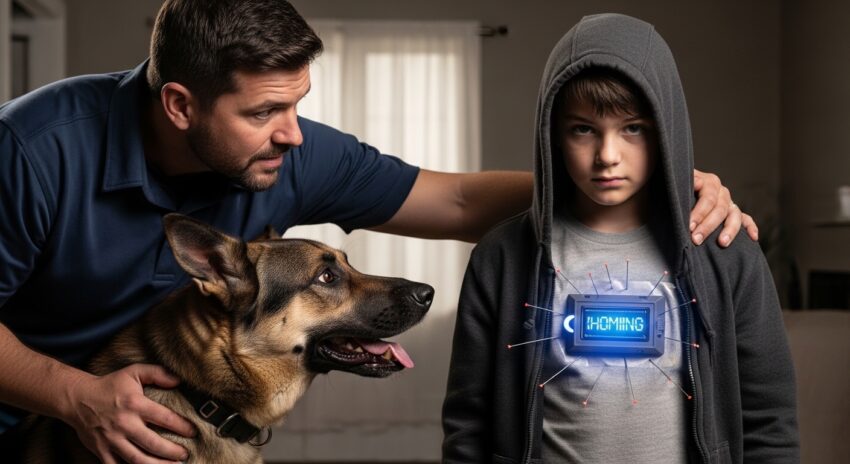
I thought I was a good father. I thought I knew my son, Leo. But as a former K9 handler, I should have known better than to trust the quiet.
When my retired partner, Bear, started growling at the boy he’d protected since he was a puppy, I didn’t see the danger. I saw a “glitch” in a hero dog’s mind. I saw my own PTSD reflected in a German Shepherd’s eyes.
I was wrong.
By the time I realized why Bear was trying to tear the clothes off my son’s back, it was almost too late. I ripped that hoodie off like I was peeling away a layer of my own soul.
What was underneath changed everything I thought I knew about our neighborhood, our “friends,” and the hidden war being fought in the hallways of a suburban middle school.
This isn’t just a story about a dog. It’s a warning.
CHAPTER 1: THE SCENT OF SILENCE
The rain in suburban Ohio doesn’t just fall; it colonizes. It settles into the cracks of the driveway, the pores of the brick, and the marrow of your bones. It was that kind of Tuesday—gray, suffocating, and smelling of wet asphalt and regret.
I was in the kitchen, staring at a box of store-bought mac and cheese like it held the secrets to the universe. Cooking for a twelve-year-old boy as a single father is a special kind of purgatory. You’re always one “wrong texture” away from a silent dinner.
Behind me, Bear was pacing.
Bear is a seventy-five-pound German Shepherd with a coat the color of burnt toast and eyes that have seen things no living creature should. We retired from the force together three years ago. I left with a shattered knee and a pension; he left with a piece of shrapnel in his hip and a deep-seated distrust of anyone wearing a heavy coat.
“Sit, Bear. Ease,” I muttered, my voice raspy.
He didn’t ease. He clicked his claws against the linoleum, his nose twitching frantically. His ears were pinned back—not in aggression, but in a frantic, vibrating confusion.
“I know, buddy. It’s the storm,” I said, trying to convince myself. But the storm hadn’t started yet. The air was just heavy with the promise of it.
Then the front door opened.
Leo walked in. My son is a beanpole of a kid, all limbs and social anxiety, hiding behind a mop of dark curls and an oversized navy blue hoodie. It was his “armor.” He’d been wearing it for three weeks straight, ever since the school year hit that brutal mid-October stride where the social hierarchies solidify like cooling concrete.
“Hey, kid. How was—”
I didn’t finish the sentence.
The moment Leo stepped into the kitchen light, Bear didn’t just bark. He exploded.
It wasn’t a “welcome home” bark. It was the sound Bear used to make when we were clearing warehouses in the bottoms of Cleveland—a guttural, chest-shaking roar that meant threat identified.
“Bear! Down!” I shouted, the old command structure slamming into my brain.
But Bear wasn’t listening. He lunged, not at Leo’s throat, but at his waist. He was snapping at the air, his teeth clicking inches from the fabric of that navy hoodie.
Leo froze. His face went the color of unbaked dough. “Dad? Dad, make him stop! What’s wrong with him?”
“Bear, back! BACK!” I stepped between them, my heart hammering against my ribs. I grabbed Bear by the harness I still made him wear—a security blanket for both of us—and hauled him back. The dog was foaming at the mouth, his eyes fixed on Leo with a terrifying intensity.
“Go upstairs, Leo! Go!”
Leo didn’t move. He stood there, trembling. He looked smaller than usual, swallowed by the folds of that sweatshirt. And then I smelled it.
It wasn’t the smell of a wet dog. It wasn’t the mac and cheese.
It was a sharp, chemical tang. Like ozone mixed with something sickly sweet—something that smelled like a hospital corridor and a burning electrical fire all at once.
Bear wasn’t attacking Leo. He was hunting a scent.
“Leo,” I said, my voice dropping an octave, the “Officer Jack Miller” voice I hadn’t used in years. “Take off the hoodie.”
“No,” Leo whispered. He clutched the front pocket, his knuckles white. “It’s just… I’m cold, Dad. Leave me alone.”
“Leo. Take. It. Off. Now.”
“It’s nothing! Bear is just crazy! You said he was getting old, you said he was losing it!” Leo was crying now, the tears carving tracks through the grime on his cheeks.
Bear let out a high-pitched, frantic whine, a sound of pure agony. He started scratching at the floorboards, digging as if he were trying to unearth a bomb.
That was the moment the professional in me overrode the father. I’ve seen that look on Bear’s face twice in ten years. Once, it was a hidden cache of pressurized explosives. The second time, it was a gas leak in an apartment building full of sleeping children.
Bear didn’t lie.
“Leo, I’m not going to ask again.”
“I can’t! They’ll know!” Leo screamed.
He tried to bolt for the stairs, but he stumbled. His movements were sluggish, uncoordinated. As he fell against the kitchen table, his hand slipped from the pocket, and I saw a faint, rhythmic glow emanating from beneath the fabric of his chest.
A blue light. Pulsing.
And then, the sound. A low-frequency hum that made the fillings in my teeth ache.
Bear went ballistic. He broke my grip, but he didn’t bite. He jammed his snout into Leo’s side, trying to flip him over, trying to get to whatever was under that cloth.
“Dad, it hurts!” Leo shrieked, his eyes rolling back. “It’s hot! It’s getting hot!”
Panic, cold and sharp, pierced my chest. I didn’t think. I acted.
I lunged forward, pushing the heavy oak kitchen table aside with a strength I didn’t know I still had. It screeched across the floor, pinning Bear against the cabinets for a split second.
I grabbed the collar of Leo’s hoodie.
“Hold still, son! Hold still!”
The fabric felt… wrong. It was vibrating. I reached for the zipper, but it was fused shut—melted into the plastic teeth.
“Dad, I can’t breathe!”
I didn’t look for scissors. I didn’t look for a knife. I hooked my fingers into the neckline and ripped.
The sound of the heavy cotton tearing was like a gunshot. I shredded the garment down the middle, my skin screaming as I touched the fabric—it was blistering hot.
When the hoodie fell away, I didn’t see a bomb.
I saw a device.
Taped to my son’s bare chest with industrial duct tape was a flat, translucent puck, about the size of a saucer. Inside, a viscous, neon-blue liquid was swirling violently, powered by a small, humming battery pack. The skin around the tape was angry, a mottled purple and red, blistered and weeping.
But that wasn’t the worst part.
The worst part was the wires. Four thin, needle-like leads were fed directly into Leo’s skin, trailing up toward his neck and down toward his heart.
“What is this?” I breathed, my hands shaking so hard I could barely touch him. “Leo, what is this?!”
Leo’s head slumped against my shoulder. His skin was clammy, his pulse a frantic, irregular drumbeat against my palm.
“They said… they said it was a game,” he wheezed. “A beta test. They said if I took it off… it would go off.”
“Who? Who said that?”
“The seniors… Miller and Vance… they put it on me behind the gym. They said… ‘Stay quiet, Little Miller. Let’s see how much your heart can take.’”
The room tilted. Miller and Vance. The sons of the men I used to call brothers. The “elite” of the high school football team.
The hum from the device increased in pitch, moving from a low throb to a piercing whine. The blue liquid started to glow brighter, turning a toxic, searing white.
Bear backed away, his tail between his legs, howling at the ceiling. It was the “death howl.” The one he gave when he knew the clock had run out.
I looked at the device, then at my son’s terrified, fading eyes.
I had spent my whole career defusing threats I could see. I had spent my whole life protecting a city that didn’t love me back. But here, in my own kitchen, with the smell of my son’s burning skin filling my nostrils, I realized the most terrifying danger wasn’t a bullet or a blade.
It was the cruelty of children, armed with something they didn’t understand.
“Jack?”
A voice came from the back door. It was Sarah, my neighbor. She was an ER nurse, still in her scrubs, holding a Tupperware container. She’d probably heard the dog.
She took one look at the kitchen—the overturned table, the shredded hoodie, the glowing, humming thing attached to my son’s heart—and dropped the container.
“Call 911,” I whispered, my voice breaking. “No… call the bomb squad. And tell them to bring a doctor who isn’t afraid to bleed.”
Leo’s body gave a violent jerk. His eyes shuttered.
“Dad…” he whispered, his voice small and distant. “Tell Mom… I didn’t cry.”
“You’re not going anywhere, Leo,” I growled, pulling him into my lap, ignoring the heat of the device against my own skin. “You hear me? You’re a Miller. We don’t quit.”
But as the device began to beep—a steady, rhythmic countdown that matched the faltering rhythm of my son’s heart—I knew.
The storm hadn’t just arrived.
It was inside the house.
And I was the only one left to stop it.
CHAPTER 2: THE SPEED OF BREATH
The siren didn’t sound like a warning; it sounded like a scream that wouldn’t end.
Inside the back of the ambulance, the world was a blur of fluorescent white light and the smell of sterile latex. I sat on the narrow bench, my knees bumping against the primary paramedic, a guy named Miller—no relation to me, just a kid with a buzzcut who looked like he wanted to be anywhere else.
“Vitals are tanking,” the kid shouted over the roar of the engine. “Heart rate is 160 and climbing. I can’t get a clean EKG because of the interference from that… whatever that thing is.”
I looked down at Leo. My boy looked like a broken marionette. The paramedics had managed to get him onto the gurney, but they wouldn’t touch the device. It was still taped to his chest, the translucent blue liquid now swirling with a violent, jagged electricity. It wasn’t just humming anymore; it was clicking. A fast, metallic tick-tick-tick that felt like it was counting down the seconds of my son’s life.
“Don’t touch the leads,” I warned, my voice sounding like it was coming from the bottom of a well. “It’s integrated. If you pull them, you might tear the pericardium.”
The paramedic looked at me, his eyes wide. “How do you know that?”
“I’ve seen IEDs rigged to bio-rhythms in the service,” I lied. It wasn’t exactly a lie—I’d seen things close enough—but right now, I needed them to listen to the cop, not the grieving father. “Get the pads ready. If he arrests, you’re going to have to jump-start him through the interference.”
Sarah was in the front seat, arguing with the driver to go faster. I could hear her voice, sharp and commanding, the “Nurse Sarah” who didn’t take crap from anyone. She was the one who had kept me sane after my wife, Elena, died three years ago. Elena had been the glue; I was just the heavy-duty staples trying to hold the cardboard together. Since she passed, the house had been too quiet, the air too thin.
And now, the only thing left of her was vibrating on a gurney, being cooked from the inside out by a “prank.”
“Leo,” I whispered, leaning over him. I took his hand. It was ice cold, despite the heat coming off the device. “Stay with me, kid. We’re almost there. Just focus on my voice. Remember the lake? Remember Bear trying to catch the dragonflies?”
Leo’s eyelids fluttered. “Dad…” his voice was a dry rasp. “It’s… it’s singing.”
“What’s singing, Leo?”
“The box. It’s… it’s playing music. Can’t you hear it?”
I felt a chill that had nothing to do with the Ohio rain. Hallucinations. His brain was misfiring from the electrical pulses.
We hit a pothole, and the ambulance jolted. The device emitted a sharp, high-pitched chirp, and Leo’s back arched off the gurney. He let out a sound that I will hear in my nightmares until the day I die—a strangled, wet gasp of pure agony.
“He’s seizing!” the paramedic yelled. “Push two of Lorazepam! Now!”
“No!” I grabbed his arm. “If you sedate him, his heart rate might drop too fast while the device is still forcing a pulse. You’ll kill him!”
“I have to stop the seizure, Jack!”
“Hold him down!” I barked.
I reached into my pocket and pulled out my old tactical folding knife. The blade was serrated, kept sharp for cutting seatbelts or heavy webbing. My hands were shaking, but the moment the steel touched my palm, the old training took over. The “K9 Jack” who had cleared rooms in the dark came back.
“What are you doing?” the paramedic screamed.
“Cutting the tape. The heat is trapped under the adhesive.”
With the precision of a surgeon and the desperation of a man on fire, I slid the tip of the blade under the thick, industrial duct tape. The smell of scorched skin hit me again—sickly sweet and copper-rich. I sliced upward, away from the skin.
The moment the tape tension broke, the device shifted. One of the leads—the needle-like wires—popped out of Leo’s chest. A spark of blue light arched from the wire to the metal of the gurney.
The heart monitor flatlined.
The long, continuous tone filled the small space.
“Code Blue!” the paramedic yelled into his radio. “We’re three minutes out! Starting compressions!”
“Get out of the way!” I shoved the kid aside. I didn’t care about protocol. I didn’t care about lawsuits. I slammed my fist into the center of Leo’s chest—a precordial thump, an old-school move for a stopped heart.
Thump.
Nothing.
Thump.
“Leo, don’t you dare,” I growled, my teeth bared. “Don’t you dare leave me!”
I started compressions. One-two-three-four. My shattered knee screamed as I balanced myself in the swaying vehicle. Sarah had climbed through the pass-through window from the front, her face pale.
“Jack, let the medic do it!”
“I’ve got him! I’ve got him!”
I was sobbing, but the rhythm of my hands didn’t break. I could feel the device underneath my palms, still hot, still humming its death song. It felt like I was fighting a machine for the soul of my son.
On the thirtieth compression, the heart monitor chirped.
A weak, erratic blip. Then another.
“He’s back,” Sarah whispered, her hand over her mouth. “He’s back.”
The ambulance screeched to a halt at the emergency entrance of St. Jude’s. The doors burst open, and a swarm of blue scrubs descended. I was pushed back, a ghost in my own life, as they wheeled him away.
I stood on the rain-slicked pavement, my hands covered in my son’s blood and the residue of the blue liquid from the device. I looked down at my palms. They were blistered.
“Sir? Sir, you can’t be out here.”
I ignored the security guard. I walked toward the back of my own truck, which Sarah had driven to the hospital behind us. Bear was in the back, his face pressed against the glass. He wasn’t barking anymore. He was just watching me.
I opened the door, and the dog didn’t jump out. He just leaned his heavy head against my chest. He smelled like home, like safety, like the life I was failing to protect.
“You knew,” I whispered into his fur. “You knew before I did.”
Bear let out a low, mournful rumble.
I looked back at the hospital doors. Somewhere in there, they were trying to figure out how to remove a device that was designed to hurt. And somewhere in this town, the people who did this were sitting in their warm living rooms, thinking it was just a joke.
I reached for my phone. My thumb hovered over a contact I hadn’t called in three years.
Elias Thorne.
Elias was my old partner. We’d started on the force together twenty years ago. He’d stayed; I’d broken. Elias was a man who lived in the gray areas. He was the kind of guy who knew which judges had gambling debts and which teenagers were selling Adderall behind the Taco Bell.
He picked up on the second ring.
“Miller? It’s eleven PM. You better be calling to tell me you finally bought that boat.”
“Elias,” I said, my voice cracking. “I need you. St. Jude’s ER. Now.”
There was a silence on the other end. I could hear the sound of a match striking—Elias and his damn cigarettes.
“Is it the kid?”
“They put something on him, Elias. Some kind of… tech. It almost killed him in the ambulance.”
“Who’s ‘they’?”
“Leo said Miller and Vance. The high school kids.”
Elias exhaled, the sound of smoke hitting the receiver. “Goddammit, Jack. You know who their fathers are. Vance is the D.A. Miller is the Chief of Police. My boss.”
“I don’t care if they’re the Pope and the President,” I snarled, the grief finally turning into a cold, hard rage. “They tortured my son. If you don’t come down here and help me do this by the book, I’m going to do it my way. And you know what my way looks like.”
“Twenty minutes,” Elias said. The line went dead.
I sat on the tailgate of my truck, the rain soaking through my shirt, and waited.
About ten minutes later, a black SUV pulled into the lot. But it wasn’t Elias. It was a sleek, silver Lexus.
The door opened, and a woman stepped out. She was dressed in a crisp trench coat, her hair perfectly coiffed despite the downpour. Sheila Vance. The Principal of Northwood Heights Middle School. The mother of the boy who had done this.
She walked toward me, her heels clicking on the asphalt. She looked concerned—the kind of practiced concern you see on a local news anchor.
“Jack,” she said, stopping a few feet away. “I heard what happened. I came as soon as the hospital called the school liaison. How is Leo?”
I didn’t stand up. I just looked at her. “He died for thirty seconds in the ambulance, Sheila.”
She flinched, but only slightly. “That’s… that’s horrific. Truly. But Jack, we need to be careful about how we talk about this. The rumors are already flying on social media. People are saying it was an attack.”
“It was an attack.”
“It was a prank gone wrong,” she corrected, her voice turning firm. “The boys… they found a device. They thought it was a haptic feedback unit from a video game. They didn’t realize it would… react the way it did.”
“Found it? Where does a fourteen-year-old ‘find’ a bio-integrated induction loop that requires medical-grade leads?”
Sheila crossed her arms. “I’m sure there’s a logical explanation. But Jack, think about Leo. If this goes to trial, if this becomes a ‘thing,’ his whole life will be under a microscope. His history of anxiety, his… social difficulties. Do you really want to put him through that?”
She wasn’t checking on Leo. She was protecting her son. She was checking the “damage” to the Vance family reputation.
“Get off my property,” I said softly.
“Jack, be reasonable—”
“This isn’t your school, Sheila. This is the real world. And in the real world, if you hurt a child, you pay.”
“You’re emotional,” she said, her voice dripping with a condescending pity that made my blood boil. “Go inside. Be with your son. Let the adults handle the investigation.”
She turned to walk away, and that’s when Bear let out a low, vibrating growl from the bed of the truck. Sheila stopped, her shoulders tensing.
“Control your animal, Jack. It’s a liability. Just like you.”
She got into her Lexus and drove away, leaving a puff of expensive exhaust in the damp air.
I stood up, my legs shaking. I felt a hand on my shoulder.
It was Sarah. She had come out to find me. Her eyes were red.
“They got it off,” she whispered. “The trauma surgeon… he had to use a localized EMP to shut down the battery pack before he could pull the leads. Jack… the device had a serial number. But it’s been filed off.”
“Where is it?”
“In the evidence locker. But the police liaison—Officer Higgins—he’s already trying to take it. He says it needs to go to the precinct for ‘safekeeping.’”
Higgins was a crony of Chief Miller. If that device went to the precinct, it would “disappear” before morning.
“Not on my watch,” I said.
I headed for the ER entrance, Bear at my heel. The hospital had a “no pets” policy, but as I walked through those sliding doors with a seventy-five-pound K9 and the look of a man who had nothing left to lose, nobody said a damn word.
We reached the trauma bay just as Higgins was reaching for a clear plastic evidence bag. He was a thick-necked guy with a mustache that looked like it was made of copper wire.
“I’ll take that, Higgins,” I said, my voice echoing in the sterile hallway.
Higgins looked up, his hand freezing. “Miller. You’re not on the job anymore. This is official business.”
“My son’s blood is on that device. That makes it my business.”
“Go home, Jack. You’re making a scene.”
I stepped into his space. I was taller than him, and I knew exactly where to put my weight to make him feel the threat. Bear sat at my side, his eyes locked on Higgins’s throat.
“Give me the bag, or I’ll have Bear show you what ‘official business’ looks like.”
“Are you threatening an officer?” Higgins hissed, his hand moving toward his belt.
“I’m protecting evidence,” I said. “And I’m not alone.”
From behind me, a deep, gravelly voice broke the tension.
“He’s right, Higgins. Hand it over.”
Elias Thorne stepped into the light. He looked like he’d slept in his suit—it was wrinkled and smelled of cheap coffee and old tobacco. He held out a badge. “Detective Thorne, Major Crimes. I’m taking lead on this. The Chief’s office has a conflict of interest, seeing as his son is a primary suspect. You want to argue with the union rep about it tomorrow, be my guest. But right now? The bag.”
Higgins glared at us, his face turning a mottled purple. He looked at the badge, then at Bear, then at me. Finally, he dropped the bag onto the counter.
“This is a career-ender, Thorne. For both of you.”
“I’ve had a good run,” Elias said, picking up the bag.
He looked at the device through the plastic. The blue liquid had settled into a dull, toxic-looking sludge. Even through the bag, I could feel the malevolence of the thing.
“Jack,” Elias said, his voice dropping. “I did a quick check on the way over. There was a break-in at a private research lab in Columbus last week. ‘Aegis Technologies.’ They specialize in ‘non-lethal’ crowd control and bio-monitoring. This thing? It’s a prototype. It’s not meant for humans. It’s meant for subduing large livestock during transport.”
I looked through the glass of the ICU window. My son lay there, hooked up to a dozen machines, his chest swathed in heavy bandages.
“They used it on a boy,” I whispered. “They used a cattle-shocker on my son.”
“It’s worse than that,” Elias said, his face hardening. “This device has a transmitter. It wasn’t just shocking him. It was sending data. Someone was watching his heart rate. Someone was watching him die in real-time.”
The rage I had felt earlier was nothing compared to the cold, paralyzing horror that settled over me now. This wasn’t just a prank. This wasn’t just some dumb kids being cruel.
This was an experiment.
And my son was the lab rat.
I looked at Bear. The dog’s ears were perked, his nose twitching toward the evidence bag. He let out a low, sharp “woof”—his signal for a “find.”
“What is it, boy?” I asked.
Bear nudged the bag with his nose. He wasn’t looking at the device. He was looking at a small piece of fabric that had been caught in the duct tape. A tiny, torn scrap of red and white nylon.
I recognized it. It wasn’t from Leo’s hoodie.
It was a piece of a varsity jacket.
“Elias,” I said, my voice cold as the grave. “Keep that device safe. Hide it. Don’t take it to the precinct.”
“Where are you going, Jack?”
I didn’t answer. I whistled for Bear and headed for the exit.
“Jack! Stay away from the Miller house!” Elias shouted after me.
But I wasn’t going to the Miller house. Not yet.
I was going to the school.
Because if this was an experiment, there had to be a control group. There had to be more of these things. And if my son was the first, he wouldn’t be the last.
As I stepped back out into the rain, the sky finally opened up. A crack of lightning split the horizon, illuminating the hospital in a harsh, strobe-light glare.
I looked at Bear. “Let’s go to work, partner.”
The dog jumped into the truck, his eyes bright with the old fire. We were back on the hunt. But this time, I wasn’t looking for drugs or bombs.
I was looking for the people who had turned my son’s heart into a playground for their cruelty.
And God help them when I found them.
Because Bear wouldn’t be the only one biting.
I pulled out of the parking lot, the tires spinning on the wet asphalt. As I drove, I looked at the passenger seat. There was a photo Leo had taken of us last summer. Me, him, and Bear at the lake. We were all smiling. It looked like a different world. A world where “pranks” meant a bucket of water over a door, not a device that stopped your heart.
I realized then that I had been blind. I had been so wrapped up in my own trauma, my own “shattered knee” and “shattered life,” that I hadn’t seen the shadows closing in on my son.
I had been trained to protect the public. But I had failed to protect the only person who mattered.
I gripped the steering wheel so hard my knuckles turned white.
“I’m coming for them, Leo,” I whispered to the empty cab. “I’m coming for all of them.”
And in the back of the truck, Bear let out a howl that drowned out the wind—a promise of justice, written in the language of the pack.
The hunt had begun.
CHAPTER 3: THE ARCHITECTURE OF CRUELTY
The rain was no longer a drizzle; it was a rhythmic assault, a percussion of cold water drumming against the roof of my Ford F-150. Northwood Heights Middle School sat atop a manicured hill, looking less like an educational institution and more like a high-security tomb. In the dark, the red brick was black, and the large glass windows of the “Innovation Wing” reflected the lightning like the eyes of a predator.
I parked in the shadows of the bus loop, far from the reach of the flickering security lights. Beside me, Bear was a statue of muscle and intent. He knew the vibe had changed. We weren’t on a casual drive anymore. We were on a breach.
“Stay, Bear,” I whispered. I reached into the glove box and pulled out my heavy-duty mag-lite and a pair of bolt cutters. My knee gave a sickening pop as I stepped out into the mud. Every step was a reminder of the night a distracted driver had ended my career, but tonight, the pain was just fuel.
I circled to the back of the school, toward the athletic wing. That’s where the “seniors”—the eighth-grade elite—ruled. The varsity locker room was their cathedral, a place where the coaches looked the other way and the hierarchy of the town was forged in sweat and entitlement.
I found the side door near the gym. It was reinforced steel, but the lock was a standard commercial grade. I didn’t use the bolt cutters. I used a slim-jim I’d kept in my tactical kit, sliding it into the frame with the muscle memory of a man who’d spent a decade “entering and clearing.”
The door clicked open with a heavy thud.
The air inside was different. It was stagnant, smelling of floor wax, laundry detergent, and that underlying sourness of a locker room. It was the smell of adolescence, but tonight, it felt like the smell of a crime scene.
“Bear, heel.”
The dog slipped through the gap, his paws silent on the polished linoleum. I didn’t turn on my flashlight. I didn’t need to. I knew the layout of this place from the countless “Active Shooter” drills I’d led back when I was the department’s golden boy.
We moved down the hallway, past the rows of trophies that gleamed in the dim emergency lighting. State Champions. Sportsmanship Awards. Excellence in Character. The words felt like a joke.
We reached the varsity locker room. I pulled the scrap of red and white nylon—the piece Bear had found on the device—out of my pocket.
“Find,” I commanded, holding the fabric to his nose.
Bear took a deep, rattling breath. His ears shifted, tracking the air currents. He began to weave between the rows of metal lockers, his nose inches from the floor. He stopped at locker 42.
VANCE. The name was etched into a brass plate. I felt a surge of bile in the back of my throat. Sheila Vance’s son. The boy who was “just pulling a prank.”
I didn’t have a warrant. I didn’t have a badge. What I had was a son in the ICU and a dog who never lied. I jammed the bolt cutters into the padlock and squeezed. The steel snapped like a dry twig.
I threw the locker open.
It was a standard teenager’s mess. Cleats, a sweaty jersey, a copy of The Great Gatsby with the spine unbroken. But at the bottom, tucked behind a pair of expensive sneakers, was a heavy, black Pelican case. The kind of case we used to transport high-end surveillance gear.
I pulled it out and set it on the bench. My heart was a frantic bird in my chest. When I flipped the latches, the light from my mag-lite revealed something that made my blood turn to slush.
Inside weren’t video games or “haptic units.” There were three more of the devices—the “pucks.” They were nestled in custom foam inserts, their translucent casings glowing with a faint, residual blue light. Beside them was a tablet and a series of syringes filled with a clear liquid.
I picked up the tablet. It was password-protected, but the lock screen was a live dashboard.
There were four names listed.
Subject A: Leo M. (STATUS: CRITICAL – SIGNAL LOST)
Subject B: Marcus G. (STATUS: ACTIVE – STABLE)
Subject C: Chloe D. (STATUS: ACTIVE – STABLE)
Subject D: Tyler S. (STATUS: ACTIVE – ELEVATED)
My hands shook so hard I almost dropped the device. Leo was “Subject A.” He wasn’t the only one. There were three other kids in this town, right now, with these things taped to their chests.
“Who’s there?”
A voice echoed from the doorway. It wasn’t the shaky voice of a teenager. It was deep, authoritative, and cold.
I turned my light toward the sound.
Standing in the entrance was Coach Garrick. He was a local legend—three state titles, a man who had more power in Northwood Heights than the Mayor. He was dressed in his coaching windbreaker, but his hand was tucked into his pocket in a way that looked very familiar to me.
“Jack Miller,” Garrick said, stepping into the room. He didn’t look surprised. He looked disappointed. “I heard about Leo. Tragic. A real shame.”
“You knew,” I said, my voice a low growl. “You knew they were doing this in your locker room.”
Garrick sighed, walking toward me. “Jack, you always were too intense for this town. You see shadows where there’s just… progress. This isn’t what you think.”
“Progress? My son’s heart stopped, Garrick! He was being monitored! I saw the dashboard!” I pointed to the Pelican case. “Who is paying you to turn these kids into lab rats?”
Garrick stopped a few feet away. Bear moved in front of me, his hackles raised, a low, tectonic vibration beginning in his chest.
“Aegis Technologies is a private firm, Jack. They’re developing a Stress-Response Integration system. It’s for the military. For the front lines. They need data on how the young, developing nervous system handles high-intensity bio-shocks. It’s about building the soldiers of the future. The boys… the Vance kid, the Miller kid… they’re just facilitators. They get a little extra ‘motivation’ for their college resumes, and the school gets a massive grant.”
“And the ‘subjects’?” I hissed. “The kids like Leo? The ones who don’t fit in? The ones nobody will miss if they ‘accidentally’ have a heart attack?”
Garrick’s face hardened. The mask of the “hero coach” slipped, revealing the cold, calculating engine underneath. “Every breakthrough requires a cost, Jack. You know that. You left your knee in a gutter for a city that forgot your name in a week. At least here, the sacrifice means something.”
He pulled his hand out of his pocket. He wasn’t holding a gun. He was holding a remote—a small, black transmitter with a single red button.
“The device on Leo was a prototype,” Garrick said. “It had a flaw. It drew too much power. But the others… they’re functioning perfectly. If you leave now, if you take that case and walk away, I’ll tell Aegis to terminate the ‘experiment’ and release the other three kids. No harm done.”
“No harm done?” I stepped toward him, ignoring the warning bells in my head. “You tortured my son.”
“If you touch me, Jack, I press this button. The three kids currently ‘active’ will receive a lethal discharge. Thirty thousand volts directly to the sinus node. They’ll be dead before you can reach the door.”
I froze.
Bear sensed my hesitation. He looked up at me, his eyes questioning. He was waiting for the “Go” command, the one that would let him tear Garrick’s arm off. But I couldn’t give it.
“You’re a monster,” I whispered.
“I’m a realist,” Garrick countered. “The world is getting more dangerous, Jack. We need people who can survive it. Your son… he was too soft. He was never going to make it anyway.”
That was the mistake.
Mentioning Leo’s “softness.”
I remembered Leo at six years old, crying because he’d stepped on a beetle. I remembered him staying up all night to bottle-feed a stray kitten. I remembered him looking at me with those wide, honest eyes and asking if the “bad guys” ever felt sorry.
My son wasn’t soft. He was good. And in a world filled with men like Garrick, goodness was the only thing worth fighting for.
I didn’t lung at Garrick. I didn’t try to grab the remote.
I looked at Bear.
“Bear,” I said, my voice steady, “Table.”
It was a non-standard command. A “trick” command we’d developed during long nights on stakeouts. It meant distraction.
Bear didn’t attack Garrick. He lunged to the side, knocking over a heavy metal equipment cart filled with basketballs. The sound was deafening in the echoing locker room—a chaotic, crashing thunder of metal on concrete.
Garrick flinched. It was a half-second, a blink of an eye.
In that half-second, I wasn’t a retired cop with a bad knee. I was a father.
I launched myself forward, my weight hitting Garrick in the midsection. We crashed into the lockers, the metal groaning under the impact. I grabbed his wrist, twisting it with a brutal, sickening wrench.
The remote clattered to the floor.
Garrick snarled, swinging a heavy fist into my jaw. My head snapped back, and the world went gray for a moment. He was stronger than he looked, fueled by the same arrogance that had led him to this.
He reached for the remote, his fingers inches from the red button.
“Bear! Get it!”
Bear was a blur of fur and teeth. He didn’t go for Garrick; he went for the remote. He scooped the plastic device into his mouth and bolted down the locker aisle.
“No!” Garrick screamed. He tried to scramble up, but I grabbed his ankle and hauled him back down.
We wrestled on the floor, a mess of limbs and desperation. I could hear Bear’s claws clicking as he circled us, the remote held firmly in his jaws.
I pinned Garrick’s arms, my chest heaving. “It’s over, Garrick. The dog has it. And he won’t give it back until I tell him to.”
Garrick started to laugh—a dry, hacking sound. “You think you’ve won? Look at the tablet, Jack. Look at the timer.”
I looked over at the Pelican case. The tablet screen had changed.
SIGNAL LOSS DETECTED. EMERGENCY PROTOCOL INITIATED. FULL DISCHARGE IN: 04:59.
The system was automated. The moment the remote was moved too far from the base station—or the moment it sensed a struggle—it triggered a “clean-up” protocol.
“You have five minutes,” Garrick wheezed, blood trickling from his nose. “Five minutes to find three kids hidden somewhere in this town and get those devices off them. But you don’t know who they are, do you? You only have initials.”
I looked at the screen. Marcus G. Chloe D. Tyler S.
I knew these kids. I’d seen them at the park, at the library, at the school plays.
“I don’t need to find them,” I said, a desperate idea forming in my mind. “I just need to kill the signal.”
“The signal is satellite-relayed, Jack. You’d have to take down the whole grid.”
I looked at the devices in the Pelican case. They were still glowing. If they were the “pucks,” they were the receivers. And the tablet was the local hub.
I let go of Garrick and scrambled toward the case. I grabbed the tablet, my fingers flying over the screen. I wasn’t a tech genius, but I knew one thing about these Aegis prototypes—they were all connected to a localized MAC address.
“Bear, come!”
The dog ran to me, dropping the remote at my feet.
I grabbed the tablet and the remote, and I looked at Garrick, who was struggling to sit up.
“Where are they, Garrick? Tell me where they are, and I might not let Bear finish what he started.”
Garrick looked at Bear. The dog’s lips were pulled back, showing four inches of gleaming, white canine. Bear wasn’t growling anymore. He was silent. The “killing silence.”
“The gym,” Garrick gasped. “The… the late-night practice. The ‘Elite’ training session. They’re in the gym.”
I didn’t wait. I grabbed the Pelican case and sprinted for the door, my knee screaming in protest.
“Bear, with me!”
We burst out of the locker room and down the hallway. The school felt like a labyrinth, the walls closing in.
03:42.
We reached the double doors of the gymnasium. I threw them open.
The lights were on, the high-arched ceiling making the space feel cavernous. In the center of the court, three kids were standing in a circle. They looked dazed, their eyes glazed over. They were wearing thin athletic shirts, and beneath the fabric, I could see the tell-tale blue glow.
Marcus, Chloe, and Tyler. They weren’t “training.” They were standing perfectly still, like statues, their bodies twitching in time with the rhythmic hum of the devices.
Standing over them was a man in a lab coat, holding a clipboard. He looked up, his face paling as he saw me—and the bloody, rain-soaked German Shepherd at my side.
“Who are you? You can’t be in here!”
“Shut it down!” I roared, slamming the Pelican case onto the bleachers. “Shut it down now!”
“I can’t! It’s in ‘fail-safe’ mode! The moment the connection was interrupted, the voltage started climbing!”
02:15.
The kids started to moan. Tyler, a small boy with glasses, fell to his knees, clutching his chest. “It’s… it’s biting me,” he whimpered. “The blue spider is biting me.”
I ran to him, ripping his shirt open. The device was fused to his skin, just like Leo’s. The heat was already blistering the flesh.
“I need water!” I shouted at the man in the lab coat. “And a grounding wire! Now!”
The man just stood there, paralyzed by fear.
I looked around the gym. My eyes landed on the heavy-duty electrical panel near the stage.
I remembered something from my training—the “Localized EMP” the surgeon had mentioned. A high-voltage surge could short out the battery packs, but it had to be precise. If I just shocked them, I’d kill them.
I grabbed the tablet. “Elias! ELIAS, PICK UP!”
I’d hit redial on my phone, which was propped up on the bleachers.
“Jack? What’s going on? I’m at the precinct—”
“I have three kids in the gym! The devices are going to discharge in two minutes! How do I kill the signal without stopping their hearts?”
“Jack, listen to me,” Elias’s voice was calm, the voice of a man who had negotiated with jumpers on the edge of the bridge. “Those pucks… they have a copper induction coil. If you can create a magnetic field, you can disrupt the firing pin. Do you see a physical override on the tablet?”
I scrolled frantically. “Nothing! It’s all encrypted!”
“Okay, then you have to do it manually. Do you have the other devices? The ones in the case?”
“Yes.”
“Set them to ‘Overload.’ If you can get all four—the ones in the case and the three on the kids—into a tight circuit, you might be able to blow the fuse on the whole hub.”
01:05.
I grabbed the three devices from the case and ran to the kids.
“Listen to me!” I shouted. “Marcus, Chloe, Tyler! You have to huddle together! Get close! Touch the devices to each other!”
The kids were terrified, crying, but they did as they were told. They huddled into a small, shivering knot in the center of the court. I knelt beside them, pressing the three spare devices into the gaps between their bodies.
The air began to crackle. The smell of ozone was so thick I could taste it.
00:30.
“Jack, get back!” Elias yelled through the phone.
“I can’t! I have to hold them!”
“You’ll take the surge, Jack! Your heart won’t take it!”
I looked at Bear. The dog was standing at the edge of the circle, his tail tucked, his eyes fixed on me.
“Bear,” I whispered. “Go. Get out of here.”
The dog didn’t move. He stepped forward, leaning his heavy body against mine, his fur brushing against the kids. He was completing the circuit. He was part of the pack.
“I love you, Leo,” I whispered, closing my eyes.
00:10.
00:05.
00:01.
The world turned white.
It wasn’t a sound; it was a physical force. A roar of energy that slammed into my chest, throwing my heart out of rhythm. I felt my muscles lock, my jaw clenching so hard I thought my teeth would shatter.
A brilliant, blinding blue arc of lightning jumped from the kids to the Pelican case, then to me, then to Bear.
And then, silence.
The gym lights flickered and died.
I was on my back, staring up at the dark rafters. My lungs felt like they were filled with broken glass. I couldn’t move my hands.
Beside me, I heard a soft, rhythmic thumping.
Thump. Thump. Thump.
It was Bear’s tail. He was alive.
“Is it… is it over?” a small voice asked.
I rolled onto my side, my vision clearing. The three kids were sitting on the floor, dazed, but alive. The devices on their chests were dark, the blue liquid turned into a harmless, gray ash.
I looked at my own hands. They were scorched, the skin peeling. But I could feel my heart. It was slow, staggering, but it was beating.
I reached out and pulled the three kids into a hug. They sobbed into my rain-soaked shirt, their small bodies trembling with the aftershocks of the trauma.
“You’re okay,” I croaked. “You’re okay now.”
I looked toward the bleachers. The man in the lab coat was gone. Garrick was gone.
But as the sound of distant sirens began to grow louder—the real sirens, the ones coming to help—I knew it wasn’t over.
Garrick was just a pawn. Sheila Vance was just a shield.
The real monster was still out there, hiding behind the “Aegis” logo, watching the data from a high-rise in Columbus.
I looked at Bear. The dog stood up, shaking his fur, his eyes glowing with a renewed ferocity.
“We’re not done, Bear,” I said, my voice hardening.
I picked up the tablet. The screen was cracked, but a single message was blinking in the center.
DATA TRANSFER COMPLETE. PHASE 2 INITIATED.
I looked at the date on the screen.
October 31st.
Tomorrow.
The town’s “Harvest Festival.” The biggest gathering of the year.
I realized then that Leo hadn’t been the end of the experiment. He had been the calibration.
The real test was tomorrow. And if I didn’t stop them, the whole town would become the lab.
I stood up, my knee popping one last time. I didn’t feel the pain. I only felt the weight of the mission.
I had saved three lives. But tomorrow, I would have to save a thousand.
“Let’s go home, boy,” I said to Bear. “We have to get ready for a party.”
CHAPTER 4: THE HARVEST OF TRUTH
The morning of October 31st didn’t bring the usual crisp, festive air of a Midwestern Halloween. It brought a hanging, humid fog that clung to the orange pumpkins and the hay bales lining Main Street like a damp shroud. I sat in my truck outside St. Jude’s, watching the sun struggle to pierce through the gray. My hands were wrapped in thick gauze, the burns from the night before throbbing in time with the pulse in my neck.
Bear was in the passenger seat, his head resting on the dashboard. He was exhausted, but his eyes were open, tracking every person who walked past the truck. We were both running on caffeine and a shared, jagged adrenaline that wouldn’t let us sleep.
The hospital doors slid open, and Sarah walked out. She looked like she’d aged ten years in a single night. She spotted my truck and walked over, leaning through the open window.
“He’s awake, Jack,” she whispered.
I felt a surge of relief so powerful it made me dizzy. “How is he?”
“He’s Leo,” she said, a small, sad smile touching her lips. “The first thing he asked was if Bear was okay. Then he asked if he still had to finish his history paper.”
I let out a breath I’d been holding since I ripped that hoodie off his chest. “Can I see him?”
“Five minutes. He’s heavily sedated, but he needs to know you’re there. But Jack…” She grabbed my wrist, her eyes searching mine. “Elias called. He found out what the ‘Phase 2’ is. You need to go to the Town Hall before the festival starts at noon.”
“What is it, Sarah?”
“The ‘Safe-Kid’ initiative,” she said, her voice trembling. “The wristbands. They distributed over five hundred of them to the elementary and middle school kids yesterday. They told the parents it was a GPS tracker for the festival crowds. But Jack… they’re the same tech as the pucks. Just smaller. Scaled down.”
I felt the world tilt. “Five hundred kids.”
“They aren’t meant to kill,” she said, trying to convince herself. “Aegis wants to test a ‘calm-down’ frequency. They want to see if they can use bio-feedback to subue a crowd without them even knowing it. They’re going to broadcast a signal from the radio tower on top of the courthouse. If the kids get too excited, too rowdy… the bands will pulse. It’s supposed to be ‘non-lethal’ crowd control.”
“Non-lethal,” I spat. “Like the ‘non-lethal’ cattle-shocker that stopped my son’s heart?”
“Go,” she said, pushing off the truck. “Save them. I’ll stay with Leo.”
I walked into Leo’s room. It was filled with the rhythmic beeping of monitors—a sound that usually terrified me, but now felt like a lullaby. He looked so small in the big hospital bed, his chest wrapped in white bandages.
I sat by his side and took his hand. His eyes fluttered open, glassy and unfocused.
“Dad?”
“I’m here, kiddo.”
“Did we win?” he whispered.
I looked at my son—the boy who’d been used as a laboratory specimen because he was “soft,” the boy who’d survived a death sentence because his dog loved him more than the world feared him.
“Not yet, Leo,” I said, kissing his forehead. “But we’re in the final quarter. And you know how we play the fourth.”
“Go get ’em, Bear,” Leo murmured, his eyes closing again.
I walked out of that hospital with a cold, crystalline clarity. I wasn’t just a father anymore. I wasn’t just a retired cop. I was a weapon.
The Northwood Heights Harvest Festival was the pride of the county. Normally, it was a sea of flannel shirts, apple cider donuts, and the sound of a local bluegrass band. But today, as I drove Bear into the center of town, it looked like an occupation.
Black SUVs with tinted windows were parked at every intersection. Men in “Security” jackets—Aegis contractors—stood near the bounce houses and the corn maze. And on every child’s wrist, I saw it: a bright neon-orange silicone band with a small, glowing blue LED.
I met Elias behind the courthouse. He was leaning against his cruiser, checking his service weapon.
“Chief Miller is in the tower,” Elias said, nodding toward the historic brick building that housed the local government and the radio transmitter. “He’s got Vance with him. They’re waiting for the ‘stress event.’”
“What stress event?”
“The fireworks,” Elias said grimly. “They’re scheduled for noon. Five hundred kids, the loud bangs, the excitement… their heart rates will spike. That’s when Aegis hits the switch. They want to see five hundred children drop to their knees in ‘calm’ at the same time. It’s the ultimate sales pitch for the Department of Defense.”
“We have twenty minutes,” I said, checking my watch.
“Jack, if we do this, there’s no going back. We’re taking on the D.A., the Chief of Police, and a multi-billion dollar tech firm. They’ll bury us.”
I looked at Bear. The dog was sitting at attention, his eyes fixed on the courthouse door. He knew the scent of the enemy now. He’d smelled it on the device, on Garrick, and now, he could smell it wafting from the tower.
“They already tried to bury my son, Elias,” I said. “They just didn’t realize he was a seed.”
We didn’t go through the front. We went through the basement maintenance tunnels—the same tunnels I’d used a dozen times during security audits. Bear led the way, his nose low, his body a coiled spring of muscle.
We reached the elevator to the tower. The display showed it was on the top floor.
“Stairs,” I said.
My knee was screaming by the tenth flight. By the fifteenth, I was dragging my leg. But every time I faltered, Bear would stop, turn back, and nudge my hand with his cold nose. Keep moving, partner. The pack is counting on us.
We reached the heavy oak door to the transmitter room. I could hear voices inside. Arrogant voices.
“…the data from the Miller boy was an anomaly,” a man was saying. I recognized the voice from the gym—the Aegis scientist. “We’ve adjusted the surge protection. The wristbands won’t exceed five milliamps. It’ll just feel like a heavy sleepiness. It’s revolutionary.”
“And the payout?” That was Chief Miller. My old mentor. My “brother.”
“The grant will be transferred to the department’s ‘Equipment Fund’ by midnight. Your son will have his Ivy League tuition covered, Chief. Consider it a thank you for your… cooperation.”
I didn’t knock.
I kicked the door. The wood splintered, the heavy lock tearing out of the frame.
I stepped into the room, Bear at my side. Elias was right behind me, his weapon drawn.
Chief Miller, D.A. Vance, and two Aegis technicians spun around. In the center of the room sat a massive server rack, cables snaking up toward the radio mast on the roof. A large monitor showed a map of the festival, with five hundred glowing blue dots moving around the town square.
“Jack,” Miller said, his face going pale. “What the hell are you doing? You’re trespassing on government property.”
“I’m here to stop a crime, Bill,” I said, my voice steady. “Shut it down. Now.”
“You’re hysterical, Jack. You’ve been through a lot. The incident with Leo… it was a tragedy, a freak accident. But this is different. This is about safety.”
“Safety?” I laughed, a harsh, jagged sound. “You’re using our children as guinea pigs for a weapon. You’re selling their heartbeats for a tuition check.”
D.A. Vance stepped forward, his suit pristine, his eyes cold. “Officer Miller, I suggest you lower your voice. You have no evidence, no standing, and quite frankly, no future if you don’t walk out that door.”
“I have the tablet from the locker room,” I said. “I have the testimony of the three kids I saved last night. And I have a detective who’s currently recording this conversation on a live feed to the State Attorney’s office.”
Elias held up his phone. “Hi, Bill. You’re on ‘Candid Camera.’”
Miller’s face twisted into a mask of pure, ugly rage. He reached for his holster.
“Bear! MOVE!”
The dog didn’t go for Miller’s throat. He’d been trained for more than that. He lunged for the arm holding the weapon, his jaws locking onto Miller’s forearm before the gun could clear the leather.
Miller screamed, hitting the floor. The two Aegis techs tried to scramble for the server, but Elias was faster.
“Hands up! Don’t even think about it!”
I ignored the chaos. I limped toward the server rack. The countdown on the screen was at 01:12.
“How do I stop the transmission?” I demanded, grabbing one of the techs by the collar.
“You can’t! It’s encrypted! The signal is already live-loading!”
I looked at the server. It was a masterpiece of engineering—sleek, silent, and lethal. I looked at the cables. They were shielded, too thick to rip out by hand.
I looked at the countdown. 00:45.
Outside, the first firework exploded. A loud BOOM that shook the windows of the tower.
On the monitor, the five hundred blue dots began to flash. The heart rates of the children in the square were climbing. The “stress event” had begun.
“Jack, the signal!” Elias shouted, struggling to keep Vance and the techs covered while Miller groaned on the floor, pinned by Bear.
I looked at the radio mast. If I couldn’t stop the software, I had to stop the hardware.
I turned to the window. It was a small, reinforced pane overlooking the roof. I smashed it with my mag-lite and climbed out onto the ledge. The wind was whipping, the fog making the roof slick and dangerous.
The radio mast was a twenty-foot steel needle, humming with power. At the base was a heavy junction box.
00:20.
I reached the box. It was locked with a heavy-duty padlock. I didn’t have my bolt cutters. I didn’t have time.
I looked back through the window. Bear was watching me. He let go of Miller’s arm for a second, his eyes locking onto mine. In that moment, I saw everything—ten years of partnership, the nights he’d kept me warm in the back of the cruiser, the way he’d saved Leo.
“Bear!” I yelled over the wind. “Table!”
The dog knew. He didn’t hesitate. He lunged across the room, ignoring the people, and slammed his seventy-five pounds of muscle into the server rack, knocking it over.
The cables strained, but they didn’t break.
00:10.
I grabbed the heavy metal mag-lite and began to bash the junction box. I swung with every ounce of fatherly rage I had left. The plastic casing cracked. The wires sparked.
00:05.
I reached inside and grabbed a handful of glowing, vibrating fiber-optic cables.
“For Leo,” I whispered.
I ripped.
The surge of electricity was different this time. It wasn’t a shock; it was a white-hot sear that traveled from my fingers to my shoulder. My vision went white. I felt myself falling, the cold air rushing past me.
But as I fell, I heard it.
The silence.
The humming stopped. The radio mast went dark.
I hit the lower roof ten feet down, the impact jarring my bones, but the pain was distant. I lay there, looking up at the gray sky.
In the town square, the fireworks continued to boom. I heard the distant sounds of children laughing. I heard a mother calling her son’s name. I heard the normal, beautiful, chaotic sounds of a life that wasn’t being monitored.
I felt a heavy weight on my chest. I opened my eyes.
Bear had jumped through the window. He was standing over me, licking the blood and rain from my face. He was whining, a low, frantic sound.
“I’m okay, boy,” I croaked. “We did it.”
The aftermath was a hurricane of a different kind.
The “Safe-Kid” wristbands were collected by State Troopers within the hour. Chief Miller and D.A. Vance were led out of the courthouse in handcuffs—a sight that was broadcast on every news station in the country. Aegis Technologies was raided by the FBI by nightfall.
But I didn’t care about the news.
Two days later, I was back at the hospital. Leo was sitting up in bed, color finally returning to his cheeks. He was eating a chocolate pudding cup, and Bear was sitting by the bed, waiting for the inevitable “accidental” drop.
Elias walked in, looking cleaner than I’d ever seen him. He was wearing a new suit.
“They offered me the Chief’s job,” he said, leaning against the doorframe.
“You going to take it?” I asked.
“Someone has to clean up the mess. And I’ve already got a list of guys I’m firing.” He looked at me, his expression softening. “The town owes you everything, Jack. But the board… they’re worried. They want to know what you want.”
I looked at Leo. I looked at the way he was laughing as Bear finally got a glob of pudding.
“I want my son to go to school without being a subject,” I said. “I want my dog to have a yard where he doesn’t have to hunt for bombs. And I want to be able to sleep without the sound of that humming in my ears.”
“Done,” Elias said. “And Jack? The department is covering all of Leo’s medical bills. And Bear’s getting a medal. The ‘Service Above Self’ award. Usually, we give it to people who are alive to see it.”
“He’ll just try to eat it,” I said.
A month later, the world had moved on to the next scandal, the next viral story. But in our house, things were different.
Leo was back in school. He still wore a hoodie, but now, it was a bright red one I’d bought him—the color of courage. He wasn’t the “quiet kid” anymore. He was the kid whose dad and dog had saved the town. He had friends now. Real friends.
I was sitting on the back porch, watching the sun set over the Ohio fields. My knee still hurt when it rained, and my hands were scarred, but the air felt clean.
Bear was lying at my feet, his ears twitching as he listened to the evening birds. He looked up at me, his eyes wise and calm.
I realized then that we had been through the fire, all of us. We had been broken, used, and discarded. But in the end, the very things that made us “broken”—my trauma, Bear’s age, Leo’s sensitivity—were the things that had saved us.
The world will always try to tell you that being “hard” is the only way to survive. They’ll tell you that empathy is a weakness and that technology can replace the human heart.
But they’re wrong.
Because in the end, a machine can’t feel the love of a father. A machine can’t understand the loyalty of a dog. And a machine can never, ever defeat the strength of a boy who refuses to stop being kind.
I reached down and scratched Bear behind the ears.
“Good boy,” I whispered.
And for the first time in years, the silence was enough.