CHAPTER 1
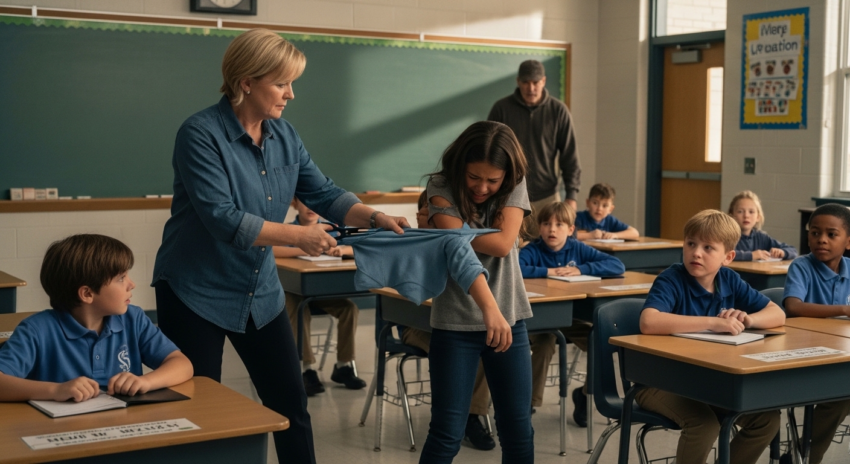
The metallic snip of the heavy crafting scissors echoed through the dead-silent classroom.
It was a sound that would play on a loop in my nightmares for years to come.
I stood frozen at the front of the AP English class, the fluorescent lights of Oakridge High School beating down on me. I was sixteen, but right then, I felt like a terrified five-year-old.
“Trash,” Mrs. Croft hissed, her perfectly manicured fingers gripping the collar of my oversized, faded green flannel shirt. “Absolute trash.”
Snip.
The heavy blades sliced through the thick cotton of the left sleeve.
I felt the cool burst of the air conditioning hit my bare skin as a jagged strip of fabric fell to the linoleum floor.
My breath caught in my throat. I couldn’t breathe. I couldn’t speak.
That shirt wasn’t just clothing. It still smelled faintly of cedarwood and Old Spice. It was the exact shirt my father was wearing the day before he deployed to Afghanistan for the last time.
It was my armor. The only thing that made me feel safe since the military completely broke my family two years ago.
And Mrs. Eleanor Croft, a woman whose entire personality revolved around her husband’s hedge fund and bullying teenagers she deemed “beneath” her, was tearing it apart.
“Mrs. Croft, please,” I whispered, my voice breaking. Tears hot and fast spilled over my eyelashes. “Stop. That was my dad’s.”
She paused, but only to look down her nose at me. Her lips curled into a sneer of pure disgust.
“Your father should have taught you basic hygiene before he left,” she said, loud enough for all twenty-five students to hear. “This is Oakridge High, Maya. We are a premier district. We do not wear literal garbage in my classroom. It’s distracting. It’s filthy. And honestly? It proves you don’t belong in an Advanced Placement program.”
She yanked the fabric again.
Snip. Riiiip.
Another piece fluttered to the ground.
I heard Chloe, my best friend sitting in the second row, let out a choked gasp. “Mrs. Croft, you can’t do that!” Chloe cried out, half-standing from her desk.
“Sit down, Chloe, unless you want a suspension on your Ivy League application,” Mrs. Croft snapped without even looking at her. Chloe sank back, her face pale, eyes welling with sympathetic tears.
I hugged myself, trying to pull the ruined flannel tighter around my chest to hide the tank top underneath. My hands were shaking so violently I couldn’t properly grip the remaining fabric.
I had been struggling for months. The grief of losing my dad had made my grades slip, my anxiety spike, and my energy vanish. I wore his shirt every single day because, on the days when the pain in my chest was so heavy I couldn’t get out of bed, putting it on felt like he was hugging me.
To Mrs. Croft, it was a violation of the dress code. To her, I was just the poor girl from the wrong side of the Virginia suburbs, dragging down her class average.
“Look at this,” Mrs. Croft continued, using the tip of the scissors to lift the shredded hem. “It’s a rag. You are wearing a rag. I am doing you a favor, Maya. If you don’t have the decency to dress appropriately, I will enforce the standards myself.”
She reached out to grab the front of the shirt, ready to cut straight down the middle.
I closed my eyes, bracing for the humiliation, wishing the floor would open up and swallow me whole. I just wanted my dad. I wanted him to walk through the door and save me.
But my dad was buried in Arlington National Cemetery.
Nobody was coming to save me.
At least, that’s what I thought.
“Excuse me.”
The voice didn’t just come from the doorway; it commanded the entire room. It was deep, gravelly, and carried the kind of absolute, unwavering authority that made the hairs on the back of my neck stand up.
It was a voice used to giving orders in war rooms.
The heavy wooden door to the classroom hadn’t just been opened; it was held wide open.
Mrs. Croft froze, the scissors suspended mid-air. She turned around, an arrogant retort already forming on her lips. “I am in the middle of a lesson—”
Her words died in her throat.
All twenty-five students simultaneously turned their heads. The silence that followed was so profound you could hear the buzz of the fluorescent lights.
Standing in the doorway was a giant of a man.
He was fifty-eight years old, six-foot-three, with salt-and-pepper hair cut to military precision. His posture was terrifyingly straight. But it wasn’t his size that sucked the air out of the room.
It was what he was wearing.
A pristine, perfectly tailored United States Army dress uniform. A chest covered in rows of colorful ribbons and combat medals. And on each shoulder, catching the harsh classroom light, were four solid, silver stars.
General Arthur Vance.
Commander of the U.S. Army Forces Command.
And my late father’s older brother.
My uncle Arthur was supposed to be at the Pentagon today. He was the man who had taken me in when my mom fell apart, the man who struggled to show emotion but made sure my lunch was packed every single morning. He had driven over to the school because I had forgotten my history textbook on the kitchen counter.
He had walked down the hallway.
He had looked through the small glass window of the classroom door.
And he had seen everything.
Uncle Arthur’s eyes, usually a calm, calculating steel gray, were currently black with a fury I had never seen in my life. He stepped into the classroom, his polished leather shoes clicking methodically on the linoleum.
He didn’t look at the students. He didn’t look at me.
His eyes were locked dead onto Mrs. Croft.
The scissors slipped from her trembling fingers and clattered onto the floor.
“What,” General Vance said, his voice dropping to a terrifyingly quiet whisper that somehow carried to the very back of the room, “did you just call my brother’s shirt?”
CHAPTER 2
The silence in the room was no longer just quiet—it was heavy, like the air right before a massive thunderstorm breaks.
Mrs. Croft’s face, which had been flushed with the arrogant heat of a bully only seconds ago, was now the color of old parchment. Her hand, still hovering in the air where she had been holding my father’s sleeve, began to tremble. Not just a twitch, but a visible, rhythmic shake that made her expensive gold bracelets clink together.
The sound of Uncle Arthur’s boots—the “Commandant’s Walk,” my dad used to call it—echoed against the tile. Click. Click. Click. He stopped exactly three feet away from her. He didn’t scream. He didn’t have to. The sheer physical presence of a four-star General in a 12-by-15-foot classroom was enough to make the walls feel like they were closing in.
“I asked you a question, Ma’am,” Arthur said, his voice a low, vibrating hum that I could feel in my own chest. “My niece told me you called this garment a ‘rag.’ I’d like to hear you say it again. To my face.”
Mrs. Croft swallowed hard. I could see her throat move. She tried to find her “Teacher Voice”—the one she used to intimidate scholarship kids and service staff—but it had deserted her.
“I… General… there is a dress code,” she stammered, her eyes darting to the floor, then to the door, then back to the silver stars on Arthur’s shoulders. “The shirt… it was tattered. It was unhygienic. I was simply enforcing the standards of Oakridge High. We are a Blue Ribbon school, and—”
“Standards?” Arthur interrupted. He reached down.
The entire class watched, breathless, as the most powerful man I knew bent over and picked up the jagged strip of green flannel Mrs. Croft had just sheared off. He held it in his large, calloused palm as if it were a piece of sacred silk.
“You see this fabric?” Arthur asked, his voice deathly calm. He turned his head slightly, addressing the entire class, but his eyes never left Mrs. Croft’s. “This shirt belonged to Major Elias Vance. My brother. Maya’s father.”
A collective gasp rippled through the room. Even the “cool kids” in the back, the ones who usually spent the whole period on their phones, were leaning forward, their eyes wide.
“Major Vance wore this shirt the night he said goodbye to his daughter before his fourth deployment to the Helmand Province,” Arthur continued. “He wore it when he sat on the edge of her bed and promised her he’d come home. He didn’t make it back, Mrs. Croft. This ‘rag’ is the last thing my niece has that still carries the scent of a man who died so you could sit in this air-conditioned room and judge children.”
I felt a fresh wave of tears hit my face. Hearing him say it out loud—to the person who had just tried to destroy it—felt like a knife being pulled out of a wound.
“I… I didn’t know,” Mrs. Croft whispered. Her arrogance was trying to survive, but it was drowning. “How was I to know? She never said—”
“She told you it was her father’s!” Chloe screamed from her seat, her voice cracking with pure indignation. “She begged you to stop, and you laughed at her!”
Arthur’s jaw tightened. A small muscle in his cheek pulsed. That was the only sign that he was about five seconds away from a total tactical meltdown.
“You took a pair of scissors to a student,” Arthur said, his voice rising just a fraction—the “General’s Roar” beginning to leak through. “You laid hands on her property. You humiliated a child in front of her peers because you didn’t like the aesthetic of her grief?”
“It’s not… it’s not like that,” Mrs. Croft said, her voice rising in a frantic, high-pitched defensive tone. “You’re blowing this out of proportion! I have a reputation! My husband is on the board of the—”
“I don’t care if your husband is the King of England,” Arthur barked, and this time, the windows actually rattled.
At that moment, the classroom door swung open again. Mr. Sterling, the principal, came skidding in. He was a small, nervous man who spent most of his time trying to appease the wealthy parents of Oakridge. He had clearly been alerted by someone in the hallway that a high-ranking military officer was currently dismantling his star English teacher.
“General Vance! General! Please!” Sterling said, his hands raised in a placating gesture. “I’m sure this is all just a terrible misunderstanding. Mrs. Croft is one of our most decorated educators. If we could just step into my office…”
Arthur didn’t even look at him. He kept his gaze fixed on the woman who was now cowering against the chalkboard.
“There is no misunderstanding, Mr. Sterling,” Arthur said. “I watched through that window for three minutes. I saw her mock my niece. I saw her use a weapon—yes, in a school, I believe we call scissors a weapon when used to assault a student—to destroy a memento of a fallen soldier. I saw the look of pure, sadistic pleasure on her face while she did it.”
“Assault? That’s an exaggeration!” Mrs. Croft cried out, her face turning a blotchy, ugly red. “I was helping her! She looks like a vagrant in that thing! Someone had to have some standards!”
The room went ice-cold.
Mr. Sterling looked like he wanted to faint. He knew Mrs. Croft was an elitist, but he also knew that saying “vagrant” to a 4-star General regarding his dead brother’s daughter was essentially professional suicide.
Uncle Arthur took one step closer to her. He didn’t touch her, but he leaned in until he was looming over her, his shadow completely swallowing her.
“Ma’am,” he said, his voice so low it was almost a growl. “You have spent your career teaching words. Today, you’re going to learn the meaning of a few new ones: Accountability. Litigation. And Unemployment.“
He turned to Mr. Sterling. “I want her out of this classroom. Right now. If she is still on this property in ten minutes, I am calling the Military Police and the local news. And believe me, the Army has a very long memory when it comes to those who disrespect the families of the fallen.”
“General, please, let’s talk about this calmly—” Sterling began.
“Maya,” Arthur said, ignoring the principal entirely. He looked at me, and his eyes softened for the first breath of a second. “Get your bag. We’re leaving.”
I moved like a ghost. My hands were still shaking as I shoved my notebooks into my backpack. I grabbed the pieces of my dad’s shirt from the floor—every single scrap—and tucked them into my pocket like they were gold nuggets.
As I walked toward the door, I passed Mrs. Croft. She was leaning against her desk, looking like her entire world had just tilted on its axis.
“You don’t deserve to wear his name,” I whispered, so only she could hear.
She didn’t say a word. She just stared at the floor, the scissors still lying there, a discarded tool of a bully who had finally picked the wrong target.
Uncle Arthur placed a heavy, protective arm around my shoulder as we walked out into the hallway. But as we stepped out, I noticed something.
Almost every student in the class had their phones out.
And they weren’t just texting. They were recording.
By the time we reached the parking lot, the video of a 4-star General defending his niece against an elitist bully was already starting to move. And it was moving fast.
But as we got into his black SUV, Arthur didn’t look triumphant. He looked at the ruined fabric in my hand, and for the first time, I saw a tear escape the corner of the General’s eye.
“I’m sorry, Maya,” he whispered. “I’m so sorry I wasn’t here sooner.”
“It’s okay, Uncle Artie,” I said, using the name only I was allowed to call him. “You’re here now.”
He nodded, his face hardening back into the mask of a soldier. “Yes, I am. And I’m not done yet. That woman has no idea what’s coming for her.”
He wasn’t lying. The storm hadn’t even reached its peak.
CHAPTER 3
The interior of the black Chevy Suburban was a sanctuary of leather and silence, a sharp contrast to the buzzing, suffocating atmosphere of the classroom I’d just fled. Outside the tinted windows, the manicured lawns of Oakridge, Virginia, blurred into a green-and-white smear. This was a town built on old money, political connections, and the kind of quiet arrogance that Mrs. Croft wore like a designer perfume.
Uncle Arthur didn’t start the engine immediately. He sat with his large hands gripped tight at ten and two on the steering wheel, his knuckles white against the dark leather. I looked down at my lap. The pieces of my father’s shirt—the “rag”—felt like lead in my hands. I tried to fit the jagged edges together, but the fabric was frayed beyond simple repair.
“I have the best tailor in D.C. on my staff, Maya,” Arthur said, his voice still vibrating with that low, dangerous frequency. He didn’t look at me, but his eyes were fixed on the rearview mirror, watching the school entrance. “He can fix anything. He’s repaired dress uniforms that went through IED blasts. He’ll fix this.”
“It won’t be the same,” I whispered. A tear landed on the green flannel, darkening the fabric. “She cut right through the pocket where he used to keep his lucky coin. It’s… it’s just ruined, Uncle Artie.”
He finally turned to look at me. The iron-hard General Vance was gone for a fleeting second, replaced by the man who had sat in the front row of my father’s funeral, holding my shaking hand while the 21-gun salute tore through the silence of Arlington.
“The shirt is fabric, Maya. The memory is bone and blood,” he said firmly. “She tried to take your dignity because she thought you were small. She thought because your father isn’t here to stand behind you, that you were an easy target. She forgot about me. And she’s about to realize that the United States Army doesn’t take kindly to its families being used as footstools for social climbers.”
His phone buzzed in the center console. It was a secure line. He swiped it open and put it on speaker.
“Vance,” he barked.
“Sir, it’s Captain Miller,” a crisp, female voice replied. Captain Sarah Miller was Arthur’s lead legal aide—a woman who could find a needle in a haystack and then use that needle to dismantle an opponent’s entire legal defense. “You might want to look at the local ‘Oakridge Community’ Facebook group. And Twitter. Actually, just look at everything. It’s everywhere.”
Arthur frowned. “The video?”
“Multiple videos, Sir. From at least six different angles. The ‘General in the Classroom’ is currently trending at number four nationwide. The caption on the most popular one is ‘4-Star General wipes the floor with Elitist Bully Teacher.’ It has three million views in forty minutes.”
I felt a pit form in my stomach. I hated attention. I spent my life trying to blend into the shadows of the hallway, wearing oversized clothes to hide the fact that I was drowning in grief. Now, my worst moment of humiliation was being broadcast to the world.
“What’s the reaction, Sarah?” Arthur asked.
“Public sentiment is ninety-nine percent on your side, Sir. People are calling for her immediate termination. However…” Miller paused. “The Oakridge School Board is already moving to protect her. Mrs. Croft’s husband, Julian Croft, just made a frantic call to the Superintendent. He’s a major donor to the governor’s campaign. They’re trying to spin it as ‘Military Intimidation’ of a civilian educator. They’re claiming you entered the premises without authorization and threatened a teacher in front of minors.”
Arthur let out a short, dry laugh that sounded like sandpaper. “Is that so? Send the footage from my dashcam and the audio from my personal recorder—the one I had active for the security briefing this morning—to the JAG office. I want a full transcript of every word that woman said to my niece before I stepped through that door.”
“Already on it, Sir,” Miller replied. “I’ve also reached out to a friend at the Washington Post. If they want a war of words, we’ll give them a scorched-earth campaign.”
“Do it,” Arthur said, then hung up.
He put the car in gear and pulled out of the parking lot. As we drove, I saw a group of mothers standing near the school gates, clutching their $5,000 handbags and talking animatedly while pointing at their phones. One of them was Mrs. Gable, the PTA president and Eleanor Croft’s best friend. She saw the Suburban and glared, her face a mask of suburban fury.
These were the “Tiger Moms” of Oakridge—women who believed their zip code made them untouchable. They didn’t see a grieving girl; they saw a threat to their polished, perfect hierarchy.
We reached the house—a modest but sturdy colonial on the edge of the woods that Arthur had bought so I could have a backyard. As I stepped out of the car, I felt the weight of the day crashing down on me. I didn’t want a legal battle. I didn’t want to be a viral sensation. I just wanted my dad back.
I went straight to my room, curled up on the bed, and clutched the ruined flannel to my chest. The smell was fading. That was the real tragedy. Every time the fabric was handled, every time it was washed or, in this case, violently shredded, a little bit more of my father’s scent disappeared.
An hour later, there was a knock on my door. It wasn’t Arthur’s heavy rap; it was a softer, more rhythmic sound.
I opened the door to see Captain Sarah Miller. She was out of uniform, wearing a sharp navy blazer and jeans, carrying a briefcase. Behind her stood a man I didn’t recognize—thin, elderly, with a measuring tape draped around his neck like a scarf.
“Maya,” Sarah said, her voice warm and genuinely empathetic. “This is Mr. Aris. He’s the man your uncle mentioned. He’s been the master tailor for the Joint Chiefs for thirty years.”
Mr. Aris stepped forward, his eyes kind and magnified behind thick glasses. He looked at the scraps of cloth on my bed. He didn’t see a “rag.” He looked at it the way a surgeon looks at a patient.
“Don’t you worry, Miss Vance,” he said in a soft Greek accent. “I have seen worse. In 1994, I repaired a flag that was pulled from a burning embassy. This? This is just a puzzle. We will find matching vintage thread. We will reinforce the seams with silk. It will be stronger than it was before.”
“Thank you,” I choked out.
As Mr. Aris carefully gathered the fabric, Sarah Miller pulled me aside.
“Maya, I need to be honest with you,” she said, her expression turning professional. “Mrs. Croft isn’t going down without a fight. She just released a statement through her lawyer. She’s claiming she was ‘concerned’ about your mental health and that the shirt was a ‘biohazard.’ She’s even implying that your uncle’s presence at the school was an act of ‘domestic terrorism’ by the military.”
I felt my blood boil. “She cut it! She laughed! How can she say that?”
“Because in her world, the truth is whatever you can get people to believe,” Sarah said. “But she made one fatal mistake. She didn’t realize who she was talking to. Your uncle isn’t just a General, Maya. He’s a man who spent thirty years learning how to dismantle enemies who are much more dangerous than a high school English teacher.”
She opened her briefcase and pulled out a tablet. “We just did a deep dive into Mrs. Croft’s ‘impeccable’ record. It turns out, you aren’t the first student she’s targeted. There are three other families—scholarship students, mostly—who she bullied out of the AP program. They were too afraid to speak up because of her husband’s influence. But now that your uncle has opened the door? They’re lining up to testify.”
Just then, the house phone rang. It was the school board. They were calling an emergency hearing for tomorrow morning at 8:00 AM.
“They want to settle this quietly,” Sarah whispered, a shark-like grin appearing on her face. “They think they can offer your uncle a private apology and move on.”
“And what does Uncle Arthur say?” I asked.
At that moment, Arthur walked into the hallway, his phone in hand, his face set in stone.
“Tell them we’ll be there,” Arthur said, his voice echoing through the house. “But tell them to move the hearing to the high school auditorium. I want the doors open. I want the cameras there. If Mrs. Croft wants to talk about ‘standards,’ let’s do it in front of the whole world.”
The battle lines were drawn. The “Tiger Moms” and the hedge-fund husbands were about to find out what happens when you try to bully a Vance.
CHAPTER 4
The parking lot of Oakridge High School looked like a showroom for luxury electric SUVs and European sports cars. But today, the sea of Teslas and Porsches was parted by the presence of three blacked-out government Suburbans and a local news van with its satellite dish aimed at the sky like a weapon.
The “emergency hearing” was no longer a private meeting in a wood-paneled office. As we pulled up, I saw the crowd gathered around the auditorium entrance. There were parents in Lululemon leggings and Patagonia vests holding signs that said “Protect Our Teachers” and “No Military Intimidation in Our Schools.” On the other side of the steps, a smaller but louder group of students and local veterans held up hastily scrawled cardboard: “Respect the Fallen” and “Fire Mrs. Croft.”
My heart was hammering against my ribs so hard it felt like it would bruise. I looked down at my hands. I wasn’t wearing the flannel today—it was in the skilled hands of Mr. Aris—but I was wearing my father’s dog tags under my sweater. The cold metal against my skin was the only thing keeping me grounded.
“Eyes front, Maya,” Uncle Arthur said. He was in his full Class A dress uniform again. Every medal, every ribbon, every star was polished to a mirror finish. He looked less like a man and more like a monument to American power. “They’re going to try to make you feel small. They’re going to try to make you feel like the intruder. Remember whose blood is in your veins.”
We stepped out of the car, and the flashbulbs started immediately. The “Tiger Moms” of Oakridge hissed as we passed.
“How dare he bring that military theater here,” I heard one woman whisper loudly. “My son is traumatized by the shouting yesterday!”
Arthur didn’t even blink. He marched toward the auditorium doors, and the crowd naturally divided. Inside, the air conditioning was humming at a low, mournful pitch. The stage was set with a long table for the School Board, and in the center sat Mr. Sterling, looking like he hadn’t slept a wink.
To the right sat Eleanor Croft. She wasn’t cowering anymore. She sat next to a man who looked like he’d been carved out of expensive marble—Julian Croft. He wore a $4,000 suit and a look of pure, unadulterated entitlement. Next to them was a man in a sharp gray suit who Sarah Miller whispered was Marcus Thorne, the most expensive defense attorney in the state.
As we took our seats on the left, Thorne stood up immediately.
“Mr. Superintendent, members of the Board,” Thorne began, his voice smooth as silk. “Before we begin this… circus… I’d like to move for the immediate dismissal of these proceedings and a formal apology to Mrs. Croft. What we saw yesterday was a coordinated attack by a high-ranking military official on a dedicated educator. My client was acting out of concern for the safety and hygiene of her classroom. The student in question has been showing signs of… emotional instability… for months.”
I felt my face heat up. Instability. That was their play. Make me out to be the “crazy, grieving girl” so Mrs. Croft’s cruelty looked like “intervention.”
“General Vance’s entrance was a violation of school security protocols,” Thorne continued, pacing the stage. “He used his rank to intimidate a woman. It was, quite frankly, a display of toxic masculinity and professional misconduct.”
Julian Croft leaned back, a smug smirk playing on his lips. He looked at Arthur as if he were looking at a hired gardener who had stepped out of line.
Mr. Sterling cleared his throat. “General Vance? Do you have a response?”
Arthur didn’t stand up. He didn’t need to. He just leaned forward, his presence filling the entire auditorium.
“I’m not here to talk about my masculinity or your protocols, Mr. Thorne,” Arthur said, his voice quiet but carrying to the back row. “I’m here to talk about a contract. A social contract that says when we send our children to school, they won’t be physically assaulted and emotionally liquidated by the people we pay to protect them.”
“Assaulted?” Thorne scoffed. “She cut a piece of old fabric, General. Let’s not be melodramatic.”
“That ‘old fabric,’” Arthur said, “was a military memento. In the eyes of the United States government, destroying it is a federal offense under the Veterans’ Memorial Preservation Act, given its status as a historical artifact of a fallen officer. But let’s set that aside for a moment.”
Arthur nodded to Sarah Miller. She tapped a button on her laptop, and the giant projector screen behind the School Board flickered to life.
It wasn’t the viral video from the classroom. It was a black-and-white security feed from the hallway, three years ago.
The auditorium went silent. The video showed Mrs. Croft in the hallway, standing over a young boy who was crying. He was wearing a slightly worn backpack and shoes that clearly weren’t name-brand. Mrs. Croft was pointing at his shoes, her mouth moving in a silent snarl. Then, she reached out and shoved him against a locker, knocking his glasses off.
“What is this?” Julian Croft shouted, standing up. “This is irrelevant! This has nothing to do with—”
“This is the first of four incidents we’ve uncovered since yesterday,” Sarah Miller said, her voice cutting through Julian’s shouting like a diamond through glass. “This is Leo Sanchez. He was a scholarship student. His parents didn’t speak English well enough to fight back when Mrs. Croft had him removed from the AP program for ‘disciplinary issues’—issues that, as the video shows, she fabricated.”
The screen changed. Another video. Another student. This time, it was a girl being mocked in front of the class for her ‘thrift store’ sweater.
“You see, Mrs. Croft doesn’t just have a ‘standard’ for dress,” Arthur said, standing up now. He walked toward the center of the stage, the light catching his stars. “She has a standard for class. She targets the ones she thinks can’t fight back. She targets the children of the people she considers ‘the help.’ She thought Maya was one of them because she didn’t know Maya has a family that knows how to hold a line.”
Eleanor Croft’s face was no longer parchment-white. It was turning a sickly shade of purple. “Those are out of context!” she shrieked. “That boy was being defiant!”
“The video doesn’t lie, Eleanor,” Mr. Sterling said, his voice surprisingly firm. He looked at the other board members. The ‘Tiger Moms’ in the front row were suddenly very quiet, looking at their shoes. They liked Eleanor when she was bullying ‘the outsiders,’ but now that the cameras were here, they were realizing she was a liability.
“We have three former students and their families in the hallway right now,” Sarah Miller added. “They are ready to testify under oath about the systematic bullying, the destruction of personal property, and the psychological abuse Eleanor Croft has inflicted on students who didn’t fit her ‘aesthetic’ of a wealthy suburb.”
Julian Croft leaned over to his wife and whispered something through gritted teeth. His smugness had evaporated. He was a businessman; he knew when a stock was crashing.
But Arthur wasn’t done.
“Mr. Thorne mentioned ‘mental health,’” Arthur said, looking directly at the lawyer. “He’s right. My niece has been through hell. She lost her father. She lost her home. And yet, she worked her way into this AP program. She earned her seat. And when she needed a teacher to be a mentor, she got a predator with a pair of scissors.”
Arthur turned to look at the School Board. “You have a choice. You can stand by this woman and the money her husband brings to your foundation, or you can stand by the children in this room. But know this: if Eleanor Croft is not terminated by the end of this hour, I will file a civil rights lawsuit against this district that will drain every penny of your ‘Blue Ribbon’ budget. And I will make sure the Department of Education opens an investigation into every single one of you.”
The room was so quiet you could hear the heartbeat of the person sitting next to you.
“We need a ten-minute recess,” Mr. Sterling whispered.
“You have five,” Arthur said.
As the board scrambled into a side room, I looked at Mrs. Croft. She was staring at me. For the first time, there was no contempt in her eyes. There was only fear. She realized that the “rag” she had tried to destroy was the very thing that was going to hang her career.
“Maya,” she whispered, her voice trembling. “I… I can make this right. I can give you an A. I can write your recommendation for Harvard.”
I stood up, my legs finally steady. I didn’t need my uncle to speak for me this time.
“My dad always told me that a uniform doesn’t make a soldier, and a title doesn’t make a teacher,” I said, my voice clear and loud enough for the media in the back to catch every word. “You weren’t trying to help me, Mrs. Croft. You were trying to erase me. But you forgot one thing.”
I pulled my father’s dog tags out from under my sweater and let them clink against my chest.
“Vances don’t erase easily.”
Julian Croft grabbed his wife’s arm and pulled her toward the exit before the board could even come back. They didn’t wait for the verdict. They knew it was over.
But as they reached the doors, they were met by a fresh wave of cameras and a pair of local police officers.
“Mrs. Croft?” one of the officers said. “We have a warrant for your arrest on charges of misdemeanor assault and destruction of property. Please come with us.”
The auditorium erupted into chaos. My uncle reached over and pulled me into a one-armed hug.
“Is it over?” I asked.
“For her? Yes,” Arthur said, looking at the door where she was being led away in handcuffs. “But for us? We’re just getting started. Let’s go get your shirt.”
CHAPTER 5
The doorbell rang at 7:00 AM on Saturday morning.
I was sitting at the kitchen island, nursing a mug of cocoa that had gone cold. My phone was vibrating incessantly on the granite countertop—hundreds of notifications from people I didn’t know, messages of support from veterans’ groups, and a few nasty emails from “Oakridge Truth” accounts that were quickly being banned.
Uncle Arthur, still in his workout gear after a five-mile run, opened the door.
It was Mr. Aris. He wasn’t wearing his measuring tape today. He was wearing a formal suit, and in his hands, he carried a high-end wooden garment box, the kind used for couture wedding dresses.
“I stayed up all night,” Mr. Aris said, his voice weary but proud. “I could not sleep until the Major’s spirit was put back together.”
We moved to the living room. Uncle Arthur stood back, his arms crossed, a rare look of anticipation on his face. I held my breath as Mr. Aris laid the box on the coffee table and lifted the lid.
I expected to see the shirt exactly as it was. But what I saw made me burst into tears instantly.
Mr. Aris hadn’t just sewn the pieces back together. He had treated the damage like Kintsugi—the Japanese art of repairing broken pottery with gold. Where the scissors had shredded the sleeves and the chest, he had reinforced the seams with a shimmering, midnight-blue silk thread—the color of the Infantry.
On the pocket where my dad’s lucky coin had once sat, he had embroidered a tiny, nearly invisible set of Major’s gold leaves.
“It is stronger now,” Mr. Aris whispered. “The scars are part of the story, Miss Vance. They show that it survived the battle.”
I reached out and touched the fabric. It was soft, familiar, and still smelled—faintly, but definitely—of cedarwood. He had preserved the scent.
“Thank you,” I sobbed, pulling the shirt to my chest. “Thank you so much.”
After Mr. Aris left, Arthur sat down next to me. He looked at the shirt, then at me. “The school board sent their formal decision an hour ago. Eleanor Croft has been stripped of her teaching license in the state of Virginia. The police are moving forward with the assault charges because of the video evidence. And Julian Croft? He’s been ‘asked to resign’ from the board of his hedge fund. The PR nightmare was too much for them.”
It felt like a victory, but a heavy one. “Are people still angry?”
“The people who matter aren’t,” Arthur said. “But Maya, you should know… the world is a lot bigger than Oakridge. You don’t have to go back there if you don’t want to. I can have you transferred to the base school or a private academy in D.C.”
I looked at the repaired shirt. The blue silk thread caught the morning light. “No,” I said, my voice surprising even myself with its firmness. “I’m going back. If I leave now, it looks like I’m ashamed. I have nothing to be ashamed of.”
Monday morning was different.
When the black Suburban pulled up to the drop-off line, the atmosphere was transformed. There were no protesters. There were no “Tiger Moms” glaring from their SUVs. Instead, as I stepped out, wearing the repaired flannel over a simple black dress, a group of students was waiting by the entrance.
Chloe was at the front. Next to her was Leo Sanchez—the boy from the video Arthur had shown. He looked nervous, but he was wearing a new pair of sneakers and his head was held high.
“Hey,” Leo said, stepping forward as I approached. “I just… I wanted to say thank you. My parents watched the hearing on the news. They cried. They thought no one cared about what happened to me.”
“I cared, Leo,” I said, my voice thick with emotion.
As we walked through the halls, the silence was respectful, not mocking. We reached the English wing. Mrs. Croft’s nameplate had already been scraped off the door. In its place was a temporary sign: Mr. Henderson.
Mr. Henderson was an older man, a retired journalist who had been subbing for years but was never given a permanent spot because he wasn’t “polished” enough for the Oakridge elite. He was sitting at the desk, reading a book, when we walked in.
He looked up and smiled. “Good morning, class. Please, take your seats.”
I went to my usual spot in the back. But before I could sit, I felt a shadow over my desk. I looked up and saw Sarah Gables—the daughter of the PTA president who had been Mrs. Croft’s biggest supporter.
The room went quiet. Sarah was the “Queen Bee” of the school. Her mother had been the one whispering about “military theater” just days ago.
Sarah looked at my shirt, her eyes lingering on the blue silk repairs.
“My mom says your uncle is a bully,” Sarah said, her voice loud enough for everyone to hear.
I felt the old familiar sting of anxiety, the urge to shrink away. But then I felt the weight of my father’s dog tags. I felt the strength of the silk thread.
“Your mom thinks anyone who holds her accountable is a bully, Sarah,” I replied calmly. “There’s a difference between power and authority. Your mom has power because of her bank account. My uncle has authority because he protects people like us from people like your mother.”
A few kids in the back actually cheered. Sarah’s face turned a brilliant shade of red, and she retreated to her seat without another word.
The lesson began, and for the first time in two years, I actually listened. I didn’t doodle in the margins of my notebook. I didn’t hide my face behind my hair. I sat tall.
But the real “giác ngộ”—the moment of true realization—came during the lunch break.
I was sitting outside on the quad with Chloe and Leo when a black car I didn’t recognize pulled up to the curb. A woman stepped out. She looked exhausted, her hair unkempt, her expensive blazer wrinkled.
It was Eleanor Croft.
She wasn’t supposed to be on campus. Security started moving toward her, but she held up her hands. She wasn’t there to fight. She looked around until she spotted me.
She walked toward our table, her eyes red-rimmed. The students nearby went silent, sensing the final act of a tragedy.
“Maya,” she said, her voice raspy.
I stood up. I didn’t feel afraid anymore. I just felt… pity.
“You shouldn’t be here, Mrs. Croft,” I said.
“I know,” she whispered. She looked at the shirt I was wearing. “I didn’t… I didn’t know it was gold. I thought it was just old.”
“It was never just a shirt,” I said. “It was a promise. And you broke it.”
“They took everything,” she said, more to herself than to me. “The house is being leveraged for the legal fees. Julian is leaving. My career is… it’s gone.” She looked at me, a flicker of her old bitterness returning. “Are you happy now? Did the General get what he wanted?”
I looked at Leo, then back at her.
“My uncle didn’t do this to you, Mrs. Croft,” I said softly. “You did this to yourself. He just turned the lights on so everyone could see what you were doing in the dark.”
She stood there for a long moment, a fallen queen in a kingdom of her own making. She looked like she wanted to say something else—an apology, a curse, a plea—but the words wouldn’t come.
The security guards reached her then. “Ma’am, you need to leave the premises immediately.”
She let them lead her away. She didn’t look back.
As she disappeared into the car, I felt a strange sense of peace. The “Tiger” of Oakridge had been declawed, not by violence, but by the simple, undeniable truth of a “rag.”
I sat back down and took a bite of my apple.
“You okay?” Chloe asked, reaching over to squeeze my hand.
I looked down at the blue silk thread on my sleeve. It was beautiful. It was strong. It was a scar that had been turned into art.
“I’m better than okay,” I said. “I’m free.”
But as the day ended and I walked out to meet my uncle, I saw him standing by the car, looking at a folder in his hand. His face was grim.
“What is it?” I asked.
“The investigation into the school board,” Arthur said. “It goes deeper than we thought, Maya. This wasn’t just one teacher. This was a system. And they’re trying to bury the evidence.”
The war wasn’t over. It was just moving to a higher level.
CHAPTER 6
The Oakridge Town Hall looked like a fortress. It was a week after the hearing, and the local news cycle had turned into a national firestorm. What started as a “teacher-student dispute” had unraveled into a full-scale investigation into the Oakridge School Board’s “Platinum Fund”—a slush fund fueled by wealthy parents to ensure their children received preferential treatment, higher grades, and protected status, all while systematically pushing out “unfavorable” students.
Uncle Arthur stood in the hallway, his hands behind his back. He wasn’t in uniform today. He wore a simple charcoal suit, but he still commanded the room like he was standing on the bridge of an aircraft carrier.
“They offered me a deal this morning,” Arthur said, his voice low. “The Superintendent offered to name the high school library after your father if I dropped the civil suit. They want the ‘General Vance problem’ to go away before the state auditors arrive.”
I looked at the mahogany doors leading into the main chamber. I could hear the roar of the crowd inside—hundreds of parents, teachers, and students who had finally found their voices.
“What did you tell them?” I asked.
Arthur looked down at me, a ghost of a smile touching his lips. “I told them my brother’s name belongs on the hearts of the people he protected, not on a building funded by bribes. I told them the Vances don’t negotiate with bullies.”
We walked in. The room fell silent.
The entire school board sat at the front, looking like defendants in a high-stakes trial. Mr. Sterling was there, pale and trembling. Next to him sat the Chairman, a man who had made his fortune in predatory lending and had spent the last decade treating Oakridge High like his private country club.
“This meeting is now in session,” the Chairman said, his voice tight. “We are here to discuss the restructuring of—”
“No,” a voice called out from the back.
It was Leo Sanchez’s father. He stood up, his work-worn hands gripping the back of the chair. “We are here to talk about the kids you erased. We are here to talk about the ‘rags’ you tried to burn.”
One by one, people stood up. It wasn’t just about me anymore. It was about the years of quiet cruelty that Eleanor Croft and her patrons had inflicted on this town.
The Chairman tried to bang his gavel. “Order! This is not a public forum for grievances!”
Arthur stepped forward. He didn’t go to the microphone. He just stood in the center aisle.
“Actually, it is,” Arthur said. “Because as of 06:00 hours this morning, the state’s attorney has authorized a full forensic audit of your accounts. And as the legal guardian of a student who was physically assaulted on your watch, I am officially filing a motion for the immediate dissolution of this board.”
The room erupted. The Chairman’s face went from arrogant to terrified in the span of a heartbeat. He looked at the cameras, then at the rows of angry parents, and finally at Arthur. He knew the “General Vance problem” wasn’t going away. It was the end of the line.
I didn’t stay for the rest of the meeting. I knew how it would end. The “Oakridge Elite” were crumbling, their polished masks shattered by the very girl they thought was too broken to fight back.
I walked out into the cool evening air. The sun was setting, casting long, golden shadows across the lawn. I walked down to the edge of the school property, where a small memorial garden sat.
I sat on a stone bench and pulled my father’s shirt tighter around me. The blue silk thread shimmered in the twilight. I closed my eyes and leaned back, and for a moment, I could almost feel a heavy, warm hand rest on my shoulder. I could almost hear that deep, rumbling laugh that always smelled like cedar and safety.
“We did it, Dad,” I whispered. “We held the line.”
A few minutes later, Arthur joined me. He didn’t say anything at first. He just sat beside me, looking out at the town that would never be the same.
“Mr. Aris sent over a package this afternoon,” Arthur said softly. He handed me a small, velvet-lined box.
I opened it. Inside was the “lucky coin” my father had always carried. It had been found in the debris of the classroom, polished and restored. But it wasn’t just the coin. Mr. Aris had turned it into a pendant, hung on a sturdy silver chain.
“He said every soldier needs their armor,” Arthur said. “But every survivor needs a reminder of why they fought.”
I put the chain around my neck. The coin felt heavy and warm against my skin, resting right next to the dog tags.
“What happens now, Uncle Artie?”
Arthur stood up and offered me his hand. “Now? Now you go to school tomorrow. You study. You laugh with Chloe. You live the life your father bought for you with his own.”
He paused, looking at the high school building one last time.
“And me?” Arthur’s eyes flashed with that familiar, steel-gray fire. “I think I’ll stay in town for a while. I hear the school board needs some new leadership. Someone who knows that a ‘rag’ is only a rag if you don’t have the heart to see the hero behind the fabric.”
We walked to the car together. As we drove away from Oakridge High, I looked back in the rearview mirror. The lights of the school were bright, but for the first time in a long time, the shadows didn’t look so scary.
I wasn’t the “poor girl in the raggerty shirt” anymore. I was Maya Vance. And I was exactly where I belonged.
The world will try to tell you that you are defined by what you wear, what you own, or who your parents are. They will try to tell you that your grief makes you weak and your poverty makes you invisible.
But they are wrong.
Because sometimes, all it takes to bring down a kingdom of bullies is one girl, one General, and a piece of green flannel that was never, ever just a rag.
Thank you for reading this story! If you enjoyed this emotional thriller, please react with a ❤️ and share it with your friends. Follow my page for more stories that will keep you up at night!