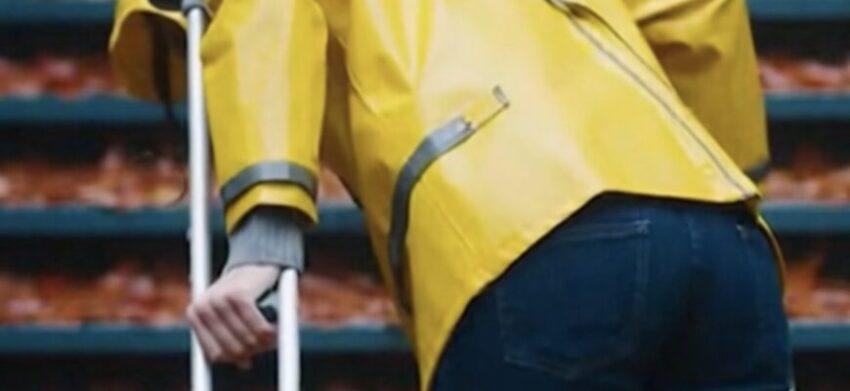
It starts with the rain and a stark visual contrast. A young woman, clad in a bright, unmistakable yellow raincoat, stands at the bottom of a long, leaf-strewn wooden staircase. She is injured, balancing on crutches with her left leg encased in a heavy white cast.
Ahead of her, marching upward in unison, is a group of men in identical dark suits.
“Please, I can’t get up there alone,” she cries out, her voice laced with desperation. Not a single man turns around. Not a single step falters. The scene ends with the woman bending over her crutches, defeated by the physical barrier before her and the emotional blow of being entirely ignored.
While brief, this poignant video acts as a powerful microcosm of real-world issues. It forces the viewer to confront uncomfortable truths about conformity, the bystander effect, and the daily struggles of those navigating a world not built for them.
The Visual Metaphor: Invisibility in Plain Sight
The cinematography of the scene relies heavily on contrast to tell its story.
* The Yellow Raincoat: The woman’s coat is vivid and desperate for attention. It represents individuality, vulnerability, and a glaring signal that she needs help.
* The Dark Suits: The men are uniform, almost robotic in their ascent. Their matching dark attire swallows them into a collective monolith. They do not represent individuals making a choice to ignore her; they represent a societal system that simply does not care.
The tragedy of the scene is that despite wearing the brightest color in a gloomy, grey environment, the woman remains entirely invisible to those with the power to help her.
The Bystander Effect and Urban Alienation
When the woman begs for help, the silence from the men is deafening. This moment is a textbook illustration of the bystander effect—a social psychological theory that states individuals are less likely to offer help to a victim when there are other people present.
However, the video takes this a step further. The men aren’t just passive bystanders; they are actively moving away from the problem. It highlights the modern phenomenon of urban alienation, where people put on blinders to the struggles of others to maintain their own forward momentum. To stop and help would mean breaking their uniform stride.
A Harsh Reality of Accessibility
Beyond the psychological metaphors, the video is a literal representation of the lack of accessibility in our environments.
For an able-bodied person, a flight of stairs in a park is merely a pathway. For someone with a broken leg, a wheelchair, or chronic pain, those same stairs are an insurmountable wall. The scene reminds us that true accessibility relies on two pillars:
* Inclusive infrastructure (like ramps or elevators).
* Human empathy and willingness to assist when infrastructure fails.
In this video, both pillars are entirely absent.
The Takeaway
Art and short film often serve as mirrors to society. This brief encounter on a rainy staircase asks us a direct question: When faced with someone struggling to climb their own metaphorical (or literal) stairs, do we break away from the crowd to offer a hand, or do we keep our heads down and keep walking?
The woman in the yellow coat is asking for the bare minimum of human connection. It is up to us to ensure that in the real world, her plea doesn’t go unanswered.