Part 1
The argument started before the cabin door even clicked shut.
Elena Carter had barely settled into seat 2A on the nonstop from San Diego to Boston when a sharply dressed woman in a cream blazer stopped dead in the aisle, looked at her boarding pass, then looked at Elena like she was something somebody had spilled and failed to clean up.
“I think you’re in my seat,” the woman said.
Her voice had that polished, practiced edge some people used when they wanted to sound civil and insulting at the same time.
Elena looked up from the window and answered in the same calm tone she’d spent years perfecting around commanding officers, hospital receptionists, insurance clerks, and anyone else who mistook exhaustion for weakness.
“No, ma’am,” she said. “I’m in 2A.”
The woman smiled, but there was no warmth in it.
“That’s impossible. I always book 2A.”
Elena blinked once.
Always.
As if airline seating had somehow become hereditary.
A flight attendant appeared almost instantly, wearing the careful expression of someone who had already decided the problem wasn’t the conflict itself, but how quickly it could be made to disappear.
“Let me see both boarding passes,” she said.
Elena handed hers over.
The other woman did the same, then said, with the kind of confidence that expected backup from the universe, “Cynthia Bell.”
Like the name alone ought to clear things up.
The attendant studied both passes. Her brow furrowed for half a second, then smoothed out again. When she looked up, it was not at Cynthia.
It was at Elena.
“Ms. Carter,” she said, lowering her voice in a way that suggested cooperation would be appreciated and resistance would be inconvenient, “there seems to be a seating issue. Would you mind stepping into the aisle for a moment?”
Elena felt her shoulders go tight.
Not because of the words.
Because of the tone.
She knew that tone.
It wasn’t neutral. It wasn’t fair. It was the tone people used when they had already decided who would be easiest to move.
“There’s no issue with my pass,” Elena said.
Cynthia crossed her arms. “I paid for first class months ago. I’m not sitting in coach because of some system glitch.”
That got the attention of the people nearby.
A man across the aisle suddenly became fascinated with his phone while listening to every syllable. Another passenger farther up glanced at Elena’s clothes—dark jeans, faded leather jacket, plain gray shirt, small duffel bag—and took her measure the way people do when they think class can be spotted from ten feet away.
Elena noticed.
Of course she noticed.
She noticed everything lately.
The last three days had hollowed her out. She’d been in Coronado cleaning out the storage unit she’d once shared with her husband, Chief Noah Carter. The unit held the kind of things people tell you matter later: old uniforms, deployment bags, dive logs, a pair of boots he never threw away, boxes labeled in his handwriting, and one cracked coffee mug from Virginia Beach that had somehow survived three moves and a death.
She’d sorted all of it under fluorescent lights and dust, deciding what to keep, what to donate, what she simply could not look at one more time.
She was tired down to the bone.
Grief had turned strange over the years. It no longer came like a knife. It came like weather. Sometimes manageable. Sometimes not. Today it sat behind her ribs like a storm front.
And now, before the cabin door had even closed, some woman in a cream blazer was looking at her like she didn’t belong in the seat she’d paid for.
The flight attendant leaned closer.
“Ms. Carter, if you cooperate, we can sort this out quickly.”
Cooperate.
That word did it.
Elena looked at her for a long moment, then said, very evenly, “I bought that seat. I’m staying in it until someone proves otherwise.”
Another attendant appeared.
Then a gate supervisor.
Then the whole thing became exactly what Elena knew it would become: not a question of facts, but a performance of authority.
She was asked to step off the plane “temporarily.”
Temporarily, in situations like this, always seemed to mean until the person causing the least embarrassment gave up.
Cynthia Bell did not wait for the matter to be resolved. The instant Elena stood, Cynthia slid into 2A and settled there like a woman reclaiming something ancestral.
Elena stared at that for one second too long.
Then she picked up her duffel and stepped into the front galley.
The gate supervisor met her there with the expression of a man determined to sound reasonable while doing something lazy.
“There appears to have been a duplicate assignment issue,” he said. “Unless you want to delay the flight, we can move you to 18C and offer a travel credit.”
For a second Elena thought she’d misheard him.
Then she laughed.
Not because anything was funny.
Because sometimes disbelief comes out sounding like that.
“So the person with the valid ticket gets punished,” she said, “because the airline wants this to go away.”
“Ma’am—”
“No,” Elena cut in. “You already gave away my seat before fixing anything.”
The supervisor drew himself up slightly, which would have been more convincing if he hadn’t already made the worst decision in the situation.
“We’re trying to resolve this efficiently.”
“Eliminating me isn’t resolving it.”
She turned sharply, and the strap of her duffel slid off her shoulder.
The bag dropped hard against a service cart. A paper cup tipped. Cold water splashed over the back of her light gray shirt and down her side.
One of the attendants reached instinctively for towels.
Elena, done with everything and everybody, shrugged off her damp leather jacket without thinking.
And that was the moment the cockpit door opened.
The pilot stepped out, glanced once toward the commotion—
—and stopped cold.
It was immediate.
Not curiosity. Not irritation. Recognition.
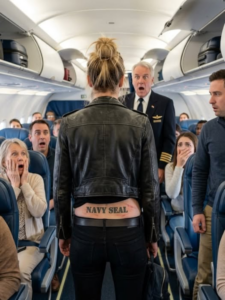
His eyes locked on Elena’s upper back where the wet shirt had clung just enough to reveal the tattoo across her shoulder blade: a Naval Special Warfare trident above a date, a call sign, and four words beneath it.
Not left behind. Not ever.
The pilot stared at it like he’d just seen a ghost in daylight.
“Where did you get that tattoo?” he asked.
The entire galley went still.
Even the attendants froze.
The man was in his mid-forties, broad-shouldered, with the kind of posture that didn’t disappear when somebody left the military. His name tag read Captain Warren Hayes. There was something old and hard in his face now, something no airline smile could smooth over.
He wasn’t looking at Cynthia Bell.
He wasn’t looking at the supervisor.
He was looking only at Elena.
She turned halfway and reached for her jacket on instinct, not because she was ashamed of the tattoo, but because the question had landed with more force than it should have.
“It’s personal,” she said.
Captain Hayes took one step closer. His voice dropped.
“The date on that tattoo. June 14, 2019. And the call sign—Reaper Two.” His eyes lifted to hers. “Who gave that to you?”
Something changed in Elena’s expression.
The anger was still there, but now something sharper slid underneath it.
“My husband,” she said.
The captain’s jaw tightened.
“Noah Carter?”
Now it was Elena who went still.
“You knew him?”
For a second the pilot didn’t answer.
The hum of conditioned air filled the silence. Passengers in the first rows had gone so quiet they might as well have stopped breathing. Even Cynthia Bell, now craning her neck over the seatback, said nothing.
Then Hayes nodded once.
“I flew support during a joint extraction operation in Syria,” he said. “Your husband pulled two men out under fire after the ground plan collapsed.”
His gaze dipped briefly to the tattoo again.
“Reaper Two was his radio call sign that night.”
Elena swallowed.
Very few people knew the exact wording beneath the trident. Not just the date. Not just the call sign. The words.
Not left behind. Not ever.
Noah had written them on a paper napkin one rainy weekend in Virginia Beach, sitting barefoot at the kitchen counter, grinning that tired grin he wore after long training cycles. He’d drawn out the shape of the tattoo in black pen and told her if she ever got ink, it shouldn’t be something pretty for strangers. It should be something earned.
After he died, she had taken that napkin to a tattoo artist and made the words permanent.
Noah’s team knew pieces of the story. A few command officers knew the date mattered. But almost nobody knew the exact sentence. The exact layout. The fact that the call sign belonged to one specific night.
The man standing in front of her knew.
“You were there,” she said softly.
Hayes gave a slight nod.
“I was the helicopter pilot on standby for the secondary lift. Noah got one of my men out alive.”
That changed the air in the galley more completely than the argument had.
The supervisor shifted, clearly eager to drag the conversation back to a place where he understood his lines.
“Captain, we’re trying to resolve a seating dispute.”
Hayes turned toward him so fast the man almost stepped backward.
“Then resolve it correctly.”
No one spoke.
The first attendant cleared her throat. “There was a duplicate first-class assignment, and Ms. Bell—”
“Ms. Carter’s boarding pass was scanned first?” Hayes asked.
The attendant hesitated. “Yes, but—”
“And did she pay for first class?”
“Yes.”
“Then why,” Hayes asked, each word suddenly very precise, “is she standing in the galley while someone else is sitting in her seat?”
Silence.
The kind that lands heavily because everyone in it knows the answer, but nobody wants to be the first person to say it.
Hayes looked at Cynthia Bell.
“Ma’am, may I see your pass?”
Cynthia handed it over with visible annoyance, as though she had been inconvenienced not by her own behavior, but by the fact that the room had stopped agreeing with it.
Hayes glanced at the ticket for maybe two seconds before handing it to the gate supervisor.
“This ticket was reissued at the gate after a missed connection from Phoenix,” he said. “It placed her in an unoccupied premium inventory slot, but 2A was never cleared because the original seat holder had already boarded.”
The supervisor stared at the pass.
“I… didn’t realize that.”
Hayes’s face did not change.
“That’s because nobody checked carefully once they decided which passenger would be easier to move.”
The words dropped like a weight.
No one in the galley missed what he meant.
Elena said nothing, but a businessman in row three, who had previously found her outfit worth evaluating, suddenly discovered the floor was fascinating.
Cynthia Bell drew herself up to her full, offended height.
“This is ridiculous. I’m a paying customer.”
Hayes looked at her with a calm so total it was almost devastating.
“So is she.”
The second flight attendant stepped forward. “Ma’am, we’ll reseat you in 4C and issue compensation.”
Cynthia’s face flushed. “I was already settled.”
That got a short, bitter laugh out of Elena before she could stop it.
Hayes turned back to her, and something in his expression changed.
Not pity.
Not awkwardness.
Recognition. Respect. The kind one service member reserves for the family of another when the bond has outlived the man himself.
“Mrs. Carter,” he said, “I’m sorry for what just happened.”
Elena folded her arms, her jacket hanging from one hand.
“Most people are only sorry after they realize who someone is.”
That one landed.
She saw it land.
But Hayes didn’t flinch away from it.
“That may be true for some people,” he said. “It shouldn’t have mattered at all.”
That answer reached her in a place the apology hadn’t.
Because it was true.
Her husband’s name should not have been the thing that restored her seat. The tattoo should not have been required evidence of dignity. A dead man’s valor should not have had to step into the aisle and speak on her behalf.
And yet.
There it was.
The supervisor cleared his throat and gestured weakly toward the cabin. Cynthia Bell was escorted out of 2A with the expression of a woman still convinced the world had somehow wronged her. Elena picked up her duffel, slid back into her seat, and buckled in.
Around her, the first-class cabin began pretending nothing had happened.
People adjusted laptops. Opened newspapers. Checked messages. Smoothed pant legs. All the ordinary little rituals people perform when they want normalcy to return faster than they deserve.
Elena stared out the window.
Her pulse still hadn’t settled.
She became aware, all at once, of the damp patch cooling against her back where the water had soaked through. Of the tattoo beneath it. Of the way Noah’s name had changed the entire temperature of the room.
She should have felt vindicated.
Instead she felt tired. Bone-tired. Not from the argument. From the recognition of an old pattern.
You are invisible until something attached to a man makes you legible.
She hated that thought.
Then she hated herself a little for having it, because Noah had never once made her smaller. Noah had spent their whole marriage doing the opposite—challenging her, laughing with her, telling her when she was being stubborn, trusting her with the ugliest truths of his work without ever pretending she couldn’t handle them.
The captain had not used Noah to diminish her.
He had used the truth to correct a wrong.
There was a difference.
Still, it sat heavily in her chest.
The plane finally pushed back.
Safety demos began.
The engines rose into a steady roar.
Elena kept her eyes on the window while the runway blurred past and California dropped away beneath them.
Only when the seatbelt sign went off did she let herself exhale all the way.
A flight attendant appeared at her elbow.
Not the same tone now. Not even close.
“Ms. Carter?” she said softly.
Elena turned.
“The captain asked if you’d be comfortable speaking with him privately after we reach cruising altitude. In the crew rest area near the galley.”
Elena looked at her for a beat. “Why?”
The attendant hesitated. “He said there’s something about your husband you deserve to know.”
That sentence went through her like cold water.
For five years she had lived with fragments.
A folded flag.
A Bronze Star citation.
A formal phone call full of measured words.
A memorial service with immaculate uniforms and condolences that all sounded polished to the point of emptiness.
And underneath all of it, a persistent feeling she could never prove—that she had not been told the whole story.
Not because Noah had lied to her.
Because other people had simplified him after he died.
Heroic action under fire. Fatal sacrifice. Mission success under adverse conditions.
The official version had always been too smooth.
Noah had never lived a smooth life. He had lived a hard one, full of improvisation, frustration, loyalty, black humor, exhaustion, and a refusal to leave people behind even when orders got stupid.
She had read the citation so many times she could hear the false notes in it.
Not false exactly. Incomplete.
And now a pilot she had met because airline staff tried to shove her into row eighteen was telling her that something she deserved to know had survived all these years.
She nodded once.
“I’ll come.”
The attendant disappeared.
Elena sat back and stared at the seat in front of her, though she wasn’t really seeing it.
Around her, service carts rolled. Ice clinked in glasses. Someone nearby ordered tomato juice. Somewhere across the aisle, a man laughed too loudly at something on his phone. The ordinary machinery of air travel resumed, but Elena felt suspended outside it.
Her mind kept circling back.
I flew support during a joint extraction operation in Syria.
Your husband pulled two men out under fire.
There’s something about Noah you deserve to know.
She closed her eyes for a moment and saw Noah the way she always did when memory came uninvited: leaning in the kitchen doorway in socks, grinning around a mug of bad coffee; bent over maps at the dining table with reading glasses he swore he didn’t need; asleep on the couch after a deployment, one hand still resting on her knee as if even unconscious he needed proof she was there.
Then another version of him rose up.
The one from the last months. Quieter. More watchful. Carrying some pressure he never fully unloaded. Telling her, more than once, that if anything ever sounded too neat after he was gone, she should trust her instincts.
At the time she told him not to talk like that.
He had smiled and changed the subject.
The plane droned eastward through bright, empty sky.
Elena rested one hand over the strap of her duffel, still tucked beneath the seat in front of her. The same bag she’d taken to Coronado. The same bag carrying a few pieces of Noah’s life she had decided she could not let strangers sort through.
She wondered what else had been kept from her.
Wondered who had decided she was better off with a cleaner story.
Wondered whether that decision had anything to do with Noah’s parents, who had hated the military life from the start and blamed it for every distance in the family, every missed holiday, every danger they couldn’t control.
After his death, they had moved quickly—too quickly—on some things. Funeral details. Personal effects. What had been returned, what had not. Elena had been too stunned in those early days to fight every battle.
By the time grief sharpened into questions, the official channels had already closed ranks.
The seatbelt sign chimed off again after a patch of light turbulence.
A baby cried somewhere farther back.
Elena opened her eyes and looked toward the front galley.
The curtain was still drawn.
Captain Warren Hayes was somewhere beyond it, holding a piece of her husband’s past she had never expected to touch.
Elena sat very still.
Hours earlier she had boarded the plane as a tired widow carrying one duffel, one boarding pass, and the familiar determination not to let one more stranger decide where she belonged.
Now the flight stretched ahead of her like a corridor toward something she had both wanted and feared for years.
The truth had a way of arriving sideways.
Sometimes disguised as humiliation.
Sometimes through a man stepping out of a cockpit and seeing four words inked across a stranger’s skin.
Elena pressed her thumb against the edge of the armrest and waited for cruising altitude, for the galley curtain, for whatever came next.
Because for the first time since Noah Carter died, she had the unmistakable feeling that the story she had been living beside—but never fully inside—was finally about to open.
Part 2
By the time the plane leveled off over the Midwest, Elena had replayed Captain Hayes’s words so many times they no longer sounded entirely real.
There’s something about Noah you deserve to know.
The sentence had settled into her like a splinter. Small. Precise. Impossible to ignore.
Around her, first class had returned to its usual polished illusion. Glasses clinked. Ice shifted in tumblers. A businessman two rows up laughed softly at something on his phone. A woman across the aisle scrolled through emails with the blank concentration of someone already living three hours ahead in the wrong time zone. The cabin looked exactly the way it was supposed to look—orderly, expensive, detached.
But Elena felt as if she were sitting inside a different world than everyone else.
Her tray table was down, though she wasn’t using it. A glass of sparkling water rested untouched near her elbow. Her duffel was still tucked beneath the seat in front of her, scuffed and plain and carrying the last physical scraps of a life she had not finished sorting through. She kept glancing at the curtain near the galley, half expecting someone to step out and tell her there had been a mistake after all. That the captain hadn’t meant anything by it. That whatever this was, it wasn’t for her.
Instead, the same flight attendant who had earlier asked her to “cooperate” appeared beside her seat wearing an expression so carefully respectful it almost hurt.
“Ms. Carter?” she said softly.
Elena looked up.
“The captain asked if you’d be comfortable speaking in the crew rest area near the galley once service begins.”
Not would you step aside for a moment?
Not if you cooperate.
Comfortable.
The word did not erase what had happened, but Elena noticed the difference anyway.
She nodded once. “I’ll come.”
The attendant gave a small, relieved smile and moved on.
Elena sat back, but she could not relax into the seat. Not fully. Her body was tired, but her mind had gone sharp in the way it always did when something buried started shifting under the surface.
She thought of Noah.
Not the formal version of him that lived inside commendations and memorial programs. Not the clean military portrait. The real Noah. The one who left boots in the hallway. The one who talked to coffee before he was awake enough to drink it. The one who laughed hardest when he was exhausted and had no business laughing at all. The one who came home from deployments carrying a silence she knew better than to attack directly.
In the last year before he died, that silence had changed.
She’d noticed it before he ever said a word. Noah had always carried things, but this was different. This felt less like burden and more like calculation. As if he were measuring people. Timing them. Deciding who could be trusted and who could not.
She remembered one night in particular. Virginia Beach. Rain against the windows. A cheap takeout dinner going cold between them while Noah sat at the kitchen table turning a pen over in his hand.
“If something ever sounds too neat,” he’d said, not looking at her, “don’t trust it.”
She’d leaned back in her chair. “That sounds like military advice or marriage advice. Which one is it?”
That got a ghost of a smile out of him.
“Both.”
She had wanted to push harder. To ask what had happened, who had failed, what mess he was circling without naming. But marriage to a man in his line of work taught you the difference between pressure that opened something and pressure that made it slam shut.
So she let it go.
Not completely.
But enough.
Now, thirty thousand feet above the country, she wondered whether that was the moment she should have pushed until the truth broke free.
The service cart came through. She barely noticed it. She answered automatically when asked if she wanted anything, then couldn’t remember what she said yes to. At some point a warm dish appeared in front of her. It might have been chicken. It might have been pasta. She did not touch it.
When the curtain near the galley finally shifted, the same attendant appeared and gave her a discreet nod.
Elena unbuckled her seatbelt, reached down for nothing—just needing her hands to do something—then left the duffel where it was and followed.
The sounds of the cabin softened the second the curtain fell behind her.
Captain Warren Hayes was waiting near the jumpseat with two coffees and a sealed envelope in one hand.
Up close, away from the authority of the cockpit and the public correction of the seating fiasco, he looked older than he had at first glance. Not frail. Not diminished. Just worn the way some men became after carrying too much memory for too long. There were fine lines around his eyes that did not come from easy laughter. His shoulders were still military-straight, but there was fatigue in the way he held himself, as if the past weighed a little more than it used to.
He offered her one of the coffees.
“Elena,” he said, and then seemed to think better of the familiarity. “Mrs. Carter.”
She didn’t take the cup.
“You said there was something I deserved to know.”
Hayes lowered the coffee.
For a second he seemed to search for the right place to begin and find none that felt adequate.
“I owe you the truth,” he said.
Elena stayed standing. “Then tell me.”
He looked at the envelope in his hand, then held it out to her first instead.
It was an ordinary envelope. White. Slightly creased at one corner. Nothing about it suggested it could alter the shape of a life.
Then Elena saw the handwriting.
Her name was written across the front in thick, block letters she would have known anywhere.
Elena.
Just that.
No last name.
No formality.
No careful spacing.
Her breath stopped.
Her fingers shook when she reached for it. “What is this?”
Hayes answered quietly. “It was written by Noah six days before that operation. He gave it to me and told me if anything happened, I was to deliver it in person.”
Everything in Elena seemed to narrow to the envelope in her hand.
The edges of the galley blurred. The hum of the aircraft deepened into distance. For a second she thought she might actually lose her balance, not from shock exactly, but from the force of something long denied suddenly made real.
“He wrote me a letter,” she said, but the words came out flat, as if they belonged to someone else.
Hayes nodded once.
Her throat tightened. “Why am I seeing it now?”
The answer did not come with hesitation. That was almost worse.
“I tried,” he said. “Twice.”
Elena lifted her eyes from the envelope.
“The first time, your father-in-law told me you were staying with relatives and didn’t want contact from anyone connected to the mission.”
A cold stillness spread through her.
“The second time,” Hayes continued, “your husband’s commanding officer informed me the family had already received all personal effects and correspondence cleared for release.”
Elena stared at him.
For a moment she heard nothing but the engine noise and the pulse in her ears.
Then she said, in a voice that had gone strangely calm, “My in-laws intercepted it.”
Hayes did not soften the answer with useless kindness. “That’s what I came to believe.”
Elena looked down at the handwriting again.
Noah.
Noah had written to her.
Noah had known enough—feared enough—to leave words behind in case he did not come home.
And those words had been kept from her.
Something sharp and old rose in her chest. Not fresh pain. Not exactly. More like an old bruise hit hard enough to reveal it had never really healed.
Noah’s parents had never forgiven the life she and Noah built together. They didn’t say it outright, not often, but it was there in every holiday conversation and every strained visit home. The military had taken him away too often. The marriage had made him harder to predict. The two of them hadn’t had children, and somehow that became a failure the older Carters laid at Elena’s feet more than once, though never bluntly enough to be challenged cleanly.
After Noah died, his parents moved through those first days with terrifying efficiency. Funeral choices. Guest lists. The handling of personal effects. What had been released and what had not. Elena had been in shock, half-drowned by military procedure and grief and the raw, unlivable fact that the future had been amputated in an afternoon.
She remembered her father-in-law telling her, very solemnly, that “the Navy handles certain things through proper channels.”
She had believed him.
Because grief makes liars easier to trust.
With careful hands, Elena opened the envelope.
Inside was a single folded sheet.
She knew the paper instantly too—not literally, but in the way wives know the gestures of the people they love. Noah always folded letters twice, clean and exact, as if even paper deserved discipline. She unfolded it slowly, terrified that the words might somehow vanish if she moved too fast.
His handwriting slanted slightly to the right. Quick, steady, practical. The script of a man who wrote to communicate, not impress.
The letter was brief.
That was Noah too.
No wasted lines. No dramatic flourishes. Just truth stripped to what mattered.
He wrote that if she was reading it, things had gone wrong.
He wrote that he loved her more than he had ever managed to say out loud.
That line broke something in her immediately.
Because it was such a Noah sentence. Honest and a little irritated with himself at the same time. He had loved fiercely, completely, but he was never elegant about it. He showed love by fixing what was broken, by watching the road when she drove at night, by remembering how she took her coffee, by sending three-word texts from impossible places that meant I’m still here.
Then the tone of the letter changed.
He wrote that he was tired of pretending certain failures in command had not happened.
Elena felt her jaw tighten.
He wrote that if he did not return, she should trust no one who tried to rush her into silence.
At the bottom was one final paragraph.
He had documented operational concerns and names through legal counsel—not for revenge, he wrote, but because truth should not depend on who survives to tell it.
Elena lowered the paper slowly.
Every part of her had gone still.
“That’s why it never fit,” she said.
Hayes watched her carefully. “What never fit?”
“The official story.” She looked up at him. “The way they told it. It always sounded polished. Too polished. Like they were sanding down the parts that would leave splinters.”
Hayes gave a faint nod. “Because they were.”
He set his untouched coffee aside.
“Noah disobeyed a retreat order,” he said, “because two men were left behind after bad intelligence and a rushed command call from someone above him who wanted the mission wrapped quickly.”
Elena closed her eyes for half a second.
Of course he had.
Of course Noah had been the man who heard an order, measured it against reality, and chosen the lives in front of him over the politics above him.
Publicly, the official narrative called it heroism under pressure. That part, Hayes explained, wasn’t false. Noah had acted heroically. He had improvised under fire. He had pulled two men out after the ground plan collapsed.
But privately, the situation was uglier.
There had been bad intelligence.
Pressure from command.
A retreat order that made sense on paper and failed human reality.
And underneath it all, a fear that if Noah survived and filed everything formally, he would expose negligence people in higher positions had every incentive to bury.
Elena opened her eyes and looked at Hayes without blinking.
“Are you saying they let the record stay incomplete on purpose?”
Hayes took a breath before answering.
“I’m saying the version given to families was cleaner than the truth.”
The galley seemed smaller now.
The air felt tighter.
Elena looked back down at the letter.
Noah had known.
Or at least he had known enough to leave instructions, to put names and concerns somewhere outside the normal chain, to try to make sure the truth survived him if he did not.
All these years, she had lived beside that possibility without proof. Grief had sharpened her instincts, but instinct without evidence becomes something people dismiss as bitterness. As inability to move on. As a widow reaching for complications because simplicity feels too cruel.
Now she had paper in her hand.
His handwriting.
His warning.
His trust.
She laughed once, but the sound caught in the middle and came out ragged. “Unbelievable.”
Hayes did not interrupt.
“My father-in-law told me the Navy had returned everything.” Her voice had gone low and dangerous now. “He stood in my kitchen and told me that. Looking me right in the face.”
“I’m sorry.”
Elena shook her head. “No. Don’t do that unless you mean it for the right thing.”
He held her gaze.
“I mean it for all of it.”
That landed differently.
She believed him.
That was the worst and best part of the whole conversation. Warren Hayes was not trying to ease his conscience with a grand confession. He had carried this long enough to know it was ugly. He was telling her because the truth had finally found the right door.
For a while neither of them spoke.
The engine noise filled the pauses. Somewhere beyond the galley curtain, someone laughed too brightly. A coffee pot clicked against its bracket. The plane kept moving east through clear air while Elena stood holding a letter from her dead husband that should have reached her five years earlier.
At last she asked the practical question.
“Why today?”
Hayes looked toward the curtain, toward the cabin where she had been nearly pushed out of her seat because she was easier to inconvenience than the woman in the cream blazer.
“When I saw that tattoo,” he said, “I knew two things.”
He paused.
“First, you were exactly who I thought you were. Second…” He let out a slow breath. “After what happened out there, I realized people have probably been deciding what you deserve to know for years.”
That hit harder than the rest.
Because it was bigger than the flight.
Bigger than Cynthia Bell.
Bigger than a boarding pass and a first-class seat and an airline supervisor deciding who was more movable.
People have probably been deciding what you deserve to know for years.
Elena looked at the letter again and then away, because suddenly if she kept looking she might cry, and she was not prepared to do that in a galley at thirty thousand feet.
She gave a short laugh to keep herself steady.
“They tried to put me in coach before asking one extra question,” she said. “That about sums up the last five years.”
Hayes’s mouth shifted in something close to a smile, but it carried no humor. Just recognition.
“Noah talked about you all the time.”
Elena looked up sharply.
Hayes continued, quieter now. “Said you were the only person in his life who never let him lie to himself.”
That did it.
Not the letter.
Not even the confirmation of command failure.
That sentence.
Because it was so perfectly Noah. So perfectly them.
She remembered late-night arguments in rental kitchens, in temporary apartments, in borrowed time between deployments. Arguments that were never really fights, just collisions between two stubborn people who respected truth too much to let each other hide behind convenience. Noah would deflect. She would push. He would go quiet. She would wait. Eventually the real answer would come out, and afterward he’d kiss her forehead and say, half-annoyed and half-amused, “You never let me get away with anything.”
“No,” Elena said softly, folding the letter back along its original lines. “I didn’t.”
Hayes watched her slide it carefully into the envelope.
“So what happens now?” he asked.
The question hung there.
It was not a small one.
Now meant many things.
Now that she knew her in-laws had hidden the letter.
Now that the official story had cracks wide enough to see through.
Now that Noah’s own words had reentered her life like a delayed detonation.
Elena rested the envelope against her palm.
“I don’t know yet,” she said.
That was honest. More honest than promising action she had not fully thought through.
What she knew, at that moment, was simpler and more dangerous than a plan.
She was no longer willing to be managed.
Not by Noah’s parents.
Not by the military record.
Not by anyone who preferred a cleaner version of events.
Hayes nodded as if that were answer enough.
“If you choose to pursue it,” he said, “I’ll tell you what I know.”
She studied him.
“You’d testify?”
“Yes.”
“Against command?”
“If that’s where the truth points.”
There was no heroism in the way he said it. No dramatic oath. Just a weary, grounded commitment from a man who had been carrying one piece of the truth too long and was finally ready to set it down in the right hands.
Elena tucked the envelope inside her leather jacket and held it there for a second, pressing the weight of it against her ribs.
For five years she had carried a grief that was heavy, but finished. Finished in the bureaucratic sense. Documented. Closed. Decorated. Contained.
Now the grief was changing shape.
Not disappearing.
Never that.
But opening.
Becoming active again.
Becoming a question.
A demand.
Hayes picked up the second coffee and offered it once more.
This time she took it.
It had gone lukewarm.
She drank it anyway.
For a few minutes they spoke about Noah—not the mission, not the report, just Noah. Small things. The kinds of things no official record ever gets right.
How he cracked jokes exactly when nobody wanted him to.
How he could go two days on terrible coffee and stubbornness.
How he had once argued with a superior officer over a call so reckless it should have been made by somebody sitting safely behind a desk.
How, in the middle of all the noise and machinery of military life, he talked about Elena like she was his fixed point.
Hayes didn’t overdo it. He didn’t turn Noah into legend.
He made him human.
That, too, felt like a gift.
Eventually the demands of the flight pulled at the edges of the conversation. A chime sounded. One of the attendants moved behind the curtain. The long, private space they had been standing inside began to close.
Hayes straightened slightly.
“We’ll be starting our descent in a little while.”
Elena nodded.
She slipped the envelope securely into the inner pocket of her jacket, the place she would have kept a passport or cash or any other object too important to lose sight of.
Then she met his eyes.
“Thank you, Captain.”
He shook his head once.
“Not for me.”
She understood what he meant.
This was not his letter.
This was not his trust.
He had only carried it longer than he should have had to.
When Elena stepped back through the curtain into the first-class cabin, the ordinary world of the flight reassembled around her. People had finished eating. Trays were being collected. Somebody had lowered their shade and gone to sleep with a blanket pulled up to the chin. Across the aisle, a man was watching a movie with the sound off and subtitles on.
Everything looked unchanged.
But Elena felt like she had crossed a border nobody else could see.
She returned to 2A and sat down slowly.
The woman in 4C—Cynthia Bell—was visible only in pieces from where Elena sat, a careful bob of coiffed hair, one rigid shoulder, a profile turned deliberately toward the window. Elena felt no interest in looking longer.
That fight belonged to a different life now.
The letter in her jacket felt like a second heartbeat.
She rested one hand over it and stared out at the late-day sky, pale and endless above the cloud line.
Noah had trusted her with the truth.
Even when other people had worked hard to bury it, he had trusted her.
The plane moved steadily east.
And Elena, for the first time in years, no longer felt like a woman stranded at the edge of someone else’s version of events.
She felt like someone standing at the threshold of the real story.
Part 3
For the rest of the flight, Elena sat with one hand resting lightly over the inside pocket of her jacket, as if the envelope might disappear if she stopped touching it.
Outside the window, the sky stretched wide and pale above the clouds, clean and indifferent. The plane moved steadily east through that endless brightness, but time no longer felt like it was moving in a straight line. It felt layered. Folded. The present had not replaced the past so much as cracked it open.
Five years.
For five years she had lived with Noah in fragments.
A folded flag in a display case.
A Bronze Star citation framed by her mother because Elena could not bear to do it herself.
An official account written in language so polished it had always felt less like truth than damage control.
Heroic action under fire. Mission compromise. Loss sustained in the line of duty.
None of it was technically false.
That was what made it so maddening.
The story she had been given had all the right nouns, all the right solemn phrases, all the right patriotic weight. But it had never sounded like Noah. It had sounded like something scrubbed. Sanded down. A human life reduced to a version of events that fit neatly into public memory.
Now, with a single folded sheet in his handwriting pressed against her ribs, Elena knew she had not imagined that feeling.
He had known something was wrong.
He had tried to leave her the truth.
And someone had decided she did not need it.
The rage came in slow.
Not hot. Not wild. Cold and clarifying.
It wasn’t only about the letter, though that alone was enough to crack her open. It was the years that letter represented. The years in which Noah’s parents had looked her in the face and spoken with the authority of grief while hiding something that belonged to her. The years in which command officers had let a cleaner narrative stand because clean narratives were easier to salute than complicated ones. The years in which people had treated her less like a wife who deserved the whole truth and more like a widow who ought to be handed a ceremony, a citation, and silence.
She looked down at the tray table, though she wasn’t really seeing it.
A flight attendant passed and asked if she wanted anything else. Elena answered automatically, and the woman moved on. Her voice had been careful, respectful, almost gentle. Earlier, that same crew had nearly helped erase her out of her own seat.
That, too, had changed shape in Elena’s mind.
At first the humiliation had felt like its own event: one more ugly little public incident, one more moment in which someone looked at her clothes, her age, her plainness, and decided she would be easier to move than the woman in the cream blazer.
Now it sat beside the letter in a more unsettling way.
It was all part of the same pattern.
People deciding what belonged to her.
What she deserved.
What version of events would be easier if she simply accepted it and moved along.
She had been asked to step aside from 2A the same way she had been asked, after Noah died, to accept the polished version. Step into the aisle. Cooperate. Don’t make this harder than it needs to be. Let other people sort out the truth while you make yourself smaller.
She almost laughed at the thought.
Not because it was funny.
Because the insult had finally become too obvious to miss.
Across the aisle, a man in a navy pullover was asleep with his mouth slightly open. Two rows ahead, someone lowered a laptop screen and closed their eyes. The quiet, insulated luxury of first class settled around her again, pretending nothing meaningful had happened.
Elena turned toward the window.
The reflection staring back at her looked the same as the woman who had boarded in San Diego—same tired eyes, same dark hair pulled back too quickly, same fatigue in the shoulders—but she did not feel the same.
When she had boarded, she was carrying grief the way she usually carried it now: privately, efficiently, like a bag she had gotten used to lifting.
Now grief had sharpened into purpose.
That frightened her a little.
Purpose asks more of a person than pain does.
Pain can be endured.
Purpose demands movement.
She thought of Noah in their kitchen in Virginia Beach, one hand braced on the counter, looking at her with that infuriatingly calm expression he wore when he was trying to tell the truth sideways.
If something ever sounds too neat, don’t trust it.
She had teased him at the time. Pushed at him. Tried to lighten the mood. And he had let her, because that was how Noah handled danger when he didn’t yet know how much of it he could share.
Now she wished she had been less gentle.
Then she immediately hated herself for the thought.
No. That was the wrong direction. The blame already belonged to enough people without Elena taking up a share that wasn’t hers.
Noah had trusted her.
That was what mattered now.
Even in the possibility of his own death, he had trusted her with the truth.
People after him had broken that trust. He had not.
The seatbelt sign chimed on for descent.
The plane tilted gradually, and the sunlight through the windows changed. The vast brightness above the clouds gave way to layered grays and the suggestion of evening below. Somewhere ahead was Boston. Cold air, crowded terminals, baggage claim, taxis, another city, another version of ordinary life waiting to pretend she could step back into it unchanged.
The cabin began to stir. Shades lifted. Phones were checked and rechecked though there was still no signal. Seat backs straightened. Trays latched into place. Overhead bins popped open too early and were firmly shut again by flight attendants who had regained their professional voices.
Elena watched all of it with a strange, detached calm.
She could feel Cynthia Bell without looking at her. Not physically, but in the way some people carried a field of self-consciousness around them when they knew they had lost. Cynthia was somewhere behind and to the right, still in 4C, still rigid, still refusing to make eye contact with the woman she had tried to displace.
Elena had no interest in the confrontation anymore.
Whatever satisfaction might have come from a final look or a cutting remark had evaporated the moment Noah’s handwriting entered her hands.
Cynthia had become small in the face of that.
Not irrelevant, exactly. The ugliness of what she had done still mattered. The ugliness of how quickly the crew and the gate supervisor had helped her mattered too. But the flight was no longer only about a seat. It had become a corridor through which something much larger had finally reached Elena.
The plane dropped through cloud.
Boston appeared beneath them in pieces—water dark as steel, roads traced in lights, neighborhoods laid out in grids and curves, the world returning from altitude into human scale.
The landing was smooth.
There was the familiar thud of wheels, the roar of reverse thrust, the long deceleration down the runway while everyone on board silently shifted from suspended time back into their own lives.
A few passengers clapped in the back, because somebody always did.
Elena stayed still.
As the plane taxied to the gate, people began performing impatience with the urgency of a ritual. Seatbelts clicked loose too early. Phones came alive. Bags were tugged halfway from bins before the aircraft had fully stopped. The businessman in row three immediately stood in the aisle even though there was nowhere to go.
Elena remained seated, one hand still resting near the letter.
When the door finally opened and the line began to move, Cynthia Bell was among the first on her feet.
She didn’t look back.
That was almost the most telling part.
A woman who had been so certain of herself in San Diego now moved with her head slightly lowered, clutching her handbag, eyes fixed on the exit as though speed itself might erase the memory of what had happened.
Elena watched her go without satisfaction.
Humiliation was not justice.
Truth was justice.
And she had only just begun to touch it.
The line in the aisle crawled forward. Elena stood last among the passengers nearest the front, slung her duffel over her shoulder, and stepped into the narrow corridor between the seats.
A couple from row three moved aside to let her through. The man, the one who had earlier glanced at her like he was evaluating whether she fit in first class, couldn’t quite meet her eyes now.
Good, Elena thought.
Not because she wanted his discomfort.
Because maybe for one second he had to live inside the fact that he had watched unfairness happen and mistaken it for normal.
The jet bridge was crowded with the stale, shuffling energy of arrival. At the far edge of the doorway, just past the aircraft threshold, the gate supervisor was waiting.
He had already arranged his face into the expression corporations teach people when they want to project accountability without actually feeling any. His tie was straight. His posture was formal. In one hand he held an envelope. In the other, a clipboard with several stapled pages attached.
“Ms. Carter,” he said as she stepped off the plane. “I want to extend our sincerest apologies for the confusion during boarding.”
Confusion.
Elena almost stopped right there just to admire the nerve it took to call public disrespect by such a tidy word.
Instead she kept her face still.
He continued, “We’d like to offer compensation for the inconvenience, including a travel credit and—”
“No.”
The word cut through the jet bridge noise cleanly.
He blinked. “Ma’am?”
Elena shifted the duffel higher on her shoulder. “Keep the credit.”
He hesitated. “We also have vouchers—”
“I said no.”
The corporate smile faltered.
Around them, passengers kept moving, though slower now, several of them clearly listening.
Elena nodded toward the papers in his hand. “What I want is the incident report.”
He looked surprised enough to be honest for a second. “The incident report?”
“Yes.” Her voice stayed level. “The one documenting that I held a valid first-class ticket, was removed from my seat before the matter was verified, and was offered a coach reassignment after my paid seat was given to another passenger.”
The supervisor swallowed.
The clipboard suddenly seemed heavier in his hands.
“I can provide a written summary,” he said.
“No,” Elena replied. “You can provide the report.”
There was just enough steel in her tone that he understood, finally, that this was not a woman he could soothe with airline points and a smile.
He shuffled the pages, pulled one free, and handed it to her.
Elena took it without thanks, scanned just enough to confirm what it was, and folded it once.
“Anything else?” the supervisor asked, trying to recover his professional footing.
“Yes.”
He straightened, hopeful for a moment that maybe the ask would be something he knew how to satisfy.
“Train your staff to verify facts before they decide who’s easier to move.”
The words landed hard.
Then Elena stepped past him into the terminal.
Logan Airport spread around her in noise and fluorescent light and the usual post-flight chaos. Rolling suitcases. Overhead announcements. The blur of faces moving in every direction for reasons that had nothing to do with her. Ordinarily, that kind of crowd made grief easier. It let a person disappear.
Today she did not want to disappear.
She had gone only a few steps when she heard her name.
“Mrs. Carter.”
She turned.
Captain Warren Hayes stood just outside the cockpit area where the crew had begun to emerge, jacket buttoned now, hat in hand. Without the cockpit behind him he looked less like the commander of the aircraft and more like what he had once been beneath all that civilian polish: a military pilot with old discipline still in his spine.
He came toward her, stopping a respectful distance away.
“I’ve already submitted my statement about what happened with your seat,” he said. “Everything from the duplicate assignment to the way it was handled before anyone checked the records.”
Elena glanced at the folded incident report in her hand.
“Thank you,” she said. “Most people wouldn’t bother once the plane’s on the ground.”
Hayes gave a small shake of his head. “That’s part of the problem.”
They stood there for a moment in the current of terminal traffic, people passing around them, none of them knowing that the quiet conversation at the edge of the concourse had more weight than all the noise surrounding it.
Hayes’s expression grew more serious.
“If you decide to pursue the rest,” he said, “the letter, the operation, the inconsistencies in the report—I’ll testify to what I know.”
Elena studied him.
There it was again. The same plain, grounded offer he had made in the galley, but now under fluorescent terminal lights where there was no privacy to make promises feel noble. Only public space. Real consequences.
“You’d put your name on it?” she asked.
“Yes.”
“Even now?”
Hayes understood the question behind the question.
Even after all this time.
Even against command.
Even if nobody thanked him for it.
“Yes,” he said again.
Elena looked at the envelope in her jacket pocket without touching it.
For years she had imagined the truth as something abstract. A locked file. A classified detail. A missing piece that might never surface. Now it had a weight. Paper weight. Ink weight. Human weight. It existed not as suspicion but as evidence, and evidence changes a person’s posture.
She felt taller somehow.
Not because she was less tired.
Because uncertainty had stopped crouching on her shoulders.
Hayes followed her gaze to the inner pocket of her jacket.
“I’m sorry it took this long,” he said quietly.
This time Elena didn’t push the apology away.
Because he wasn’t apologizing for the wrong thing.
He wasn’t apologizing for her discomfort or trying to paper over a system failure with politeness. He was apologizing for time. For delay. For the years the letter had lived everywhere except where it belonged.
“It wasn’t your fault,” she said.
“No,” he answered. “But I still should’ve found another way.”
There was no easy response to that.
Maybe he was right. Maybe he wasn’t. The world was full of things people should have done sooner and truths that should have arrived intact. Regret had its place, but Elena no longer wanted to live inside it.
What mattered now was simpler.
The letter had reached her.
The truth was no longer only theirs.
She drew in a slow breath and let it out.
“I don’t know what I’m going to do first,” she admitted.
Hayes nodded. “You don’t have to know tonight.”
That was the most humane thing anyone had said to her all day.
Not an instruction.
Not a timeline.
Not a suggestion to be calm, reasonable, patient, cooperative.
Just room.
Room to think. Room to grieve differently. Room to become dangerous in the measured, deliberate way truth sometimes requires.
At last she gave him a small, steady nod.
“Thank you, Captain.”
Hayes looked at her the way men sometimes looked at one another after service funerals or in hangars after bad nights—directly, without performance.
Then he said, “He would’ve found you eventually.”
Elena felt that sentence all the way down.
Not because it was sentimental.
Because it was exactly right.
Noah had never left important things undone if he could help it. He had been stubborn about loyalty. Stubborn about promises. Stubborn about making sure the people he loved were not left standing in the dark while others pretended darkness was cleaner.
Even dead, apparently, he had not let go of that.
The letter had been delayed.
Buried.
Intercepted.
But not lost.
No, she thought. He would have found me.
She tightened her hand on the incident report, adjusted the strap of her duffel, and looked out into the moving river of the terminal.
When she had boarded in San Diego, she had been one more tired passenger with one duffel bag, one boarding pass, and one more insult than she had the energy to absorb.
She stepped away from Captain Hayes carrying something far heavier and far more valuable.
Proof.
Proof that Noah had trusted her with the truth even when others had worked hard to bury it.
Proof that the official story was not the whole story.
Proof that being pushed aside was no longer an option she was willing to accept.
She moved into the terminal crowd then, not hurried, not uncertain, not looking over her shoulder to see whether someone else might decide where she belonged.
People passed around her with carry-ons and coffees and airport fatigue written all over their faces. Nobody stopped her. Nobody stared. Nobody knew that an entire chapter of a dead man’s life had just been returned to the woman who should have had it from the beginning.
But if they had looked closely, they might have seen the difference.
She no longer looked like a woman who had been pushed out of her seat.
She looked like someone who had finally been handed back her place.