My husband drained our accounts and vanished with my sister. At 33, I was living in a women’s shelter.
I still remember the sound my phone made when the bank app refreshed—one sharp buzz, then a balance that looked like a typo. $14.22. Not “low.” Not “tight.” Gone.
My husband, Trevor Lane, had always been the charming type—smiling in photos, calling me “his rock,” talking about “our future.” My sister Paige was the person my mother trusted more than air. Pretty Paige. Fragile Paige. Paige-who-needed-more.
So when I came home from my shift and the house was empty—closets hollowed out, our shared laptop missing, even my grandmother’s ring gone—I knew before I saw it: Trevor didn’t leave alone.
He left with Paige.
The police took a report, but reports don’t pay rent. Two weeks later I was sleeping on a thin mattress in a women’s shelter in Tacoma, Washington, staring at a ceiling with water stains shaped like maps. Shame isn’t just emotional—it’s physical. It sits on your chest and tells you to apologize for taking up space.
My mother didn’t offer help. She offered criticism.
“You were always so dumb,” she said on the phone, like she was diagnosing the weather. “You let him do this. You always choose wrong.”
I waited for the part where she said, Come home. She didn’t.
I asked, “Mom… can you at least watch my dog until I’m stable?”
She snorted. “Don’t make your problems my problems.”
Then she hung up.
Three days after that call, the shelter counselor drove me to apply for food assistance because I hadn’t eaten a full meal in two days. My hands shook as I filled out the forms. I was a grown woman, and I felt like a child begging to be allowed to live.
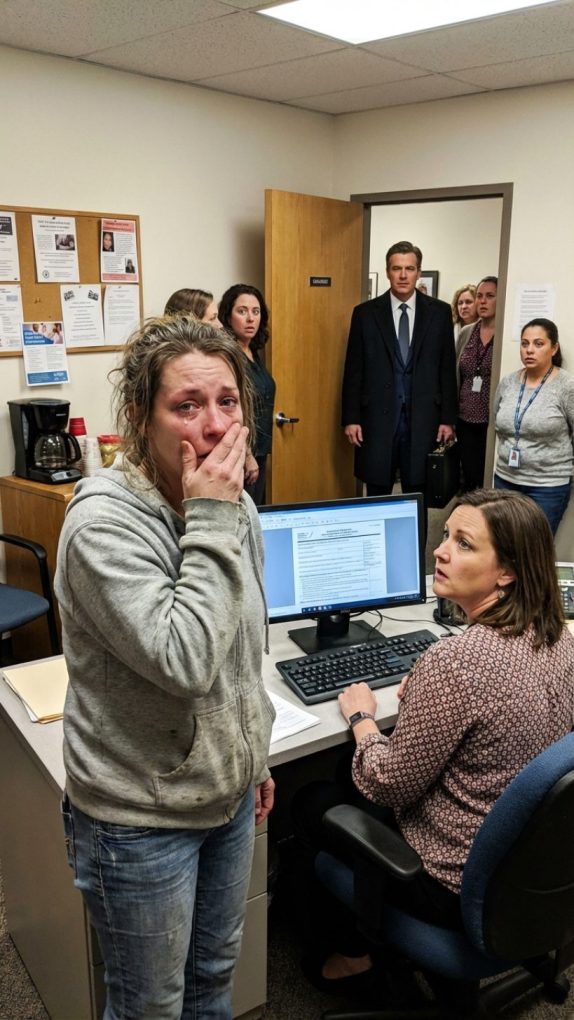
The caseworker—Ms. Everett, mid-forties, tired eyes but gentle voice—typed my information. Name. Birthdate. Address (temporary). Then she asked for my Social Security number.
I recited it from memory. You don’t forget the number you’ve used your whole life.
Her fingers paused.
She stared at the screen.
Then she looked at me like she was seeing two versions of me at once.
“Ms. Lane,” she said slowly, “can you wait right here?”
My stomach flipped. “Did I do something wrong?”
“No,” she replied quickly. “Not… wrong. Just—please wait.”
She stood up and walked to a side office, closing the door halfway. I heard her voice drop into a careful tone.
“I need to make a call,” she said.
I sat there with my palms pressed to my knees, trying to breathe. In my head, every fear lined up: identity theft, warrants, mistakes I didn’t know I’d made.
Two hours later, a man in a $3,000 suit walked into the office.
He wasn’t a cop. He wasn’t a social worker. He moved like someone used to boardrooms—calm, precise, impossible to ignore.
He looked at me gently and said, “Ms. Lane… I’m here because your SSN matched a protected file.”
My throat went dry.
Then he placed a folder on the desk and said the sentence that changed the temperature of my entire life:
“You’re not broke. You’ve been hidden.”
The man introduced himself as Graham Sutter, senior counsel for NorthSound Fiduciary Services. His voice was polite, but his eyes didn’t wobble the way people’s do when they’re about to deliver bad news.
“I’m sorry to meet you like this,” he said. “I came as soon as your caseworker contacted us.”
Ms. Everett hovered near the doorway, looking uneasy. “Her number flagged,” she explained softly. “I didn’t know what it meant, but it said ‘protected beneficiary file.’”
Graham nodded once, then turned back to me. “Ms. Lane, your Social Security number is attached to a dormant trust account established in your name in 2009,” he said. “It has not been accessed because the conditions were not met until recently.”
I stared at him. “A trust?” I whispered. “I don’t have a trust. I grew up clipping coupons.”
Graham slid the folder toward me. Inside was a copy of a trust document, embossed and official, with a name I hadn’t said out loud in years:
Evelyn Hartwell.
My grandmother.
She’d died when I was nineteen. My mother told everyone there was “nothing left.” She said Grandma was “bad with money.” She used that story anytime she wanted me to feel grateful for scraps.
My hands shook as I turned the pages.
Graham spoke gently, like he knew the pain was catching up. “Your grandmother was not bad with money,” he said. “She sold a property in 2008 and placed the proceeds into a protected trust for you. She appointed a corporate trustee so no family member could drain it.”
My mouth went dry. “How much?”
Graham didn’t flinch. “After growth and reinvestment… $1.86 million.”
The room blurred.
I tried to speak, but the words caught. “My mother… she knew?”
Graham’s pause was careful. “Your mother is listed as a notified party,” he said. “She received annual statements. She was not allowed to withdraw, but she was informed.”
I felt something cold settle behind my ribs. Not just betrayal—confirmation.
Ms. Everett whispered, “Oh honey…”
Graham continued, practical now. “The reason we were alerted is because the trust includes a security protocol. If you ever applied for public assistance, it triggered a welfare check to ensure you weren’t being financially coerced or deprived.”
Financially coerced. Deprived.
My husband draining accounts. My sister disappearing. My mother refusing help while she knew this existed.
It all fit too neatly, like a puzzle someone else had been solving for years.
Graham looked at me. “I need to ask: did your husband or anyone else have access to your identity documents?”
“Yes,” I whispered. “My laptop, my files—everything. They took it.”
Graham nodded. “Then we act quickly,” he said. “We’ll secure your identity, relocate you safely if needed, and put a freeze on your credit. We’ll also coordinate with law enforcement regarding theft and potential fraud.”
I stared at the trust document again, at my grandmother’s signature copy, and in the margins a typed note:
“For my granddaughter, so she never has to beg.”
My throat burned. “I begged,” I said. “I begged and nobody—”
Graham’s voice softened. “You won’t again,” he said. “Not if you let us do this correctly.”
He slid one more paper across the desk: a disbursement authorization and a temporary housing placement letter.
“Tonight,” he said, “you’re leaving the shelter.”
And for the first time in weeks, my body didn’t feel like it was bracing for the next hit.
It felt like it might be allowed to stand up.
By sundown, everything had changed in the most unromantic way possible: forms, signatures, security questions, a new bank account that only I could access.
Graham didn’t hand me a suitcase of cash. He handed me control.
He arranged a short-term furnished apartment through a partner program—quiet building, secure entry, a case manager who didn’t treat me like a charity project. The shelter staff hugged me goodbye like they were happy and sad at once.
The next morning, my mother called.
She didn’t start with, “Are you safe?” She started with, “Why is someone calling me about Evelyn’s trust?”
My stomach tightened. So she’d gotten the notification as soon as the file activated.
I kept my voice calm. “Because Grandma left it to me,” I said.
A sharp inhale. Then her tone changed—sweeter, suddenly maternal. “Honey… why didn’t you tell me you were struggling? You could’ve come home.”
I laughed once, quiet and empty. “I did tell you,” I said. “You called me dumb.”
Silence.
Then she tried the next move: entitlement. “Well, I’m your mother. That money is family money.”
“No,” I replied. “It’s the money Grandma protected from you.”
Her voice snapped. “How dare you—”
I cut in, steady. “How dare you watch me fall when you knew there was a net.”
That’s when she said the sentence that proved everything:
“I was saving it for when you learned your lesson.”
My hands went cold.
I hung up.
That afternoon, Paige messaged me from an unknown number—because apparently disappearing with my husband didn’t stop her from stalking my life.
He says you’re getting money. Don’t be selfish. We can talk.
Graham had warned me this would happen. “They’ll come back when they smell resource,” he said. “Not love. Resource.”
So we didn’t “talk.”
We filed.
A police report was updated with proof of the drained accounts, the missing items, and the fact that Trevor accessed my online banking from a device registered to Paige. Graham’s team helped me request emergency orders freezing any accounts linked to my name and flagged identity theft.
Two weeks later, Trevor was located in Boise after using my stolen card at a hotel. Paige tried to claim she was “just visiting.” The receipts didn’t care.
I won’t pretend it healed me instantly. Betrayal leaves bruises you can’t photograph.
But the ending wasn’t me getting rich and gloating.
The ending was me getting safe and getting smart.
I enrolled in therapy. I took a financial literacy course—not because I was ignorant, but because I never again wanted to feel powerless in a room where someone else held the paperwork. I rebuilt my life without begging for permission.
And the lesson I carry now—one I wish every woman in a shelter could hear without feeling ashamed—is this:
Being broke doesn’t mean you’re broken.
And being betrayed doesn’t mean you deserved it.
Sometimes the turning point isn’t a miracle.
It’s a record. A document. A system that finally notices you’re missing—
and brings you back to yourself.
My mother tried to make my lowest point a life sentence.
My grandmother wrote me an exit, years before I knew I’d need one.
And when the man in the $3,000 suit walked in, he didn’t hand me rescue.
He handed me what my family never wanted me to have:
proof—and a way out.