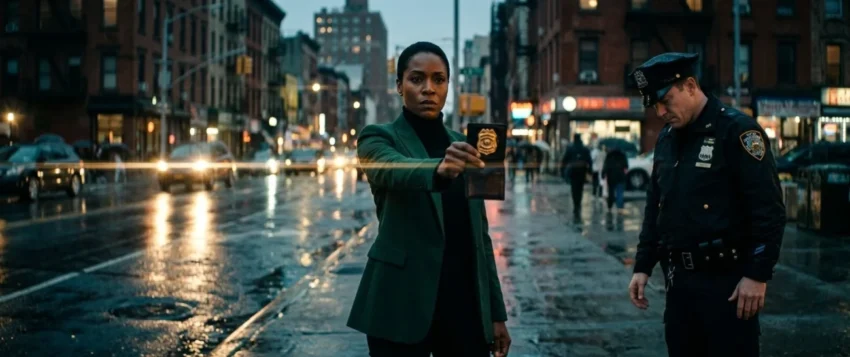
The evening was ordinary until it wasn’t.
Detective Maya Reeves had just left a late debrief at the Seventh District. Fourteen years on the force. Commendations on her wall. A closed homicide case that afternoon.
She was off the clock, heels clicking against Jefferson Avenue, leather bag at her hip, phone in hand.
She wasn’t thinking about work. She was thinking about dinner.
“Hey.” The voice came sharp from her left. “Stop right there.”
She turned.
Officer Craig Dunbar. Twelve years her junior, two years on the job, a chest puffed like he’d been waiting all day for this.
“You’re under arrest,” he said.
Maya stopped walking.
Not fast. Not startled. She stopped the way a person stops when they’re deciding how to respond to something absurd.
“For what?” she asked.
Dunbar looked her over. The blazer. The heels. The calm eyes that didn’t flinch.
“For existing where you don’t belong,” he said, voice dropping to that practiced low register. “Hands behind your back.”
The bus stop couple went silent. A man walking his dog slowed. Across the street, a phone came up.
Maya didn’t move her hands.
“Say that again,” she said.
He shifted his weight. “Don’t play games with me. You’re being detained.”
She felt the old familiar heat rise in her chest. Not panic. Not even fear. Something older, sharper — the specific anger of being reduced to a problem someone needs to manage.
She thought of the names. The footage. The explanations that never explained anything.
Officer felt threatened. Suspect failed to comply. Tragic outcome.
“You don’t know anything about me,” she said.
“I know enough.”
He moved one hand toward his belt.
“Reach into your jacket,” he said, “and I will—”
“I’m reaching into my jacket,” she said, voice flat and controlled. “Watch carefully.”
She reached in.
Slowly.
Deliberately.
Her fingers closed around the badge and she pulled it out.
Gold. Shining under the streetlight. Heavy with everything it meant.
She held it up between them like a mirror.
The blood left Dunbar’s face in real time.
His hand dropped. His shoulders fell. The whole performance — the swagger, the authority, the certainty — crumpled in about three seconds.
For a moment, nobody on that street breathed.
Then someone whispered, “Oh my God.”
The phone across the street tilted up, now openly recording.
Maya clipped the badge back to her belt.
“Are you done?” she asked.
“I—I didn’t realize—”
“No,” she cut in. “You didn’t ask.”
She straightened her jacket.
“My name is Detective Maya Reeves. Seventh District. Fourteen years on this job.” She let that settle. “And you just detained me on a public street for walking while Black. On camera.”
Dunbar opened his mouth.
“Don’t,” she said. “Just don’t.”
She pulled out her phone, kept her eyes on his, and dialed the watch commander.
By nine that evening, the clip was everywhere.
No shaky footage, no bad audio — clean and clear, every word captured. A well-dressed Black woman. A uniformed officer. Five words that rewrote the rest of the night: For existing where you don’t belong.
Local news ran it at ten. National outlets picked it up by midnight.
Social media did what it always does — it split the country down the middle, then the middle split again.
Maya didn’t read the comments.
She was on the phone with Internal Affairs.
The conference room at district headquarters smelled like burnt coffee and anxiety.
Internal Affairs arranged along one wall. The department’s legal counsel across from them. Two city council liaisons in the corner. A union rep Dunbar hadn’t asked for but got anyway.
Maya sat at the far end of the table, arms folded, expression neutral.
Dunbar sat in the middle.
He hadn’t slept.
The footage played on the screen. Full audio. Full visual. No gaps, no ambiguity.
For existing where you don’t belong.
The room went so quiet Maya could hear the ventilation system.
Lieutenant Sandra Howell, lead IA investigator, set down her pen.
“Officer Dunbar,” she said. “I’m going to ask you once. What were you responding to?”
Dunbar looked at his hands. “She looked—”
“What were you responding to?” Howell repeated.
Silence.
“There was no call,” Howell said. “No dispatch. No reported incident. No exigent circumstances of any kind.” She tapped the folder in front of her. “You stopped a fourteen-year veteran detective on her personal time because, in your assessment, she looked like she didn’t belong.”
Dunbar’s union rep put a hand on his arm.
He shook it off.
“I made a mistake,” he said quietly.
“Yes,” Howell said. “You did.”
Maya leaned forward.
“I want to say something,” she said.
The room turned to her.
“I’m not here because I’m angry,” she said. “I’m angry, but that’s not why I’m here.” She looked directly at Dunbar. “I’m here because what you did to me last night — you’ve done to other people. People who didn’t have a badge to hold up. People who couldn’t make one phone call and end the encounter. People who went home shaking and filed a report that went nowhere.”
Dunbar didn’t look up.
“That’s who you actually harmed,” Maya said. “Not me. Them.”
She let that sit.
“You stopped me because you made a split-second decision about who deserves to move freely through a public street. That decision didn’t come from nowhere. It came from a habit, a pattern, a failure in this department to take implicit bias seriously.” She looked around the table. “And that is on all of us. Not just him.”
The IA rep cleared his throat.
“Detective Reeves,” he said. “The department wants to assure you that—”
“I don’t need assurances,” she said. “I need accountability. Real accountability. Not a suspension, not a letter in a file. I need to know what changes.”
The room got very quiet again.
What followed wasn’t fast. Real accountability never is.
Dunbar received a formal disciplinary review, a thirty-day suspension without pay, and mandatory retraining. His record was flagged. Three prior complaints — all from Black residents, all dismissed — were reopened for review.
Two of them resulted in formal findings.
The department announced a full audit of discretionary stops over the previous five years. The footage triggered a city council hearing. Fourteen officers testified. Six requested voluntary retraining. Two submitted early retirement paperwork.
It wasn’t justice.
But it was movement.
Maya gave one interview.
“I want people to understand something,” she said to the reporter. “What happened to me gets attention because I had a badge. Because the story has a twist. Because it’s easier to care when the optics are clear.” She paused. “But Black people don’t need to be detectives to deserve respect on a public street. They don’t need to produce credentials. They don’t need to earn the right to exist in their own city.”
She looked directly into the camera.
“That’s not a political statement. That’s a constitutional one.”
Three weeks later, Maya walked down Jefferson Avenue again.
Same cracked sidewalk. Same neon signs flickering on at dusk. Same evening rhythm of traffic and footsteps and the particular hum a city makes when it’s shifting gears.
She walked without hurrying. Without looking over her shoulder.
A kid on a bike swerved past her and yelled “sorry!” without slowing down. An older man in a Cardinals cap nodded at her from the bus stop. Two women laughed loudly at something on one of their phones.
Ordinary. Human. Unremarkable.
She stopped at the exact spot.
No marker. No memorial. Just a square of sidewalk that looked like every other square of sidewalk.
She stood there for a moment.
Not because she was afraid. Not to reclaim something. Just to remember.
Then she kept walking.
Heels clicking softly. Badge at her hip. Head up.
Blending back into the city the way she always had, the way she always would.
The way she had every right to.
Back at the precinct the following Monday, Dunbar was cleaning out his temporary reassignment locker when he found a folded piece of paper someone had slid underneath it.
He unfolded it.
It was a copy of the city’s revised stop-and-detain policy. Fourteen pages. Dense with language about legal standards, documentation requirements, and community accountability review.
At the top, in neat handwriting: You should know what the rules actually are.
No signature.
He stood there a long time, holding it.
Then he sat down, smoothed it flat against his knee, and started reading.