My name is Ethan Carter, and if you had asked me a year ago whether I was a good man, I would have said yes without hesitation. I had a successful construction company in Dallas, a beautiful house in the suburbs, and a wife who had been by my side since I was broke and renting a small apartment above a laundromat. Rachel had been with me through everything. She believed in me before anyone else did. But somewhere along the way, success made me arrogant, and attention made me stupid.

I met Vanessa at a charity gala. She was intelligent, glamorous, and knew exactly how to make a man feel like the most important person in the room. She laughed at the right moments, touched my arm when I spoke, and looked at me in a way Rachel hadn’t in years—or at least that’s what I told myself. The truth was uglier: Rachel was eight months pregnant, exhausted, swollen, and worried about our future, while I was chasing the thrill of being admired.
The fights at home got worse. Rachel knew something had changed in me even before she found proof. She started asking harder questions. I came home later. I stopped reaching for her. One night, after finding messages on my phone, she stood in the kitchen crying, one hand on her belly, and asked me, “How could you do this to us?”
I didn’t answer like a husband. I answered like a coward.
“It’s over, Rachel,” I said. “I can’t keep living like this.”
She looked at me like I had slapped her. “I’m carrying your child.”
“I know,” I snapped, hating myself inside but too proud to stop. “Go stay with your sister.”
I watched my pregnant wife walk out of the house with two suitcases, tears streaming down her face. And instead of going after her, I called Vanessa.
Within weeks, Vanessa moved into my life as if she had always belonged there. She told me Rachel was holding me back, that I deserved peace, luxury, excitement. When she told me she was pregnant too, I thought it was fate. I booked the best private maternity suite in the city, paid every bill in advance, and convinced myself I was finally building the life I wanted.
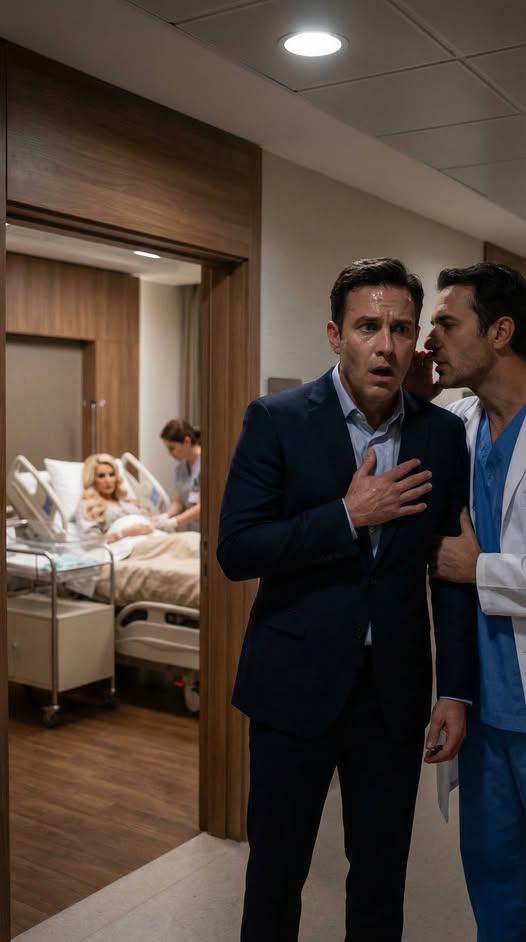
Then the day came. My son was born shortly after dawn. I was standing outside the recovery room, smiling like a king, when the doctor came out, grabbed my arm, and said quietly, “Mr. Carter… we need to talk. Right now.”
Part 2
The look on Dr. Bennett’s face wiped away all my joy.
I followed him into a consultation room, my heart pounding so hard it hurt my chest. He closed the door, took off his glasses, and sat across from me. For a moment, he said nothing—and that made it worse. Finally, he clasped his hands and spoke carefully.
“Mr. Carter, I need to ask you a delicate question. Are you the biological father of this child?”
I stared at him. “What kind of question is that?”
“The baby’s blood type and some preliminary markers don’t match the information we were given,” he said. “This alone doesn’t prove anything, but it raises serious concerns. We recommend a paternity test immediately.”
My mouth went dry. “No. That’s not possible.”
He didn’t argue. He just slid a form across the table.
When I returned to Vanessa’s room, she was lying in bed, smiling weakly, while the baby slept in the bassinet beside her. For one absurd second, I almost convinced myself the doctor was wrong. Then Vanessa saw my face.
“What happened?” she asked.
I showed her the paper. “They say I need a paternity test.”
Her expression changed so quickly it made my stomach turn. “That’s ridiculous.”
“Is it?” I asked. “Tell me the truth.”
She looked away. That was all I needed.
I stepped closer to the bed. “Vanessa, look at me.”
“It doesn’t matter,” she said quietly. “You were going to love him anyway.”
The room started spinning.
“Doesn’t matter?” I repeated. “You told me this was my son.”
She broke down crying, but I was already too shattered to feel sympathy. “I was scared, Ethan! I needed security. I needed someone who could take care of us.”
Us. Not me. Not love. Not fate. A financial plan.
The test results came back faster than normal because I paid for rush processing. Zero probability. I was not the father.
I walked out of that clinic feeling like the ground had opened beneath my feet. But the humiliation wasn’t even the worst part. The worst part was that, as I sat in my car staring at that paper, my phone buzzed with a message from Megan, Rachel’s sister.
Rachel is in labor. Emergency C-section. She told me not to contact you, but I thought you should know.
I read it three times before it sank in. While I had been spending a fortune on another woman and another man’s child, my real wife was in surgery giving birth to my baby without me.
I drove to County General like a madman. My expensive shoes hit the dirty hospital floor as I ran to the maternity desk and gave Rachel’s name. The nurse looked me up and down and said coldly, “You’re late.”
She was right. I was late to the birth. Late to the truth. Late to being the man I should have been from the beginning.
And when I finally saw Rachel through the recovery room window—pale and exhausted, holding our daughter against her chest—I understood that I hadn’t just lost money or pride.
I had destroyed my family with my own hands.
Part 3
Rachel refused to see me that night.
Megan stood outside her room like a guard and told me exactly what I deserved to hear. “You threw her out when she needed you most. Don’t make this harder for her.”
So I waited in the hallway for three hours, staring at vending machines and listening to newborns crying behind closed doors. For the first time in months, there was no Vanessa, no luxury suite, no designer flowers, no story I could tell myself to feel better. There was just me and the wreckage I had created.
The next morning, Rachel agreed to talk to me for five minutes.
I walked into the room and barely recognized her. She looked exhausted, fragile, and somehow stronger than ever. Our daughter slept in her arms, wrapped in a hospital blanket with a tiny pink hat.
“She’s beautiful,” I said.
Rachel kept her eyes on the baby. “Her name is Grace.”
I nodded, swallowing hard. “Rachel… I’m sorry.”
She let out a short, bitter laugh. “Sorry doesn’t cover what you did, Ethan.”
“I know.”
“You humiliated me. You abandoned me. You made me pack my life into two suitcases while carrying your daughter.”
Every word hit like a hammer because it was true.
“I know,” I said again, my voice breaking. “I was selfish. I was cruel. And I believed lies because they suited me.”
That finally made her look at me. “They suited you?”
I told her everything—the doctor, the paternity test, Vanessa’s confession. Not to gain sympathy, but because, for once, Rachel deserved the whole truth, no matter how pathetic it made me look.
When I finished, she was silent for a long moment.
“Do you know what hurt the most?” she asked. “It wasn’t that you cheated. It was that you made me feel disposable.”
I had no defense for that. “You never were.”
“But that’s how you treated me.” She adjusted Grace carefully against her chest. “I’m not going back to you just because another woman lied to you. If you want to be in your daughter’s life, then be a father. Consistently. Quietly. Without expecting a reward.”
That was the only door she left open—and I knew I didn’t even deserve that.

The divorce was finalized eight months later. Rachel kept the house; I didn’t argue. I saw Grace every week, paid child support without complaint, and spent the next two years proving that I could at least be a reliable father, even if I had failed as a husband. Vanessa disappeared from my life as quickly as she had entered it. The money I lost hurt, but not as much as watching Rachel build a peaceful life without me in it.
These days, when people ask how I lost my marriage, I don’t blame temptation, stress, or bad timing. I tell the truth: I mistook loyalty for boredom, attention for love, and I didn’t understand the value of what I had until I destroyed it.
Part 4
Two years taught me something I should have understood much earlier—time doesn’t forgive you. It just gives you space to see what you’ve done more clearly.
I saw Grace every Wednesday and every other weekend.
At first, she didn’t recognize me. I was just a man with a careful smile and a bag of toys, someone who tried too hard and spoke too softly, like he was afraid of breaking something fragile. And I was. Not her—my second chance.
Rachel never made things easy for me, but she never made them impossible either.
She was… fair. And somehow, that hurt more than anger would have.
She spoke to me politely, like we were coworkers handling a long-term project instead of two people who once built a life together. No warmth. No softness. Just boundaries.
And I respected them.
Because I had shattered everything else.
Grace was almost three when she first called me “Daddy” without hesitation.
Not “that man.” Not “Ethan.” Not confusion.
Just Daddy.
We were at the park. She had fallen trying to climb up a small slide, and I rushed over, panic shooting through me like electricity.
“I’m okay,” she sniffled, wiping her tears with tiny fists.
I crouched down. “You sure?”
She nodded, then reached up and wrapped her arms around my neck.
“I want Daddy to carry me.”
That word hit me harder than anything Rachel had ever said.
Not because I deserved it.
But because she gave it anyway.
That night, I sat in my car outside my apartment long after I dropped her off.
For the first time in years, I cried without trying to hide it.
Not out of self-pity.
But because I finally understood the weight of what I had almost lost completely.
Rachel started trusting me in small, careful ways.
She let me pick Grace up from daycare.
She asked if I could watch her for an extra evening when work ran late.
She even—once—laughed at something I said.
It was quick. Unintentional.
But I noticed.
Of course I noticed.
Because for a long time, I thought I would never hear that sound again.
But life doesn’t circle back just because you’ve learned your lesson.
And just when things felt… stable—
Vanessa came back.
I hadn’t seen her in over two years.
Not a message. Not a call. Nothing.
So when I walked out of my office one evening and saw her leaning against my truck, it felt like stepping into a past I had buried.
She looked different.
Less polished. Less… calculated.
But her eyes were the same.
Sharp. Observant.
Dangerous.
“Ethan,” she said, like we had just spoken yesterday.
I stopped a few feet away. “What do you want?”
No greeting. No pleasantries.
I had learned at least that much.
She smiled faintly. “Straight to the point. I see you’ve changed.”
“Answer the question.”
Her expression flickered—just for a second.
Then she pushed herself off the truck.
“I need your help.”
I almost laughed.
“Wrong person,” I said. “You made that clear two years ago.”
She stepped closer. “I wouldn’t be here if I had another option.”
“That’s not my problem.”
I moved to walk past her, but she said something that stopped me cold.
“It’s about the child.”
I turned slowly. “What child?”
Her jaw tightened.
“The one you thought was yours.”
A heavy silence settled between us.
I stared at her. “What about him?”
She hesitated.
And for the first time since I’d known her—
Vanessa looked uncertain.
“He’s sick,” she said quietly.
I felt something twist in my chest before I could stop it.
It didn’t make sense.
It wasn’t my child.
It never had been.
But still—
“He’s not mine,” I said, more harshly than I intended.
“I know that,” she replied. “But you’re the only one who can help.”
“That’s not how biology works.”
“No,” she said. “But money does.”
There it was.
The truth.
Always the truth with her—just dressed differently each time.
I let out a slow breath. “How much?”
She flinched slightly. Maybe she hadn’t expected me to go there so quickly.
“A lot,” she admitted. “Treatment, specialists… I’ve run out of options.”
“And the father?” I asked.
Her silence answered for her.
Of course.
There was always a missing piece.
I ran a hand through my hair, frustration building.
“You lied to me. You used me. You let me walk away from my real family while you built a life on a lie.”
“I know,” she said, her voice quieter now.
“And now you want my help?”
“I’m asking,” she corrected. “Not expecting.”
That was new.
Vanessa never asked before.
She took.
I looked at her, really looked this time.
The confidence was still there—but thinner.
Like something underneath it had cracked.
“Why me?” I asked.
“Because,” she said slowly, “for all your mistakes… you were never heartless.”
That almost made me angry.
Because two years ago—
I had been exactly that.
I thought about Grace.
About Rachel.
About the man I had spent two years trying to become.
And I realized something uncomfortable:
This wasn’t about Vanessa.
It wasn’t even about that child.
It was about who I was now.
I exhaled slowly.
“I’ll help,” I said. “But not the way you think.”
Her eyes narrowed slightly. “What does that mean?”
“It means I’m not giving you cash and walking away.”
“Then what are you doing?”
“I’m paying the hospital directly. I want records. Doctors. Proof of everything.”
Her lips pressed into a thin line.
Still controlling. Still cautious.
“Take it or leave it,” I added.
A long silence passed.
Then she nodded once.
“Okay.”
As she turned to leave, I called out, “Vanessa.”
She paused but didn’t look back.
“This doesn’t change anything,” I said.
“I know,” she replied quietly. “It’s not supposed to.”
And just like that—
She walked out of my life again.
That night, I sat across from Rachel at her kitchen table while Grace colored quietly in the living room.
I hadn’t planned to tell her.
But I did anyway.
Because lies were what destroyed us the first time.
When I finished, Rachel was silent.
Then she asked one question.
“Why are you helping her?”
I looked down at my hands.
“Because I don’t want Grace to grow up thinking people only help when it’s easy.”
Rachel studied me for a long moment.
Then she nodded slightly.
Not approval.
Not forgiveness.
But something… close to understanding.