A grieving biker father lingered at highway truck stops after his daughter’s funeral, unable to move on. When he kept spotting a silver Honda with the same four numbers, he began to fear she might still be alive.
There are certain kinds of grief that don’t end with a funeral. They just change shape, settle into the bones, and follow you into places you never thought you’d return to. Caleb Mercer learned that the hard way somewhere between the third and the fortieth truck stop he visited after his daughter was buried. At first, people assumed he was just another biker killing time on the road, a man with too many miles behind him and not enough reasons to go home. But if anyone had watched closely—really watched—they would have noticed the pattern in his stops, the way he lingered near families, the way his eyes tracked every child who walked past like he was searching for something he refused to admit might still exist.
The truth was, Caleb wasn’t riding to forget. He was riding because stopping meant accepting something he wasn’t ready to accept. His daughter, Ellie Mercer, had been gone for three months. Officially, the case had cooled. That was the language the authorities used—“cooled”—as if the disappearance of a ten-year-old girl could be measured like a cup of coffee left on a counter too long. There had been searches, volunteers, dogs, drones, interviews. For a while, the entire county had seemed to hold its breath. Then, slowly, inevitably, life moved on for everyone except Caleb.
Ellie had vanished on an ordinary Tuesday afternoon, the kind of day that left no mark on anyone else’s calendar. She had been walking home from a friend’s house, less than a mile, a route she had taken dozens of times. Somewhere along that quiet stretch of road, something—or someone—had interrupted that routine. By the time Caleb realized she was missing, the sun was already low, and the world had already begun to rearrange itself into before and after.
The funeral had been a blur. Closed casket. Too many flowers. Too many people saying things that sounded like comfort but landed like static. Caleb remembered standing there, staring at the polished wood, feeling an overwhelming certainty that something about it was wrong. Not in a dramatic, movie-like way—just a quiet, persistent sense that the story didn’t fit. But grief does strange things to the mind, and eventually, even that feeling got buried under the weight of what everyone else seemed ready to accept.
Everyone except Caleb.
He started riding more after that. At first, it was just long, aimless drives to clear his head. Then the routes became more deliberate. Highways. Truck stops. Rest areas. Places where people passed through without leaving much behind. He told himself it was because Ellie had always liked road trips, that being out there somehow made him feel closer to her. But if he was honest—and he rarely allowed himself to be—it was because some part of him believed that if she was out there, if she had been taken, then she would pass through places like these.
It wasn’t a logical belief. It wasn’t even a hopeful one. It was something deeper, more stubborn. Instinct, maybe. Or refusal.
That’s how he ended up frequenting the same stretch of interstate in western Pennsylvania, haunting a cluster of truck stops near Exit 211 like a ghost who didn’t know where else to go. The staff started recognizing him. Some pitied him. Others avoided him. A few, like the night clerk named Jenna, would occasionally offer him coffee without asking, as if kindness might soften something that clearly couldn’t be softened.
What Caleb didn’t expect was that someone else had been noticing patterns too.
Jenna Walsh had worked the afternoon shift at a fast-food counter attached to one of those truck stops for nearly six years. She had seen every type of traveler pass through—families on vacation, truckers running on caffeine and deadlines, teenagers chasing something they couldn’t quite name. She was good at reading people, not in a professional sense, but in the way someone becomes observant when their job depends on noticing small changes in tone, posture, timing.
It started with the orders.
At exactly 3:12 p.m., give or take a minute, a vehicle would pull into the drive-thru and place the same request. Not the same meal—those changed—but always the same sequence of numbers. Eight. Five. Twelve. Sixteen. The voice delivering them was always quiet, slightly uneven, like someone trying very hard not to draw attention. At first, Jenna dismissed it as coincidence. People had habits. Regulars ordered the same things all the time.
But this was different.
The cars weren’t the same. Different makes, different plates. The drivers didn’t match either. Sometimes it was a man. Once it was a woman. Another time, a younger guy who barely looked old enough to drive. Yet the pattern persisted. Same numbers. Same cadence. Same hesitation between each word.
After the fourth day, Jenna started writing them down.
She didn’t tell anyone. Not at first. It felt too strange, too easy to explain away. But the feeling in her chest—tight, insistent—refused to go away. By the tenth day, she had a small collection of receipts tucked into her locker, each one marked with the same sequence.
Eight. Five. Twelve. Sixteen.
On the twelfth day, she couldn’t ignore it anymore.
She stood in the back office, staring at the numbers pinned to a corkboard, her fingers hovering over them as if touching them might make the meaning clearer. She wasn’t a detective. She didn’t have training. But she had instincts, and those instincts were louder than logic.
A=1. B=2. C=3.
Eight. Five. Twelve. Sixteen.
H. E. L. P.
The realization didn’t arrive all at once. It crept in, piece by piece, until it settled into something undeniable. Her stomach dropped. The air felt thinner.
“Help.”
The word echoed in her mind, heavy and urgent.
Jenna didn’t hesitate after that.
She ran outside.
Caleb was there, leaning against his bike, staring at nothing in particular. He looked up as she approached, something in her expression cutting through the fog he’d been living in.
“What is it?” he asked, his voice rough from disuse.
Jenna held up the receipts, her hand shaking. “I think… I think someone’s trying to send a message.”
He frowned, confusion flickering across his face. “What kind of message?”
She took a breath, forcing the words out. “A child. I think it’s a child. They’ve been using the drive-thru orders to spell something. Numbers. Over and over again.”
Caleb’s posture changed, subtle but immediate. “What does it spell?”
Jenna swallowed. “Help.”
For a second, nothing happened. Then everything did.
“Where?” Caleb asked, his voice suddenly sharp.
Jenna pointed toward the drive-thru. “There’s a car there now. Silver Honda. Same pattern. Same voice.”
Caleb didn’t move right away. Hope was a dangerous thing, especially for someone who had already buried a child. But something in Jenna’s tone—steady, certain—cut through his hesitation.
“Are you sure?” he asked quietly.
“No,” she admitted. “But I’ve never been more sure about something feeling wrong.”
That was enough.
Caleb reached for his phone.
The call he made wasn’t to the police. Not yet. It was to someone who understood him in a way few others did. Marcus “Griff” Hale, the president of his motorcycle club. A man who didn’t ask unnecessary questions.
“Griff,” Caleb said when the line connected.
“Yeah?”
Caleb’s grip tightened on the phone. “I think I found something.”
There was a pause. “What kind of something?”
Caleb glanced toward the drive-thru, where the silver Honda idled. “The kind that means I might need backup.”
Griff didn’t hesitate. “On my way.”
What happened next unfolded in a blur of controlled urgency. Jenna stalled the order, buying time. Caleb positioned himself where he could see the vehicle without drawing attention. When the backseat shifted, when a small figure moved just enough to catch the light, something inside him broke and reformed all at once.
It was her.
Older. Thinner. But her.
Ellie.
The moment stretched, fragile and unbearable. Caleb forced himself to stay still. One wrong move, and the car would be gone.
Then the engine revved.
The car started to pull away.
Caleb moved.
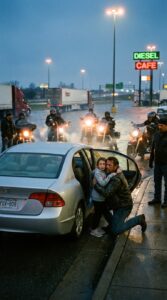
Not recklessly. Not blindly. He angled his bike just enough to block the exit, forcing the Honda to stop without causing a collision. The driver hesitated, caught between escape and confrontation.
That’s when the sound arrived.
Motorcycles.
Dozens of them.
Griff and the others didn’t rush in like chaos. They formed a presence, a barrier that was impossible to ignore. Calm. Controlled. Watching.
The driver’s confidence faltered.
Hands went up.
Doors opened.
And then Caleb was at the backseat, his heart pounding so hard it felt like it might tear through his chest.
He opened the door slowly.
“Ellie,” he said, his voice barely more than a whisper.
For a second, she didn’t react. Then, slowly, she looked up.
Recognition flickered.
“Dad?” she whispered.
That was the moment everything changed.
Later, after the authorities arrived, after statements were taken and the situation began to settle into something resembling order, Caleb sat beside his daughter in the back of an ambulance, holding her hand like he was afraid she might disappear again if he let go.
Jenna stood nearby, watching, her chest still tight with adrenaline.
Caleb looked up at her.
“You heard her,” he said quietly.
Jenna shook her head. “She made sure someone would.”
The lesson in all of it wasn’t complicated, but it was easy to ignore in everyday life: danger doesn’t always announce itself loudly. Sometimes it hides in patterns, in small repetitions that feel insignificant until someone takes the time to look closer. Paying attention—really paying attention—can mean the difference between something being dismissed and something being saved. Trusting your instincts doesn’t mean acting recklessly; it means allowing yourself to question what doesn’t feel right and being willing to take that discomfort seriously. And perhaps most importantly, the responsibility to notice doesn’t belong only to professionals or authorities. Ordinary people, in ordinary places, can become the turning point in someone else’s survival simply by refusing to look away.