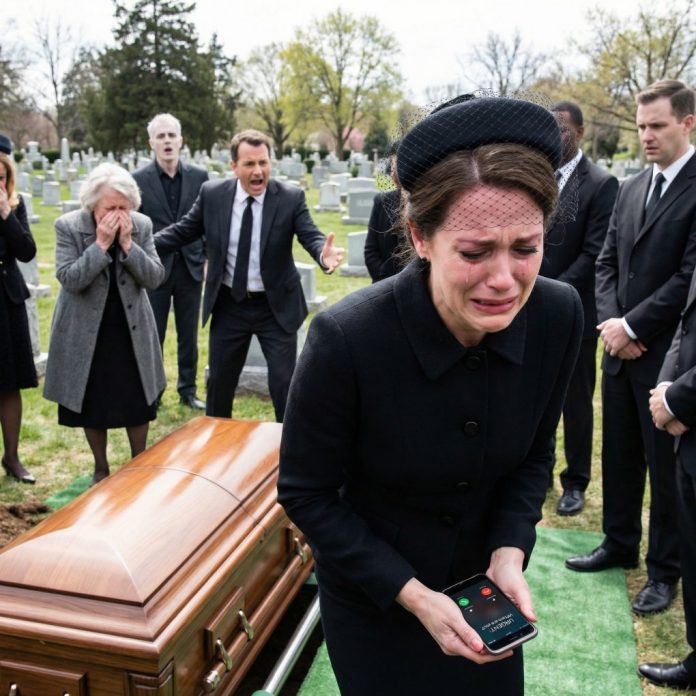
By the time the casket began to descend, I had stopped looking for them.
Not for my mother, not for my father, not for my younger brother Caleb, and not for Vanessa Morgan, the woman I had called my best friend since freshman year of college. I had spent the whole morning making excuses for each of them to people who should not have had to ask.
“Traffic out of Richmond is terrible.”
“My dad’s blood pressure was high this morning.”
“Vanessa’s little boy woke up sick.”
“Caleb’s flight got delayed.”
Every lie tasted bitter, but less bitter than the truth: none of them had come to bury my husband.
The November wind moved through the cemetery in long, cold ribbons. Our pastor was speaking softly about grace and endurance, words I could barely hear over the pounding in my own head. My black gloves were damp where I had twisted them too hard in my hands. Beside me stood Daniel’s older sister, Rachel, red-eyed and rigid with grief, and his uncle Martin, hat pressed to his chest. On the other side, my ten-year-old daughter, Ellie, clung to my coat sleeve and stared at the polished walnut casket with the bewildered stillness children have when the world becomes something they cannot organize.
My husband, Daniel Pierce, was thirty-eight years old.
Three weeks earlier, he had been arguing with our insurance company over physical therapy approvals after a highway accident left him with complications no one thought would turn fatal. Then a clot broke loose in the middle of the night, and by dawn I was a widow.
The people who came for me were his people.
His law partners sent food and paid for hotel rooms for out-of-town relatives. Rachel practically moved into my kitchen the first week. Uncle Martin fixed the porch light without being asked. But my family—my own blood—offered sympathy through screens and distance through phone calls. My mother cried dramatically on FaceTime and said she was “too upset to drive.” My father muttered something about not handling funerals well. Caleb texted, I’ll come see you next weekend, promise. Vanessa sent white-heart emojis and said she felt “emotionally overwhelmed.”
Not one of them showed up.
The pastor nodded to the cemetery staff. The straps tightened. The casket lowered by inches into the earth.
That was when my phone began vibrating in my coat pocket.
Once. Twice. Again. Again.
I ignored it at first. Then Ellie looked up and whispered, “Mom, your phone.”
I pulled it out, expecting some work emergency I would hate for another hour.
Instead I saw my mother’s name.
A text message sat at the top of the screen:
We need to talk right now.
Under it were more notifications than I could process at first. Missed calls. Dozens of them. Then more. Voicemails. Messages from Caleb. From Vanessa. From my father. From numbers I did not recognize. In the space of the last fifteen minutes, my phone had exploded.
By the time I understood the count, my stomach had gone cold.
100 missed calls.
Rachel saw my face change. “Claire?”
I couldn’t answer.
Then another text came through from my mother.
Do not leave the cemetery alone. Call me NOW. He found out.
For a second, the world seemed to tilt sideways.
Who found out?
About what?
I stared at the words while my husband’s casket disappeared below the line of wet grass, and all at once I knew with the absolute certainty grief sometimes gives you—that every fake excuse, every absence, every strained voice over the last three weeks had not been selfishness alone.
They had all been hiding something from me.
And whatever it was had just exploded while I was burying my husband.
I did not call my mother at the grave.
I stood there until the brief service ended, until Ellie tucked the white rose from the funeral spray onto the mound of fresh earth, until the last polite condolences were spoken and the cemetery staff stepped back to give us privacy. Only then did I hand Ellie to Rachel for a moment, walk ten yards away beneath a row of bare maples, and press call.
My mother answered on the first ring.
“Claire, where are you?”
“At the cemetery,” I said. My voice sounded flat and far away, even to me. “Explain what you meant by he found out.”
She began crying immediately. Not softly. Not with control. The full, messy sobbing she used when she wanted emotion to outrun accountability.
“Oh, honey, just listen to me, okay? Don’t go home yet.”
My grip tightened around the phone. “Mom.”
She inhaled shakily. “Darren knows.”
I frowned. “Darren who?”
Then I knew.
Darren Cole.
The private investigator.
Six months earlier, when Daniel first told me he thought something was wrong with a cluster of procurement contracts at the logistics company where he worked as CFO, that was the name he said over and over: Darren Cole, internal compliance investigator, outside consultant, “the bulldog,” in Daniel’s words. A former federal agent the board hired when they suspected somebody in senior leadership was moving money through shell vendors.
I had met Darren once at a company holiday fundraiser. Sharp suit. Calm eyes. The kind of man who listened so carefully it made other people nervous.
I felt the blood drain from my face.
“Knew what?” I asked.
My mother hesitated just long enough to answer the question without speaking.
I said it for her.
“What did you do?”
“Claire, your father didn’t mean for it to go this far—”
A sound came out of me then, not quite a laugh and not quite a gasp. Rachel turned from the car and took one step toward me. I held up a hand.
“What,” I said, each word precise, “did Dad do?”
My father came onto the line next. Not because my mother handed the phone over gracefully, but because I heard her say, “You tell her,” through tears.
His voice was rough and low. “Daniel came to me in September.”
I shut my eyes.
September. Two months before the funeral. Before the accident. Before the clot. Before the hospital.
“He said he was gathering records on fraud at the company,” my father continued. “Said if it broke publicly there could be subpoenas, investigations, media… He was worried about you and Ellie. He asked whether you should move some savings temporarily to protect household cash flow if accounts got frozen.”
I pressed my free hand to my forehead. “And?”
“And I told your brother.”
Of course he had.
Caleb had failed at two businesses in four years, carried debt he never fully explained, and always smelled opportunity where other people smelled smoke.
My father went on, voice thinning with shame. “Caleb said if Daniel was talking about frozen accounts and insider information, he could get in trouble. He said we needed advice. He said Vanessa knew someone in corporate law.”
Vanessa.
My best friend.
The missed calls made sick sense all at once.
“What did she do?” I whispered.
“It was only supposed to be confidential guidance,” my mother jumped back in. “She mentioned it to her husband, and her husband mentioned it to someone he golfs with, and that person knew one of the board members, and then somehow that investigator—Darren—started asking questions. Caleb panicked. Vanessa panicked. Your father panicked. We all told each other not to say anything until after the funeral because we didn’t want to burden you—”
“Until after the funeral?” I repeated, stunned.
Rachel was close enough now to read my face and not hear the words. Her hand came lightly to my elbow.
My mother kept talking, as if speed could soften content. “Darren contacted Caleb this morning. He said he has phone records, messages, dates, and that someone leaked confidential information that may have interfered with an internal investigation. Caleb finally admitted everything to us. He thinks the company may come after him. Vanessa’s husband says there could be civil liability. Your father is terrified. We need to figure this out together.”
Together.
The word landed like an insult.
My husband had trusted my father with a fear. My father had handed it to Caleb. Caleb had dragged in Vanessa. Vanessa had spread it farther. And while Daniel was still alive—while he was trying to protect evidence, protect his family, protect his job—the people closest to me had turned his private warning into gossip with consequences.
I looked across the cemetery at the rectangle of fresh dirt where the last part of Daniel had just been taken from sight.
Then I said the question none of them wanted.
“Did this get back to the people he was investigating before his accident?”
Silence.
My father answered first, too fast. “We don’t know.”
Which meant yes. Or maybe. Or enough to damn them all.
Then my mother said the sentence that finished whatever was left of me for that day.
“Darren thinks Daniel may have known right before he died.”
For one long second, I forgot how to breathe.
Because if Daniel had learned, in the last days of his life, that the danger he was trying to contain had reached his own family through mine—
Then none of them had merely skipped his funeral.
They had hidden from it.
I did not go home with my family that day.
I did not meet them for coffee, or let them “explain in person,” or allow my mother to show up on my porch carrying casseroles and tears like props in a play she had not earned the right to perform. Rachel drove Ellie and me back to the house Daniel and I had shared in Alexandria, and after I put my daughter down for a nap in the guest room—exhausted clean through from grief—I sat at the kitchen table while Rachel made tea I never touched.
Then I called Darren Cole myself.
He answered as if he had been expecting me.
“Mrs. Pierce,” he said. Not warm. Not cold. Just steady. “I’m sorry for your loss.”
I closed my eyes. “My family says you called them.”
“I did.”
“Then tell me the truth. All of it.”
There was a pause. Papers shifted on his end. When he spoke again, the words came with the careful exactness of a man used to testimony.
Daniel had uncovered a vendor-splitting scheme inside his company—fraud routed through two subcontractors that were, in reality, controlled by relatives of a senior operations executive. Daniel did not steal anything. He was not a target of the investigation. He was one of the people quietly helping expose it. But because he held financial authority, he knew enough to understand how ugly the fallout could become once the board moved. He had asked my father for personal advice, not corporate help. He had never authorized that conversation to go further.
It went further anyway.
Call records and metadata showed Caleb contacted Vanessa within hours. Vanessa’s husband contacted a golf partner tied to the company board within two days. That board member, whether carelessly or deliberately, raised concerns in the wrong company circles. Within a week, one of the executives under scrutiny had altered email retention settings and attempted to move files. Darren’s team eventually caught it, but not before part of the investigation was compromised. Not destroyed. Just dirtier, riskier, harder.
“And Daniel?” I asked.
Darren did not evade.
“About five days before the accident,” he said, “he told me he suspected someone in your family had talked. He didn’t have proof. He looked… disappointed.”
That word shattered me in a way anger had not.
Not betrayed. Not furious. Disappointed.
Because that was Daniel. Even wounded, he always made room for human weakness before he made room for condemnation.
I asked the question that had been poisoning me since the cemetery.
“Did the leak cause his death?”
“No,” Darren said immediately. “Not directly. The accident was real. We found no evidence it was staged, tampered with, or connected to the fraud. I need to be very clear about that.”
I nodded even though he could not see me.
“But,” he continued, “the leak created professional exposure, pressure, and risk in the last weeks of his life. It also damaged trust at a time he needed support. That part is true.”
After the call, I sat in silence for a long time while Rachel pretended not to watch me break.
The next month was a controlled demolition.
Darren’s investigation moved forward. The company terminated two executives and referred evidence to federal prosecutors. Caleb was never criminally charged, but he was pulled into depositions and retained a lawyer he could not afford. Vanessa’s husband’s firm distanced itself from him after his “informal conversations” became part of discovery in a civil suit tied to the compromised investigation. Vanessa called me crying so hard I had to hold the phone away from my ear. I did not comfort her. My father came to my door once and stood on the porch for twenty minutes before leaving when I did not answer. My mother wrote me a ten-page letter about intentions, family, fear, and mistakes. I read every word.
Then I put it away.
Because intention was the least interesting thing about what they had done.
The ending, when it came, was not dramatic. It was final.
Three months after the funeral, I met my parents and Caleb in a mediator’s office—not for money, not for property, but because I wanted one clean conversation in which nobody could rewrite chronology or hide behind emotion. I told them exactly what Daniel had been to me: decent, serious, imperfect, loyal. I told them he had trusted my family once and paid for it in the worst season of his life. I told them I did not blame them for his death, because that would have been untrue and too easy. But I did hold them responsible for making his final weeks harder, lonelier, and more compromised than they should have been.
My father cried openly. Caleb looked smaller than I had ever seen him. My mother kept whispering, “We were scared.”
“I know,” I said. “You chose yourselves anyway.”
That was the sentence that ended us as we had been.
I did not cut them off forever. Life is rarely clean enough for forever, especially with a child involved. But I changed everything. No unannounced visits. No access to Ellie without me. No shared holidays for a long time. Vanessa and I never recovered; some friendships do not survive being shown what they are made of.
A year later, on the anniversary of Daniel’s funeral, I took Ellie to the cemetery with fresh white roses. The air was cold again. She was taller. Old enough now to ask harder questions and hear gentler truths. We stood by the headstone, and I told her her father had been a brave man who tried to do the right thing even when it was inconvenient and costly.
Then I told her something else.
“That matters,” I said, smoothing a hand over the petals. “Because when people are frightened, they tell themselves all kinds of stories about why loyalty can wait. Your dad didn’t.”
The wind moved through the trees. Ellie slipped her hand into mine.
My phone stayed silent.
And this time, that silence felt like peace.