At 6:07 on a cool spring morning in Cedar Ridge, Kansas, the neighborhood was still half asleep. Porch lights were fading, coffee makers were turning on, and most curtains were still closed against the pale light coming over the rooftops. It should have been an ordinary morning on Hawthorne Lane, the kind that passed quietly without leaving any memory behind.
But that morning did not stay ordinary for long.
The first sound came low and steady from the far end of the street. It was not loud enough to shake windows or send people rushing outside, but it was enough to make those already awake pause and listen. One engine rolled in, then another, then another, until the soft morning stillness was filled with the unmistakable hum of motorcycles moving with discipline and control.
A woman watering a potted plant inside her kitchen stopped and looked through her blinds.
Then a man across the street stepped onto his porch with his phone already in his hand.
The motorcycles kept coming.
One after another.
Black bikes. Dark vests. Broad shoulders. Serious faces.
And then, to everyone’s growing alarm, they did not pass through the neighborhood.
They stopped.
Not in clusters.
Not carelessly.
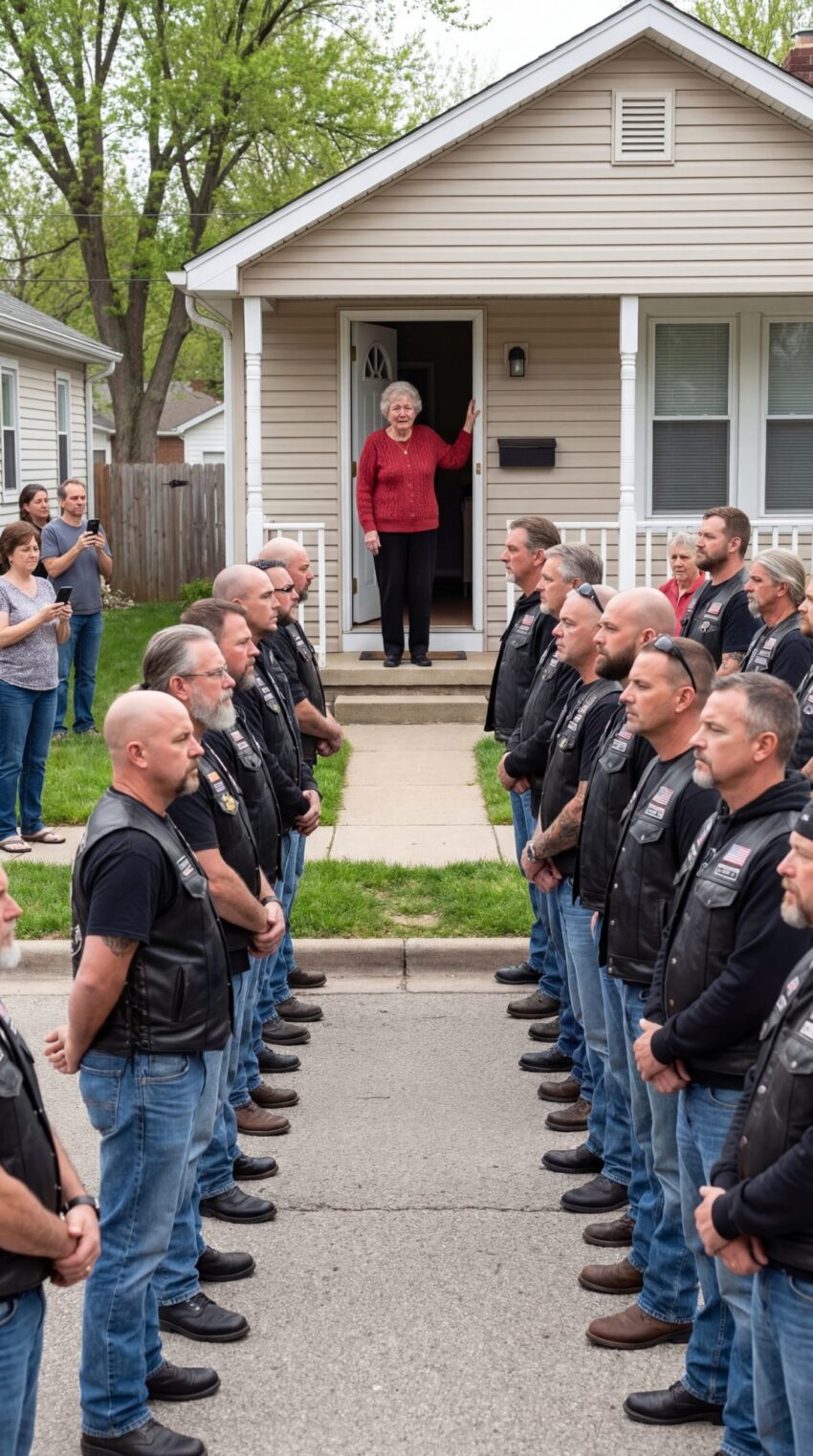
They lined up in an almost perfect formation in front of one small white house with blue shutters and a narrow porch.
That house belonged to Ruth Delaney.
Ruth was sixty-two years old, and three days earlier, she had buried her husband.
Her husband, Calvin Delaney, had been the kind of man people respected without ever fully understanding. He was quiet, gentle, and steady. He fixed broken things for neighbors without charging them. He folded towels the same way every Sunday. He always saluted the flag in front of the VFW hall when no one seemed to notice. He drank his coffee in the same chair by the window and rarely spoke about his past.
Now he was gone, and the silence he had left behind still felt too large for the little house to hold.
Ruth had barely slept since the funeral. Calvin’s reading glasses still rested on the side table beside his chair. His jacket still hung near the back door. The smell of his old aftershave still lived faintly in the hallway, showing up when she least expected it and hitting her harder every time.
So when she heard the engines outside, her first feeling was not irritation.
It was confusion.
Then worry.
She moved slowly toward the front window, her fingers tightening around the edge of the curtain. When she pulled it back just enough to see outside, her breath caught in her throat.
There were dozens of bikers standing in front of her home.
Not talking.
Not laughing.
Not even moving much.
Just standing there in silence, facing her house like they were waiting for something no one else could understand.
The Neighborhood Mistook Silence for Danger
The street changed within minutes.
Front doors opened.
Garage doors lifted halfway.
People stepped outside in slippers and robes, whispering to one another with the urgent energy of a neighborhood that sensed something was wrong but did not yet know what. Fear began filling the empty spaces where truth had not yet arrived.
“Why are they here?” one woman asked in a frightened voice.
“Did Calvin owe somebody something?” another man muttered.
“This doesn’t look right at all,” someone else said. “Call the police.”
The problem was not that the bikers were doing anything openly threatening.
The problem was that they were not doing anything at all.
They stood too still.
Too organized.
Too quiet.
To frightened eyes, silence from a large group of strangers did not look respectful. It looked planned. It looked heavy. It looked like pressure. It looked like a warning no one could yet explain.
Ruth stepped onto her porch in her gray cardigan, one hand gripping the screen door as if she needed its frame to steady herself. Her face still carried the softness of recent grief, but now that grief was being pushed aside by uncertainty.
She looked at the line of men and called out, “Can I help you?”
Her voice was not weak, but it did not carry far enough to change the mood of the street.
No one answered.
At the front of the group stood one man taller than the others, with a gray beard, weathered hands, and an expression that looked neither hostile nor warm. He simply watched the house with a kind of attention that made Ruth feel even more uneasy.
Not her.
The house.
That somehow unsettled her most of all.
A neighbor shouted from across the street, “Ma’am, go back inside!”
Another voice followed quickly. “Officers are coming!”
Ruth stayed where she was.
She was afraid, yes, but something in the scene felt strange in a way she could not explain. It did not feel wild. It did not feel reckless. It felt controlled, like everyone standing there had agreed to obey a purpose she had not yet been told.
The gray-bearded biker finally took one step forward.
Boot to pavement.
A single sound.
And the entire street seemed to tighten around it.
“What do you want?” Ruth asked, her voice thinner now.
The man reached into his vest.
Immediately, the reaction around them exploded.
“Hey!”
“What’s he doing?”
“Back up!”
Phones lifted higher. Someone began recording and talking loudly into the camera. A man near the corner raised his voice and said, “This is exactly why people get nervous. This isn’t normal.”
But the man did not pull out anything dangerous.
He pulled out a phone.
That was all.
He typed a short message, lowered his hand, and returned to stillness.
Yet somehow, even that made the neighbors more uneasy.
Because fear rarely waits for facts.
The Police Arrived Before the Truth Did
The first siren reached the street only moments later, sharp and urgent against the thin morning light. Two police cruisers turned onto Hawthorne Lane, lights flashing across parked cars and front windows. Several neighbors visibly relaxed, believing control had finally arrived.
An officer stepped out first, his hand resting near his belt as he quickly assessed the scene.
Dozens of bikers.
A widow alone on a porch.
A tense neighborhood.
It was not hard to see what he assumed.
“Everybody stay where you are,” he called firmly.
No one argued.
But the bikers did not move either.
Their stillness remained intact.
The officer walked a few steps forward and addressed the gray-bearded man. “Sir, I need you to tell me what’s going on here.”
No answer.
The man did not challenge him. He did not sneer or step closer. He simply held his place, eyes fixed ahead as though he had no intention of turning this moment into a confrontation.
The second officer tried next, more sharply this time. “If this gathering becomes a disturbance, we’re going to have a problem.”
Still nothing.
The silence began pressing down on everyone.
Even the officers, trained to read behavior, seemed unsettled by the way the bikers held their ground without aggression and without explanation. It was not rebellion. It was not compliance. It was something stranger than both.
Then the gray-bearded biker moved again.
Slowly.
Carefully.
He took one step forward, pulled out his phone once more, and sent another short message.
When he lifted his head, he looked not at the officers, not at the neighbors, but at Ruth.
And in a voice so calm it almost seemed too gentle for the tension around him, he finally said, “We’re not here to frighten her.”
The words did not calm the street.
They deepened the mystery.
If they were not here to frighten her, then why had they come in silence before sunrise? Why had they gathered in such numbers? Why had no one explained anything from the beginning?
Ruth stared at him, feeling something shift inside her. The fear was still there, but now it had been joined by confusion and the first faint tremor of something else.
Recognition was too strong a word.
But instinct was not.
Somehow, the man’s voice carried respect.
And before anyone could speak again, another sound entered the street.
Not sirens.
Not engines.
Something quieter.
Measured footsteps.
A Folded Flag Changed Everything
Every head turned toward the far end of the block.
A small group of uniformed service members was walking toward the house. One carried a folded American flag with careful hands. Another held his cap against his chest. Their pace was slow, dignified, and unmistakably solemn.
The effect on the street was immediate.
The whispers stopped.
The officers lowered their intensity.
Even the neighbors who had been the loudest a moment earlier fell silent.
The bikers did not turn dramatically, but their posture changed in a way that could be felt more than seen. Shoulders straightened. Chins lifted slightly. What had looked threatening from a distance now began to resemble something else entirely.
Honor.
The service member in front stopped near Ruth’s yard and removed his cap. His face carried the weight of someone delivering more than words.
“Ma’am,” he said gently, “we’re here to honor your husband.”
Ruth’s fingers slipped from the porch railing.
She did not fall.
She simply lost, for one suspended second, the strength she had been using to hold herself together.
The folded flag caught the morning light.
And suddenly the entire shape of the moment changed.
These men had not come to pressure her.
They had not come to threaten her.
They had not come to settle anything ugly from Calvin’s past.
They had come because of it.
Because of something she did not know.
Something her husband had carried quietly all those years.
The gray-bearded biker stepped back instead of forward, giving the uniformed men room to approach. Then, without any shouted order or visible signal, every biker in the line lifted his hand to his chest.
One by one.
Slowly.
Together.
The gesture was so simple, and yet it transformed the whole street. The same neighbors who had seen menace now saw restraint. The same officers who had prepared for trouble now seemed to understand they were witnessing a tribute.
Ruth looked from the flag to the bikers and back again, and the question inside her finally found words.
“Who are you?” she whispered.
The Husband She Thought She Knew Had Carried a Hidden Life of Service
The gray-bearded man stepped to the edge of her yard but did not cross it. There was care in that choice. He seemed to understand that grief had already taken enough from her, and he would not take even a foot of her space without permission.
His voice, when he spoke again, was rough but deeply respectful.
“My name is Wade Mercer,” he said. “Your husband rode with us years ago.”
Ruth shook her head lightly, not out of rejection but because the sentence did not fit the Calvin she had known.
Calvin Delaney was the man who fixed loose cabinet doors. The man who always carried peppermints in his coat pocket. The man who hated attention, avoided crowds, and never even liked loud restaurants.
A biker?
It felt impossible.
Wade seemed to read her disbelief.
“Not the kind you’re thinking of,” he said. “He wasn’t chasing noise. He was showing up for people who had no one. Veterans in bad shape. Families who were trying to get back on their feet. Older folks who needed someone to stand beside them when life got hard. He did more than most men ever say out loud.”
Ruth looked at him through wet eyes. “He never told me.”
Wade nodded slowly. “He said your home was the one place he wanted to keep gentle. He loved you too much to bring every hard story through your front door.”
That sentence broke something open inside her.
Not because she felt excluded.
But because it sounded exactly like Calvin.
He had always protected her in quiet ways. He fixed things before she saw they were broken. He took burdens from her hands without announcing it. He softened difficult days with little acts so small they were easy to miss until he was no longer there to do them.
Of course he would have kept helping others without talking about it.
Of course he would have let the world misunderstand him if it meant his family could rest in peace.
Wade looked down briefly, then continued. “He made us promise something. He said that when his time came, if we could make it, we should stand outside your home at sunrise. No speeches. No crowding you. No making it about us. Just presence. Just respect.”
Ruth pressed a trembling hand to her mouth.
The silence of the bikers made sense now.
It had never been meant to frighten anyone.
It had been his request.
His final kind of language.
No noise.
No show.
Only loyalty.
The Street Learned the Difference Between Fear and Honor
Once the truth settled over Hawthorne Lane, the whole street seemed to shrink with quiet embarrassment.
The same phones that had been raised to record a threat were now lowered in shame. The same voices that had rushed to the worst conclusion disappeared behind closed lips. No one wanted to say much anymore, because nothing sounded right after realizing how wrong they had been.
One of the officers took off his hat.
A woman across the street wiped her eyes.
An older man near the mailbox looked down at his porch as though replaying every fearful assumption he had made in the last ten minutes.
Ruth stepped off her porch and moved a few feet closer, though her legs felt unsteady. She looked along the line of bikers, really seeing them for the first time. Their faces were worn by years, weather, and hard roads. Their hands looked like working hands. Their eyes did not ask to be admired. They only asked to complete what they had come to do.
“He helped all of you?” she asked softly.
Wade answered, “More than he would’ve admitted. Sometimes with money. Sometimes with rides. Sometimes by sitting beside a man who thought nobody remembered him anymore. Sometimes by showing up when a family needed protection from loneliness more than anything else.”
Ruth closed her eyes for a brief moment.
She thought of all the evenings Calvin had come home quiet, saying only that he had been “out with some people.” She thought of the times he had returned tired but peaceful. She thought of how often he had brushed off praise, how often he had changed the subject when anyone tried to thank him for something kind.
She had never realized those missing pieces formed another whole life.
Not a secret life in any shameful sense.
A hidden life of compassion.
The kind that asks for no applause.
The kind that leaves others carrying your memory when you are gone.
Wade reached into his vest again, and this time Ruth did not tense. He pulled out a small folded note and held it carefully with both hands.
“He wrote this months ago,” he said. “He asked me to keep it in case the day came sooner than any of us wanted.”
Ruth took the note with trembling fingers and opened it slowly.
The handwriting was Calvin’s.
Steady.
Plain.
Beloved.
It read:
If you’re seeing this, then these men kept their word. Don’t be afraid of them, Ruth. They’re standing where I would stand if our places were reversed. I never told you everything because I wanted our home to stay soft, but please know this: every good thing I gave away came back to me every time I walked through our front door and saw you.
Tears ran freely down her face then.
Not the sharp tears of shock.
Not the hollow tears of the funeral.
These were different.
These were the tears of being allowed, at last, to meet the full heart of the man she had loved.
They Left as Quietly as They Came
No one shouted.
No one clapped.
No one tried to turn the moment into something bigger than it was.
That was perhaps the most beautiful part of all.
Once the flag had been presented and the silence had done its work, Wade gave Ruth a small nod. It carried gratitude, sympathy, and the final respect of a promise fulfilled.
Then he turned back toward his motorcycle.
One by one, the others followed.
Engines started again, low and measured, filling the street with the same sound that had frightened everyone only minutes earlier. But now it sounded different. Now it felt like farewell.
The officers stepped aside.
The neighbors watched without speaking.
Ruth stood in her yard holding the note against her chest as sixty bikers rolled away from the little white house and disappeared down the street in the clean morning light.
And when the last motorcycle turned the corner, Hawthorne Lane became quiet again.
But it was not the same quiet.
It was fuller now.
More honest.
The kind of quiet that comes after a truth has finally been given room to breathe.
Ruth looked at Calvin’s chair through the front window. She looked at the flag in the hands of the service member. She looked at the empty stretch of road where the bikers had stood.
And for the first time since his passing, her grief did not feel like a locked room.
It still hurt.
It still ached.
But now it held something else inside it.
Pride.
Wonder.
And the deep, humbling comfort of knowing that the man she loved had left goodness behind him in places she had never seen.
She had lost her husband.
But that morning, she discovered the larger shape of his kindness.
And in that discovery, she no longer felt entirely alone.
Some of the most meaningful people in this world are not the ones who speak the loudest about what they have done, but the ones who quietly carry burdens for others and leave behind a trail of comfort that only becomes visible after they are gone.
Real honor is not always wrapped in polished words or public ceremonies, because sometimes it arrives in silence, stands at the edge of your pain, and lets loyalty say everything that grief cannot.
We are often too quick to judge what we do not understand, and this story is a reminder that fear can distort even the purest acts of respect when we look only with suspicion instead of patience.
A gentle life should never be mistaken for a small one, because the kindest people often build invisible bridges between broken hearts, tired families, and forgotten souls without ever asking to be remembered for it.
Love inside a home and service outside of it do not cancel each other out, because the strongest hearts are often the ones that protect their families while still making room to care for strangers.
There is something deeply moving about a promise kept after death, because it proves that character is not measured by how people speak about you when you are present, but by what they still choose to do when you are no longer there to ask.
Many people spend their whole lives trying to be seen, but the most unforgettable lives are often the ones that quietly become shelter, strength, and steady light for others in their hardest moments.
Before assuming the worst about someone’s presence, someone’s appearance, or someone’s silence, we should remember that dignity does not always arrive in familiar forms, and goodness does not always wear the face we expect.
The people who truly love us sometimes protect us in ways we never fully understand until much later, and when the truth finally reaches us, it can break our hearts and heal them at the same time.
In the end, the most beautiful legacy any person can leave is not wealth, status, or attention, but the undeniable proof that their life made other people feel less afraid, less forgotten, and far more deeply loved.