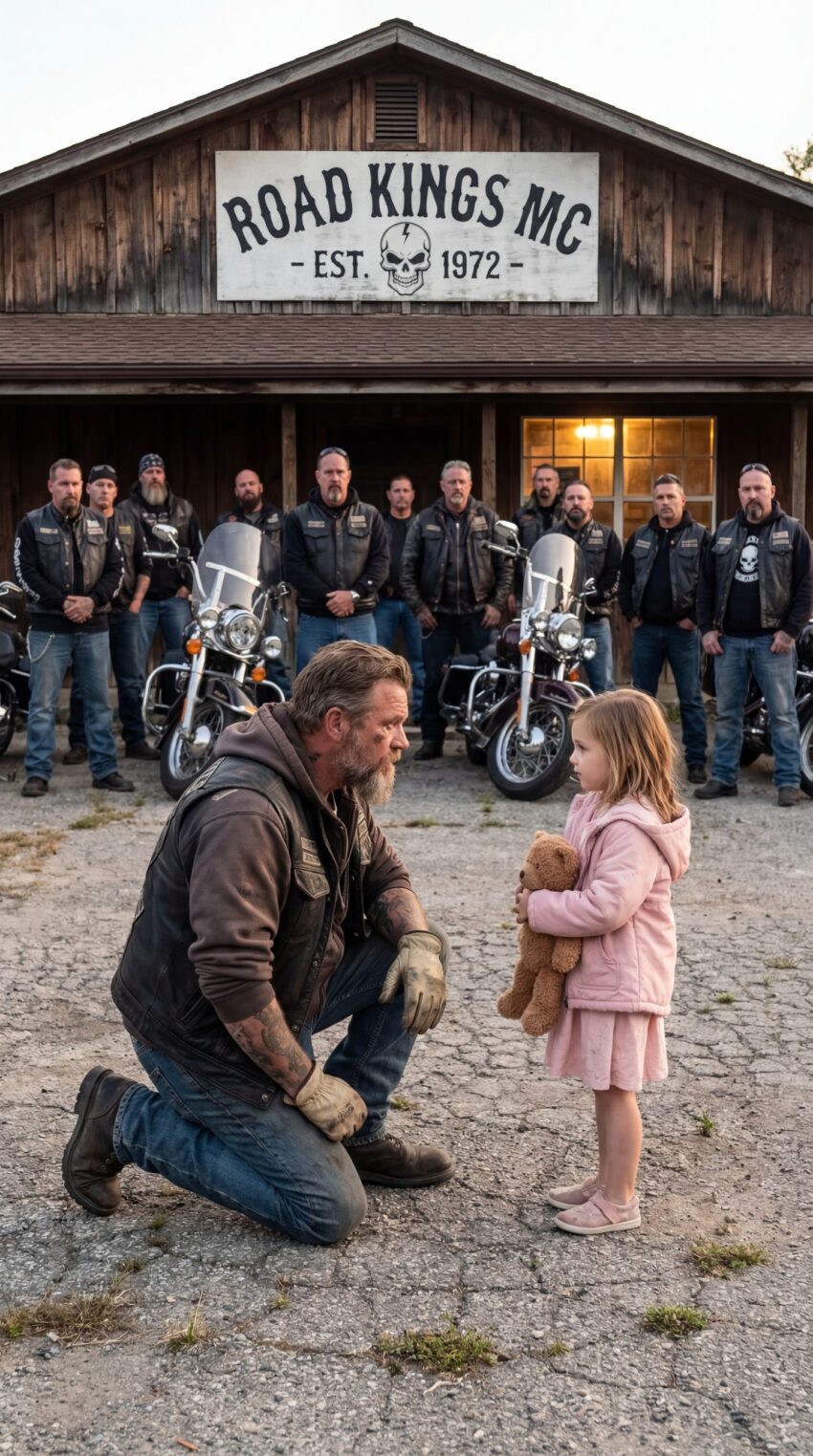
The Night a Small Knock Changed Everything
Rain hammered the pavement outside Iron Hollow Garage on the south side of Tulsa, Oklahoma, turning the lot into a mirror of broken headlights and neon reflections. Inside, the men of the Red Vale Riders sat around scarred wooden tables, drinking coffee, playing cards, and talking in low voices that rolled through the room like distant engines. It was late, the kind of late when decent people were already home and only the restless stayed awake.
Then someone knocked on the front door.
Not a loud knock. Not the pounding of police or the careless shove of a drunk. Just three small taps that somehow silenced the whole building.
Every head turned.
Boone Keller, the club president, looked up from the corner table. At forty-six, Boone had the kind of face people remembered for the wrong reasons. Hard jaw. Old lines around the eyes. A long pale scar near his chin. He had spent most of his life being the man others stepped aside for. But something about that sound pulled him to his feet before anyone else could move.
When he opened the heavy door, cold rain rushed in around a little girl standing alone on the step.
She looked no older than six.
Her wet curls clung to her cheeks. One side of her face was swollen. In her small hands she held a faded purple blanket with a torn edge. She was shaking so hard her teeth nearly clicked together.
She lifted her eyes to Boone, and in a voice so small it almost disappeared under the storm, she said, “Please help me. They hurt my mama.”
For a second, Boone could not breathe.
The room behind him went still in a way he had only heard before a fight.
He had spent years telling himself that nothing from his childhood could reach him anymore. He had buried those nights under noise, miles, and bad decisions. But one frightened little face at his door pulled every buried memory back into the light.
He stepped aside without hesitation.
“Come inside, sweetheart,” he said, his voice rough but careful. “You’re safe now.”
The Man Who Remembered Too Much

The girl stood just inside the doorway, dripping water onto the concrete, while the club watched her with stunned silence. Most of them had never seen Boone speak softly to anyone. Most had never seen him kneel.
But that was exactly what he did.
He lowered himself until he was at her eye level and asked, “What’s your name?”
She sniffled and rubbed her nose with the edge of the blanket. “Lila. Lila Mae Porter.”
Boone nodded slowly, repeating it like he wanted her to know he would remember. “Lila Mae. That’s a strong name.”
She swallowed hard. “My mama said if anything bad happened, I should run where there were lots of people. I saw your lights.”
One of the men near the bar muttered, “Boone, call 911. We don’t need this.”
Boone did not even look back. His eyes stayed on the child.
He remembered being eight years old in a trailer outside Amarillo, hearing his own mother cry in the kitchen and not being big enough to do anything about it. He remembered the helplessness. The shame. The rage that had nowhere to go.
No child should ever carry that feeling.
“We’ll figure it out,” Boone said. “But first you need warmth, dry clothes, and something to eat.”
Lila hesitated, then gave one tiny nod.
That was enough for Boone.
A Child in a Room Full of Rough Men
He led her toward his office in the back, passing rows of leather jackets, old bike parts, and men who suddenly did not know where to put their eyes. The clubhouse had seen arguments, celebrations, and plenty of nights no one would ever speak about again, but this was different. This felt like the whole room had been asked a question none of them expected.
Boone pushed open the office door. The space was plain: a battered desk, a filing cabinet, two chairs, and an old lamp that cast a soft amber glow. On the shelf behind the desk sat a tiny wooden airplane, worn smooth with age. Lila noticed it right away.
“Is that yours?” she asked.
Boone glanced at it and almost smiled. “Had it a long time.”
A minute later, Everett “Doc” Grayson came in carrying a first-aid bag. He was nearly sixty, gray-bearded, and steady in the way only certain men become after seeing too much. He had patched up riders for years without asking questions he did not want answered.
He crouched beside Lila gently. “Hi there, honey. I’m Doc. I just want to make sure you’re all right.”
Lila leaned a little closer to Boone.
Boone said, “He’s good people. You can trust him.”
Doc checked the bruise on her cheek, the red marks on her small wrists, and the scrape on her knee. His face tightened as he worked.
When he stood, he looked at Boone and said quietly, “She’ll heal, but somebody’s been rough with her. And this isn’t the first time she’s been scared.”
Boone’s jaw hardened.
He turned back to Lila. “Can you tell me what happened to your mama?”
Tears filled her eyes again. “Some men came to the apartment. Mama saw something outside and told me to stay quiet. Then they came in. They said she should’ve kept her mouth shut. She pushed me behind the couch and told me to run when the lamp fell over.”
Boone felt something cold and sharp settle in his chest.
“Did you see where they took her?”
Lila nodded weakly. “A big gray building with blue doors. One man had shiny teeth. He laughed the whole time.”
The Club That Could Not Look Away

By dawn, the Red Vale Riders were no longer arguing about whether the child was their problem. Lila sat on the couch with dry clothes that did not quite fit, eating scrambled eggs while one of the roughest men in the club awkwardly tried to cut her toast into stars.
A woman named Tessa Cole arrived with two shopping bags and more sense than everyone else in the room combined. Tessa managed a nearby music bar and had known Boone for years. She understood danger, but she also understood children.
She knelt beside Lila with a kind smile. “I brought you a sweater, some socks, and a stuffed rabbit because every hard night deserves one soft thing.”
Lila held the rabbit against her chest like she had been waiting for it all her life.
Boone watched from the doorway, surprised by the tight feeling in his throat.
The men in the club tried, in their own clumsy way, to help. One brought apple juice. Another found crayons from an old diner promotion. Someone else dug up a blanket that did not smell like motor oil for once. No one said much about the change happening in the room, but everyone felt it.
Boone called in his two most reliable men, Nolan Pike and Wade Mercer.
“Take the east side and start asking careful questions,” he told them. “Broken windows, blue doors, men moving too quiet for honest business. I want to know who’s been operating in neighborhoods they don’t belong in.”
Nolan nodded once. Wade grabbed his helmet without wasting a word.
As they left, Lila looked up at Boone and asked, “Are you gonna find her?”
He did not answer quickly, because some promises were too important to say lightly.
Then he crouched beside her and said, “Yes. I’m bringing your mama back.”
The Truth Hidden in a Drawing
While the men searched, Tessa sat with Lila at a folding table and helped her color. At first the child drew simple things: a house, a moon, a little girl with long curls. Then, with quiet focus, she started drawing a building.
Blue doors.
A cracked parking lot.
A broken streetlight leaning to one side.
And beside the loading dock, the number 18 painted in white.
When Boone returned to the table and saw it, he froze.
“Lila,” he said carefully, “have you seen this building before?”
She tapped the paper. “That’s where they took Mama. I remembered because the light kept blinking and it made me dizzy.”
Nolan and Wade came back less than an hour later with rain on their jackets and trouble in their faces.
Nolan pointed at the drawing. “We know this place. Old freight warehouse off Archer Road. Been used lately by a crew moving pills and cash. Nobody local likes them.”
Wade added, “And the guy with shiny teeth? That sounds like Curtis Vane. Mean man. Smiles when he shouldn’t.”
Boone looked at the picture again. A child’s hand had just given them what grown men had been chasing all morning.
Tessa folded her arms. “You’re not going in blind.”
Boone replied, “No. We go smart.”
The Woman They Refused to Leave Behind
That evening the clubhouse became quieter than usual. No music. No laughter. Just planning.
Boone stood over a hand-drawn map of the warehouse district while the others listened.
“We’re not storming in like fools,” he said. “We get her out fast and clean. Nobody fires unless there’s no other choice. Our job is to bring a mother home to her little girl, not turn this city upside down.”
For all his rough history, Boone had rules. Children were not bargaining chips. Women running for their lives were not to be ignored. And fear was not supposed to win.
Tessa took Lila to the small room above the office and stayed with her there. Before leaving, Lila ran back to Boone and held out the stuffed rabbit.
“Can he help too?” she asked.
Boone looked at the toy, then at her solemn little face.
“He can stand guard right here till we get back,” he said.
She nodded, satisfied, and handed him the rabbit like it was a badge of trust.
Boone tucked it on the office shelf beside the old airplane.
Then he headed out into the night with Nolan, Wade, Doc, and three others.
The Rescue in the Rain
The warehouse stood in a forgotten corner of the city, surrounded by rusted fencing and puddles that reflected the weak glow of industrial lights. The blue doors from Lila’s drawing looked even colder in real life.
Boone’s group approached from the rear alley, keeping low and quiet.
Inside, the place smelled like dust, damp concrete, and stale smoke. They could hear voices from the upper level. One laugh cut through the rest, sharp and ugly.
Wade whispered, “That’s him.”
Boone raised a hand for silence.
They moved up the back stairs and reached a half-open office door. Through the gap Boone saw a woman tied to a chair. Her hair was loose and tangled. One side of her lip was split. But even tired and bruised, she sat with her chin up like she was refusing to let them take the last piece of her dignity.
This had to be Lila’s mother.
A man with bright gold caps on two front teeth stood nearby, talking like he had all the time in the world.
Boone did not.
The next few moments moved fast and hard. Nolan pulled one guard away from the doorway. Wade blocked another before he could shout. Boone crossed the room and got to the woman first.
“My name is Boone Keller,” he said as he cut the rope at her wrists. “Your daughter is safe. We came for you.”
The woman stared at him, stunned. “Lila?”
“She’s waiting for you.”
Something inside her broke loose then, not fear but hope. Her legs nearly gave out when she tried to stand, and Boone caught her before she fell.
From the far corner, Curtis Vane reached for a weapon.
Boone turned with a voice that stopped the whole room.
“Don’t do it.”
For one long breath, nobody moved.
Then Curtis made the wrong choice.
The struggle was short, ugly, and over fast. Boone’s people shut it down before it could spill into something worse. When silence finally returned, all that mattered was getting the woman out alive.
As they hurried down the stairs, she clutched Boone’s arm and asked, “Is she really all right?”
He answered without hesitation. “She made it to us. She was brave the whole way through.”
Tears filled her eyes. “That sounds like my girl.”
The Hug That Changed the Room
When Boone brought her into the clubhouse just before midnight, Lila was already awake, sitting under a blanket with Tessa beside her. The moment she saw her mother, she flew across the room so fast the stuffed rabbit tumbled from her lap.
“Mama!”
Her mother, whose name was Elena Porter, dropped to her knees and caught the little girl in both arms. The sound she made was the kind that comes from pain finally meeting relief. She kissed Lila’s hair, her cheeks, her forehead, like she needed to prove the child was real.
“I’m here, baby,” Elena cried. “I’m here. I’m so sorry. I’m so sorry.”
Lila shook her head fiercely. “You came back. I knew you would.”
Nobody in the room spoke for a while.
Even men who had spent half their lives pretending nothing could reach them looked away and cleared their throats.
Doc took Elena to the back room to clean the cuts on her hands and face. Tessa made tea. Wade stood near the window like a guard without needing to be asked. Nolan picked up the stuffed rabbit and set it carefully beside Lila on the couch.
Boone remained where he was, watching the mother and child hold on to each other as if the whole world had narrowed to that one safe space.
Tessa walked over and said quietly, “You did good.”
Boone stared at the floor for a second. “We all did.”
But she knew, and so did he, that something bigger had happened.
A man who had built his life on distance had let one child’s fear break through every wall he had ever put up.
The Home They Built After the Storm
In the days that followed, Elena gave statements to people who could actually be trusted. The men who had terrorized her were not untouchable after all. With the right evidence and the right witnesses protected in the right way, they were finally brought down.
Boone expected that to be the end of it.
It was not.
Lila started asking for him by name.
She wanted Boone to read her stories because he made every character sound serious. She wanted to sit beside him while he fixed old bike parts because he explained things like they mattered. She wanted to know why he had a tiny airplane on his shelf and whether he had ever been little too.
Elena, slowly recovering, saw something in Boone that most people missed. Beneath the heavy silence and the battered history was a man who knew exactly what it meant to be afraid as a child and exactly how far he was willing to go so another child would not feel abandoned.
Months later, the clubhouse looked different.
There were crayons in a jar near the coffee machine. A stack of children’s books sat beside engine manuals. The men cursed less when little ears were nearby. Tessa helped turn one unused room into a quiet family space for women and children who needed a safe place for a night or two.
They never called it charity.
They called it doing what should have been done in the first place.
Boone did not become a different man overnight. He was still blunt. Still guarded. Still carried the past like old weather in his bones. But when Lila laughed in the hallway or Elena smiled without fear in her eyes, the whole building felt less like a hideout and more like a second chance.
One evening, as thunder rolled in the distance again, Lila climbed into the chair across from Boone’s desk and held up a drawing.
It showed a big man in a black jacket holding an umbrella over a little girl and her mother.
Across the top, in careful crooked letters, she had written: My brave friend.
Boone looked at it for a long moment before saying, “That might be the nicest thing anybody’s ever given me.”
Lila smiled. “You opened the door.”
And maybe that was the whole story.
Not the fight. Not the warehouse. Not even the rescue.
Just one small knock on a stormy night, and one man deciding not to turn away.
A Quiet Promise for the Days Ahead
Years later, people in that part of Tulsa still told the story in different ways. Some said it was about a biker who surprised everyone by choosing kindness. Some said it was about a mother who survived because her daughter was brave enough to keep running. Others said it was proof that broken people sometimes become the safest shelter because they know exactly how cold the world can be.
They were all right.
Because in the end, the story was never really about fear.
It was about what happens when somebody opens the door.
And every time rain hit the roof of Iron Hollow Garage, Boone still remembered the little girl standing there with soaked curls, trembling hands, and more courage than most grown men ever find in a lifetime.
He remembered her voice.
“Please help me. They hurt my mama.”
And he remembered the promise he made after that night, one he kept for the rest of his life.
No child who reached that door would ever be turned away again.
Sometimes the people the world judges the fastest are the very ones who understand pain deeply enough to protect someone else without asking what they might gain in return.
A child’s courage can be so pure and powerful that it reaches places in an adult heart that years of anger, regret, and silence were never able to heal.
Real strength is not proven by how loudly someone can scare others, but by how gently they can hold a frightened person who has nowhere else to go.
The most important turning points in life often do not arrive with grand speeches or perfect timing, but with a small voice asking for help at the exact moment someone chooses to listen.
There are wounds that do not show on the skin, and sometimes the greatest act of love is simply giving another human being a safe place where fear no longer gets the final word.
Family is not always formed by blood alone, because sometimes it is built through loyalty, protection, sacrifice, and the decision to stay when leaving would have been easier.
A person’s past may explain their hardness, but it does not have to define their future, especially when compassion gives them one honest reason to become more than their pain.
Children remember who made them feel safe, and that kind of safety can shape the rest of a life more powerfully than money, status, or anything else the world usually celebrates.
Hope can return in the middle of the darkest night when even one person decides that somebody else’s suffering matters enough to act on it right away.
The world becomes a little less cruel every time someone opens a door, offers protection, and proves that mercy is still stronger than fear.