A Voice That Sounded Harsh
The afternoon heat sat over the shopping plaza in Tempe, Arizona, like a sheet of glass. The sun bounced off the windows of a nail salon, a sandwich shop, and a tiny corner market where people moved in and out with cold drinks, paper bags, and distracted expressions. It was one of those ordinary afternoons that felt too small to hold anything unforgettable.
Near the entrance of the market stood a little girl named Elsie Rowan. She looked about six years old, with soft brown curls gathered into a loose ponytail that had started to fall apart in the heat. She wore pink sneakers, denim shorts, and a pale yellow T-shirt with a faded rainbow across the front. In her hands she had been carrying a plastic cup of water almost too large for her to manage.
A second later, the cup slipped.
It hit the pavement, rolled once, and came to a stop near the curb. Water spilled across the concrete in a bright, shining sheet that looked harmless at first. It spread slowly, then more quickly, tracing thin silver lines under the afternoon sun.
Elsie stared at the puddle in silence.
Her small face changed all at once, as if she already knew she had done something wrong. She froze with her hands half-raised, not sure whether to pick up the cup, call for someone, or simply step away and hope nobody noticed.
That was the moment a deep voice cut across the parking strip.
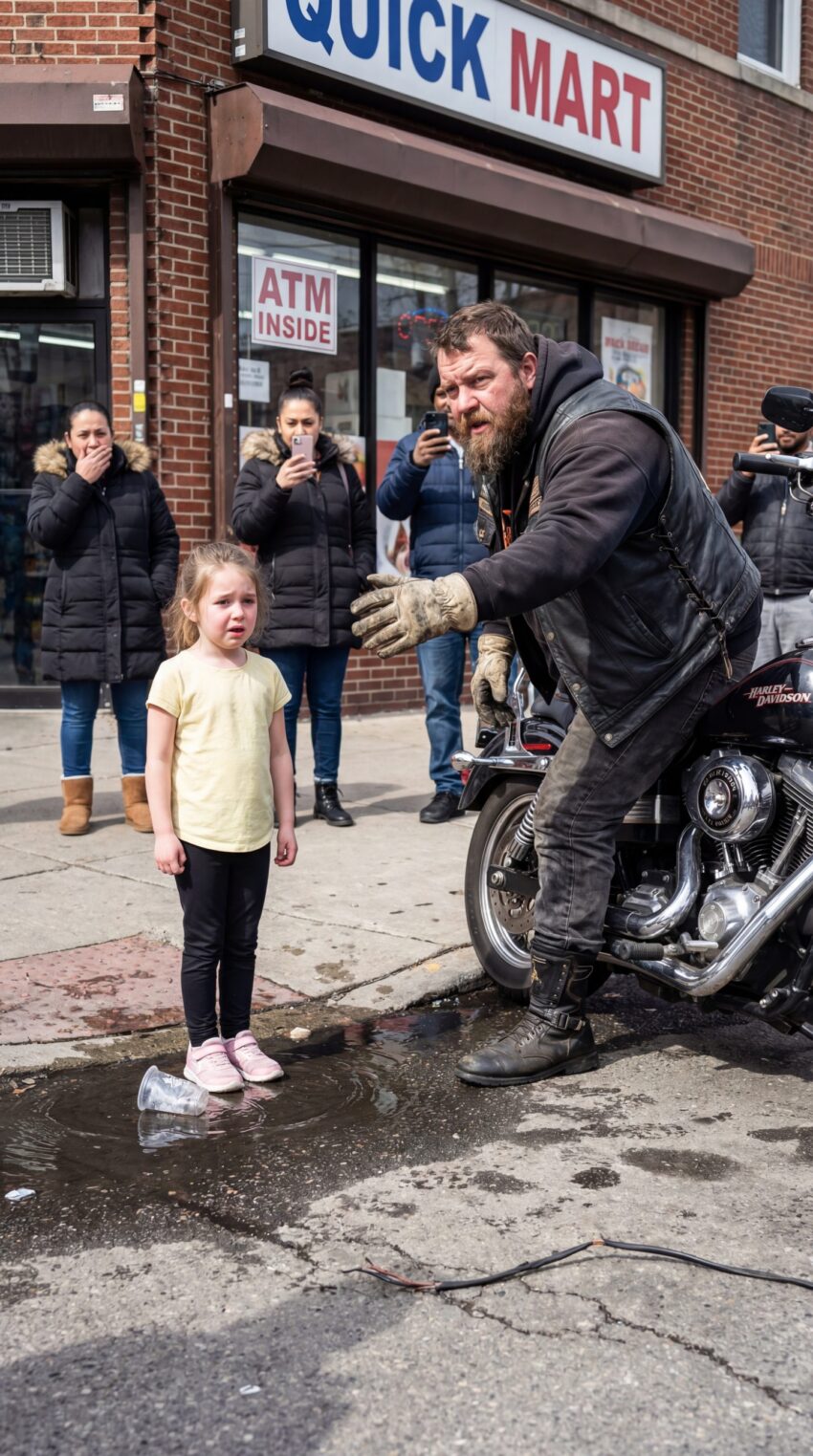
“Don’t move. Do you hear me? Don’t take another step.”
The words were so sudden, so firm, that everything nearby seemed to stop. The sound did not belong to the ordinary quiet of a shopping plaza. It belonged to something urgent. Something sharp enough to make people turn before they even understood what they were looking at.
Elsie flinched and looked up in fear.
A biker was striding toward her from beside a row of parked motorcycles.
He was tall, broad-shouldered, and dressed in worn black boots, dark jeans, and a weathered leather vest over a charcoal shirt. His name was Callan Mercer, though nobody there knew it yet. From a distance, he looked intimidating in the way strangers sometimes do when they carry too much silence in their posture. His arms were strong, marked by old ink, and his expression was serious in a way that made people uneasy before he said another word.
He stopped several feet from the child and repeated himself.
“Stay exactly where you are.”
Elsie’s eyes filled at once.
“I’m sorry,” she whispered.
To everyone watching, that was enough to decide what was happening.
The Moment Everyone Judged
A woman coming out of the market gasped and hurried toward the little girl. Her name was Dana Whitmore, and she had been holding a paper sack of groceries in one arm and her car keys in the other. The instant she saw a grown man barking orders at a frightened child, her face hardened.
“What is wrong with you?” she snapped. “She’s just a little girl.”
A man near the soda machine looked over, then another by the curb. Within seconds, attention spread the way it always does in public places. People paused mid-conversation. Someone lifted a phone. Someone else stepped closer, already wearing the expression of a witness who believed he understood everything.
Callan did not answer Dana.
He did not look at the crowd gathering around him. He did not defend himself, apologize, or soften the hard line in his voice. Instead, he kept his eyes fixed on the pavement near Elsie’s shoes.
That made it worse.
To the people standing there, it seemed cold. Detached. Almost arrogant.
Dana moved closer and reached toward the girl. “Come here, honey.”
But before Elsie could take a step, Callan’s voice came again, low and controlled.
“No. Don’t let her move.”
The man near the curb frowned. “You don’t get to yell at a kid over spilled water.”
Another person raised a phone higher. Now the moment had an audience, and that changed the air around it. People were no longer simply observing. They were choosing sides.
Elsie sniffled and shifted one foot.
Callan moved instantly, not toward her face, not toward the crowd, but toward the space in front of her. He lifted a hand, palm open, blocking her path without touching her.
“Please,” he said, more quietly this time. “Stay there.”
But the softer tone did not erase what everyone thought they had already seen.
Dana stepped in front of Elsie protectively. “Back away from her.”
Callan’s jaw tightened. He still did not explain. He kept looking down.
It was strange, that fixed attention he gave to the ground, but the crowd read it as stubbornness. They read it as a man refusing to admit he had gone too far. Nobody there had yet noticed that he was not angry with the child at all.
He was watching the water.
What He Saw First
The puddle had spread farther now, moving in a thin sheet across the concrete toward the base of the building. Sunlight flashed on its surface. To most people, it was nothing more than spilled water reaching for a crack in the pavement.
But Callan had noticed something else the instant the cup hit the ground.
Near the wall beneath the market window sat a damaged service box. It was the kind of thing most people never looked at, painted to blend into the building and forgotten until something went wrong. From the lower edge of it, almost hidden by shadow, ran a narrow black cable with a split in the outer coating.
He had seen it because he had spent years working with engines, tools, and power lines on ranch property before life took him elsewhere. He knew what exposed copper looked like even from a distance. He knew what water did when it found the wrong path. He knew how quickly something ordinary could turn dangerous.
And now that strip of water was inching closer.
Elsie shifted again, frightened by the crowd, by the shouting, by the strange man whose voice felt too large for a child’s heart.
Without thinking, she started to step sideways.
Callan reached out on instinct and caught her wrist.
Not roughly. Not with force. Just fast.
Still, the crowd reacted as if a line had been crossed.
“Hey!” the man by the curb shouted.
Dana pulled Elsie back at once and wrapped an arm around her shoulders. “Don’t touch her!”
A low chorus of alarm rose around them. One person said security had been called. Another said police should be on the way. Phones tilted for better angles. A few people moved closer, hungry for certainty.
Callan let go immediately and stepped back half a pace.
“You don’t understand,” he said.
It was the wrong sentence for that moment. Too vague. Too late. The kind of words people say when they have no good explanation.
Dana stared at him in disbelief. “Then explain it.”
He looked at her for the first time. There was frustration in his face, but not the kind people had imagined. It was not cruelty. It was the strain of a man trying to keep something from happening while the room around him insisted on seeing a different story.
Before he could answer, the puddle crawled another inch.
Callan’s eyes dropped again.
And that was when the store manager came outside.
The Truth on the Ground
Grant Hollis had been restocking a shelf near the register when the noise at the entrance pulled him outside. He still had the store keys in one hand and a half-finished inventory sheet tucked under his arm. At first he looked only irritated, like a man expecting to break up a pointless argument at the end of a long shift.
“What’s going on out here?” he asked.
Several voices answered at once.
“He scared that little girl.”
“He grabbed her arm.”
“He’s been shouting at her over spilled water.”
Grant turned toward Callan with the automatic look of someone preparing to take control of a situation. But before he could speak, he noticed where the biker was looking.
Down.
At the puddle.
At the narrow stream of water stretching toward the wall.
At the thin black cable lying too close to it.
Grant’s face changed slowly.
He took one step forward, then stopped dead.
“Hold on,” he murmured.
The crowd quieted just a little, confused by the sudden shift in his expression.
Callan spoke without lifting his eyes. “There’s a split in the line.”
Grant leaned carefully to one side. Now he saw it fully. The damaged casing. The exposed copper inside. The water almost touching it.
His skin seemed to drain of color.
“Everybody move back,” he said sharply.
That voice carried authority in a different way than panic did. It was not emotional. It was immediate. It made people listen even before they knew why.
Dana pulled Elsie backward.
The man near the curb lowered his phone halfway. “What is it?”
Grant pointed toward the doorway. “Nobody comes closer.”
He disappeared inside for a moment and returned with a dry wooden broom. He extended it carefully, using the handle to nudge the cable away from the advancing water.
The spark was small.
Tiny, really.
A fast, bright snap that might have gone unnoticed on another day.
But everyone saw it.
And in that instant, the whole story changed.
The Silence After the Spark
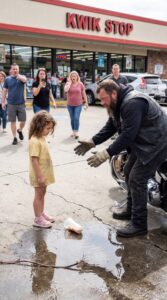
No one said anything for several long seconds.
The air did not merely quiet. It settled into a heavy kind of silence that feels different from ordinary embarrassment. It was the silence that comes when a crowd realizes it had been absolutely certain and completely wrong at the same time.
Elsie clung to Dana’s side, wide-eyed and confused. She looked from the wire to the puddle to the biker who had frightened her.
Grant exhaled shakily and reached for his phone. “I’m calling maintenance right now.”
Dana lowered her eyes. The anger in her face collapsed into something closer to shame. The man near the curb shoved his phone into his pocket without another word. A few others stepped back as if distance alone might hide the fact that they had been recording.
Callan finally relaxed his shoulders.
Not by much. Just enough to show that the danger had passed.
Elsie looked up at him, still blinking away tears. “Why were you yelling at me?”
The question landed differently than everything else had. It did not accuse. It asked. It came from a child who had been frightened and wanted to understand the reason.
Callan crouched a little, though not all the way to the ground. He seemed like a man unpracticed at gentleness but willing to reach for it anyway.
“You were about to step into something dangerous,” he said. “I needed you to stop fast.”
Her small mouth trembled. “But I thought you were mad at me.”
He gave one quiet nod. “I know.”
There was something honest in the way he said it. No excuses. No attempt to make himself look better. He did not say she should not have been scared. He accepted that she had been.
Dana swallowed hard. “I misread this.”
Callan stood again. “So did everybody else.”
It was not a bitter answer, only a tired one.
Grant, still shaken, looked toward him. “You noticed that before anyone else.”
Callan shrugged lightly, as if he did not think it deserved much discussion. “Water was heading the wrong way.”
The sentence sounded plain, but there was a world inside it. Attention. Experience. Instinct. The kind of seeing that comes from years of learning that trouble often hides inside ordinary details.
A Man Who Did Not Stay for Praise
Now that the danger had a name, people wanted to repair themselves.
One woman muttered, “I’m sorry.”
The man who had shouted earlier rubbed the back of his neck and said, “I thought—” but never finished.
Dana tried again. “You helped her.”
Callan looked at Elsie, then at the wire, then back toward the row of motorcycles parked across the lot. He did not seem angry anymore. Just distant. As though public misunderstanding was not new to him.
“She’s okay,” he said.
He turned and began to walk away.
Grant took a step after him. “At least let me thank you properly.”
But Callan only lifted one hand without turning around. “No need.”
He crossed the parking area, reached a matte-black cruiser, and swung onto it with the easy movement of someone who had spent much of his life on the road. The engine rumbled to life beneath him, deep and steady. For a brief second, the sound filled the plaza where all the shouting had been.
Elsie slipped out from Dana’s arm and called after him in a small voice.
“Mister?”
He looked back once.
“Thank you for making me stop.”
Something softened in his face then, though it was gone almost as quickly as it came.
“You’re welcome, kiddo.”
Then he rode away under the bright Arizona sun, leaving behind a crowd that had expected a villain and discovered a protector instead.
What the Camera Showed That Night
By evening, the story had already started to travel.
Not because Callan told it. He did not return to explain himself, and he did not seem like the kind of man who would. But the market had security footage above the entrance, angled down over the walkway. Grant reviewed it after maintenance secured the damaged line and the sidewalk was declared safe again.
From above, the truth was impossible to miss.
The footage showed the cup falling, the water spreading, and Callan turning his head before anyone else even noticed something was wrong. It showed him looking not at the little girl’s face, but at the ground. It showed him moving to stop her path again and again, always between her and the danger. It showed the crowd closing in, certain they understood what they were seeing.
Without sound, the images were even more revealing.
The problem had never been his intention.
It had been his tone.
A clipped command can sound harsh when fear is underneath it. Urgency can resemble anger when people arrive in the middle of a moment. And appearances, once formed, can be stubborn things.
Grant shared the footage with the people who had left their contact information. By nightfall, fragments of the story had made their way across neighborhood pages and local message boards. Some recognized the scene from the videos they had recorded before they knew the truth. Some deleted those videos quietly. Some wrote apologies to a man they would likely never meet again.
The next morning, the puddle was gone. The broken cable had been replaced. Families passed the market without noticing anything unusual.
But Elsie noticed.
Every time she looked at the patch of sidewalk where her water had spilled, she remembered not only how scared she had felt, but what came after. She remembered that a person can sound rough and still be trying to protect you. She remembered that not every kind face sees danger in time, and not every intimidating one brings harm.
She would carry that much longer than anyone expected.
The Lesson That Stayed
A week later, Dana returned to the market and saw Elsie there with her father, buying a frozen treat from the cooler near the register. The little girl pointed outside toward the place where it had happened and said, “That’s where the biker saved me.”
She did not say, “That’s where he yelled at me.”
She did not say, “That’s where everyone got mad.”
Children, somehow, know how to keep the heart of a story when adults get distracted by its noise.
Dana bent down and asked gently, “Are you still afraid when you think about that day?”
Elsie considered the question with surprising seriousness.
“Not really,” she said. “I was scared then. But now I think maybe he was scared too. Just for me.”
Dana felt that answer settle deep inside her.
Because that was exactly it.
Sometimes the loudest voice in a hard moment does not come from pride. Sometimes it comes from urgency. Sometimes the person willing to look unkind for a few seconds is the same person willing to carry everyone’s misunderstanding if that is what safety requires.
Callan Mercer never returned for praise. No one in that plaza knew much about him beyond the motorcycle he rode and the split-second judgment they had once made about him. But in one brief moment, he had done something rare. He had chosen being misunderstood over being too late.
And maybe that was the quiet kind of courage people speak about far less than they should.
Sometimes the person who protects us does not arrive wrapped in softness, and if we judge only by tone, clothing, or first impressions, we may completely miss the quiet courage standing right in front of us.
The world becomes gentler when we learn to pause before condemning someone too quickly, because a moment that looks harsh on the surface may be hiding an act of care underneath.
Not every act of protection sounds warm in the moment, and one of the hardest lessons in life is realizing that urgency and love do not always speak in calm, polished voices.
There are people who will accept being misunderstood if it means someone else gets to remain safe, and that kind of sacrifice deserves more honor than public approval ever could.
A frightened child may remember the fear first, but with time the deeper truth often rises to the surface, and what remains is gratitude for the person who stepped in before harm could reach her.
Too many people look at appearances and decide the ending before the story has even unfolded, yet wisdom begins the moment we admit that what we saw first may not be the whole truth.
Real character often reveals itself not in grand speeches or public praise, but in the split second when someone notices danger, acts immediately, and asks for nothing in return afterward.
We should all try to become the kind of person who pays close attention to small details, because life-changing moments often begin with something everyone else thought was too ordinary to matter.
The strongest hearts are not always the gentlest-looking ones, and the people who seem rough around the edges may still carry a deep instinct to shield the vulnerable when it matters most.
If this story leaves anything behind, let it be this: kindness is not always quiet, goodness is not always easy to recognize, and sometimes the person who looks least understood is the very one standing between danger and a child.