The Five Dollars That Brought the Light Back
Delaney Boone had become an expert at hiding pain in ordinary places.
She hid it while tying her daughter’s lunch in a plastic grocery bag because the zipper on the real lunchbox had broken two months ago. She hid it while smiling at customers in the Maple Street Grill, balancing plates on one arm and coffee refills in the other. She hid it while scrubbing bathrooms at a roadside motel after dark, pretending the sting in her lower back was only tiredness and not the kind of exhaustion that had started living in her bones.
But some pain does not stay hidden forever.
On a bitter Sunday evening in Ash Hollow, Indiana, Delaney sat alone at the kitchen table after her nine-year-old daughter had gone to bed. The duplex was small, drafty, and clean in the careful way poor homes often are. There were school papers on the refrigerator, a stack of overdue envelopes near the toaster, and a little blue lamp on the counter that made the room feel softer than it really was.
In front of Delaney lay one more letter.
She had read it twice already. The message had not changed.
Past due rent. Additional fees. Final demand. Ten days.
She lowered the page and pressed one hand over her eyes. The house was so quiet she could hear the ticking of the kitchen clock and the weak groan of the furnace trying to hold on through another cold night.
“I don’t know what to do anymore,” she whispered to nobody.
She did not know that someone had heard her.
At the edge of the hallway, Willa Boone stood barefoot in her pajamas, one hand resting against the wall. She was old enough to read enough of the letter to understand what it meant, and young enough to believe there still had to be one brave answer somewhere in the world.
She did not cry. She did not interrupt.
She simply watched her mother’s face and made a quiet decision that would change all of their lives.
A Child’s Plan
Children do not always make their biggest choices out loud.
Sometimes they do it silently, with a serious little heart and a kind of courage that adults no longer know how to carry.
The next afternoon, Delaney got called into an extra shift at the diner because another waitress had a sick son at home. Willa sat in the last booth with a grilled cheese sandwich, a pack of crayons, and her school backpack beside her. Outside, the winter sky had turned dull and metallic, and trucks rattled past on the highway beyond town.
Across the street, in the cracked lot beside Harper’s Auto Repair, a group of bikers had gathered around their motorcycles.
Most people in Ash Hollow called them trouble before they even knew their names. They saw leather vests, heavy boots, old scars, and loud engines, then decided that was enough to know. Grown-ups lowered their voices when they talked about them.
Willa had noticed something different.
Once, in the summer, she had seen a man yelling at a cashier behind the diner until the poor woman looked like she might cry. One of the bikers had stepped in, not loudly, not dramatically, but firmly enough that the man left without another word. Another day, she had seen that same biker unload canned food at the church pantry when he thought no one was watching.
He looked rough. He looked strong. And to a little girl who had watched her mother carry too much for too long, strength felt like hope.
The big biker’s name, she had overheard, was Mason Crowe.
So while Delaney rushed between tables, apologizing for long wait times and wiping down counters, Willa opened the front pocket of her backpack and took out the one five-dollar bill she had been saving since her birthday.
Her teacher had tucked it into a card and told her to keep it for something special.
Willa had.
She just had not known what special meant until now.
She slipped out the side door into the cold.
Five Dollars and a Brave Face
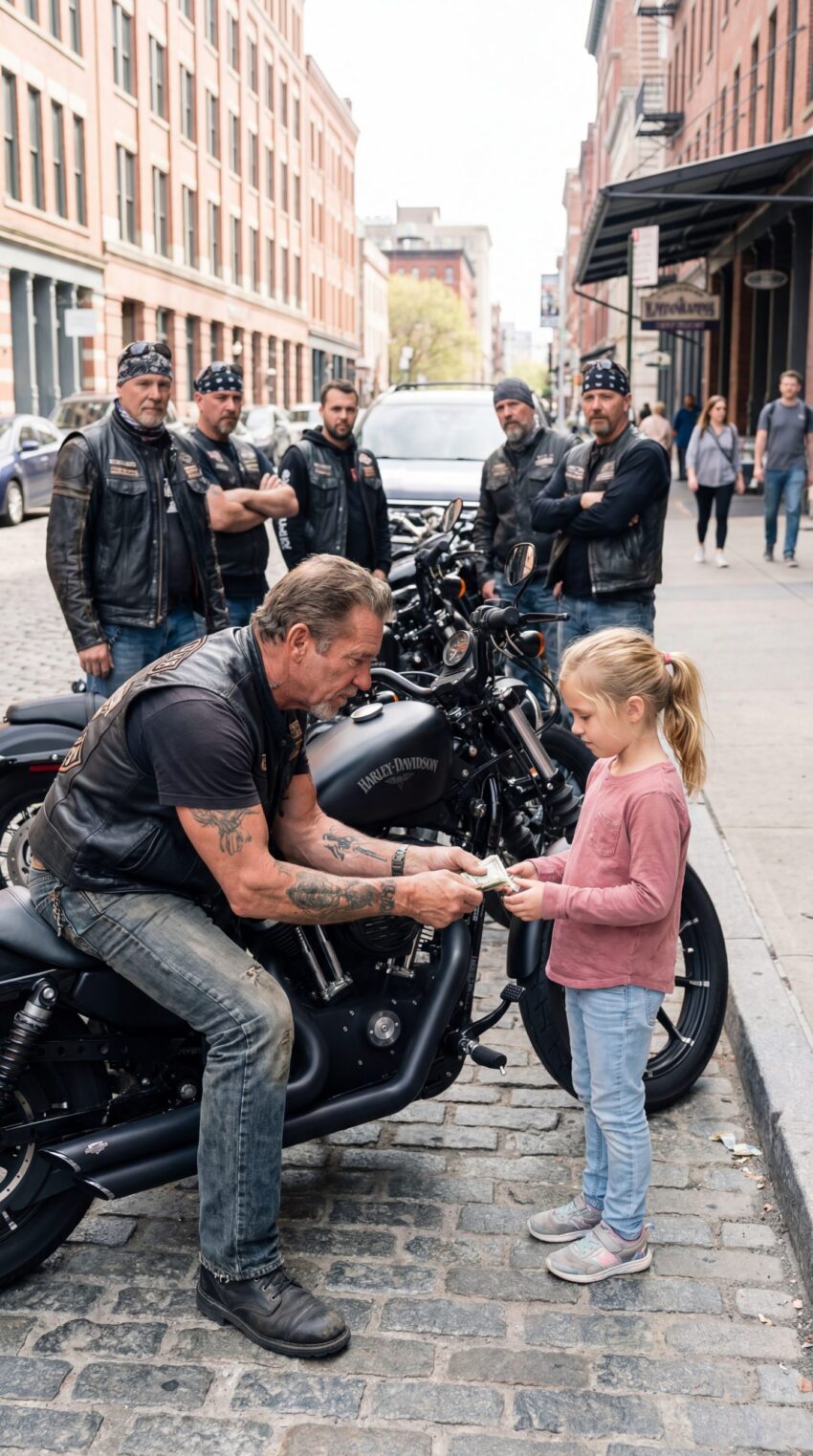
The wind bit at her cheeks as she crossed the parking lot. Engines rumbled. Men laughed in voices deep enough to scare off most children. Chains clinked. Boots scraped against the pavement.
When the bikers noticed a little girl walking toward them alone, the entire group went strangely quiet.
Mason Crowe stood beside a dark motorcycle with weathered chrome and a tank striped in silver. He was a large man, broad-shouldered and gray at the edges, with a beard that made him look even more severe than he really was. His leather vest stretched across his chest, and old ink disappeared into the sleeves of his flannel shirt. He looked like the sort of man strangers judged in a single glance.
When Willa stopped in front of him, he looked down in surprise.
“You lost, honey?” he asked.
Willa lifted her chin, even though her knees were trembling. “No, sir.”
A few men behind him traded glances.
Mason crouched a little so she would not have to crane her neck. “Then what do you need?”
Willa reached into her coat pocket and pulled out the crumpled five-dollar bill.
“I need help,” she said. “And I can pay.”
No one laughed after that.
Mason’s face changed first with confusion, then something gentler. “What kind of help?”
Willa swallowed. “It’s my mom.”
The silence deepened.
“What about her?” he asked.
“She works all the time. She smiles at people when she’s tired, and then she cries when she thinks I’m asleep. A man sent a paper, and now she says she doesn’t know what to do anymore.”
Mason glanced toward the diner windows across the street, then back at the child in front of him.
“What was in the paper?”
Willa looked down at the bill in her hand. “He says he’s taking our home away.”
Something old and painful passed through Mason’s eyes.
Not pity. Not anger exactly.
Recognition.
“So you came to me?” he asked.
She nodded.
“Why?”
Willa gave him the only answer she had. “Because you look strong. And you look like somebody who doesn’t let people get hurt.”
The men behind him fell still.
Nobody had described Mason Crowe that way in a very long time.
He looked at the five-dollar bill again, then at the child holding it out with all the seriousness of someone making a real contract.
“What do you want me to do?” he asked softly.
Willa’s voice shook, but she did not pull back. “Please help my mama smile again.”
Mason took a slow breath.
Then he carefully folded her fingers back over the money.
“Keep it, kid,” he said. “I’ll help you for free.”
Her eyes widened. “You will?”
“Yeah,” he replied. “Let’s go talk to your mother.”
The Mother at the Back Door
Delaney came out the diner’s side entrance ten minutes later with a bag of trash in one hand and exhaustion all over her face.
Then she saw her daughter standing beside a giant biker.
The trash bag slipped from her fingers and hit the concrete with a dull spill of paper cups and napkins.
“Willa!” she gasped, rushing forward. “What are you doing?”
Willa flinched but stayed where she was. “Mom, don’t be mad. I hired him.”
Delaney froze. “You what?”
“I hired him to help you smile again.”
Mason stepped back and lifted both hands slightly. “Ma’am, I’m not here to cause trouble.”
Delaney stared at him, caught between fear, embarrassment, and something close to heartbreak. “Then why are you with my child?”
“Because she came to me with five dollars and a mission,” Mason said. “And because what she told me sounded serious enough that I didn’t think she should walk back alone.”
Delaney closed her eyes for one second. She was too tired for this, too tired for strange miracles, too tired for the humiliation of being seen so clearly by strangers.
When she opened her eyes again, Willa was holding out the wrinkled bill like evidence.
“I just wanted to fix it,” the little girl whispered.
Delaney covered her mouth. A laugh almost came out, but it broke halfway into tears.
Mason looked away, giving her the dignity of not watching too closely.
After a moment, he said quietly, “If there’s a notice on your table and a deadline on that paper, maybe I can at least take a look.”
Delaney’s first instinct was to say no.
No to help. No to being known. No to letting a stranger with scars and a leather vest step into the mess of her life.
But her daughter’s face was lifted toward her with so much hope it nearly hurt to see.
She nodded once.
“I get off in ten minutes.”
“I’ll wait,” Mason said.
And he did.
The House With the Thin Walls
Delaney’s duplex looked smaller with Mason’s motorcycle parked outside.
Inside, the kitchen light was yellow and weak. The floors were old. The curtains had come from a thrift store. The unpaid bills were stacked neatly because neatness was one of the few things Delaney could still control.
Mason did not comment on any of it.
That bought more trust than any speech could have.
Delaney sat at the kitchen table and pushed the envelope toward him. “It’s an eviction notice,” she said. “I keep calling it something else because that sounds less ugly.”
Mason read the paper carefully. “How much?”
She hesitated. “A little over three thousand. Maybe less if the fees aren’t real. I don’t know anymore.”
She explained in pieces.
Her ex-husband had drifted out of their lives two years earlier after too many broken promises. She had surgery the previous spring during a gap in insurance. Medical bills had piled up. One job became two. Then school schedule changes made her lose motel hours because she could not afford regular childcare. Winter utilities came early. Rent came late. The landlord, Clayton Harlan, liked reminding people that business was not kindness.
Mason listened without interrupting.
When she finished, he pulled a phone from his vest and scrolled through his contacts.
Delaney blinked. “You know somebody who can help?”
“Depends how much you trust my taste in friends,” he said.
Then he placed the call.
The man who answered sounded tired and sharp. Mason spoke briefly, gave the address, and ended the call.
“He’ll be here in twenty minutes,” Mason said.
“Who?” Delaney asked.
“A lawyer.”
Willa, sitting on a chair with both elbows on the table, nodded as if this confirmed everything she had hoped.
A Man in a Wool Coat
The lawyer arrived in a charcoal coat and polished shoes that looked too expensive for the neighborhood. His name was Nathan Vale. He was lean, calm, and carried himself like a man who had spent years learning how to make bad people nervous without ever raising his voice.
He read the notice, asked a few questions, then sat back.
“All right,” he said. “First, your landlord is aggressive. Second, his paperwork may be sloppy. Third, that helps us.”
Delaney gripped her coffee mug. “What does that mean in plain English?”
Nathan almost smiled. “It means I may be able to buy you time and challenge some of these extra charges. You still owe rent, but I don’t think he gets to push you out as quickly as he wants.”
Delaney shut her eyes for a moment. “Time would matter.”
“Time matters,” Nathan said. “Panic helps men like him. Paperwork helps me.”
Mason leaned against the counter with his arms crossed. “Can you stall him?”
“Yes,” Nathan replied. “Can I erase the debt with clever words? No. But I can slow this down and make him follow the law instead of his mood.”
For the first time in weeks, Delaney felt the air in the room shift.
The danger had not disappeared.
But it no longer felt like a locked door.
When Nathan left, Willa ran to Mason and whispered, “You really did help.”
Mason crouched in front of her. “Job’s not done yet.”
She held up the five-dollar bill again. “Then you still have to keep working.”
A laugh escaped Delaney before she could stop it.
Willa gasped. “See? It’s already working.”
The Ride for a Roof
What happened next spread through Ash Hollow faster than anyone expected.
Mason belonged to a motorcycle brotherhood called the Iron Saints. They were the kind of men who organized toy drives at Christmas, escorted veterans to appointments, and helped fix roofs without making a performance of it. By the next morning, the whole club knew about the little girl with five dollars and a mother on the edge of losing everything.
Their president, an older rider named Boone Mercer, listened to the story in silence. Then he said, “If a child has that much faith in us, we better earn it.”
Within days, they organized a benefit ride and community barbecue.
No pity language. No dramatic signs. Just a simple announcement posted around town:
RIDE FOR A ROOF
SATURDAY NOON
BARBECUE, MUSIC, RAFFLE
FAMILY WELCOME
The town came out in numbers nobody expected.
Some came because they cared. Some came because they were curious. Some came because bikers usually threw better food events than church committees. But they came.
Retired mechanics. Teachers. Veterans. Teenagers. Church ladies with casseroles. Families in puffy coats. Men who had judged the bikers for years but still lined up for brisket and raffle tickets.
By the middle of the afternoon, they had raised more than half of what Delaney needed.
Not enough yet.
But enough to make the impossible feel smaller.
And then, just when hope had started to feel safe, Delaney’s family arrived.
The People Who Called It Help
Delaney’s mother, Lorraine, stepped onto the fairground lot in a camel coat, with her older daughter, Candace, at her side. Both women wore expressions that belonged in quiet judgment, not public support.
Candace folded her arms. “Tell me this is not for you.”
Delaney stared at her. “You already know it is.”
Lorraine’s mouth tightened. “This is humiliating.”
Delaney let out a bitter little laugh. “For who?”
Candace lowered her voice, though not enough. “You’ve put Willa in the middle of this circus.”
Before Delaney could answer, Mason appeared beside her, steady and unreadable.
Candace looked up at him and visibly recoiled.
“This is a family matter,” she said.
Mason’s voice stayed calm. “It stopped being private when family offered help with conditions.”
Lorraine’s expression hardened. “We offered stability.”
Delaney felt something fierce rise inside her. “You offered to take my daughter if I signed her over. That is not stability. That is control.”
Candace flushed. “Mom called Family Services,” she said.
The whole world seemed to go silent around Delaney.
“You what?”
“If there’s nothing wrong,” Candace said quickly, “then you have nothing to worry about.”
For one dangerous second, Delaney thought she might say something she could never take back.
Mason stepped slightly closer, not touching her, just anchoring the moment.
“Ma’am,” he said to Lorraine, respectful but firm, “if you came to help, the donation table is over there. If you came to make today harder, this visit can stay short.”
Candace bristled. “You don’t get to speak to us like that.”
Mason finally turned his full gaze on her. “I am speaking kindly.”
And that was the end of that conversation.
Lorraine and Candace left without donating a dime.
Delaney sat behind the raffle table afterward, hands shaking.
“What if they take her from me?” she whispered.
Mason looked at her for a long moment. “A nicer house does not make a better mother.”
Those words stayed with her.
The Last Gap
The social worker did come two days later.
Her name was Elise Morton, and she had the practical kindness of someone who had seen too much to be fooled by appearances. She walked through the duplex, took notes, asked questions, and finally sat down beside Willa on the old couch.
“Your aunt was worried,” Elise said gently.
Willa frowned. “My aunt worries in a mean way.”
Elise almost smiled. “Tell me about the biker who visits.”
Willa brightened immediately. “You mean Mason? He fixed the porch. And he made my mom laugh. Twice.”
When the visit ended, Elise stood on the porch with Delaney.
“Ms. Boone,” she said, “you are behind on rent, not on loving your child. Unless someone gives me evidence of harm instead of prejudice, this report will go nowhere.”
Delaney nearly sank with relief.
By Thursday, Nathan had negotiated the final settlement amount. The town’s fundraiser had covered most of it, but they were still short.
Delaney was trying not to let Willa see the fear on her face when Mason arrived that evening with an envelope.
“What’s that?” she asked.
“The rest,” he said.
She stared at him. “No. I can’t take that.”
He looked toward the street before answering. “You can. And you will.”
Only later did she learn he had sold a motorcycle he had rebuilt years earlier with the closest friend he had ever had.
He did not tell her that himself.
She heard it from one of the other riders, who said it quietly, as if telling the truth was not meant to become a show.
The House That Stayed Standing
The final payment was made on a bright, bitter morning at the county office.
Clayton Harlan counted the certified funds twice, looking deeply unhappy that the woman he thought he could pressure had shown up with a lawyer, a biker in a clean flannel shirt, and a little girl holding her mother’s hand like she had personally arranged justice.
When the clerk stamped the receipt, Willa rose onto her toes to see it.
Outside the courthouse, she looked up at Delaney.
“Did we win?”
Delaney laughed through tears. “Yes, baby. I think we did.”
Willa turned to Mason. “That means your job is done.”
He reached into his wallet and looked at her with a smile that had become easier lately. “Not quite.”
She blinked. “There’s more?”
He held up the old five-dollar bill she had tried to pay him with.
“Now it’s finished,” he said.
This time, he kept it.
A Different Kind of Family
The months that followed were not magically easy.
Bills still came. Delaney still worked hard. Life did not become a fairy tale simply because one battle had been won.
But something had changed.
The Iron Saints kept showing up, not as rescuers, but as people who had quietly decided this family mattered to them. One rider repaired the gutter in spring. Another sat in the third row at Willa’s school concert when Delaney got delayed at work. Nathan helped Delaney apply for a clerical position at a legal aid office, one that paid less than two jobs combined at first but came with health insurance, steady hours, and evenings at home.
She got the job.
The house grew warmer in every sense.
Willa started laughing more. Delaney stopped waking up with panic already in her throat. Mason came by often enough that his presence no longer felt unexpected. He still looked intimidating to strangers. He still rode hard and spoke little. But he started carrying cold apples in his saddlebag because Willa liked them, and he learned how to sit through elementary school events without pretending he would rather be anywhere else.
Love did not crash into their lives like thunder.
It arrived slowly.
In repaired steps. In quiet dinners. In ordinary Tuesdays. In the way Delaney stopped flinching when kindness came without a price.
A year later, with help from a city program Nathan insisted she apply for, Delaney bought her half of the duplex.
On closing day, Willa sat swinging her legs beneath the conference table while Delaney signed her name with steady hands.
Outside, in front of the little blue door that was finally hers, Willa grinned and said, “Best five dollars ever.”
Mason shook his head. “Worth every penny.”
And maybe that was the real miracle.
Not that a biker helped save a home.
But that a child saw a heart inside a man the world had misjudged, and by trusting it, reminded everyone around her what strength was supposed to be for.
There are stories people tell because they are dramatic, and there are stories people keep telling because they are true in the deepest way.
In Ash Hollow, they still tell the one about the little girl, the five dollars, the biker, and the winter that almost took everything.
Every version sounds a little different.
But they all keep the same heart.
A tired mother refused to trade her daughter for comfort.
A child refused to believe despair was the end of the story.
A rough-looking man chose gentleness and discovered it had been living inside him all along.
And a town remembered that community begins the moment someone else’s trouble starts to matter to you too.
10 long messages and reflections
Sometimes the people who look the strongest are not the people with the nicest clothes, the smoothest words, or the cleanest reputation, but the ones who know exactly how pain feels and therefore cannot ignore it when they see it in someone else.
A mother’s dignity is not measured by how perfectly she hides her struggle, but by how fiercely she keeps loving her child even when life has pushed her to the edge and offered cruel bargains disguised as help.
Children can see goodness with a clarity that adults often lose, because they are still brave enough to trust what feels true before the world teaches them to judge by appearances alone.
Real help never begins with control, shame, or conditions, because the kind of support that heals people is the kind that protects their dignity while lifting part of the weight from their shoulders.
Some families are formed by blood, some by law, and some by the quiet decision to keep showing up for one another until loyalty becomes stronger than fear and love becomes stronger than loneliness.
A community becomes beautiful not when everyone is polished, respectable, and easy to understand, but when ordinary people decide that compassion matters more than gossip and presence matters more than opinion.
The hardest hearts are not always heartless, because sometimes they are simply carrying old hurt for so long that they forgot anyone could still ask them to be gentle and expect them to say yes.
Hope does not always arrive in grand, shining moments; sometimes it walks across a freezing parking lot in worn shoes, carrying a crumpled five-dollar bill and believing with all its might that kindness can still be hired back into the world.
People who have suffered deeply often become either colder or kinder, and the most powerful choice a person can make is to let their pain turn into protection instead of bitterness.
When someone helps save your life, your home, or your spirit, the greatest gift you can offer in return is not just gratitude, but the courage to believe that love can return, trust can grow again, and the future does not have to look like the worst thing that almost happened.