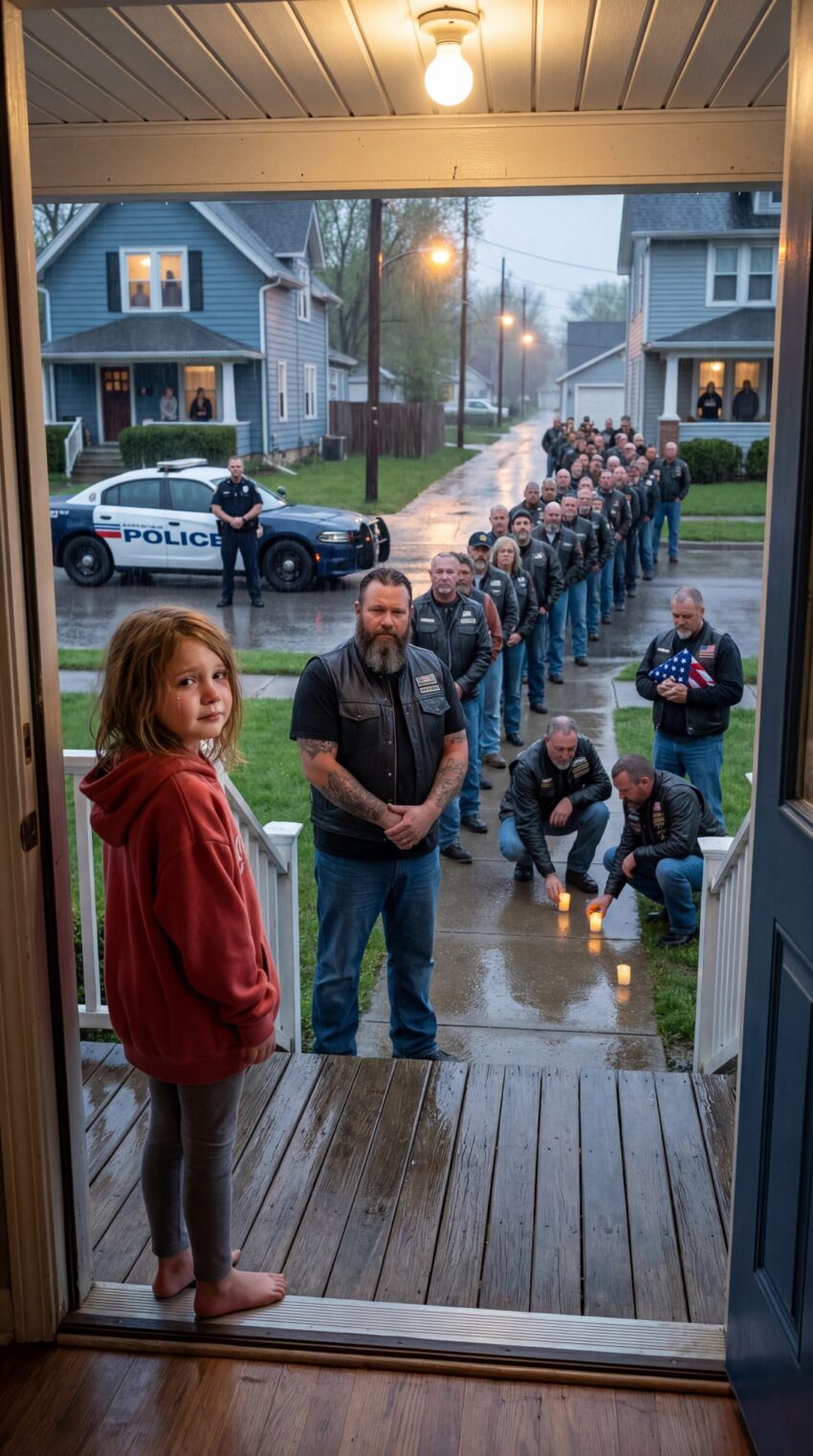
The Night the Street Fell Silent
On a wet November evening in Springfield, Missouri, Maple Grove Drive was supposed to be quiet. It was the kind of street where porch lights turned on at the same time every night and where neighbors measured the rhythm of life by garbage trucks and school buses. But at 7:12 p.m., that rhythm shifted.
Rain fell in steady sheets, tapping against windows and washing the last of the fallen leaves into the gutters. The small gray house at the corner of the block had been unusually still for days. No music. No laughter. No sound of tools from the garage.
Three nights earlier, a patrol car had stopped in front of that house without sirens. Two officers had walked to the door with their hats in their hands. The news they carried was quiet but heavy.
Inside that house now lived eight-year-old Harper Lane.
Her father, Daniel Lane — known among his friends as “Steel Dan” — had passed away suddenly after collapsing at work. He had been a welder, a single father, and a longtime member of a local riding club. He had been the kind of man who fixed his neighbors’ fences without charging them and who never missed Harper’s school recitals.
At 7:18 p.m., Mrs. Kline from across the street noticed the first motorcycle.
It did not roar. It did not draw attention to itself. It simply turned onto Maple Grove and parked neatly along the curb.
Then another followed.
And another.
Engines in the Rain
By 7:25 p.m., the narrow residential street held nearly thirty motorcycles, lined with deliberate care along both sides of the pavement. Their headlights were off. Their chrome dulled under the rain.
The riders stepped off one by one.
Black leather vests darkened by water. Boots pressing into wet asphalt. Shoulders broad, posture steady.
They did not gather in a tight circle. They did not shout greetings. They simply formed a quiet line along the sidewalk in front of Harper’s house.
Across the street, curtains shifted.
A porch door opened.
Mrs. Kline whispered to her husband, “Why are they here?”
Another neighbor pulled out a phone and called the non-emergency police line. “There are dozens of bikers on Maple Grove. It feels tense.”
But the men did not move.
They stood with their hands visible. Some folded in front. Some resting loosely at their sides. Heads slightly bowed.
Rain slid down their jackets and dripped from their sleeves.
A Child Inside
Upstairs, Harper sat cross-legged on her bedroom floor, clutching a worn-out teddy bear. Her aunt, Melissa Rhodes, had been staying with her since the funeral arrangements began. Melissa was trying to explain what the next day would look like — the service, the flowers, the people who would come to say goodbye.
Harper listened without really hearing.
When she noticed the faint hum of engines outside, she stood and walked to her window.
From behind the curtain, she saw them.
A line of riders, silent in the rain.
She did not feel afraid.
She felt confused.
The Police Arrive
At 7:38 p.m., two patrol cars rolled slowly onto the street, their tires hissing against the wet road. Officers stepped out cautiously, scanning the line of leather-clad figures.
One officer approached a tall man near the center of the group. He appeared to be in his late fifties, with a salt-and-pepper beard and calm eyes beneath the brim of his helmet.
“Evening,” the officer said. “What’s going on here?”
There was a pause, not of defiance, but of careful choice.
The bearded man removed his gloves and answered evenly. “We’re not here to cause trouble, officer.”
“You blocking traffic?” the officer asked.
“No, sir. We made sure we’re clear.”
The officer glanced down the street. The bikes were parked properly. No engines revving. No raised voices.
Still, the tension lingered.
Melissa opened the front door slightly and stepped onto the porch, pulling her cardigan tight around her shoulders. Her eyes darted across the line of men.
“What do you want?” she asked, her voice trembling despite her effort to steady it.
The bearded rider turned toward her but did not step forward.
“We’re here for Daniel,” he said.
The words landed awkwardly in the cold air.
Melissa stiffened. “You’re not taking anything from this house.”
A murmur passed quietly through the riders, not angry, but heavy.
The officer raised a hand gently. “Let’s keep this calm.”
Standing Watch
A supervisor arrived shortly after — Sergeant Thomas Avery, known in the department for his patience.
He surveyed the scene carefully before addressing the bearded rider.
“You’ve made your presence known,” Avery said. “Now explain.”
The rider nodded once.
“We’re standing watch.”
“From what?” the sergeant asked.
The man glanced briefly toward the neighboring houses where phones were still pointed at them.
“From noise,” he replied.
The answer puzzled the officers.
But he did not elaborate.
Instead, he reached slowly into his vest pocket. Several hands instinctively shifted closer to belts and radios. The tension sharpened for a heartbeat.
He pulled out his phone, typed a short message, and slipped it back into place.
“That necessary?” Sergeant Avery asked.
“Yes, sir.”
“To who?”
The rider met his eyes calmly. “Friends.”
The Reinforcements
At 8:14 p.m., a distant rumble rolled through the rain.
Not chaotic.
Not wild.
Measured.
Five additional motorcycles appeared at the far end of the street, followed by two pickup trucks with their hazard lights blinking softly. They parked with careful spacing, engines idling low before shutting off.
Three women stepped out of the trucks, dressed in dark coats. One carried a folded American flag inside a clear protective case. Another held a small wooden box.
A tall man in his early sixties removed his helmet and approached Sergeant Avery.
“Evening,” he said respectfully. “We’re here for the watch.”
“What watch?” Avery asked again.
The man nodded toward the house.
“For Daniel Lane.”
The name settled differently now.
The original bearded rider spoke gently. “He rode with us for nearly twenty years. Never missed a charity event. Never missed a hospital escort for kids who needed comfort.”
He gestured toward the upstairs window, faintly lit.
“His daughter’s inside.”
Candles in the Rain
The wooden box was opened carefully.
Inside were small battery-powered candles.
No banners. No speeches. No chanting.
Just light.
One by one, the candles were passed down the line of riders. Each man took one and held it steady in his hands.
The rain continued to fall, but the small lights flickered warmly against the darkness.
Sergeant Avery watched closely. There were no threats in their posture. No sign of aggression. Only quiet intention.
The bearded rider stepped forward slowly, making sure his movements were clear. He knelt near the edge of the walkway leading to Harper’s front door and placed a candle there.
Then he stepped back into line.
A Little Girl Steps Outside
At 8:27 p.m., the front door opened wider.
Harper stepped onto the porch, wrapped in an oversized sweatshirt. Her bare feet curled against the cool wood. Melissa stood close behind her, uncertain but no longer panicked.
The line of riders did not shift.
The bearded man removed his helmet completely and held it under his arm.
“Evening, sweetheart,” he called gently.
Harper scanned the line of faces, rain dripping from their jackets.
“Are you my dad’s friends?” she asked.
The man nodded once.
“Yes, ma’am.”
The word felt soft and respectful.
No one laughed. No one recorded.
One of the women placed the folded flag carefully at the bottom of the porch steps.
“For tomorrow,” she said quietly.
Harper looked down at the candles glowing along her walkway.
“Why are you standing in the rain?” she asked.
The bearded rider answered without hesitation.
“So you don’t have to stand alone.”
The rain softened to a mist.
Harper walked down two steps and picked up the nearest candle. She held it carefully in both hands, studying the warm glow.
Behind her, Melissa wiped her eyes.
Across the street, Mrs. Kline lowered her phone slowly.
Sergeant Avery removed his cap.
The tension that had filled Maple Grove Drive earlier now felt misplaced.
No one had demanded anything.
They had simply shown up.
The Quiet Departure
At 8:41 p.m., without a command or signal, the riders began turning off their candles one by one. The bearded man gave Harper a small nod.
“We’ll see you tomorrow,” he said.
The engines started gently — low and controlled — and the motorcycles pulled away in neat formation.
No loud acceleration.
No drama.
Just taillights fading into the wet night.
By 8:48 p.m., the street returned to stillness.
But on the walkway of a small gray house, drops of wax marked the places where thirty-five men had stood in the rain for a child who had lost her father.
Inside, Harper placed her candle on the windowsill, its soft light glowing against the glass.
And though the house still held grief, it no longer felt empty.
Because sometimes strength does not shout, it simply stands steady in the rain to remind someone small and hurting that love does not disappear when a heartbeat stops, that loyalty is measured not in noise but in presence, that true friendship does not fade when circumstances change, that community reveals itself most clearly in moments of sorrow, that protection can come quietly without intimidation, that compassion often wears unexpected clothing, that dignity can live inside silence, that children remember who shows up more than who speaks loudly, that honor is proven in consistency rather than spectacle, and that even on the coldest nights, a small circle of light can push back the dark just enough to help someone breathe again.