The Morning Everything Was Taken Away
For twenty-four years, Elena Whitmore had walked the children’s wing of St. Catherine’s Medical Center in Columbus, Ohio with the kind of calm that made frightened parents breathe a little easier the moment they saw her. At fifty-three, she had a face that carried softness without weakness, and the quiet patience that only comes from years of staying beside sick children long after everyone else had gone home.
The nurses on the pediatric floor trusted her. The younger staff learned from her. The children, even the ones too small to understand what a nurse truly was, seemed to know they were safer when Elena was near. She was the kind of woman who remembered favorite stuffed animals, knew which child needed the lights dimmed, and could tell the difference between pain, fear, and loneliness just by the way a little hand gripped the blanket.
That Tuesday began like so many others. She tied back her dark blond hair, clipped on her badge, and moved from room to room with steady grace. She reassured a mother whose toddler had a fever that would not seem to break. She sat beside a boy who had just finished a difficult treatment and stayed with him until his breathing slowed and his eyes stopped searching the room in panic.
Then, just before noon, a message came asking her to report to administrative offices.
She almost never went there.
The hallway felt colder than the pediatric floor. The lights were sharper. The silence was too clean. Elena stepped into a small office where a woman in a tailored navy jacket sat behind a desk, a folder already open in front of her.
The badge on the woman’s blazer read Audra Kincaid.
Audra did not ask Elena to sit down.
“Due to internal restructuring, your position has been eliminated effective immediately,” she said in a smooth, practiced voice.
For a moment, Elena truly thought she had heard wrong.
“I’m sorry,” she said carefully. “What exactly are you saying?”
Audra folded her hands. “Your employment is ending today.”
Elena stared at her. “That makes no sense. My reviews have always been strong. If there’s an issue, I deserve to know what it is.”
Audra glanced down at the file as if the answer had already been settled somewhere far above basic human decency.
“A patient family raised a serious concern.”
“Then I’d like to see the complaint.”
“That information is confidential.”
Elena felt the room tilt in a way that had nothing to do with balance. “So I’m being dismissed over something I’m not even allowed to respond to?”
Audra’s expression never changed. “You may file an appeal. However, during the process, you will not be allowed on hospital grounds. And I should advise you that if this matter becomes difficult, a recommendation for future employers may not be possible.”
It was not a conversation. It was a warning.
Stay quiet. Leave gracefully. Accept the damage.
Within fifteen minutes, a security employee was walking her back to her locker, avoiding eye contact as if shame were contagious. Staff members she had once trained kept their focus on their computer screens. No one said her name. No one asked if she was all right.
By the time she reached the door, her name had already been removed from the schedule board.
Her working life, the better part of her adulthood, now fit into a cardboard box: a stethoscope, a coffee mug with faded cartoon stars on it, a framed photograph of her late parents, and the old pediatric clogs with little painted clouds that children always smiled at.
In the parking lot, Elena climbed into her aging Ford sedan, set the box on the passenger seat, and finally let herself cry.
She was not only losing a paycheck.
She was losing the one place that had kept her from feeling how empty her house had become.
When the tears stopped, reality remained. Five hundred and twelve dollars in her bank account. Rent due in less than two weeks. No husband to call. No children to lean on. No idea what would come next.
A Choice That Made No Sense
By late afternoon, Elena had driven to the bus terminal because staying in the city suddenly felt unbearable. Her small hometown of Marlowe, Kentucky, was three hours away, and for the first time in years she wanted something she had denied herself over and over again: distance from the place that had broken her.
The terminal smelled like old coffee, engine fumes, and tired people. She stood in line with her purse tucked close to her side and asked for the next bus heading south.
The clerk tapped a few keys. “Standard fare is forty-nine dollars.”
Elena nodded, then noticed another option on the screen beside him.
Premium cabin.
Wider leather seats. More legroom. Quieter section.
Cost: two hundred thirty-eight dollars.
It was ridiculous.
It was careless.
It was the kind of choice responsible people did not make when they had just lost their income.
Yet after years of putting everyone else first, Elena felt something inside her whisper that she wanted just one small piece of comfort before the world asked more from her.
“I’ll take the premium seat,” she said.
Even as she handed over her card, she knew how foolish it was. That money could have covered groceries. It could have bought a week of breathing room. It could have been the difference between panic and survival.
Still, when she boarded and found seat 2A, she let herself sink into the cool leather and close her eyes. The space around her was quiet. No alarms. No overhead calls. No administrative voices. Just the soft hum of the air vents and the distant murmur of passengers settling in.
For forty minutes, she allowed herself to believe she could simply be still.
Then raised voices broke through the curtain dividing premium from the rest of the bus.
The Man in the Narrow Seat
Elena pulled the curtain back and saw a man in the economy section struggling to lower himself into a seat that was clearly too tight for him.
He was large in the way some men are when life has made them solid rather than merely strong. He wore a weathered leather vest over a dark long-sleeved shirt despite the warmth inside the bus. Pale scar tissue traced up from his hands to his wrists and reached the side of his neck, disappearing under his collar. His right hand trembled as he tried to fasten the seatbelt.
The driver had already lost patience.
“Sir, if you can’t sit properly, I can’t leave the station,” he said.
The man’s jaw tightened. “I paid for my ticket. I’ll manage.”
But it was clear he was in pain. Every movement pulled at skin that had healed hard and uneven. The seat was too narrow, the armrests too unforgiving, and the eyes of strangers were making everything worse.
Elena recognized the look on his face immediately.
Not weakness.
Humiliation.
The kind that hurts more when witnessed.
She stepped closer. “I’m a nurse,” she said gently. “Would you like some help?”
His eyes moved to hers. They were gray, tired, and guarded.
“I don’t need pity.”
“That’s good,” Elena replied, her voice calm. “Because I’m not offering pity.”
The driver exhaled sharply. “We need to move this along.”
Elena glanced back toward the premium curtain, then returned her attention to the man.
“Take my seat.”
He stared at her as if he had misheard.
“No.”
“Yes.”
“Ma’am, I can’t do that.”
“You can,” she said softly. “And you will, because I’m asking you to.”
He shook his head once, stubborn and ashamed. “I’m not taking something you paid extra for.”
Elena almost laughed at the absurdity of the moment. She had lost her job, spent money she should not have spent, and was now arguing with a stranger who looked like life had already demanded more from him than most people could survive.
“Listen,” she said, lowering her voice. “Today has been the worst day I’ve had in years. Let me do one decent thing before it ends.”
Something changed in his expression then. Not surrender exactly. More like recognition.
The driver adjusted the ticketing details while Elena paid the difference to move herself back. It meant even less money in her account. It meant another choice that did not help her future.
Still, when the man accepted the new boarding slip, he held it as if it mattered far beyond comfort.
“You have no idea what this means,” he murmured.
A Conversation Behind the Curtain

Elena helped him into the premium seat, making sure the angle of the chair would not pull too hard against his scars. He moved carefully, with the practiced precision of someone who had learned to live around pain rather than defeat it.
Once he was settled, he let out a breath he seemed to have been holding for miles.
“I’m Reid Callahan,” he said.
“Elena Whitmore.”
For a while, neither spoke. The bus rolled onto the highway while the evening light stretched gold across the windows. Then, perhaps because kindness had made silence feel safe, Reid began to talk.
A house fire eighteen months earlier had changed everything. He had made it out. His wife and six-year-old daughter had not. He survived with burns that never stopped reminding him of that night, and with the heavier burden of continuing to wake up after the people he loved no longer could.
He did not tell the story dramatically. He said it the way men often speak when grief has become part of the bone.
Elena listened the way she had listened to frightened children and exhausted parents for half her life: without rushing, without correcting, without trying to dress pain up into something neat.
When he finished, she said the truth in return.
“I was dismissed from the hospital today.”
He turned to her. “For what?”
“I still don’t fully know.”
“That sounds convenient for them.”
“It does,” she said with a tired smile.
Reid reached into the inside pocket of his vest and pulled out a worn leather card holder. From it, he removed a small business card with the emblem of a motorcycle brotherhood stamped into the corner. His fingers were stiff, but he managed to write on the back before handing it to her.
She looked down.
In this family, kindness is never forgotten.
Elena looked back up. He was watching her with quiet seriousness.
“You gave me back something I was losing,” he said. “Not just comfort. Dignity.”
She swallowed hard, suddenly afraid to feel how much those words mattered.
“I only gave you a seat.”
He shook his head. “No. You saw me as a man before you saw the scars.”
The Call the Next Morning
The next morning, Elena woke in the little white house she rented on a quiet street in Marlowe with the same problems she had gone to sleep with. Bills on the kitchen table. Rent approaching like a storm. Her old life still gone.
She sat at the table in a robe, staring at job listings that all seemed to ask for endless experience while offering too little security to rebuild anything. Around nine, her phone rang.
It was a former coworker from Columbus.
“Elena, I thought you should know,” the woman whispered. “Audra’s already telling people you were unstable on the floor. She’s trying to bury you before you can speak.”
Elena closed her eyes.
“Thank you for telling me.”
After the call ended, she stood at the sink, gripping the counter until the ache in her chest settled.
Then the phone rang again.
Unknown number.
She almost ignored it.
“Hello?”
A deep voice answered. “Ma’am, my name is Wade Turner. I’m a brother of Reid Callahan. He told us what you did for him yesterday. I was hoping you’d meet me for lunch.”
Elena frowned. “I’m sorry, who exactly are you?”
There was the sound of a smile in his voice. “Someone who believes gratitude should be louder than words.”
Against her own instinct to avoid surprises, she agreed to meet him at a diner near the town square.
At noon, fifteen motorcycles rolled into Marlowe.
People turned to watch from sidewalks and storefront windows as the riders parked in a clean line outside the diner. They were broad-shouldered men and women in road-worn leather, not loud in the reckless way people imagine, but steady, disciplined, and purposeful.
Inside, Wade Turner rose from a booth when Elena approached. He was in his early sixties, silver at the temples, with the kind of presence that made people lower their voices without being asked.
He motioned for her to sit.
“Reid says you helped him when nobody else on that bus wanted to get involved,” Wade said.
“I didn’t do anything extraordinary.”
“That’s usually what extraordinary people say.”
Elena let out a weak laugh she had not planned on giving.
Wade folded his hands. “Tell me what you need right now.”
She opened her mouth to insist she was fine. The words almost came.
Then the truth arrived first.
“I need work,” she said quietly. “I need to pay my rent. I need one honest chance to start breathing again.”
Wade nodded once, as if that was all he had needed to hear.
“Be home tomorrow at eight.”
When the Street Began to Tremble
At 7:52 the next morning, Elena was standing by her front window with a cup of coffee she had barely touched when she felt a faint vibration under the floorboards.
At first she thought it was construction somewhere down the block.
Then the sound grew.
Deep. Layered. Rolling.
She stepped onto the porch just as the first motorcycle came into view.
Then another.
Then another.
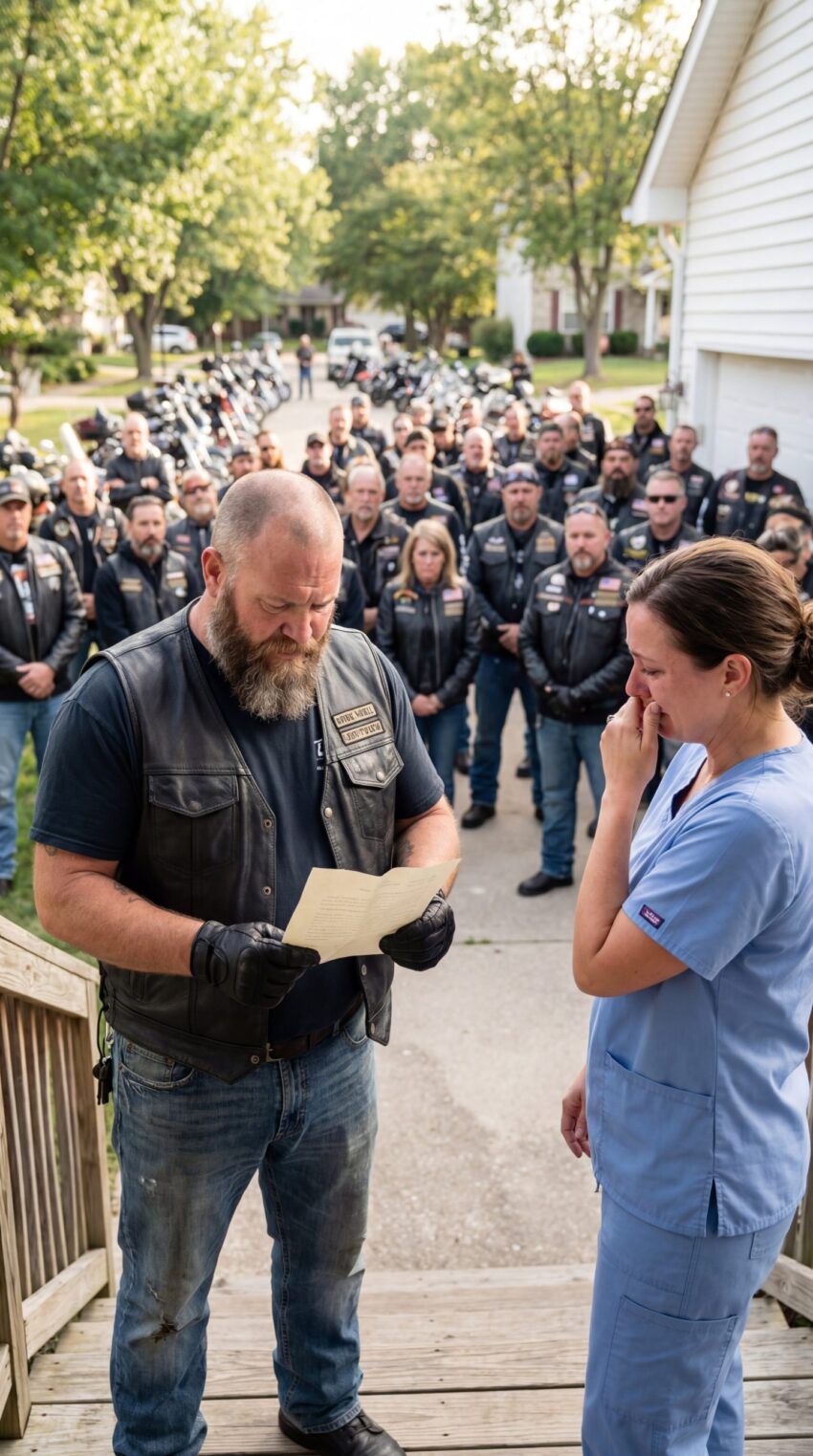
By the time the last one turned onto her street, ninety-nine motorcycles had filled the quiet road outside her house. Neighbors opened curtains. Children pressed their faces to windows. A mail carrier stopped in the middle of the sidewalk and simply stared.
The riders parked with surprising order, engines fading one by one until the street fell into a silence that seemed even larger than the sound had been.
Wade stepped forward with a manila envelope in one hand and a smaller white envelope in the other.
Elena could barely speak. “What is happening?”
Wade’s expression was steady, but there was warmth beneath it.
“The truth is catching up to the people who ran from it.”
He handed her the larger envelope first.
Inside were copied documents, printed emails, and a signed statement from a hospital board attorney. Audra Kincaid had been removed from her position and taken into custody that morning as part of an investigation into misdirected charitable funds and false internal reporting. Several employees had now come forward. Elena’s dismissal had been used as a shield to keep attention away from larger misconduct.
Her eyes moved over the page once, then again, hardly believing the words.
Wade spoke gently. “The board wants you back.”
Elena looked up.
“Back?”
“Not just as staff nurse,” he said. “They’ve asked whether you’d accept the role of interim pediatric care director while they clean house.”
She pressed a hand to her mouth.
The smaller envelope contained a cashier’s check and a short list of paid confirmations: rent, utilities, car insurance, and grocery credit at the market downtown.
Elena stared at them, overwhelmed. “I can’t take this.”
Wade smiled faintly. “You already did. Yesterday, when you treated one of ours like his life still had worth.”
Then he handed her the white envelope.
Her name was written across the front in careful block letters.
Inside was a note from Reid.
Thank you for looking at me and seeing a person instead of a wound. Some kindnesses do not end where they begin. Some return with an engine, a promise, and a street full of people who remember.
Elena read it twice before the tears blurred the page.
Walking Back Through the Same Doors
A week later, Elena returned to St. Catherine’s Medical Center.
The same building looked different when truth had entered it.
This time, no one escorted her out. The board chair met her at the entrance. A formal apology had already been issued. Her lost wages were restored. Staff members who had looked away now stopped to greet her, some with shame in their eyes, others with relief.
Elena accepted all of it with grace, but not blindness. She had learned that institutions could fail as easily as people could. What mattered was what one chose to become after the failure was revealed.
When she stepped back onto the pediatric floor, the familiar sounds of monitors, rolling carts, and soft voices filled the air. A little girl in a princess bandage looked up at her from a hospital bed and smiled.
And just like that, Elena knew she had not lost the most important part of herself after all.
She still belonged to the work.
She still knew how to comfort fear.
She still knew how to stay.
That evening, her phone rang just after sunset.
It was Reid.
“I heard you went back,” he said.
“I did.”
“How did it feel?”
Elena looked out the kitchen window at the darkening Kentucky sky and smiled to herself.
“Like stepping into a room that remembered me.”
There was a pause, then the softened sound of his voice.
“I’m glad.”
They spoke for almost an hour. About recovery. About grief. About the strange ways people survive one impossible season only to discover another door quietly opening. Before the call ended, they made a plan together.
They would create a travel fund for burn survivors, long-term patients, and medically fragile families who needed to travel with dignity instead of desperation.
It would begin small.
But so had everything that mattered.
The Kindness That Came Back Like Thunder
Months later, people in Marlowe still talked about the morning the motorcycles lined Elena Whitmore’s street. Some remembered the sound first. Others remembered the sight of neighbors gathering on porches in silence. But Elena remembered something simpler than all of that.
She remembered a man trying not to wince in a seat too small for his pain.
She remembered her own hand lifting a curtain.
She remembered making one choice that did not solve her life, did not protect her future, and did not make practical sense.
And yet that one choice had traveled farther than she ever imagined.
Because sometimes compassion does not arrive as a grand speech or a perfect rescue.
Sometimes it is a seat given up quietly.
A voice lowered gently.
A stranger treated like he still belongs in the world.
And sometimes, when kindness is offered with no demand attached to it, life sends it back in a form so powerful it can shake an entire street.
Elena never forgot that.
Neither did Reid.
And neither did the people whose lives were changed because one weary nurse, on the worst day of her life, still chose to make room for someone else.
Words to Carry in Your Heart
There are moments when life strips away the title you wore, the routine you trusted, and the place you thought would always welcome you, but even then, the deepest part of who you are cannot be taken unless you surrender it yourself.
A kind act does not become less valuable simply because the world is being unkind to you at the same time, and often the most meaningful goodness is the kind offered by people who have every reason to turn inward but choose generosity anyway.
The people who carry scars are not always asking to be rescued; sometimes they are simply hoping not to be reduced to the worst thing that ever happened to them.
Dignity is one of the greatest gifts a person can offer another human being, because when someone feels seen instead of judged, they begin to remember that their life still holds weight, purpose, and belonging.
Not every loss is the end of your story, and not every closed door means you were rejected by life; sometimes it only means the truth has not arrived yet, and what is coming next will fit your heart far better than what was taken.
There is a quiet strength in people who keep choosing softness after disappointment, because staying gentle in a harsh world is not weakness at all; it is one of the bravest forms of courage a person can live.
Real gratitude is not made of pretty words alone; it is built through loyalty, action, remembrance, and the willingness to show up for someone when they least expect anyone to come.
The world changes in ways we rarely get to measure when ordinary people decide that another person’s pain is worth noticing, because compassion has a reach that extends far beyond the moment in which it is first given.
Sometimes the help that saves you does not come from the people with polished titles or elegant offices, but from those who understand suffering firsthand and therefore know exactly how much mercy can matter.
If you ever wonder whether one small choice can truly make a difference, remember this: many lives begin to change not with power, wealth, or influence, but with a single moment when one person decides that another person will not face the day alone.