The Morning Everyone Misread
The Thursday morning outside Brookdale Elementary in Columbus, Ohio, looked so ordinary that no one would have expected it to be remembered for years.
Parents were easing their cars toward the curb in a slow, impatient line. Teachers stood near the front doors with bright smiles and coffee cups warming their hands. Backpacks bounced against small shoulders. Children hurried through the gate, some laughing, some dragging their feet, all of them moving inside the safe routine of a school day.
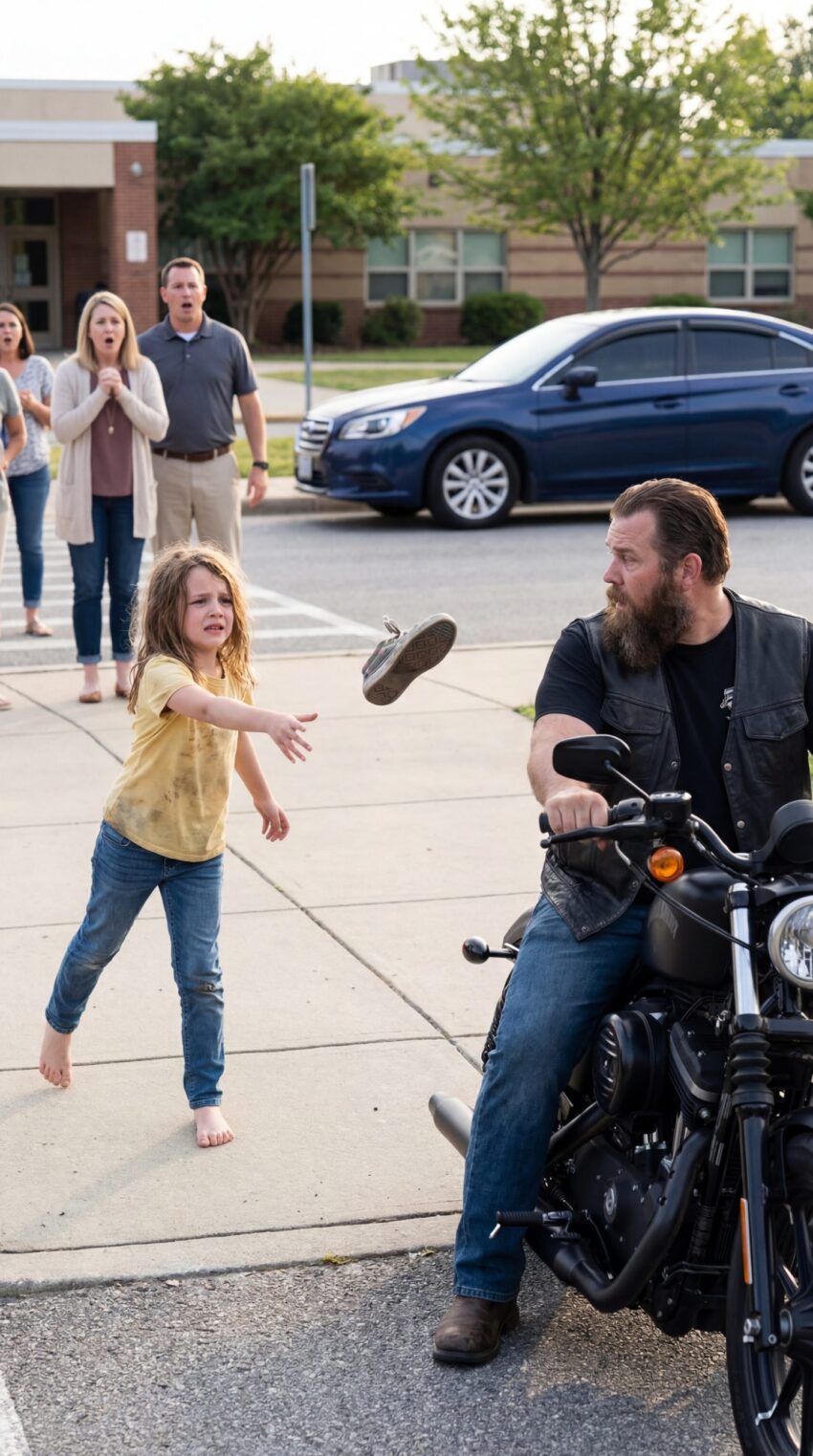
And just beyond that routine sat a man on a motorcycle.
He was parked near the sidewalk, a little away from the main entrance, where he could see the school but did not seem interested in calling attention to himself. His engine was off. His gloved hands rested loosely on the handlebars. He wore a faded leather vest over a gray shirt, dark jeans, and boots that looked as though they had crossed half the country. He had a broad frame, tired eyes, and the kind of stillness that made people uncomfortable when they did not know how to read it.
Some parents noticed him right away.
Then more parents noticed the ones noticing him.
Soon the whispers began.
“Why has he been sitting there so long?”
“Is he waiting for someone?”
“I don’t like this.”
No one walked over to ask.
No one wanted to be the first.
At seven years old, Tessa Winrow had no idea why adults always took so long to trust what they felt.
She stood near the gate beside her mother, her small hand tucked inside hers, and stared past the crowd with a tightness growing in her chest. She had seen the dark blue sedan again. The same one from the afternoon before. The same one that had idled too long near the crosswalk. The same one whose driver had kept glancing toward the doors like he was counting something.
Yesterday, she had not known what to do.
Today, when she saw it again, parked across the street with the engine running and the windows dim behind the glass, the fear returned so fast it made her skin go cold.
Then she saw the biker.
He was not smiling. He was not talking to anyone. But somehow he looked like someone who would listen fast if she made him.
Tessa pulled her hand free.
“Tessa, wait,” her mother said, startled.
But the little girl was already running.
The Shoe That Changed Everything
The crowd had barely enough time to understand that a child was heading toward a stranger before Tessa did the one thing no one expected.
She stopped, bent down, yanked off one of her sneakers, and threw it.
The shoe struck the biker squarely in the shoulder.
Gasps burst from the parents around them.
A man near the curb threw up his hands. “What on earth is she doing?”
A teacher took a step forward. “Honey, no!”
Tessa stood there in one sock, breathing hard, her eyes fixed on the biker’s face.
For a second, he did not move.
He did not shout.
He did not jerk back in anger.
He simply turned his head, slowly, and looked at her.
There was nothing playful in her expression. Nothing rude. Nothing wild. Only urgency.
She took one small step closer and whispered something that no one else could hear.
The biker’s face changed.
It was not dramatic. Most people would have missed it. But the softness vanished from his eyes, replaced by something sharper, older, and instantly alert.
Tessa’s mother rushed in and seized her daughter gently by the arm.
“What are you doing?” she said, shaken. “You can’t run off like that.”
Tessa twisted to look back at the biker. “He didn’t see.”
“See what?” her mother asked.
But Tessa did not answer.
Phones were already out. A few people had begun recording. The whispers turned faster, meaner, more confident.
“This is exactly the problem now. Kids think they can do anything.”
“That man shouldn’t be sitting out here in the first place.”
A teacher with warm eyes and a patient voice knelt beside Tessa. “Sweetheart, slow down. Tell me what happened.”
Tessa swallowed and pointed with her bare foot toward the street.
Not at the biker.
Past him.
Across the road.
Everyone turned.
The dark blue sedan was still there, quiet and motionless except for the faint vibration of the idling engine.
At first glance, nothing seemed wrong.
At second glance, it felt deeply wrong.
The Stranger Across the Street
The biker swung one leg off the motorcycle and stood.
He was taller than people had expected, heavier in the shoulders, with the kind of presence that made the air shift around him. That movement alone was enough to send a fresh wave of alarm through the crowd.
A father moved his son behind him.
The school security officer began striding over from the gate.
“Sir, I need you to stay right there,” the officer called.
The biker did not argue. He did not puff up or challenge anyone. He kept his attention on Tessa.
“What did you say?” he asked her in a low, steady voice.
Tessa’s lips trembled. “He’s back.”
The teacher frowned. “Who’s back?”
Tessa lifted her shaking hand and pointed again at the sedan.
“The man in that car.”
The crowd quieted in a new way now, no longer fueled by judgment but by uncertainty.
The biker followed her line of sight. His jaw tightened.
The security officer reached him. “I said don’t move any closer.”
The biker glanced at him briefly, then back to the car. “Watch the driver’s hands.”
The officer looked irritated. “Sir, I’m handling this.”
Tessa stepped forward from her mother’s side, her voice suddenly louder than anyone expected.
“He keeps looking at the doors.”
That landed differently.
A teacher stood up straighter. A few parents turned fully toward the street now instead of half-looking.
The sedan remained in place.
Too patient.
Too careful.
The biker took a slow step off the curb.
“Stop right there,” the officer warned.
Then Tessa said the words that made everything change.
“He did it yesterday too.”
The Man Who Knew the Pattern
The biker stopped for one beat, as though that sentence had confirmed something forming inside him.
He did not rush. He did not perform for the crowd. He walked with a quiet purpose that somehow felt more serious than panic.
The security officer moved with him now, close enough to intervene, but not close enough to stop what was already happening in the minds of the adults nearby. They were no longer only watching the biker. They were watching the sedan.
The driver remained hidden behind the tinted glass.
The biker crossed the street.
Several parents shouted at once.
“Don’t go over there.”
“Someone call the police.”
“This is getting out of hand.”
The officer spoke urgently into his radio as he followed. A second staff member ushered children toward the building. Teachers stopped waving families in and instead began pulling the entrance doors wider, ready to bring everyone inside if needed.
Tessa stood frozen beside her mother, who now held both her arms but had stopped trying to scold her. Fear had replaced embarrassment.
Across the street, the biker reached the driver’s side window and paused.
He leaned just enough to look inside.
Then the driver moved.
It was quick. A sudden downward motion, like someone reaching under the seat or near the console.
The biker reacted instantly.
His hand shot through the open window gap before anyone could process it. His posture shifted from watchful to controlled force, not wild, not reckless, but exact.
The crowd screamed.
The officer ran the last few steps.
“Step back now!”
The biker’s voice came low and hard, cutting through the noise.
“Everyone stay back.”
For the first time that morning, Tessa saw something in his face that matched the fear in her own chest.
Recognition.
Not confusion. Not guesswork.
Recognition.
The Truth Inside the Car
By the time the police sirens echoed around the corner, the entire drop-off lane had changed shape. Parents had pulled their children closer. Teachers had moved students toward the doors. Nobody was whispering now. Nobody was casually judging anything.
The biker still stood at the driver’s window, his arm braced, his body angled between the car and the school as though instinct had placed him there before thought could.
The officer reached him and grabbed his shoulder, but the biker only said, “The driver was reaching below the dash.”
Two police cruisers arrived within seconds. Officers came out fast, voices firm and practiced.
“Driver, show your hands.”
“Step away from the vehicle.”
The biker slowly released his hold and stepped back with his hands visible. Calm. Composed. No sign of wanting credit. No sign of wanting trouble.
The driver was pulled from the car and placed in restraints.
One officer leaned inside the sedan.
Then his expression changed.
Another officer joined him, looked, and immediately called for additional units.
That was when the fear spread for real.
Not because anyone knew every detail yet, but because the professionals did, and their faces said enough.
A detective who arrived moments later spoke quietly with the security officer, then with the biker, then with Tessa’s mother. Across the street, evidence bags began to appear.
Tessa, tucked against her mother’s side, watched everything with wide, tired eyes.
An officer crouched down near her and softened his voice.
“Can you tell me what made you notice the car?”
Tessa looked at the pavement for a moment. “Yesterday it was parked there too. He kept watching the doors. And he reached down when kids were walking out.”
The officer nodded carefully. “Why didn’t you tell someone then?”
She blinked back tears. “I thought maybe I was wrong. But today he came back.”
Her mother closed her eyes for a second, pain crossing her face. “Oh, sweetheart.”
The officer looked toward the biker. “And you?”
The biker answered without drama. “Same pattern. Long wait, running engine, sightline on the entrance, eyes moving with the children instead of the parents.”
The detective studied him. “You’ve seen that before?”
A pause passed between them.
“More than once,” the biker said.
“Former law enforcement?”
The biker gave a small nod. “Former deputy. A long time ago.”
That explained something about the steadiness in his movements, the disciplined way he had intervened, the absence of ego in the middle of chaos.
But it did not explain why his eyes had looked so haunted the moment he saw the evidence bag.
A Name From Long Ago
The school parking lot slowly emptied under police guidance. Morning announcements had already started inside the building, but many parents lingered outside, unable to leave while questions still hung in the air.
Tessa sat on a low brick planter wrapped in a borrowed cardigan from one of the teachers. One of her shoes was still missing somewhere near the biker’s motorcycle.
The biker stood beside his bike, helmet hanging loosely from one hand, speaking with the detective. His name, people now learned, was Colter Vance.
He looked tired in the way some people only look when they have carried old memories too far without setting them down.
The detective returned from one of the patrol cars holding a clear evidence sleeve.
Inside was a printed photograph.
When Colter saw it, his face changed so slightly that only someone watching closely would have noticed. But Tessa noticed.
The detective held the sleeve lower. “Do you recognize this child?”
Colter stared at the picture.
It was an old image of a little girl, taken from too far away, the kind of picture that should never have existed at all. Written beneath it in dark ink were notes about school hours and pickup times.
But what caught Colter was not just the image.
It was the name scrawled in the corner.
He exhaled as though something inside him had cracked open.
Tessa slipped off the planter and approached slowly. Her mother started to stop her, then let her go.
“What is it?” Tessa asked.
Colter hesitated, then crouched to her height.
From the inside pocket of his vest, he pulled out a folded photograph so worn at the edges it looked as though it had been opened hundreds of times.
He unfolded it with care.
Inside was an old picture of a younger Colter standing beside another man in uniform. Between them stood a little girl with bright eyes and a crooked ponytail.
Tessa stared at it.
Then back at him.
Then back at the photo again.
“Who’s that?” she asked softly.
Colter’s voice grew quieter than before.
“That’s your father.”
Tessa froze.
Her mother stared at him in disbelief. “What did you say?”
Colter stood slowly. “Evan Winrow and I worked together years ago. He kept that photo in his locker for months before he ever showed it to me because he said he talked about his daughter so much people were going to think she ran the station.”
Tessa’s mother covered her mouth.
Evan had passed away when Tessa was very young. She knew him mostly through stories, old pictures, and a handful of phrases people repeated because they could not bear for her to lose even those.
One of those phrases had come back to her that morning.
If something feels wrong, trust it.
Colter looked at Tessa again. “Your dad used to say you could spot trouble before grown men finished arguing about it.”
A tiny laugh escaped through her tears.
“He said that?”
Colter nodded. “More than once.”
The Girl Who Was Right
The detective later explained only what needed to be explained.
The man in the sedan had no good reason to be parked there repeatedly, and what officers found in the vehicle confirmed that the attention he had been giving the school was deeply concerning. The details stayed mostly with the police, where they belonged. Parents did not need every fact to understand how close that morning had come to becoming something far worse.
What mattered was this:
A little girl had noticed what adults overlooked.
A man everyone mistrusted at first had chosen to act when seconds mattered.
And because both of them trusted what felt wrong, the day ended safely.
By noon, the story had already started traveling through Columbus. But the versions moving fastest online missed the truth in familiar ways. They talked about a child throwing a shoe at a biker. They talked about a strange scene at a school. They talked about the shock.
They did not understand the heart of it.
The heart of it was not chaos.
It was courage.
Before Tessa went inside for class, a teacher returned her missing sneaker. The sole was dusty, and one lace had come loose, but she slipped it on like something important had been restored.
Colter set his helmet on his bike and prepared to leave.
Tessa ran over one more time.
“Mr. Vance?”
He turned.
She held out the old photograph he had let her keep for a moment before handing it back. “Thank you for listening.”
He looked at her for a long second, then smiled in the smallest, gentlest way.
“Thank you for making me.”
She thought about that as she walked toward the school doors, her mother’s hand resting lightly on her shoulder this time instead of gripping it in fear.
Behind her, the motorcycle engine came to life in a low, steady rumble.
Not frightening now.
Just steady.
Like someone leaving after doing exactly what he had come to do, even if he had not known that was why he was there.
Tessa turned once before stepping inside.
Colter lifted two fingers from the handlebar in a quiet goodbye.
Then he rode away.
And for the rest of her life, whenever people doubted what she noticed, Tessa remembered that morning outside Brookdale Elementary, when nearly everyone got the story wrong at first, and the only thing that saved the day was the choice to trust a small voice that refused to stay silent.
A Quiet Reminder That Stayed Behind
Some stories are not about who looks powerful at first glance, but about who chooses to pay attention when everyone else is busy judging the surface.
Some warnings do not come in polished language or perfect timing, because fear often arrives in the small voice of a child who only knows that something feels wrong and needs one brave person to believe her.
The people who protect others are not always the ones the crowd feels comfortable with, and sometimes the safest hands in a hard moment belong to someone the world had already decided to misunderstand.
A child’s instincts should never be dismissed simply because they are young, because children often notice patterns adults explain away in the name of politeness, routine, or hesitation.
There are days when courage looks loud and dramatic, but there are also days when courage looks like a little girl standing on one sock in front of a crowd and refusing to pretend she saw nothing.
The strongest kind of wisdom is not always found in official titles or perfect appearances, because real discernment lives in people who have learned to recognize danger, remain calm, and move with purpose instead of pride.
Every school, every family, and every neighborhood becomes safer when people stop worrying so much about seeming awkward and start taking quiet concerns seriously before they grow into something harder to stop.
The world changes in meaningful ways when adults choose to listen with humility, because one moment of genuine attention can protect a child, restore trust, and prevent a lifetime of regret.
There is something deeply powerful about the fact that help arrived through two people who should have been ignored by the crowd, one because she was small and one because he looked like someone others were prepared to fear.
In the end, the morning was saved not by appearances, not by assumptions, and not by whoever spoke the loudest, but by the simple, life-changing choice to notice, to listen, and to act before it was too late.