The Morning Mrs. Willow Asked for Help
The smell of bacon, toast, and fresh coffee had settled so deeply into Maple Street Grill that it felt like part of the walls. Every table carried years of conversation in its scratches and faded shine. The old clock above the pie case ticked with the same patient rhythm it had kept for decades, and on most mornings, the diner moved in a familiar pattern that never really changed.
Cora Bennett knew that pattern by heart.
At twenty years old, she could tell what kind of day a customer was having by the way they set down a coffee mug or folded a napkin. She knew who wanted extra jam without asking, who needed the corner booth for privacy, and who came in just to sit somewhere warm for an hour before going back to a life they did not talk about.
She also knew Mrs. Willow Hart.
The old woman came every Tuesday and Friday at exactly nine in the morning. She always asked for one pancake, one cup of decaf, and a little dish of strawberries if the kitchen had any left. She moved slowly, carefully, as if every step had to be negotiated with her own body before it could happen. Her back had curved so much over the years that it seemed like life itself had pressed a permanent weight onto her shoulders.
Still, she always thanked Cora with a soft smile.
That morning, though, something felt different before Mrs. Hart even walked in.
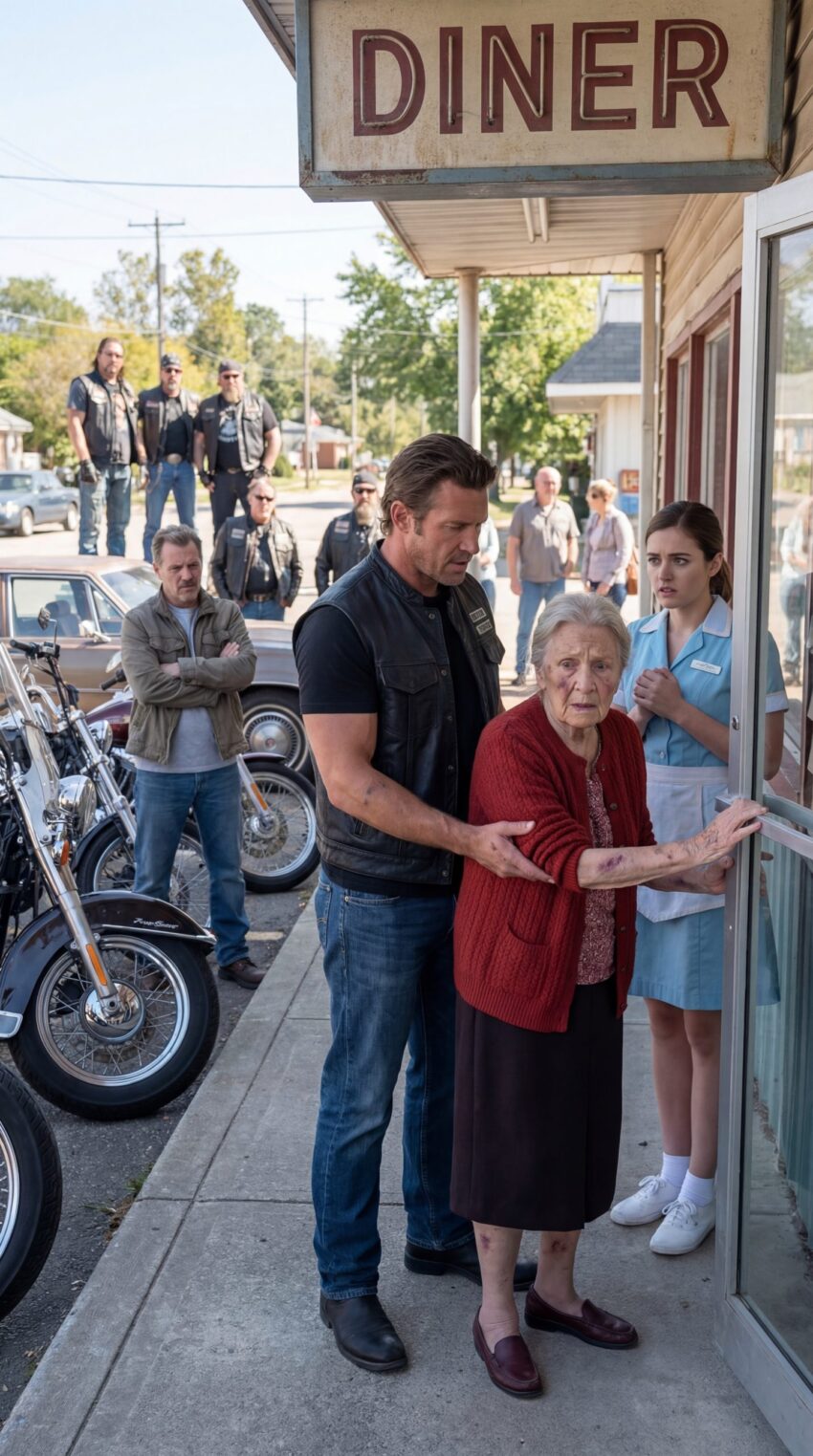
The roar of motorcycles rolled through the street outside and shook the front windows. A few customers lifted their heads. Others went quiet. Cora looked toward the glass and saw six bikes lined up near the curb, all chrome, leather, and heavy engines. A group of riders stepped inside, their boots striking the floor in slow, steady rhythm.
They were from a local riding club called the Iron Saints.
People in town talked about them like they were trouble even when they had no proof. Most had never exchanged more than a few words with the men. They judged the leather vests, the scarred hands, the deep voices, and decided that was enough.
At the center of the group was a man everyone called Boone Mercer.
He was broad-shouldered, heavily built, with silver starting to show at the sides of his dark beard. He looked like someone carved out of oak and road dust. When he sat down in the back corner with his crew, the room seemed to shift around him.
Cora’s manager, Dale, leaned near her and muttered, “Just keep their coffee full and don’t stare.”
Cora nodded, though she was already thinking about the way Boone had pulled out a chair for one of the older riders before taking his own seat. It was a small thing. The kind of thing most people never noticed.
A few minutes later, the bell above the door rang again.
Mrs. Hart had arrived.
The Woman in Booth Four
Cora hurried over with her usual smile. Mrs. Hart was wearing a pale blue cardigan that had once been elegant but now hung loosely on her thin frame. Her shoes were polished, though worn at the edges. Her white hair was pinned carefully in place, as if she still believed in maintaining dignity no matter what the day held.
“Good morning, Mrs. Hart,” Cora said gently.
The old woman looked up and offered that same faded smile. “Good morning, sweetheart. Booth four, if it’s free.”
“It’s always waiting for you.”
Mrs. Hart gave a quiet little laugh and made her slow way toward the booth, one hand dragging along the top edge of the counter for balance.
Cora brought her breakfast and watched from a distance while refilling other tables. Mrs. Hart ate the way she always did now—slowly, methodically, taking small bites, resting often. It took nearly an hour for her to finish a single pancake. Once, Cora imagined, she had probably been graceful. There were traces of that woman still left in the careful way she held her fork and folded her napkin.
But there was something else, too.
Fear.
Cora had noticed it for months.
She had seen faint marks on Mrs. Hart’s forearms that looked too much like the shadow of rough fingers. She had seen the woman flinch when someone reached too quickly near her. She had seen the way her breathing changed whenever it got close to ten-thirty.
That was when her nephew usually arrived.
His name was Travis Cole, and every time he came in, the air around Mrs. Hart changed. Her shoulders tightened. Her eyes dropped. Her hands began to shake.
He was not loud. In some ways, that made him worse. He spoke through clenched teeth, with thin patience and hard eyes. He never shouted across the room. He did not need to. The way he grabbed her elbow, the way he rushed her, the way he acted as though even helping her into the car was an inconvenience—those things said enough.
Cora had seen him once pull Mrs. Hart up so quickly that the old woman gasped in pain.
When Cora asked later if she was alright, Mrs. Hart only said, “I’m just slow these days, dear. That’s all.”
But it was not all.
Cora knew that.
She just did not know what to do with what she knew.
The Moment No One Moved
At 10:08, Mrs. Hart folded her napkin, placed a few bills carefully beside her plate, and prepared to stand.
Cora had seen this part many times. It always took effort, but on most days, Mrs. Hart managed after two or three tries. She would brace both palms against the table, push, pause, breathe, and eventually rise.
This time, she pushed once and sank back down.
Then again.
Then a third time.
Her hands trembled. Her mouth tightened in pain. A small breath escaped her lips, the kind of sound someone makes when they are trying very hard not to let the room hear how much something hurts.
Cora stopped in the middle of pouring coffee.
At nearby tables, people noticed and then looked away. One man opened his newspaper wider. A couple near the window became suddenly very interested in their toast. It was not cruelty exactly. It was that softer, sadder failure people fall into when they hope someone else will step in first.
Mrs. Hart tried one more time and could not do it.
Then, slowly, she turned her head.
Her eyes moved past the truck driver at the counter, past the family by the door, past Cora and Dale and the regulars who had known her face for months.
They settled on Boone Mercer.
The laughter at the bikers’ table faded before she even reached them.
Using the backs of chairs and the edge of a nearby table for support, Mrs. Hart made her way across the diner one careful step at a time. The whole room watched now. Even the kitchen seemed to go still.
She stopped in front of Boone and tipped her chin upward to meet his eyes.
Her voice was so soft Cora almost missed it.
“Excuse me,” Mrs. Hart said. “Would you help me stand?”
Silence dropped over the room.
Boone did not answer right away. He looked at her—not at her age, not at her bent back, not at the awkward way she leaned to one side, but straight into her face as if he were listening for something beyond the words.
Then he pushed his chair back and stood.
For a second, Cora’s heart lurched with fear, though she did not know why. Maybe because the moment felt too large. Maybe because everyone had built these men into something hard and dangerous in their minds.
But Boone did not loom over Mrs. Hart.
He knelt.
The leader of the Iron Saints dropped to one knee on the diner floor until he was level with her eyes.
His voice, when he spoke, was low and gravelly, but astonishingly gentle.
“Tell me where it hurts, ma’am.”
Mrs. Hart pressed a trembling hand to her lower back. “There, mostly. And my legs don’t always listen anymore.”
Boone nodded once. “Alright. Then we won’t ask them to do the work.”
He looked over his shoulder. “Mack, Eli, come here.”
Two of the riders stood immediately and walked over without a word.
Boone turned back to Mrs. Hart. “My name is Boone. We’re going to help you up slowly. I need you to breathe and let us carry the weight. Can you do that for me?”
A tear slipped down the old woman’s cheek.
“I can try.”
“That’s enough,” he said.
A Kindness the Room Had Forgotten
Boone positioned one hand lightly near Mrs. Hart’s elbow. Mack stood to her left. Eli moved behind her, careful and steady.
“On three,” Boone said. “One… two… three.”
They lifted her with such care that it looked less like effort and more like reverence.
Mrs. Hart rose slowly, supported on both sides, her face tightened for one tense second—and then changed.
The pain eased.
Her shoulders, though still curved, straightened more than Cora had seen in months. Her eyes widened with pure surprise.
“Oh,” Mrs. Hart whispered. “Oh my goodness.”
Boone stayed close in case her knees failed. “You with us?”
She nodded, crying openly now. “Yes. Yes, I am.”
Around them, the room remained frozen.
Cora could not stop staring.
She had watched plenty of people ignore Mrs. Hart. She had watched others offer sympathy from a distance, the kind that made them feel good without costing them anything. But this was different. These men were not making a show of helping her. They were simply helping her, like it was the most natural thing in the world.
Boone motioned toward the door. “Let’s get your coat on before your ride gets here.”
At the word ride, something dimmed in Mrs. Hart’s expression. Cora saw it immediately.
Boone saw it too.
He did not comment. He just walked with her to a table by the front window and helped settle her into a chair with more comfort and respect than many people showed their own relatives.
Then he asked, “Would you like to sit a minute before heading out?”
Mrs. Hart gave a tiny nod. “That would be nice.”
The riders stayed with her.
Not crowding. Not questioning. Just nearby.
And that was when Cora knew she could not stay quiet anymore.
The Note Under the Plate
Her hands were shaking before she even reached for the pen in her apron.
Dale saw her standing still near the register and frowned. “You alright?”
Cora barely heard him.
Her mind was racing through every uneasy memory she had tried to explain away. Mrs. Hart’s bruised arms. The frightened glances. The way she became smaller in spirit whenever Travis was due to arrive. The terrible look of relief on her face when Boone had simply been kind.
Cora grabbed a napkin.
She did not have room for a speech. She did not have proof neat enough for a report. All she had was instinct sharpened by months of watching something wrong unfold in small pieces.
She wrote six words.
He hurts her. Please stay here.
She folded the napkin once, then again.
At the back of the diner, Boone had risen to fetch Mrs. Hart’s purse from the booth. For one brief second, his table stood empty except for mugs and plates.
Cora picked up a coffee pot to make her movement look normal and walked over with every nerve in her body sounding the alarm. She gathered dishes with one hand and, with the other, slid the folded napkin beneath a plate near Boone’s seat.
Then she turned and walked away before her courage could fail.
She expected someone to stop her.
No one did.
From behind the counter, she kept her head down but watched through the reflection in the pie case glass. One of the riders, Eli, returned first. He picked up the plate, saw the napkin, and paused. His eyes flicked once toward Cora.
Then he handed it to Boone.
Boone unfolded the paper.
The shift in his expression was immediate.
Not loud. Not dramatic.
Just stillness.
A colder kind of attention settled over his face. He folded the napkin again and tucked it into his vest pocket. Then he sat beside Mrs. Hart and, in the same calm tone as before, said, “Looks like we’ve got time. Why don’t we keep you company until your ride shows up?”
Mrs. Hart looked confused, then relieved.
“You don’t have to do that.”
Boone gave her the smallest smile. “I know.”
The Man at the Door
At 10:31, an older gray sedan pulled sharply into the lot.
Cora’s stomach dropped.
Travis Cole stepped out wearing a pressed jacket and the same impatient expression he always carried, like the whole world had asked too much of him simply by needing basic decency. He shoved the diner door open, and the bell above it rang so hard it bounced twice.
His eyes went straight to Mrs. Hart.
Then to the men sitting around her.
He stopped.
For the first time since Cora had known him, he looked uncertain.
“Aunt Lorraine,” he said, forcing a smile that never reached his eyes. “You ready?”
Mrs. Hart shrank back a little before catching herself.
Boone stood.
He did not raise his voice. He did not step aggressively. He simply stood there between Travis and the old woman, solid as a wall.
“She’ll be ready in a minute,” Boone said.
Travis gave a short laugh. “And you are?”
“A friend,” Boone replied.
The word landed in the diner like a stone dropped into water.
Cora saw Travis’s jaw tighten. He looked around the room and must have realized that this time, people were actually watching him. Not glancing and turning away. Watching.
Mrs. Hart’s hands trembled in her lap.
Boone looked at her, not Travis. “Ma’am, do you want a few more minutes?”
It was such a simple question, but Cora saw what it did to her.
Choice.
Maybe no one had offered her that in a very long time.
Mrs. Hart swallowed. Her voice came out barely above a whisper.
“Yes. I think I do.”
Travis took a step forward. “She needs to come home.”
Boone’s expression did not change. “Then she can say that herself.”
The room was so quiet Cora could hear the hum of the refrigerator behind the counter.
Mrs. Hart looked down at her hands. Then she looked up at Boone. Then, slowly, she turned toward Cora.
Cora stepped out from behind the counter before she could talk herself out of it.
“She doesn’t seem comfortable leaving yet,” she said, her voice unsteady but clear. “And if she wants, I can call someone to make sure she gets home safely.”
Travis stared at her as if she had crossed a line no one was supposed to cross.
Maybe she had.
But once it was crossed, it did not feel frightening anymore. It felt necessary.
Dale, who had said nothing all morning, finally moved beside her.
“Maybe that’s best,” he muttered. “Maybe we slow this down.”
It was a weak sentence, late and imperfect, but it was still more than silence.
Mrs. Hart pressed a hand to her chest. Tears gathered again in her eyes.
“I don’t want to be hurried today,” she said softly. “I’m tired of being hurried.”
No one in the room moved.
Travis opened his mouth, then closed it.
For once, he was not dealing with a bent old woman he could rush past and ignore. He was standing in front of witnesses.
And he knew it.
The First Safe Breath
Boone crouched beside Mrs. Hart’s chair again, his voice dropping low enough that only those nearby could hear.
“Would you like us to stay while you make a phone call?”
Mrs. Hart nodded.
Cora brought the house phone with both hands.
The old woman held it as if it weighed more than it should. Her fingers trembled while she dialed. She called a church friend from her old neighborhood, a woman named Marlene who, as it turned out, had been asking for months why Lorraine never came by anymore.
Marlene said she was on her way.
Those words changed everything.
It was not a dramatic rescue. No one shouted. No one overturned a table. No one made a speech about justice.
But the truth came into the light in the plainest possible way: through witnesses, through a question asked gently, through a woman finally being given enough space to admit she did not feel safe.
When Marlene arrived twenty minutes later, she rushed in with worry all over her face and gathered Mrs. Hart’s hands into her own.
“Lorraine, honey, why didn’t you tell me?”
Mrs. Hart broke then. Not loudly, but fully. The kind of crying that comes when someone has held themselves together too long and suddenly realizes they do not have to.
Boone stepped back. So did the others.
They had not come to own the moment. They had only held the door open for it.
As Marlene helped arrange for Mrs. Hart to stay with her, Cora felt something inside her settle. Not because everything was fixed. It was not. Healing never happens that quickly. But because the old woman sitting by the window finally looked less alone.
Before leaving, Mrs. Hart reached for Boone’s hand.
He took it carefully.
“Thank you,” she said. “I didn’t know who else to ask.”
Boone’s eyes softened. “I’m glad you asked anyway.”
Then she looked at Cora.
“And thank you for seeing what I couldn’t say.”
Cora nearly cried herself.
After Mrs. Hart left with Marlene, the diner stayed quiet for a long while. The kind of quiet that comes after people have seen something they cannot unsee.
Boone walked to the register to pay for his group’s breakfast. Dale tried to wave him off, but Boone placed the money down anyway.
Before heading to the door, he glanced at Cora and said, “You did the brave part.”
Cora shook her head. “No. I just wrote a note.”
Boone gave a faint, tired smile. “Sometimes that’s where brave starts.”
Then he and the Iron Saints walked out into the cold Montana morning, engines rumbling to life one by one, while inside Maple Street Grill, the air somehow felt lighter than it had in months.
And from that day on, booth four never looked quite the same to Cora again.
Because now she understood something she had not known before:
The people who look the toughest are not always the ones to fear.
And the quietest act of courage can be the one that changes everything.
The world becomes colder every time people decide that someone else’s pain is none of their business.
Real kindness is not always loud, polished, or easy to recognize, but it is often the very thing that helps a hurting person take their first safe breath again.
Sometimes the most important thing you can do for another person is notice what everyone else has chosen not to see.
There are moments when a gentle question can protect someone more deeply than a hundred dramatic words ever could.
No one should have to beg for basic dignity, especially not after carrying the weight of a long life on tired shoulders.
Courage does not always arrive as a grand speech or a perfect plan; sometimes it comes as shaking hands, a folded napkin, and the decision not to stay silent.
We should never measure goodness by appearances, because compassion often lives in the people the world misunderstands the most.
A small act of respect can restore something in a person that fear has been trying to erase for years.
When we make room for someone to speak honestly, even in a whisper, we may be giving them the first real chance they have had to choose safety.
The kindest people are often the ones who use their strength carefully, not to control others, but to make the vulnerable feel less alone.
If this story leaves anything behind, let it be this reminder: paying attention, stepping closer, and treating another human being with tenderness can become the turning point that changes the rest of their life.