The Knock in the Snow
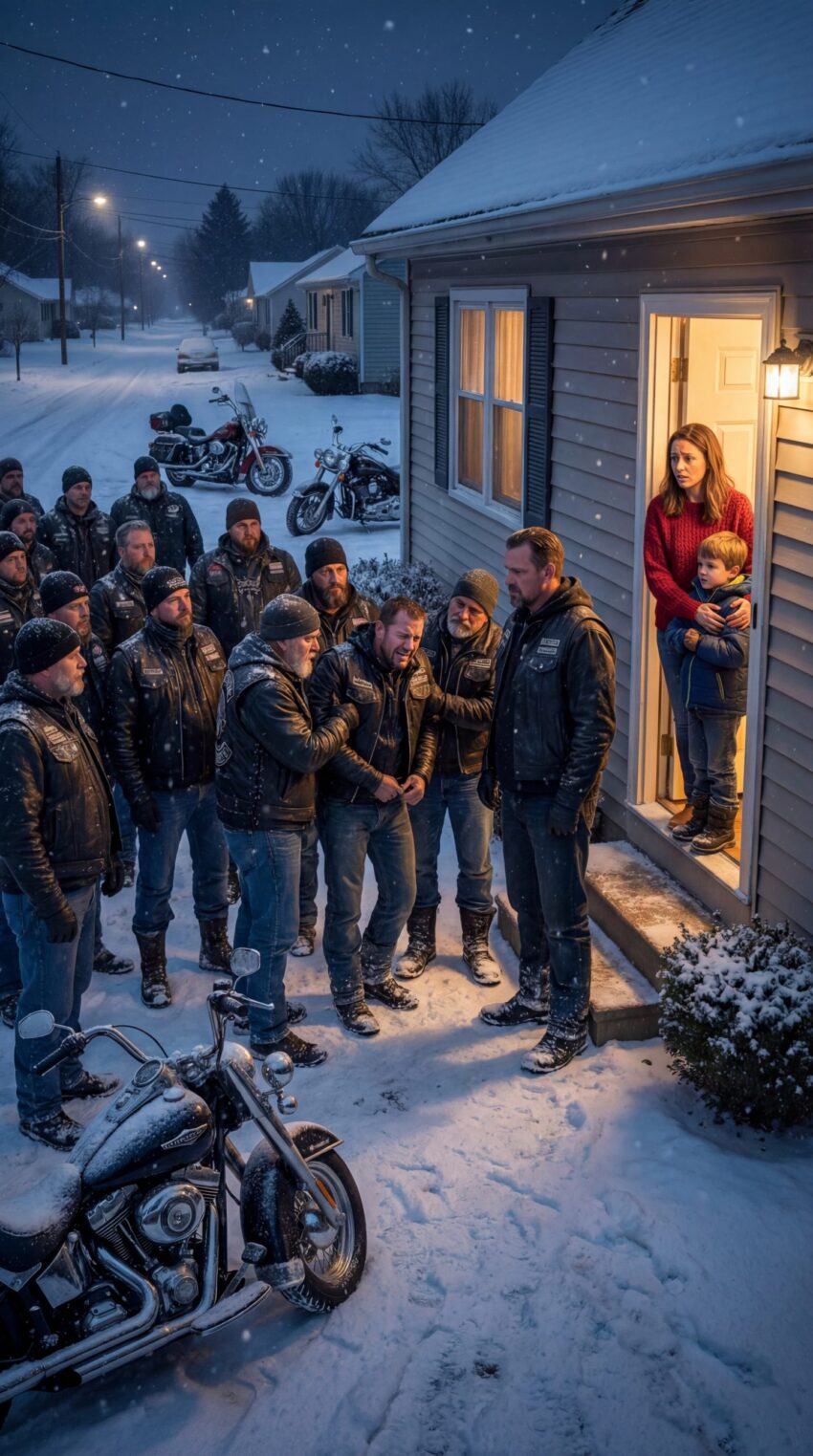
Christmas Eve arrived under a sky so thick with snow that the whole town of Fairbrook, Colorado, seemed to disappear behind it. Wind pushed hard against the small rental house at the end of Alder Street, rattling the windows and forcing cold air through every gap in the frame. Inside, Tessa Langley stood near the front door with her eight-year-old son asleep against her shoulder, listening to the storm and praying the lights would stay on one more night.
Then someone knocked.
Not once. Not gently. It came in a fast, urgent burst that made her whole body tense.
Tessa tightened her arms around Owen and held her breath. For one uneasy second, all she could hear was the wind. Then voices rose outside, rough and strained, barely carrying over the weather.
“Ma’am, please! We need a little help out here!”
She did not move at first. Her heart pounded so hard it made her chest hurt. Nobody came to her house at night. Nobody in Fairbrook checked on her unless they wanted rent, gossip, or an explanation. She stepped closer to the frosted glass and looked through the narrow corner that the ice had not claimed.
What she saw made her freeze.
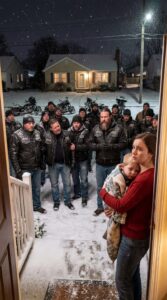
A line of motorcycles leaned half-buried along the road. Snow clung to chrome and leather. Men stood hunched under the porch light, shoulders white with ice, boots sunk into the drifts. There were far too many of them for her tiny house, and every one of them looked like the kind of stranger a woman alone was taught to fear.
Owen stirred against her and whispered, “Mom… who is it?”
Tessa swallowed hard. “I don’t know yet, baby.”
She should have stepped away from the door. She knew that. She should have stayed quiet and let the storm answer for her. But then she noticed one man slumped lower than the others, his weight sagging against a companion who was struggling to hold him upright. Even through the blur of snow, she could see something was wrong.
Another knock came, softer this time.
“We’re not here to cause trouble,” a deep voice called. “One of our brothers is hurt, and the roads are bad. We just need warmth till morning.”
Tessa closed her eyes for a moment. Her house had barely enough heat for two people. The furnace had failed three days earlier. She had been warming soup on a small gas burner and layering blankets over Owen at night while pretending not to worry. Her pantry held canned beans, rice, and half a loaf of bread. Her landlord had ignored every message she sent.
Still, her late mother’s voice came back to her with painful clarity: when someone is desperate, help them if you can, because one day mercy may be all that stands between you and the dark.
Tessa opened her eyes and looked at her son.
Owen’s cheeks were flushed from the mild fever he had been fighting all day, but he was watching her with quiet trust.
She drew in a shaking breath, unlocked the door, and opened it just enough to speak.
“You come in peaceful, or not at all.”
The tallest man among them gave a short nod. Snow clung to his beard, and his eyes looked tired more than dangerous.
“Peaceful,” he said. “You have my word.”
A House Full of Strangers
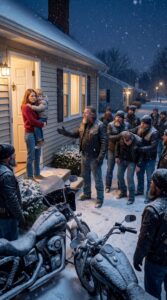
The moment the door opened wider, the storm tried to push itself inside with them. Cold air rushed across the floor. Snow melted off boots. Leather darkened with wet. Tessa stepped back, every instinct alert, while the men entered carefully, almost awkwardly, as if they understood how much fear they brought with them simply by appearing.
The tall man removed his gloves first.
“My name’s Boone Mercer,” he said. “We’ll stay out of your way.”
Two men helped the injured rider onto her old couch. He was young, maybe early thirties, pale with pain, one leg stiff and badly soaked near the knee. Tessa handed Owen a blanket and guided him toward the kitchen corner.
“Stay where I can see you,” she whispered.
“Okay,” he said, though his eyes stayed wide on the visitors.
To her surprise, the room did not turn wild or loud. No one barked orders. No one touched anything without asking. The riders took off their boots and lined them near the door. One man folded a wet scarf and placed it neatly over the back of a chair. Another opened a saddlebag and quietly set out bottled water, jerky, crackers, and instant coffee as if making an offering.
Boone glanced toward the couch. “His name is Wade. He went down on black ice about ten miles back.”
Tessa knelt beside the injured man and carefully rolled up the torn fabric around his knee. The cut was deep, angry-looking, but not beyond help. She had no medical training beyond raising a child alone and learning how to manage every emergency life tossed her way. Still, she knew how to clean a wound, stop bleeding, and calm someone who felt worse than he looked.
Wade winced as she dabbed the cut.
“Sorry,” she murmured.
He forced a weak smile. “Still better than freezing in a ditch.”
That earned a few tired laughs around the room.
Tessa found herself answering with the smallest smile of her own. “Good. Because I’m not carrying you back out there.”
Boone’s expression softened for the first time. “Fair enough.”
In the kitchen, Owen sat wrapped in a blanket like a little king in a faded blue fortress. One gray-haired rider crouched several feet away so he would not seem too imposing.
“Hey, buddy,” the man said gently. “I’m Clancy. Mind if I sit here?”
Owen looked at his mother. Tessa gave a careful nod.
“You can sit,” Owen said.
Clancy reached into his vest pocket and produced a small pack of fruit chews, then set them on the table instead of handing them over directly.
“For later,” he said. “When your mom says it’s fine.”
That simple respect did more to ease Tessa’s fear than any promise could have.
The Lives People Never See
As the hours passed, the little house changed.
It did not become less crowded. If anything, it felt impossible that so many people could fit beneath one roof without knocking the walls apart. Yet somehow the place also grew warmer, fuller, steadier. The riders took turns standing near the stove for heat. Someone fixed the loose latch on her back window without being asked. Someone else found a leak beneath the sink and tightened the pipe with a tool from his pocket.
Tessa noticed these things the way a person notices kindness when she has gone too long without it. Quietly. Carefully. Almost suspiciously.
Boone stood near the counter with a mug of black coffee between both hands. In the candlelight his face looked lined with old fatigue.
“You expected something worse from us,” he said.
Tessa did not bother pretending otherwise. “I expected a long night.”
He gave a faint smile. “That part was true.”
One of the riders, a broad man with a scar near his eyebrow, spoke from the floor where he sat cross-legged with Owen’s crayons spread around him.
“Most people only see the jackets,” he said. “They don’t ask who wore the uniform before this.”
Tessa looked up.
Another man tapped the faded stitching on his sleeve. Army. Another lifted a wrist marked with an old anchor tattoo. Navy. Clancy mentioned three grandchildren in Missouri. A rider named Ellis said he used to run an auto shop before medical bills buried him. Wade, still weak on the couch, muttered that he had once coached Little League.
These were not the stories she had heard whispered around town.
She leaned against the sink and, without planning to, told them a little of her own life. She spoke about the grocery store job she had lost when hours were cut. About taking night cleaning work while Owen slept at a neighbor’s house until even that arrangement fell apart. About the café she used to sketch in a spiral notebook, a place with warm cornbread and soup and pie, the kind of place where nobody ever felt unwelcome.
She almost apologized for saying too much. But nobody interrupted her.
Boone only said, “You’ve been carrying more than one person should.”
Tessa looked away before the tears could rise too quickly. “That doesn’t make me special.”
“No,” Clancy said softly from the table. “It makes you strong.”
Owen held up a crayon drawing of a building with a crooked sign over the door.
“This is my mom’s restaurant,” he announced.
The room answered him with murmurs of approval that were so sincere they hurt.
“Looks like a place that serves the best chili in Colorado,” Ellis said.
Owen grinned. “And grilled cheese.”
“Then I’m definitely coming,” Ellis replied.
For the first time in months, Tessa heard laughter inside her house that did not sound forced. It surprised her how much that sound mattered.
The Night Breaks Open
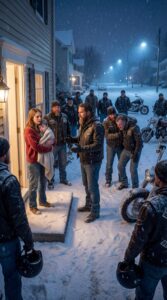
Sometime after midnight, the warmth in the room shifted.
Wade’s skin had turned hot beneath Tessa’s hand. His breathing grew shallow. A fever had arrived fast, and the pain in his leg had sharpened into something more dangerous. Boone was beside the couch in an instant, his jaw tight with concern.
“Tell me what he needs.”
Tessa moved with the calm she only ever found when someone else needed her more than she had time to need herself. She fetched cool water, clean towels, the last of her pain reliever, and an old tin of herbal salve her mother once swore could help almost anything if paired with patience and steady hands.
“I need space,” she said. “And I need him to stay awake.”
Every rider in the room obeyed without question.
The men who had filled the doorway like a wall now looked helpless in a way that changed them. They were no longer strangers with heavy boots and road-worn faces. They were worried friends watching someone they loved drift too close to danger.
Tessa pressed a cloth to Wade’s forehead.
“Stay with me,” she said.
He opened his eyes halfway. “Trying.”
“Try harder,” she answered.
A weak laugh escaped him. Boone let out a breath that sounded almost like relief.
For the next hour she sat beside the couch, speaking to Wade the same way she spoke to Owen when fever kept him tossing all night. Calm voice. Cool hands. No panic. Just presence.
Eventually the heat in Wade’s face began to ease. His breathing slowed. The tension in his shoulders loosened.
Clancy rubbed both hands over his face and whispered, “Thank God.”
Wade blinked at Tessa through exhaustion.
“You’re some kind of miracle,” he murmured.
She shook her head. “No miracle. Just a tired mother who wasn’t about to let you fall apart on her couch.”
That earned another ripple of relieved laughter, and this time even Boone looked away for a second as emotion caught him off guard.
Then he reached into his jacket and placed a thick envelope on the table.
Tessa stared at it. “What is that?”
“It’s what we can leave tonight,” Boone said.
“No.” She stepped back. “I didn’t open my door for money.”
Boone’s voice stayed gentle, but firm.
“Maybe not. But kindness should not leave you emptier than it found you.”
She should have argued longer. Pride wanted her to. But Owen was asleep at the table with his head on folded arms, and the envelope sat there like a lifeline she was almost too ashamed to touch.
So instead of refusing again, she whispered, “Thank you.”
Boone nodded once as if he understood exactly how hard those two words were for her.
Morning Leaves a Promise
By dawn the storm had weakened, though snow still covered the street in thick shining drifts. Pale winter light filled the house, revealing sleeping forms on the floor, steam on the windows, and the strange peace that sometimes follows a difficult night.
The riders were already preparing to leave when Tessa rose from her chair. Wade could stand now, though Clancy stayed near him just in case. Owen woke and immediately looked for the men as if afraid they had vanished while he slept.
“You’re going already?” he asked, his voice small.
Clancy smiled and reached into his vest. He pulled out a round cloth patch, worn at the edges, and placed it in Owen’s hand.
“You keep that for me,” he said. “That means we’re friends.”
Owen held it like treasure.
At the doorway, Boone paused before stepping out into the snow.
“Open this after we’re gone,” he said, handing Tessa a folded note.
She frowned. “What is it?”
His expression was unreadable for a second, then unexpectedly warm.
“A promise.”
Engines came alive one by one outside, low and rumbling under the pale sky. Tessa stood on the porch with Owen beside her and watched the line of riders disappear down Alder Street, black silhouettes moving through a world made white.
When they were gone, the silence felt larger than before.
She unfolded Boone’s note with cold fingers.
We remember who stood with us.
That was all it said.
She read it twice, then tucked it carefully inside the family Bible on the kitchen shelf, not because she understood it, but because something in the words felt too serious to leave lying around.
Thunder on Alder Street
The town heard about the riders before noon.
By evening, the gossip had grown teeth.
At the corner market, people went quiet when Tessa walked in. Her landlord called to warn her that he would not tolerate “that kind of activity” near his property. A woman from three houses down watched from behind her curtain as if Tessa had invited danger to move in permanently.
She went to bed that night exhausted, discouraged, and embarrassed that hope had ever touched her so strongly.
Then, the next afternoon, the ground began to shake.
At first she thought another storm was rolling in. The sound built slowly, then steadily, then all at once. Not thunder. Not wind.
Engines.
Owen ran to the window first.
“Mom!” he shouted. “They came back!”
Tessa stepped onto the porch and forgot how to breathe.
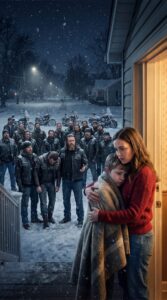
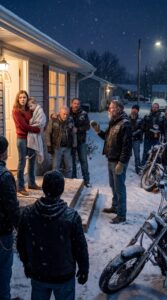
The road was full.
Motorcycles stretched in both directions, row after row, shining beneath the winter sun. Men. Women. Older riders. Younger ones. Trucks loaded with lumber, heaters, paint, tools, groceries. There were so many people that Alder Street looked less like a neighborhood and more like the gathering point for something far bigger than any one life.
Boone stood at the front, and beside him were Wade, Clancy, and dozens of others she had not met.
Then more engines rolled in behind them.
And more.
And more.
Fairbrook had never seen anything like it.
Boone climbed the porch steps while the entire street watched from windows, porches, and half-open doors.
“You gave shelter to twenty-five frozen riders when nobody else would,” he said. “Word got around.”
Tessa looked past him at the endless crowd and shook her head in disbelief.
“This is too much.”
Boone smiled for real then, the kind of smile that transforms a face.
“Not yet.”
Clancy stepped forward with a folder in his hand.
“This covers your overdue rent, the furnace replacement, and enough to get your kitchen started,” he said. “And before you say no, you should know the vote was unanimous.”
Tessa’s mouth parted, but no words came out.
Behind them, riders had already begun unloading supplies. One group headed for the roof. Another carried in insulation. Two women with tool belts under their coats measured the kitchen. Someone brought in sacks of flour, canned goods, fresh produce, coffee, and enough food to fill every empty space in her pantry twice over.
Owen laughed aloud with pure wonder. “Mom, they remembered!”
Tessa covered her mouth with one hand as tears rose too fast to stop.
The House Becomes a Beginning
The work started immediately.
It happened with the speed and discipline of people who knew how to organize themselves without wasting motion. Within an hour, her broken furnace had been removed. By noon, new pipes were in place. By afternoon, a fresh coat of paint brightened the kitchen walls in a warm cream color she would never have chosen for herself but instantly loved.
A carpenter built shelves near the stove. Another rider repaired the porch steps. Someone replaced the cracked front window. Someone else brought tables and chairs from a closed diner two towns over.
At some point Tessa stopped trying to protest. Gratitude had overwhelmed protest anyway.
Owen ran from room to room, narrating every miracle.
“They fixed the sink!”
“Mom, come see the new light!”
“Mr. Clancy says the sign is going to be blue!”
Late in the day, Boone walked into the kitchen carrying Tessa’s old notebook. The one with the café sketches.
“Your son showed us where you kept the plans,” he said.
Tessa laughed through tears. “Of course he did.”
Boone set the notebook gently on the counter.
“You dreamed this place before any of us arrived,” he said. “We’re just helping the dream stand up.”
She looked around the room at the new counters, the clean stove, the groceries, the light filling the space in a way it never had before.
“I don’t know how to repay any of this.”
Boone shook his head.
“You already did. You opened the door.”
By sunset a hand-painted sign was hung above the kitchen entryway.
Langley’s Table
Owen clapped so hard his cheeks turned pink. The crowd outside answered with cheers and a chorus of revving engines that rolled through Fairbrook like celebration instead of fear.
Even the neighbors began to soften. Mrs. Holloway from across the street came carrying a warm dish of baked cornbread. A young couple from the corner house offered coffee beans from the shop where they worked. The same people who had barely nodded at Tessa for years were now standing in her yard, uncertain and humbled, as if they were realizing too late how wrong they had been.
Tessa welcomed them anyway.
Because she understood now that being seen after a long period of being overlooked can change more than one life at a time.
Never Alone Again
That evening, with lights glowing from every window and the smell of fresh food wrapping itself around the house, Boone gathered everyone in the yard.
Snow still lined the edges of the street, but the cold no longer felt cruel. Music played softly from somewhere near the trucks. Owen stood beside his mother holding Clancy’s patch in one hand and a grilled cheese in the other.
Boone looked at Tessa before speaking.
“This woman gave warmth when she had almost none to spare,” he said. “She offered mercy without asking who deserved it first. A lot of us have been judged by how we look, where we ride, and what people assume. She looked past all that. She saw human beings standing in the snow.”
The crowd answered with applause that seemed to shake the air.
Tessa cried openly now. There was no point hiding it.
For years she had lived as if survival was the only goal. One bill to the next. One worry to the next. One lonely night after another. But standing there with Owen tucked against her side and a street full of people who had come back for her, she felt something stronger than relief.
She felt held.
Not rescued in a way that erased her strength, but met in it. Honored in it.
Boone stepped closer and said quietly, only for her to hear, “You and that boy of yours have people now. Don’t forget it.”
Tessa nodded through tears. “I won’t.”
And for the first time in a very long while, she knew she was telling the truth.
Tomorrow, Langley’s Table would begin as more than a sketch in a notebook. It would become a real place with warm food, open chairs, and a door nobody would be afraid to knock on.
But that night, as the engines faded and laughter stayed behind like a blessing over Alder Street, Tessa stood beneath the porch light with her son in her arms and understood that one act of courage can travel farther than fear ever will.
She had opened the door on the worst night of the year.
What came back to her was not danger.
It was family.
Kindness often feels smallest in the moment it is given, especially when it comes from someone who is already tired, burdened, and struggling, but the truth is that even the smallest act of mercy can become the turning point in someone else’s life and, in time, the beginning of healing in your own.
People are very often judged by their appearance, their past, their clothes, their silence, or the stories others tell about them, yet the heart of a person is rarely visible at first glance, which is why compassion remains one of the most powerful ways to see what fear tries to hide.
There are seasons in life when it seems as though the world has forgotten your name, your effort, and your pain, but that does not mean your goodness is unseen, because sometimes the reward for your faithfulness arrives from places you never expected and through people you were taught not to trust.
A person does not need wealth, status, or perfect circumstances to change someone’s future, because sometimes all it takes is an open door, a steady voice, and the courage to treat another human being with dignity when no one else will.
The people who appear strong are often carrying invisible grief, and the people who seem most rough around the edges may still have gentle hearts, deep loyalty, and wounds that have taught them how to recognize suffering in others without needing it explained.
No hardship you have survived is ever wasted when it teaches you how to comfort someone else, because the pain that once threatened to break you can become the very thing that makes your compassion deeper, wiser, and more life-giving.
True community is not built only by people who live nearby or share the same background, but by those who choose to show up, stand beside one another, and prove through action that belonging is something we create together, not something we wait to be handed.
There is something deeply powerful about being remembered for goodness in a world that moves so quickly, because when you help others without calculation, you leave a mark that no storm, rumor, or difficult season can easily erase.
A second chance does not always arrive as a dramatic miracle, but sometimes it begins with a conversation, a meal, a helping hand, or one unexpected moment that reminds you your life is not over, your dream is not foolish, and your future is still worth building.
When life has made you feel invisible, unwanted, or alone, hold on to this truth with everything in you: one honest act of love can open a road to people, purpose, and hope that you cannot yet imagine, and what feels like the coldest chapter of your story may still lead you toward the warmest home your heart has ever known.