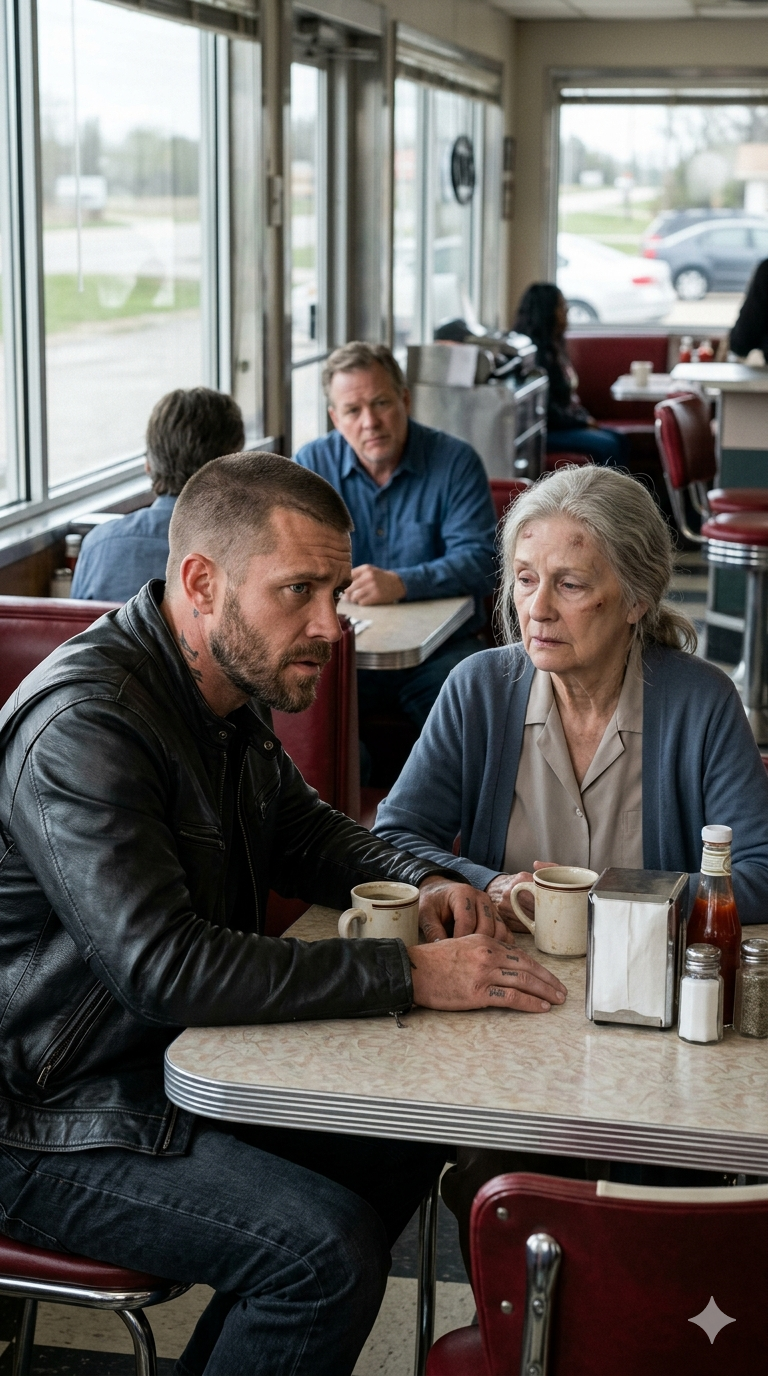
The Morning Nolan Knew Something Was Wrong
At 6:10 on a quiet Thursday morning, Nolan Briggs rode his old cruiser down a two-lane highway outside Mesa Hollow, Arizona.
He was sixty-four now, with silver hair, broad shoulders, and hands that still looked stronger than most men half his age. Years ago, people had known him as the hard-faced leader of a biker crew that no one wanted to cross. But that life was behind him.
For fifteen years, Nolan had kept things simple. He fixed motorcycles. He drank coffee before sunrise. And every morning, he stopped by his mother’s diner.
June Briggs was eighty-six, stubborn, sharp-tongued, and still proud of the little place she had built with her own hands.
June’s Table sat on the corner of Main Street and Cedar Avenue. It was not fancy. The booths were red, the counter was old, and the coffee cups did not match. But everyone in town knew that if you walked in hungry, June would feed you like family.
That morning, something felt different.
The parking lot was empty.
The open sign was on, but no one was inside.
Nolan killed the engine and stared through the front window. The lights were bright. The coffee was brewing. The grill was warm.
But his mother was not behind the counter.
He stepped inside.
“Morning, Mom,” he called.
No answer.
Then he saw her near the kitchen doorway.
June turned slowly, and Nolan’s chest tightened.
One side of her face was swollen. Her lip was cut. Her hand pressed a towel against her ribs.
For a moment, Nolan could not move.
This was the woman who had raised him alone. The woman who had never backed down from bills, storms, rough customers, or hard years.
Now she looked afraid.
“Mom,” he said quietly. “Who did this?”
June looked away.
“I slipped,” she whispered. “It was nothing.”
Nolan stepped closer, careful not to scare her.
“Please don’t lie to me.”
Her eyes filled with tears.
“If I tell you, you’ll become that man again,” she said. “And I can’t lose you to your past.”
The Diner They Wanted to Take
Nolan’s next stop was the sheriff’s office.
Sheriff Martin Cole looked surprised when Nolan walked in. They had shared coffee many times. They had talked about old injuries, bad weather, and the way small towns changed too fast.
But this morning, Nolan did not sit down.
“My mother was hurt last night,” Nolan said.
Martin’s face went pale.
“June?”
“Don’t act surprised. You knew Redstone was pushing people.”
The sheriff lowered his eyes.
That told Nolan enough.
After a long silence, Martin opened a drawer and pulled out a folder. Inside were property records, sale agreements, and private notes. Redstone had already bought nearly every building on Main Street.
The hardware store. The old theater. The salon. The bakery.
Only June’s diner remained.
“They said it would help the town,” Martin said weakly. “New jobs. New money. A resort outside the highway.”
“And they paid you to look away?”
Martin swallowed.
“My daughter’s medical school bills were more than I could handle. I told myself no one would get hurt.”
Nolan leaned over the desk.
“That’s what men say when they want to sleep at night.”
Martin gave him a name.
Garrett Pike.
The man hired by Redstone to pressure holdouts.
The Man in the Trailer Park
Garrett Pike lived in a faded trailer near the edge of town.
He was younger than Nolan, bigger too, with a shaved head and cold eyes. He opened the door like he had been expecting company.
“You Briggs?” Garrett asked.
“You know why I’m here.”
Garrett smiled.
“Your mother should have signed the papers.”
Nolan’s voice stayed low.
“She is eighty-six.”
“Business doesn’t care about age.”
For a second, Nolan felt the old version of himself waking up. The one who solved problems fast and hard. The one he had spent fifteen years burying.
But he remembered his mother’s words.
Do not become that man again.
So Nolan did something harder.
He stayed in control.
He stepped inside and spoke calmly.
“Tell me who hired you.”
Garrett laughed at first. Then Nolan showed him photos Buck had sent—old records, former charges, names Garrett did not want repeated.
The smile faded.
Garrett finally gave him what he needed.
Redstone Properties was run by Preston Vale, a polished real estate developer in Phoenix. But the company was only a front. Behind the resort plan were hidden investors, fake contracts, and a scheme that would erase Mesa Hollow’s Main Street for private profit.
June’s diner was the final piece.
Without it, the project could not move forward.
Garrett tossed a business card onto the table.
“Vale wants to meet you tonight,” he said. “Phoenix. Nine o’clock. He thinks he can buy you.”
Nolan picked up the card.
“He doesn’t know me.”
The Choice Before Phoenix
Nolan spent the afternoon in his garage.
The place smelled like oil, metal, and old leather. Motorcycles sat in careful rows, each one waiting for repair.
On the back wall was a locked cabinet.
Inside was his old biker vest.
He had not worn it in fifteen years.
Nolan opened the cabinet and looked at it for a long time. That vest belonged to another life. A louder life. A darker life.
He had been feared then.
But fear was not the same as respect.
And power was not the same as peace.
His phone buzzed.
It was Buck.
“I’ve got six old brothers ready to ride,” Buck said. “Say the word.”
Nolan closed the cabinet.
“Not yet.”
“You sure?”
“I’m going to give the law one chance to work.”
Buck was quiet, then said, “That sounds like the man your mother hoped you’d become.”
Nolan looked toward the diner down the street.
“I hope she’s right.”
The Meeting in the Glass Tower
Preston Vale’s office was on the ninth floor of a Phoenix tower, all glass, marble, and cold lighting.
Preston looked like a man who had never fixed anything with his own hands. His suit was perfect. His smile was calm. His eyes were empty.
Beside him stood an older attorney named Richard Lyle.
“Mr. Briggs,” Preston said. “Your mother is a difficult woman.”
Nolan did not sit.
“My mother is the reason men like you still have towns to visit.”
Preston gave a small laugh.
“Sentimental. I expected that.”
Nolan placed a folder on the desk. Inside were copies of bank transfers, property documents, and messages connecting Redstone to intimidation, bribery, and illegal financial activity.
Preston’s smile faded.
“Where did you get this?”
“From people who talk when they realize the truth is heavier than money.”
Richard stepped forward.
“You should be careful making accusations.”
Nolan looked at him.
“You should be careful standing beside a man who hurts old women for land.”
Preston’s voice hardened.
“Your mother has seven days to sell.”
“No.”
“Then she may regret it.”
Nolan’s face changed. Not loud. Not wild. Just cold.
“You will never go near my mother again.”
Preston leaned back.
“And what will you do? Bring back your biker friends? Scare me with stories from twenty years ago?”
Nolan shook his head.
“No. I brought something better.”
At that moment, the office door opened.
Sheriff Martin Cole walked in with two federal agents.
Preston stood quickly.
“What is this?”
Martin looked ashamed, but steady.
“It’s me doing my job too late,” he said.
Nolan had sent the evidence earlier. Martin had agreed to wear a recording device for the meeting. Every threat Preston made had been captured.
For the first time that night, Preston looked truly afraid.
The Ride Back Home
By midnight, Preston Vale and Richard Lyle were in custody.
Redstone Properties was under investigation.
Sheriff Martin Cole resigned the next morning and agreed to cooperate fully. He would have to answer for what he had done, but at least he had finally stopped hiding from it.
Nolan rode back to Mesa Hollow before sunrise.
When he reached June’s Table, the lights were on.
Inside, June was pouring coffee for six gray-haired bikers who looked too old to cause trouble and too loyal to ignore a call from a brother.
Buck sat at the counter with a plate of pancakes in front of him.
June looked up when Nolan walked in.
Her face was still bruised, but her eyes were clear.
“Is it over?” she asked.
Nolan nodded.
“It’s over.”
June pressed one hand to her heart.
Buck stood and pulled Nolan into a rough hug.
“You did it clean,” Buck whispered. “That matters.”
Nolan looked at his mother.
“I almost didn’t.”
June walked around the counter and touched his cheek.
“But you did. That is the difference.”
Just Clayton Again
A week later, the town began to breathe again.
The diner stayed where it had always been.
The hardware store reopened with a handwritten sign in the window.
The salon owner brought June flowers.
People who had been too afraid to speak began coming by to apologize.
June accepted some apologies. Others, she simply answered with coffee.
Nolan stood outside the diner one quiet morning, watching the desert turn gold under the rising sun.
His old life had knocked on the door.
For one dangerous moment, he had almost opened it.
But he had chosen another way.
June stepped beside him with two mugs of coffee.
“You know what real strength is?” she asked.
Nolan smiled faintly.
“I’m guessing you’re about to tell me.”
“Real strength is not knowing how to fight,” she said. “It is knowing when to stop.”
Nolan looked at the diner, at the street, at the town his mother had refused to give up.
For years, people had called him dangerous.
But that morning, he felt something better.
He felt useful.
He felt forgiven.
He felt like a son.
And for Nolan Briggs, that was enough.
A man is not only measured by the years he spent making mistakes, but by the courage he shows when life gives him one more chance to choose differently.
Protecting family does not always mean returning to anger; sometimes it means staying calm long enough for the truth to stand taller than fear.
The strongest people are often the ones who could do damage, but decide that justice matters more than revenge.
A small diner, a quiet home, or an ordinary corner of town can mean everything when it was built with sacrifice and love.
When good people stay silent because they are afraid, unfairness grows louder, but one honest voice can still change the direction of a whole town.
A mother’s love can follow a son through every dark road and still believe there is a better man waiting inside him.
Second chances are not gifts we receive once and keep forever; they are choices we must protect every time anger asks us to become who we used to be.
There is no shame in having a past, but there is great responsibility in refusing to let that past control the person we are trying to become.
True brotherhood is not about standing beside someone when they are wrong, but helping them find the courage to do what is right.
Peace is not weakness; sometimes peace is the hardest victory a person will ever win.