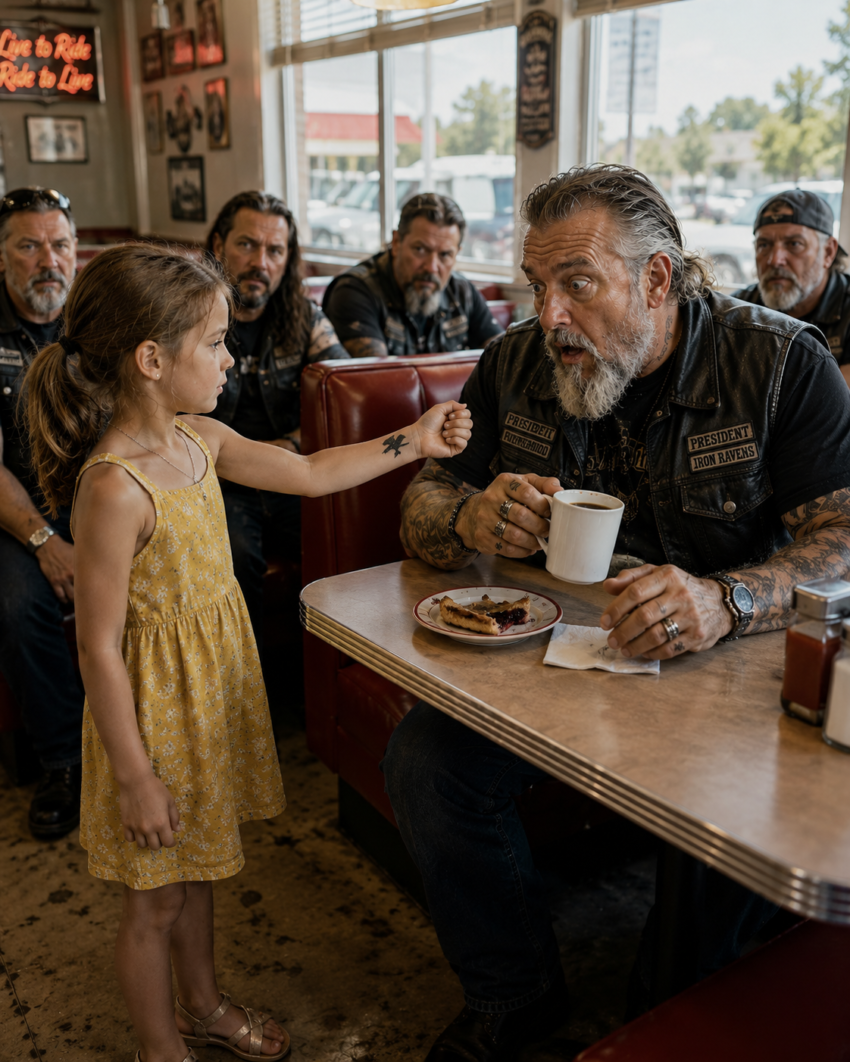
A Little Girl Walked Into a Small-Town Diner With a Raven Drawn on Her Wrist
The lunch rush at Millstone Diner in Red Lodge, Montana, was almost over when the little girl pushed open the front door.
She was small, maybe ten years old, with a faded yellow jacket, dusty sneakers, and a backpack that looked too heavy for her narrow shoulders.
Nobody noticed her at first.
Not until she walked straight past the hostess stand.
Not until she stopped in front of the corner booth where five bikers sat drinking coffee in silence.
The largest man at the table looked up first.
His name was Wade Mercer, but everyone in town called him Flint.
He had wide shoulders, a gray-streaked beard, a black leather vest, and the kind of calm eyes that made people lower their voices without knowing why.
The girl lifted her sleeve.
On her wrist was a small black raven.
Not a real tattoo.
Just a careful drawing made with old ink, slightly faded at the edges.
Flint stared at it.
The other bikers stopped moving.
The girl swallowed and whispered,
“My mom drew this on me. She said someone would know what it means.”
The Mark Nobody Outside the Club Should Know
Flint did not answer right away.
His eyes stayed fixed on the little raven.
It was not perfect. The lines were shaky, like someone had drawn it with tired hands.
But the shape was unmistakable.
Open wings.
Bent head.
Three tiny marks beneath the tail.
That was not just a bird.
That was the old sign of the Raven Road brotherhood.
A sign only a few people had ever earned.
Flint leaned forward slowly.
“Who is your mom, sweetheart?”
The girl tightened her fingers around the strap of her backpack.
“Her name is Maren Cole.”
The name hit the table like thunder without sound.
One biker lowered his coffee cup.
Another looked toward the window.
Flint’s face went still.
For nearly twelve years, nobody had heard from Maren Cole.
Not a call.
Not a letter.
Not one clear sign.
And now her daughter was standing in front of them with the raven drawn on her wrist.
The Mother Who Was Still Waiting
The girl’s name was Clara Cole.
She explained everything in a quiet, careful voice.
Her mother was still alive, but very sick.
They had been living in a small rented room outside Billings. Maren had grown weaker over the past few months, and some days she could barely stand long enough to make soup.
But she kept one old bottle of black ink in a tin box beneath her bed.
Two nights earlier, with shaking hands, Maren had drawn the raven on Clara’s wrist.
Then she gave her daughter a folded note and told her to go to Red Lodge.
“She said if I found the right people, they would bring her home,” Clara whispered.
Flint’s voice became rough.
“Where is she now?”
Clara looked down.
“At the motel near the highway. Room twelve. She told me not to be scared, but she was scared too.”
Flint stood so fast the booth creaked.
“Boys, we’re leaving.”
The Ride Back to Room Twelve
Five motorcycles rolled out of the diner parking lot within minutes.
Clara rode in Sandra’s old pickup truck behind them, wrapped in a blanket the waitress had pulled from her office.
Flint did not speed.
He stayed steady.
Controlled.
But everyone who knew him could see the tension in his shoulders.
Maren Cole had once been family.
Not by blood.
By loyalty.
Years earlier, she had ridden with the Raven Road men across Montana, Wyoming, and Idaho. She fixed engines, handled maps, calmed arguments, and remembered every birthday nobody else remembered.
She was not loud.
She was not reckless.
She was the quiet center of a rough group of men who had forgotten how to trust soft things.
Then one spring morning, she disappeared.
Some thought she had chosen a better life.
Some thought she wanted distance.
Flint had never believed she left because she stopped caring.
Now he knew he was right.
The Door That Opened Too Slowly
The motel sat beside a lonely stretch of highway, its blue sign flickering in the afternoon light.
Clara ran ahead, then froze outside room twelve.
Flint stepped beside her and knocked gently.
“Maren?”
For a moment, nothing happened.
Then a weak voice answered from inside.
“Clara?”
Clara’s eyes filled immediately.
“Mom, I found them.”
The door opened slowly.
Maren Cole stood there, thinner than Flint remembered, one hand holding the doorframe.
Her hair was pulled back loosely. Her face was pale. Her old gray sweater hung from her shoulders.
But her eyes were the same.
Tired.
Kind.
Unmistakable.
Flint could not speak at first.
Maren looked at him and gave a small, broken smile.
“Took you long enough, Flint.”
His eyes shone.
“You should have called me.”
She looked down.
“I tried. Too many times. The numbers were gone. The old places changed. I didn’t know who was left.”
The Truth Behind the Silence
They brought Maren inside and helped her sit.
Clara stayed close to her mother, holding her hand as if letting go might make everything vanish.
Flint knelt in front of Maren’s chair.
“Why did you disappear?”
Maren closed her eyes for a second.
“Because I was pregnant. Because I was scared. Because I thought Clara deserved a quiet life.”
Nobody spoke.
Maren continued softly.
“I didn’t leave because I stopped loving the club. I left because I loved my daughter more.”
Flint bowed his head.
For years, he had carried the unanswered question like a stone in his chest.
Now the answer hurt, but it also healed something.
Clara looked between them.
“So you really knew my mom?”
Flint smiled gently.
“Kid, your mom once drove through a snowstorm to bring me medicine when I had a fever so bad I couldn’t stand.”
One biker near the door added,
“She rebuilt my bike after I ruined the engine.”
Another said,
“She made all of us better men.”
Maren looked away, trying not to cry.
The Raven Was Never Just a Drawing
That evening, Sandra brought food from the diner.
The bikers repaired the broken heater in the motel room.
One called a local clinic and arranged for Maren to be seen the next morning.
Nobody made a big speech.
Nobody asked for thanks.
They simply moved like people who had already decided.
Clara sat beside Flint near the window.
She touched the fading raven on her wrist.
“Mom said it meant family.”
Flint nodded.
“She was right.”
“But I’m not a biker.”
He smiled.
“You don’t have to be.”
Clara frowned.
“Then why did she draw it on me?”
Flint looked toward Maren, who had fallen asleep under a clean blanket.
“Because she knew if any of us saw it, we would understand that you belonged to someone we loved.”
Clara’s eyes softened.
“Does that mean you’ll help her?”
Flint’s voice was quiet but firm.
“It means she won’t face this alone anymore. And neither will you.”
The Morning Everything Changed
By sunrise, the Raven Road men had already made calls.
A small house behind the diner was offered for Maren and Clara to stay in.
A retired nurse from town agreed to check on Maren every day.
Sandra arranged school paperwork for Clara.
Flint contacted an attorney to help with medical forms, housing documents, and everything Maren had been too tired to handle alone.
When Maren woke and heard all of this, she covered her face.
“I didn’t come back to be a burden.”
Flint sat beside her.
“You came back because you trusted us.”
“I was afraid you’d be angry.”
“I was,” he admitted. “But not at you. I was angry that you had to carry this by yourself.”
Maren’s lips trembled.
“I thought I was protecting Clara.”
Flint looked at the little girl sleeping on the other bed.
“You did. Now let us protect both of you.”
The Girl Who Brought Her Mother Home
Two weeks later, Clara stood outside the small house behind Millstone Diner.
The old raven drawing had faded from her wrist, but Flint had given her a leather bracelet with a tiny silver raven charm.
Not a club mark.
Not a grown-up symbol.
Just a promise.
Maren sat on the porch wrapped in a soft blue blanket, watching her daughter laugh as two bikers taught her how to polish a motorcycle mirror.
She was still weak.
The road ahead was still uncertain.
But she was no longer hidden in a motel room, hoping the world would somehow find her.
Clara had found the right people.
The raven had done what Maren prayed it would do.
It had led family back to family.
Flint stepped onto the porch and handed Maren a cup of tea.
“You know,” he said, “you could have come home sooner.”
Maren smiled faintly.
“I know that now.”
Clara ran up the steps and leaned against her mother’s side.
“Are we staying?”
Maren looked at Flint.
Then at the bikers in the yard.
Then at the little bracelet on Clara’s wrist.
Her eyes filled with peace.
“Yes, baby,” she whispered. “I think we finally are.”
Sometimes family is not only the people who share your name, but the people who remember who you were before life became hard and still open the door when you return.
A mother may hide her pain behind quiet smiles, but the love she leaves in small signs can guide her child toward safety when words are no longer enough.
The strongest people are not always the ones who never fall; sometimes they are the ones who keep searching for help even when their hands are shaking.
A simple symbol can carry years of loyalty, memory, and love when it was made by someone who hoped the right heart would recognize it.
Children should never have to carry adult worries, but one brave step from a child can awaken an entire room full of people who still care.
Not every goodbye means someone stopped loving you; sometimes people leave because they believe distance is the only way to protect the person they love most.
True loyalty does not disappear with silence, lost phone numbers, or passing years, because real family waits beneath the surface until it is needed again.
The people who look rough from the outside may still carry gentle promises inside, especially when someone vulnerable stands before them asking for help.
A second chance does not always arrive loudly; sometimes it walks into a diner wearing dusty sneakers and a fading raven drawn on one small wrist.
Home is not always the place where life began, because sometimes home is the place where someone finally says, “You don’t have to carry this alone anymore.”