The Boy at the Fence
After her divorce, Nora Bennett moved to Ash Hollow, Wisconsin, hoping quiet streets might help her nine-year-old son, Caleb, feel safe again.
Their next-door neighbor, Boone Harlan, looked like the kind of man people judged before they knew him. He was huge, bearded, covered in old tattoos, and every evening his black Harley rumbled into the driveway like thunder rolling down the block.
Caleb noticed him immediately.
At first, he covered his ears.
Then he stopped.
By the third week, he stood at the fence every afternoon, watching Boone work in his open garage.
Boone never pushed him. He never asked Caleb why he was quiet. He never said the things adults always said, like “look at me” or “use your words.”
He simply worked.
He cleaned tools, changed oil, tightened bolts, and placed every wrench back exactly where it belonged.
Caleb watched every movement like it was a language he finally understood.
The Garage Door That Stayed Open
Nora was careful.
Caleb was on the spectrum, and the world had not always been gentle with him. School was too loud. Grocery stores were too bright. Family gatherings were full of people giving advice they did not understand.
So when Boone opened the gate one afternoon, Nora’s whole body went tense.
Boone noticed.
He stepped back and pointed to a folding chair near the driveway.
“Garage door stays open, ma’am. You can sit right there the whole time.”
On the workbench, Boone had placed a clean rag, a small socket wrench, a spark plug, and a pair of blue child-sized work gloves.
Blue was Caleb’s favorite color.
Boone knelt slowly, keeping his voice low.
“Engines don’t care if you talk,” he said. “They care if you listen.”
Caleb stepped forward.
For the first time in months, Nora saw her son move toward someone instead of away.
The Bikers Everyone Misunderstood
Every Saturday morning, Boone’s riding brothers arrived.
They wore leather vests, heavy boots, and faces that made neighbors pull their curtains aside. But they didn’t come to cause trouble.
They brought groceries.
They fixed porches.
They carried dog food for elderly neighbors.
They repaired bicycles for kids whose parents were too tired to ask for help.
One morning, twelve bikes rolled into Boone’s driveway while Caleb was in the garage. The noise made Caleb freeze.
Boone lifted one hand.
Every engine shut off at once.
A large biker with a red beard stepped down first. His vest said Miller. Another man with a limp carried a paper bag from the diner.
Boone looked at them and said only two words.
“Quiet feet.”
And those grown men walked into the garage like they were entering a library.
No loud jokes. No sudden movements. No crowding.
The red-bearded biker placed the paper bag on the bench.
“Blueberry muffin,” he said. “Thought the kid might like one.”
Caleb did not look up, but his hand slowly reached toward the bag.
Nobody cheered.
Nobody made a big deal of it.
They simply let him be.
That was when Nora realized Boone’s brotherhood was not about leather or engines. It was about discipline, patience, and knowing when silence could be kindness.
The Day School Crossed a Line
Near the end of summer, Caleb came home from school quieter than usual.
Nora saw faint marks on his wrist where an adult had grabbed him during a loud cafeteria moment.
Caleb did not cry.
He went straight to the fence.
Boone saw the marks.
His face changed, but he did not raise his voice.
“Who did that?”
Nora explained what happened.
Boone nodded once.
The next morning, fifteen bikers stood in the school parking lot beside their motorcycles. Engines off. Helmets in hand. No shouting. No threats.
Boone held a folder filled with printed pages about student support plans, school policies, and parent complaint forms.
The principal looked nervous.
Boone handed her the folder.
“Nobody needs to be afraid,” he said. “But this child will be treated with respect.”
The principal asked, “Are you trying to intimidate us?”
Boone looked at her calmly.
“No, ma’am. I’m reading.”
For three years, Nora had sat in meetings apologizing for her son while adults failed to understand him.
Boone did not apologize for Caleb.
He stood beside him.
And that changed something inside Nora forever.
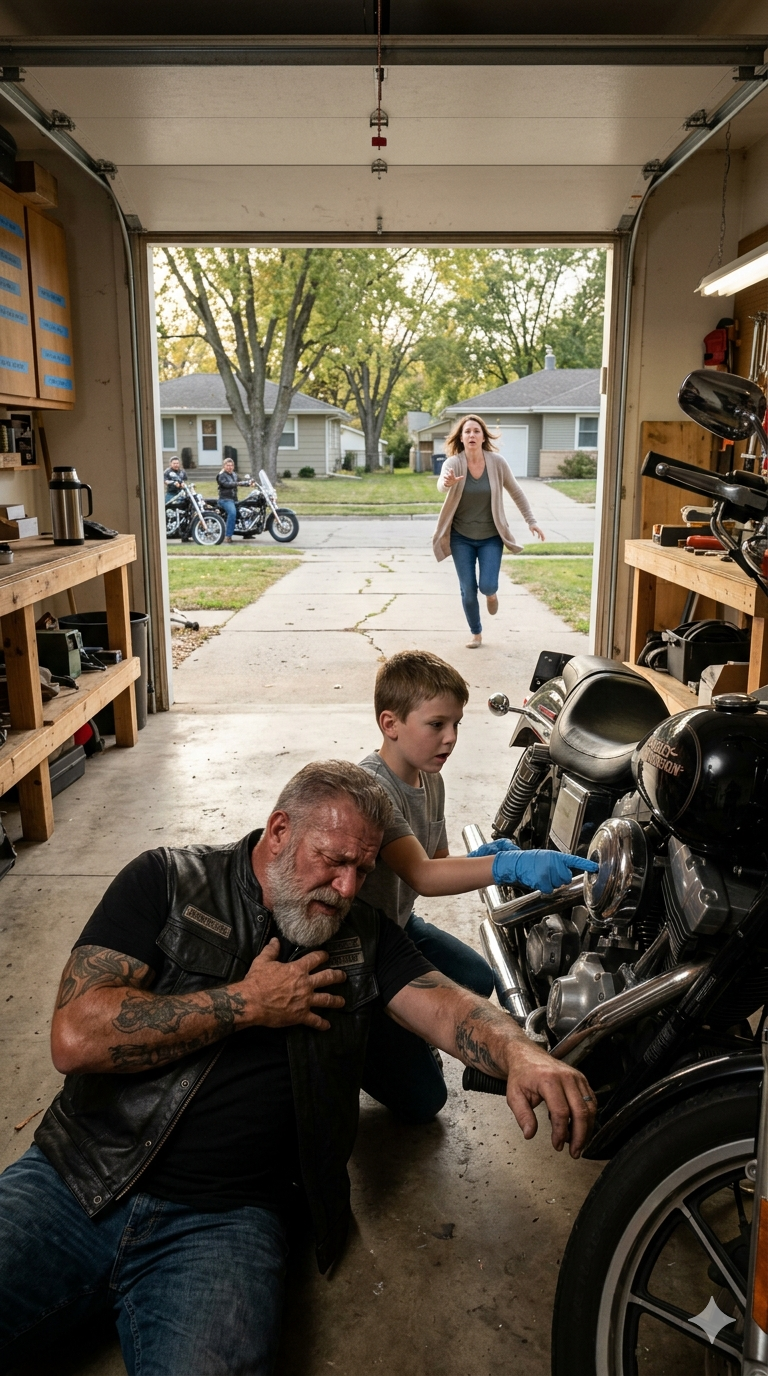
The Afternoon Boone Fell
That same afternoon, Boone came home pale and tired, but he opened the garage like always.
Caleb was already waiting.
They worked on the Harley in silence, but Nora noticed Boone rubbing the center of his chest. He dropped a socket twice. His breathing sounded wrong.
“Boone?” Nora asked.
He waved her off.
“Just the heat.”
Then his knees hit the concrete.
Nora ran to him. Boone’s face had gone gray beneath his beard. He tried to push himself up, but she stopped him.
“Don’t move.”
Boone looked past her toward Caleb.
“Kid,” he whispered. “Blue phone. Workbench.”
Caleb stood frozen.
Nora tried to keep her voice steady.
“Caleb, honey, call 911.”
For one long second, nothing happened.
Then Caleb walked to the bench, picked up Boone’s old blue flip phone, and pressed the buttons with shaking fingers.
When the dispatcher answered, Caleb spoke to a stranger for the first time in nearly two years.
“Help. Boone fell down.”
The Spark Plug Secret
The ambulance arrived within minutes.
Boone complained at the paramedics, which everyone took as a good sign. His riding brothers came one by one until the whole street filled with motorcycles and quiet worry.
As they lifted Boone toward the ambulance, Caleb suddenly pointed at the Harley.
“That wire is wrong.”
Everyone stopped.
Boone turned his head.
“What?”
Caleb pointed again.
“That wire is wrong.”
One of the bikers checked the connection and froze.
It looked correct from above. But from Caleb’s height, from the side, the mistake was clear.
Boone had placed it wrong on purpose.
Later, Nora learned why.
Under the Harley seat was an old photo of a little boy in blue work gloves, sitting on the same garage floor, holding a spark plug.
On the back, in faded marker, were four words:
Noah saw it first.
Noah had been Boone’s son.
He had been quiet, brilliant, and deeply misunderstood by the world. Years earlier, Boone had not been the man he was now. He had made hard choices, lost his family’s trust, and missed years he could never get back.
By the time Boone returned home and tried to rebuild himself, Noah was gone.
All Boone had left was a shoebox of small things: blue gloves, a school bus patch, a spark plug, and one photograph.
So Boone built a new life from those pieces.
He taught his biker brothers how to move gently around children who needed calm.
He helped families.
He delivered groceries.
He kept the garage open.
And when Caleb appeared at the fence, Boone recognized a kind of silence most people misunderstood.
The Letter for Caleb
Boone survived, but the scare changed him.
When he came home from the hospital, he looked smaller, paler, and very annoyed about both things.
Caleb stood at the fence waiting.
Boone walked slowly to the gate and held up his leather vest. Inside was a small yellow school bus patch stitched near the lining.
Under it was one name.
NOAH.
Caleb reached through the fence and touched the patch with one finger.
Boone swallowed hard.
“Your wire was right,” he said.
Caleb answered without looking up.
“Yours was wrong.”
Boone nodded.
“Yeah,” he said softly. “Mine was wrong for a long time.”
Later, Boone gave Caleb a letter.
In it, he wrote that engines were easier than people because engines did not pretend. He told Caleb that quiet did not mean empty. He told him that seeing details others missed was not a weakness.
It was a gift.
Small Fire, Right Place
Months passed.
Caleb no longer stood behind the fence. Boone painted him a blue stool beside the workbench.
The old gloves stayed on a nail above it, not to be worn, but to be honored.
Caleb got his own pair.
Every Saturday, the bikers still arrived with low engines and quiet feet. They brought muffins from the diner, coffee in dented thermoses, and the kind of patience that made room for a child to breathe.
The school changed too.
Not perfectly.
But enough.
Caleb got a better support plan. Teachers learned not to grab him. The principal stopped treating Nora like a difficult mother and started listening.
Boone never claimed credit.
He did not need to.
One winter morning, Nora found Caleb drawing at the kitchen table.
He had drawn a large man beside a motorcycle, a small boy beside him, and a spark plug between them.
Above the picture, Caleb had written three words:
Small fire waits.
When Boone saw it, he stared for a long time.
Then he cleared his throat.
“Good lines.”
That was all he said.
But he went outside for several minutes before coming back in.
The Ride to Remember
Years later, Caleb still rode with Boone’s club on Noah’s birthday.
They traveled before sunrise, moving slowly through the Wisconsin back roads until they reached a small cemetery outside Eau Claire.
The bikers cut their engines together.
Complete silence.
Caleb stepped forward and placed one clean spark plug near Noah’s stone.
Not flowers.
Not a toy.
A spark plug.
Because sometimes love is not loud.
Sometimes it is a garage door left open.
A chair set out for a worried mother.
A pair of blue gloves waiting on a workbench.
A group of bikers learning quiet feet for one child.
And sometimes, it is one silent boy finding his voice at the exact moment someone needs him most.
Boone had taught Caleb that small fire, in the right place, could make an engine come alive.
But Caleb taught Boone something too.
A heart can restart in more ways than one.
Sometimes the people who look the roughest on the outside are the ones who have learned the deepest lessons about gentleness, because life has already shown them how much damage careless words and careless hands can do.
A child’s silence should never be treated as emptiness, because some children are not refusing to connect; they are simply waiting for the world to become calm enough for them to step forward.
Real protection does not always come with big speeches or dramatic promises; sometimes it looks like an open garage door, a chair placed nearby, and a grown man choosing patience over pressure.
The people who truly care about a child do not demand that the child become easier for adults; they learn how to become safer, calmer, and more respectful for the child.
Boone’s story reminds us that a person’s past does not have to be the final definition of who they are, because a changed life is built through repeated actions, quiet service, and the courage to do better.
Nora spent years feeling alone in rooms where people talked about her son without really seeing him, but one neighbor with a scarred heart showed her what advocacy can look like when it is steady, informed, and fearless.
Brotherhood is not proven by matching jackets or loud engines; it is proven when a group of men changes the way they walk, speak, and stand so one child can feel safe.
Caleb did not need to be fixed, rushed, or forced into someone else’s idea of normal; he needed space, trust, rhythm, and one patient teacher who understood that listening can be a language of its own.
The smallest details in a story often carry the greatest meaning: a blue glove, a spark plug, a wrong wire, a quiet nod, and a child’s first brave sentence can change the way an entire community sees love.
In the end, this was never just a story about a biker and a boy; it was a story about how broken people can become safe places for others, and how one small fire, protected at the right moment, can light up a life again