Part 1
The Little Girl Who Waved at Thirty Bikers From a Hospital Window
I have worked as a pediatric nurse for more than twenty years, and I still remember the exact second everything changed.
It happened on a warm Sunday afternoon in late September outside St. Gabriel Children’s Medical Center in Columbus, Ohio.
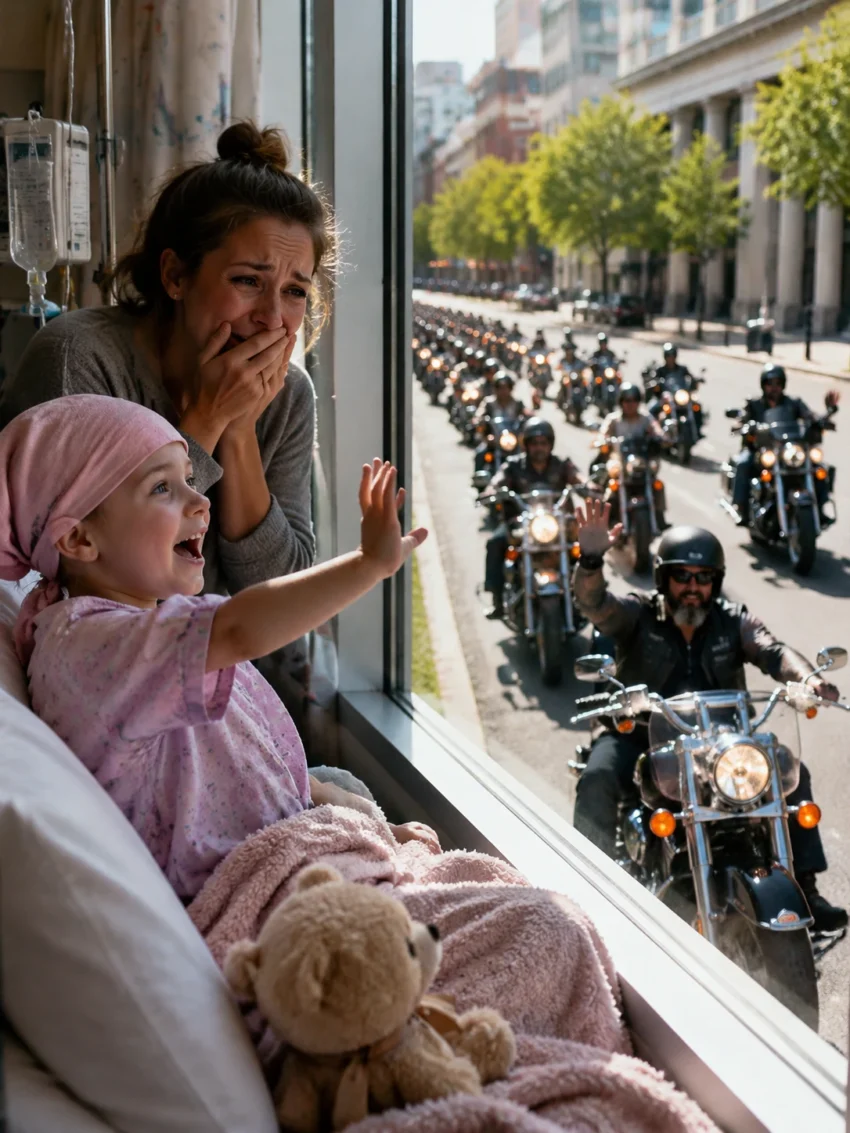
At exactly 2:47 p.m., a seven-year-old girl named Emily Rowan lifted her tiny hand toward the fourth-floor hospital window and waved at a line of motorcycles rolling slowly down Broad Street below.
She never expected anyone to wave back.
But one biker did.
And then thirty more followed him.
That moment changed far more lives than any of us realized at the time.
The Girl in Room 418
Emily Rowan had been admitted to St. Gabriel’s three months earlier after doctors discovered an early-stage blood disorder that required immediate treatment.
Compared to many children on the oncology floor, Emily’s condition had a hopeful outlook. Her doctors believed recovery was possible if treatment responded well.
Still, for a seven-year-old little girl, the hospital felt endless.
She missed school.
She missed her golden retriever named Daisy.
She missed sleeping in her own pink bedroom with glow-in-the-dark stars on the ceiling.
Most of all, she missed feeling like a normal child.
Her mother, Claire Rowan, stayed beside her every day in room 418. Claire was thirty-four years old, exhausted beyond words, and surviving on coffee, cafeteria sandwiches, and maybe three hours of sleep a night.
But she never let Emily see how scared she truly was.
Every morning, Claire brushed Emily’s eyebrows carefully after treatment caused parts of them to thin out.
Every night, she sat beside the bed reading old fairy tale books even after Emily fell asleep.
The nurses all knew them.
Emily was quiet during the first few weeks. Sweet. Polite. But quiet.
Then treatment became harder.
The medications made her tired. Some days she barely wanted to talk. Some mornings she refused to look out the window at all.
I noticed it before anyone else.
I kept a tiny notebook in my locker where I secretly tracked smile counts for long-term pediatric patients. I started doing it years ago because sometimes small victories matter more than medical charts.
Emily’s smile count had been frozen at zero for thirty-eight days.
Then came that Sunday afternoon.
The Sound Outside the Window
Emily had been lying in bed coloring quietly when the distant sound of motorcycle engines echoed through the open hospital window.
At first it sounded like thunder rolling across the city.
Then louder.
Closer.
Emily slowly looked up.
“Mom?” she whispered.
Claire glanced away from her laptop. “Yeah, sweetheart?”
“Can you help me to the window?”
Claire pushed the wheelchair gently across the room until Emily could see the street below.
Thirty Harley-Davidsons were moving through downtown Columbus in a slow organized formation.”..
Part 2
Emily’s tiny hand froze mid-wave as the engines rumbled closer. Thirty Harley-Davidsons glinted under the autumn sun, their chrome catching sparks of light that danced across the white stone of St. Gabriel Children’s Medical Center. The roar of engines was not menacing; it was a heartbeat, steady and loud enough to shake her chest with excitement.
“Mom… they’re real,” she whispered, clutching Claire’s hand like it was a lifeline.
Claire’s eyes widened as she peered down. What she saw made her heart stutter: dozens of bikers, men and women of all ages, slowly rolling through Broad Street, looking up at the hospital windows as if following some invisible map. Each one raised a hand in salute, a wave that spoke louder than any words.
Emily’s lips curled into a small, tentative smile—the first in nearly forty days. A nurse walking past the room paused mid-step, her eyes misting over as she caught the scene outside.
One of the bikers, a man with a faded red bandana and a chest tattoo of wings, raised his hand higher. “Hey, kiddo! That’s a good wave!” he shouted. And suddenly, the air vibrated with laughter and encouragement.
Emily’s smile grew. She waved back energetically, and the line of bikers mirrored her motion. Engines roared approval. Drivers honked gently, a sound so musical it could have been composed for this exact moment.
Claire hugged her daughter, feeling the tension of months dissolve in a single heartbeat. “They came for you, Emily. Every Sunday from now on.”
From that day forward, Sundays became sacred. The bikers returned week after week. Some days, Emily could barely lift her hand, her body drained by treatment. Still, the sound of engines was enough to lift her spirits. The nurses began calling it “Emily’s Parade,” and the stories spread through the hospital: a little girl who taught hardened men to smile, if only for an hour.
One Sunday, a nurse asked, “Do you know them, Emily?”
Emily shook her head. “No… but I think they know me.”
And maybe, that was all that mattered. That connection—a bridge forged from a wave, a line of engines, and unspoken understanding—was enough to remind Emily that life could still be beautiful, even when it was cruel.
Part 3
The miracle took an unexpected turn one crisp November morning. Claire opened the window to wave at the approaching bikers and noticed a stranger at the head of the line. He wasn’t wearing a vest, no patches, just a plain leather jacket. He pulled off his helmet and looked directly up at Emily.
Her heart skipped. There was something haunting in his eyes—recognition, sorrow, and something else she couldn’t name. He whispered a name under his breath, loud enough only for her to hear:
“Rowan.”
Emily’s blood ran cold. She didn’t know how, but something in that moment told her this man had been following her story long before the hospital. And then, in a way that made Claire step back in alarm, he reached into his jacket pocket and held up a small, worn notebook.
It was filled with sketches—drawings of a girl waving from a hospital window. Her window. Her life. Every Sunday, captured, chronicled, admired.
“I promised,” the man said, his voice breaking, “I’d make sure no one forgets.”
Tears streamed down Claire’s face as Emily’s small hands reached toward the window. For once, she didn’t wave. She just smiled—the kind of deep, radiant smile that healed everyone who looked at it.
That Sunday, for the first time, the bikers didn’t ride away. They parked along Broad Street. They stepped down one by one, leaving engines to hum like a soft chorus in the background. They entered the hospital lobby, spoke with staff, brought gifts, letters, and tokens of encouragement.
By the end of the afternoon, Emily’s room was filled with laughter, with strangers who had become family, and with hope that even the hardest battles could be softened by humanity. The nurses, once hardened to pain and sorrow, cried openly. They had never witnessed anything like it: a community of strangers turned saints, led by a little girl’s innocent wave.
Emily’s story became a legend—not just in Columbus, not just in the hospital, but everywhere the sound of engines could carry hope. And the final twist, the thing no one anticipated, came weeks later: a foundation was established in Emily’s name, dedicated to children in hospitals nationwide. The first donors? The bikers, who never expected anything in return—except perhaps the memory of one little girl’s wave that had reminded them how to be human again.
The hospital never looked the same. Neither did Emily. Neither did anyone who had witnessed the Sundays when hope roared on thirty motorcycles, and a little girl taught the world how to keep smiling