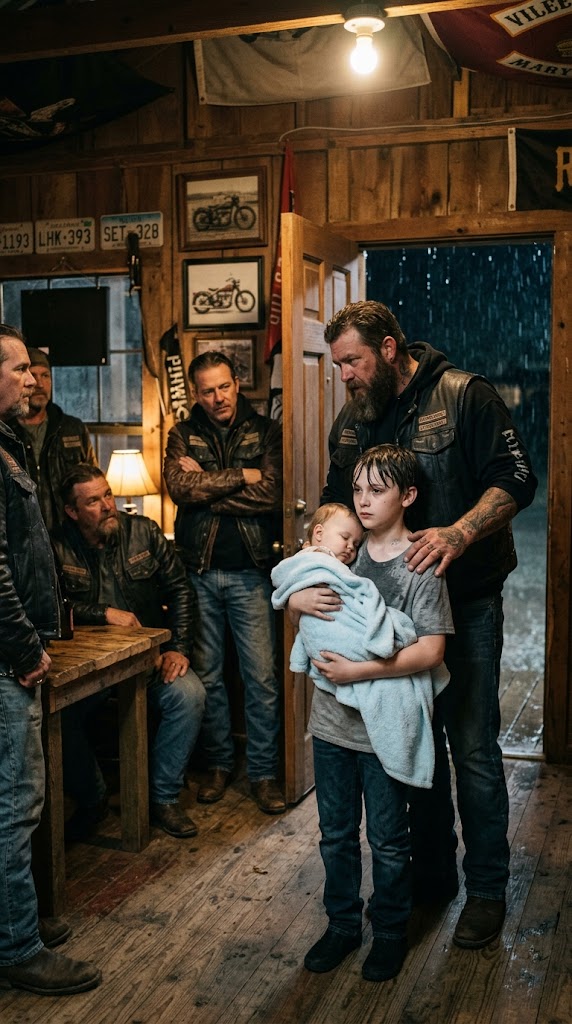
A Boy Ran Through the Storm With His Baby Sister
Rain covered the streets of Cedar Hollow, Tennessee, turning the small town into a blur of porch lights, wet pavement, and shaking tree branches.
Twelve-year-old Rowan Mercer ran barefoot through it all.
His baby sister, Lily, was pressed tightly against his chest, wrapped in a damp yellow blanket that had once smelled like laundry soap and warm milk. Now it smelled like rain, fear, and the trailer home they had just escaped from.
Behind them, far down the road, a man’s angry voice carried through the storm.
Rowan did not turn around.
He could not.
His stepfather, Troy Vance, had been drinking again. Most nights, that meant yelling, slammed cabinets, and his mother trying to keep peace until morning. But tonight had crossed a line Rowan would never forget.
His mother, Mallory, had grabbed his shoulders with shaking hands and whispered, “Take Lily and run. Don’t stop until you reach the riders’ clubhouse.”
Rowan had stared at her, terrified.
“The bikers?” he had asked.
Mallory’s eyes filled with tears. “They look scary, baby. But they protect people who need help. Go now.”
So Rowan ran.
He ran past dark mailboxes, closed stores, and puddles that splashed up his jeans. Lily whimpered against him, too cold and too tired to cry loudly anymore.
“I’ve got you,” Rowan whispered. “I promise I’ve got you.”
At the edge of town stood an old brick building beside a repair garage. Motorcycles lined the front like black shadows in the rain.
The sign above the door read: Iron Harbor Riders.
Everyone in Cedar Hollow had heard stories about them.
People crossed the street when they saw their leather vests. Parents warned kids not to stare. Shop owners lowered their voices when the riders walked in.
But Rowan remembered his mother’s words.
Not to kids.
Not to women who needed help.
He reached the heavy wooden door and pounded with both fists.
“Please!” he shouted. “Please help us!”
For one long second, the building went silent.
Then the door opened.
A tall man with a gray beard, broad shoulders, and a black leather vest stood in the doorway. His face looked hard enough to scare anyone.
But his eyes moved from Lily’s wet blanket to Rowan’s bare feet.
Then his expression changed.
“Son,” the biker said softly, “get inside.”
The Men Everyone Feared Became Quiet
Warm air hit Rowan’s face as he stumbled into the clubhouse.
The room smelled like coffee, leather, old wood, and motor oil. A few men had been playing cards. Others stood near the bar. Every one of them turned when Rowan entered with a baby in his arms.
Nobody laughed.
Nobody asked careless questions.
The gray-bearded biker crouched in front of Rowan.
“My name is Silas Boone,” he said. “You’re safe in here. What happened?”
Rowan’s lips trembled. He wanted to be brave, but the words came out broken.
“My stepdad scared Mom really bad. She told me to run.”
The room changed.
A younger biker grabbed towels. Another brought a blanket. A third hurried to the small kitchen and returned with warm soup and bread.
Silas gently reached for Lily.
“May I?”
Rowan hesitated.
Silas nodded toward the food. “You need to eat if you want to stay standing.”
Rowan slowly handed Lily over. To his surprise, the huge biker held the baby like she was made of glass.
Lily blinked at his beard, then tucked her face against his vest.
Silas looked down at her and whispered, “That’s it, little one. You’re warm now.”
Rowan sat at the table and ate so fast his hands shook.
One biker, a heavyset man named Wade, looked away and muttered, “That boy’s been hungry longer than tonight.”
Silas heard every word but said nothing.
Rowan told them what he could.
Troy had lost another job. He had come home angry. His mother had tried to calm him down. Then the argument became frightening. Mallory had seen something in Troy’s face that made her push Rowan toward the back door.
“She said if anything ever happened, I should come here,” Rowan whispered.
Silas’s jaw tightened.
“Where is your mother now?”
“I don’t know.”
Silas stood slowly with Lily asleep against his shoulder.
Several riders moved toward the door at once.
One of them said, “We’re going over there.”
Silas raised one hand.
“We do this right,” he said. “No foolish moves. No giving that man an excuse. We bring her back safe.”
Then he looked at Rowan.
“Tell me the address.”
The Ride Back to the Trailer Park
Twenty minutes later, three motorcycles rolled into the trailer park with their headlights cutting through the rain.
Troy Vance was on the front steps, pacing under the porch light. He turned when he heard the engines.
At first, he looked annoyed.
Then he saw who had arrived.
Silas Boone stepped off his motorcycle, followed by Wade and a quiet rider named Eli Knox. They did not shout. They did not rush.
They simply walked toward the trailer.
That scared Troy more than yelling would have.
“What is this?” Troy snapped. “You people don’t belong here.”
Silas stopped a few feet away.
“Mallory Mercer does.”
Troy’s face twitched. “This is my house.”
“Then act like a man who knows what a home is.”
For a moment, the rain was the only sound.
Inside the trailer, Mallory appeared near the hallway. Her hair was messy, her face pale, and her hands shook around the edge of an old sweater.
Eli moved past Troy and spoke gently.
“Ma’am, Rowan and Lily are safe. They’re at the clubhouse.”
Mallory covered her mouth and began to cry.
Troy stepped forward, but Silas blocked him.
“You’re going to stay right there,” Silas said.
Troy tried to laugh, but it sounded weak. “You threatening me?”
Silas leaned closer.
“No. I’m explaining that this family is done being afraid of you.”
Neighbors watched from behind curtains. Someone had already called the police after hearing the earlier argument.
When officers arrived, Silas stepped back and let them do their job.
Mallory gave a statement. Troy tried to argue, but his words became smaller when he realized the whole trailer park had seen him lose control.
By the time Mallory climbed into Wade’s truck, she was shaking so badly she could barely fasten the seat belt.
Silas stood in the rain beside her window.
“Your children are waiting,” he said.
Mallory nodded through tears.
“Thank you.”
Silas looked uncomfortable with the words.
“Don’t thank me yet. You still have to eat something warm.”
A Safe Room Above the Clubhouse
Rowan cried when his mother walked into the clubhouse.
He ran to her so fast the chair behind him nearly fell over. Mallory dropped to her knees and wrapped both arms around him.
“I’m sorry,” she whispered again and again. “I’m so sorry.”
Rowan shook his head.
“I got Lily out. Like you told me.”
Mallory touched his wet hair.
“You saved your sister.”
From Silas’s arms, Lily reached toward her mother, half asleep and confused. Mallory held both children close while the riders quietly gave them space.
That night, the Iron Harbor Riders opened the small apartment above the repair garage.
It was not fancy.
There were two beds, a patched couch, a little kitchen, and a window that looked out over the motorcycles.
But the door locked.
The lights worked.
And for the first time in months, no one raised their voice.
Mallory sat on the edge of the bed while Rowan and Lily slept beside her. Downstairs, the bikers kept watch without making a show of it.
Silas sat outside under the awning, drinking black coffee as rain ran off the roof.
Wade joined him.
“You think Troy’s done?” Wade asked.
Silas stared into the dark parking lot.
“Men like that don’t like being seen clearly.”
“So what now?”
“Now we stay awake.”
The Man Who Came Back
Two nights later, Troy returned.
He parked his truck two streets away and tried to approach the clubhouse from the side alley. His clothes were soaked, his eyes restless, and his hands moved like he had no plan he trusted.
But Silas had expected it.
The Iron Harbor Riders had cameras around the building, not because they wanted trouble, but because trouble had found them before.
Eli spotted Troy first.
He touched the small radio clipped under his vest.
“Silas,” he said quietly. “He’s here.”
Inside the clubhouse, nobody panicked.
Mallory and the children were moved to the upstairs room. Wade locked the back door. Another rider called the police before anyone stepped outside.
Then the floodlights came on.
Troy froze in the alley.
Seven bikers walked out of the clubhouse.
Slowly.
Silently.
Silas stood in front.
“Troy,” he said. “Go home before you make tonight worse for yourself.”
Troy pointed at him with a shaking hand.
“You ruined my life.”
Silas shook his head.
“No. You finally met people who wouldn’t look away.”
Troy’s face twisted.
“She belongs with me.”
Silas’s voice stayed calm.
“No person belongs to someone who makes them afraid.”
Sirens sounded at the end of the street.
Troy turned, startled. For a second, he looked like he might run. Then two police cars pulled into the lot, lights flashing across the wet pavement.
An officer stepped out and called his name.
Troy shouted, argued, and tried to push past them, but it ended quickly. The officers placed him in the back of the cruiser while rain slid down the windows.
One officer walked over to Silas.
“You called us early.”
Silas nodded.
“That boy already ran through one storm. He didn’t need another.”
The officer looked toward the upstairs window, where Mallory stood behind the curtain holding Lily.
“You may have prevented something serious tonight.”
Silas lit a cigarette, then changed his mind and tucked it back into the pack.
“Just trying something different.”
A New Morning at Iron Grounds Café
Weeks passed.
Mallory and her children stayed in the apartment above the garage while legal paperwork, housing support, and safety plans slowly came together.
At first, Mallory apologized for everything.
For taking up space.
For needing help.
For Lily crying at night.
For Rowan asking too many questions about motorcycles.
Silas finally stopped her one morning in the hallway.
“Mallory,” he said, “you don’t have to apologize for surviving.”
She looked down, unable to answer.
The clubhouse had a small café attached to it called Iron Grounds. It served truck drivers, mechanics, nurses coming off night shifts, and anyone brave enough to walk past the motorcycles out front.
One morning, Silas found Mallory wiping tables even though nobody had asked her to.
“You ever run a register?” he asked.
She looked up. “Years ago.”
“Make coffee?”
“Yes.”
“Show up on time?”
Mallory almost smiled. “Always.”
Silas nodded toward the counter.
“Then you start Monday.”
She stared at him.
“Are you offering me a job?”
“Looks that way.”
Tears filled her eyes.
Silas immediately looked uneasy.
“Don’t do that.”
“Do what?”
“Cry. I’m terrible with crying.”
Mallory laughed softly, and the sound surprised her.
It had been a long time since laughter felt natural.
The Boy Who Learned Engines
Rowan changed slowly.
At first, he jumped whenever a door slammed. He kept Lily close. He checked locks twice. He asked his mother where she was going even when she only walked downstairs.
Silas never rushed him.
Instead, he invited Rowan into the repair garage.
“You know what this is?” Silas asked, pointing to a motorcycle engine.
Rowan shook his head.
“No, sir.”
“Good. Means I can teach you without you pretending you already know.”
Rowan smiled for the first time in days.
Soon, he learned the names of tools. He learned how to wipe grease from chrome. He learned that engines sounded different when something was wrong.
Silas told him, “Machines tell the truth if you listen long enough.”
Rowan thought people might be the same way.
The riders still looked rough. They still wore leather. Their bikes still shook the windows when they left in a group.
But Lily loved them.
She called Wade “Bear” because of his size. She called Eli “Quiet” because he rarely spoke. She called Silas “Si,” because his full name was too hard for her small mouth.
Every time she reached for Silas, he pretended to be annoyed.
“I’m not a babysitter,” he would grumble.
Then he would carry her around the café for twenty minutes.
The Truth Behind the Vest
One evening, after the first warm rain of spring, Rowan sat beside Silas outside the clubhouse.
The sky was purple over the hills. The motorcycles were parked in a clean row. Inside the café, Mallory was laughing with a customer while Lily stacked napkins into uneven towers.
Rowan looked at Silas.
“Why did Mom know to send us here?”
Silas stayed quiet for a while.
Then he said, “Your grandfather helped me once.”
Rowan turned. “My grandpa?”
Silas nodded.
“I was nineteen. Angry at everything. Had nobody worth calling. Your grandfather ran the old gas station outside town. One winter night, I came in with no money and nowhere to go. He gave me coffee, a sandwich, and a place to sit until morning.”
Rowan listened carefully.
“That’s why you helped us?”
“Partly.”
“What’s the other part?”
Silas looked through the café window at Mallory holding Lily.
“Because nobody should have to earn kindness before they receive it.”
Rowan swallowed.
“People say you’re dangerous.”
Silas chuckled.
“Some of that’s earned.”
“But not all of it.”
The old biker looked at him.
“No,” he said softly. “Not the part that matters most.”
The Family That Stayed
By summer, Mallory had saved enough to rent a small blue house three blocks from the café.
It had a porch swing, two bedrooms, and a backyard with a maple tree. The first night they slept there, Rowan checked the windows only once.
That was progress.
Iron Harbor Riders helped move them in.
Wade carried the couch.
Eli fixed a loose stair.
Silas stood in the kitchen pretending not to care while Lily stuck star stickers on his boots.
Mallory looked around the house with tears in her eyes.
“I don’t know how to repay any of you.”
Silas picked a sticker off his boot and sighed.
“You can start by making better coffee than Wade.”
Wade frowned. “My coffee is fine.”
Eli shook his head.
“Your coffee tastes like burnt tires.”
For the first time, Rowan laughed loudly without covering his mouth.
Mallory looked at him, and something in her heart loosened.
They were not healed all at once.
Some nights were still hard. Some memories still returned without warning. Some mornings, Mallory woke up tired from dreams she could not explain.
But they were safe.
They were together.
And they were no longer alone.
Months later, Rowan stood outside the café watching Silas tune an old motorcycle.
“When I’m older,” Rowan said, “I want to help people like you do.”
Silas glanced at him.
“Then start now.”
“How?”
Silas handed him a clean rag.
“Notice when someone’s standing in the rain.”
Rowan looked toward the road, where the afternoon sun was breaking through the clouds.
He understood.
That storm had not been the end of their story.
It had been the night they found the door that opened.
And behind that door were the people everyone feared, quietly becoming the family no one expected.
Sometimes the safest place is not the one that looks perfect from the outside, but the place where people notice fear in a child’s eyes and choose to act with patience, courage, and kindness.
A rough voice, a leather vest, or a hard past does not always reveal the truth of a person’s heart, because many good people carry their kindness quietly.
Children remember the adults who make them feel safe, especially in the moments when the world feels too loud, too dark, and too heavy for them to understand.
A mother starting over does not need judgment; she needs a door that opens, a steady voice, and someone who reminds her that survival is not something to apologize for.
Real strength is not shown by frightening others, but by standing between danger and the people who cannot protect themselves alone.
The smallest act of help can travel through time, because one sandwich, one cup of coffee, or one safe room can become the reason another family survives years later.
People often fear what they do not understand, but sometimes the ones with the hardest reputations are the first to protect a child without asking for anything in return.
Healing rarely happens in one dramatic moment; it grows slowly through quiet mornings, locked doors, warm meals, honest work, and people who keep showing up.
No child should have to be brave too early, but when a child is forced to run through the storm, the world should be ready with open arms on the other side.
The most important part of a person is not always the story people tell about them, but what they choose to do when someone desperate knocks on their door.