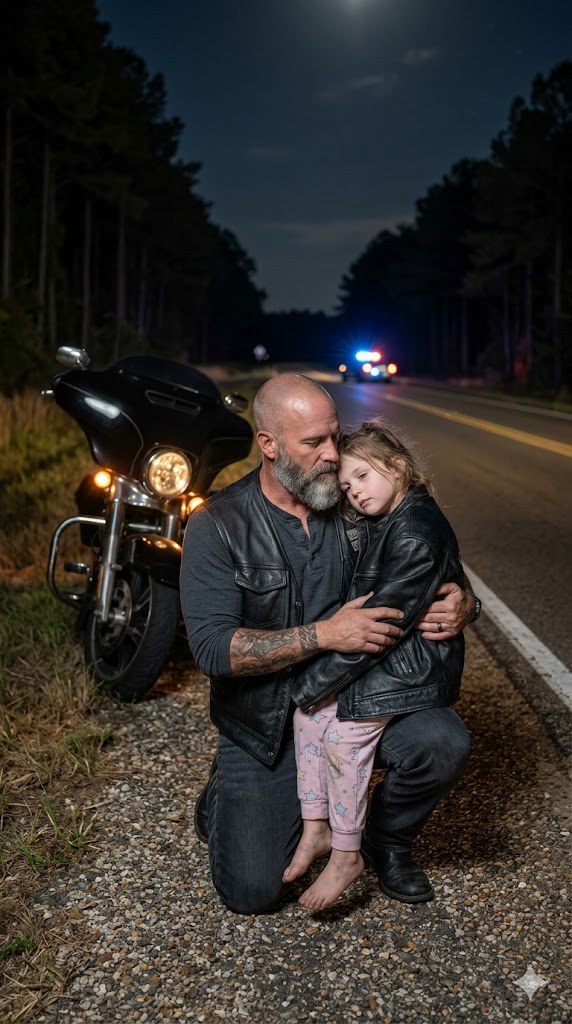
The Little Girl on Route 72
At 1:18 in the morning, a seven-year-old girl in lavender pajamas walked alone along the shoulder of a quiet highway outside Meridian, Mississippi.
Her feet were bare. Her hands were tucked under her arms. The road behind her was dark, and the road ahead looked endless.
She did not know where she was going.
She only knew she could not stay where she had been.
A motorcycle came around the bend with one bright headlight cutting through the pine trees. The rider passed her at first. Then his brake light flashed red in the dark.
That was the moment Wyatt Mercer turned around.
He was fifty-three years old, broad-shouldered, gray-bearded, and known around town as the quiet man who fixed engines and never asked anyone for attention. He rode a black Harley Road King and lived in a small house behind his repair shop on the edge of Lauderdale County.
That night, he was riding home from a late card game at a friend’s place.
He almost did not understand what he had seen.
A child.
A tiny child.
Alone on the side of the highway after midnight.
The Man Who Turned Back
Wyatt stopped his motorcycle carefully on the shoulder, left the hazard lights blinking, and walked back slowly.
He kept his hands visible.
He did not rush.
The little girl stood frozen near the grass, watching him through tired eyes. Her pajamas had tiny white stars on them. Her hair was tangled from the wind. Her face looked too calm for a child standing beside a highway in the middle of the night.
Wyatt stopped several feet away and lowered his voice.
“Hey, sweetheart. My name is Wyatt. I’m not here to scare you. Are you okay?”
The girl stared at him.
For a few seconds, she said nothing.
Then her chin trembled.
“I’m just tired.”
Wyatt later told a local reporter that those three words stayed with him longer than anything else he had ever heard.
Not because they were dramatic.
Because they were too small.
Too quiet.
Too heavy for a child.
He knelt down on one knee so he would not tower over her.
“Can I call somebody to help us?”
She nodded.
“Can I stand here with you until they come?”
She nodded again.
Then, after a moment, she whispered:
“Can you hold me? My feet hurt.”
Wyatt’s face changed.
He did not ask too many questions. He did not make promises he could not keep. He simply opened his arms.
“Yes, sweetheart. I can hold you right here.”
Thirty Minutes Beside the Road
Her name was Lila Warren, though Wyatt would not learn that until many years later.
At the time, she was just a small child who had walked nearly half a mile from a trailer set back from the highway.
Inside that home, adults had been arguing for hours. Something had shattered in the kitchen. Voices had risen. Lila had climbed through her bedroom window because the night outside felt safer than the noise inside.
She had seen the distant lights of a gas station and thought maybe someone there would let her use a phone.
But she never reached it.
Wyatt lifted her carefully, one arm beneath her knees, the other supporting her back. The moment he picked her up, her body relaxed against him like she had been waiting for permission to stop being brave.
He took off his leather jacket and wrapped it around her.
Then he called 911.
His voice on the call was calm.
“My name is Wyatt Mercer. I’m on Route 72 eastbound, about half a mile past Pine Creek Road. I have a little girl with me. She’s barefoot, cold, and very tired. She needs someone to check on her.”
The dispatcher asked if the child could speak.
Wyatt looked down at Lila.
Her eyes were closed against his jacket.
“She’s resting right now,” he said gently. “I don’t want to push her.”
For the next several minutes, Wyatt stood on the gravel shoulder with a child in his arms while his motorcycle blinked red behind him.
Cars did not pass.
The highway stayed quiet.
The pine trees moved softly in the wind.
Lila’s small hand held the edge of his shirt.
Once, barely awake, she whispered:
“Your jacket is warm.”
Wyatt looked down and answered:
“Then you keep it on as long as you need.”
The First Promise
Deputy Marcus Ellison arrived first.
When his cruiser pulled up, he saw a large biker standing under the flashing lights, holding a little girl wrapped in a leather jacket that nearly swallowed her whole.
Marcus approached carefully.
“Sir, are you the one who called?”
“Yes, sir,” Wyatt answered. “She’s been walking alone. She needs help.”
The deputy looked at Lila’s bare feet, her tired face, and the way she clung to Wyatt’s shirt even in her sleep.
He understood quickly that this was not a normal call.
An ambulance was requested. Another unit was sent to check the nearby homes. Wyatt answered every question calmly, but when Marcus told him it was time to carry Lila to the cruiser where she could stay warm, Wyatt hesitated.
Not because he wanted to interfere.
Because letting go felt harder than he expected.
He looked down at her and whispered something only she could hear.
Then he handed her to the deputy, jacket and all.
“Please make sure she keeps that,” Wyatt said. “She’s cold.”
Marcus nodded.
“We will.”
Wyatt stepped back toward his motorcycle. He stood with both hands on the handlebars, head lowered, for a long moment before starting the engine.
Then he rode away into the dark.
He did not ask for attention.
He did not ask for a picture.
He did not ask what happened next.
But he never forgot her.
The Jacket That Stayed
Lila spent that night at the hospital being checked by kind nurses who spoke softly and moved slowly.
The leather jacket stayed with her.
It went with her to a children’s support center the next morning. It went with her to a temporary home two days later. Six weeks after that, it went with her to the house of a retired school counselor named Naomi Fletcher.
Naomi had opened her home to children for almost fifteen years. She had seen quiet children, angry children, frightened children, and children who smiled too fast because they did not know what else to do.
But Lila was different.
She barely spoke.
She kept Wyatt’s jacket folded across her lap like a blanket.
On the second night, Naomi sat beside her on the living room floor and asked gently:
“Honey, where did that jacket come from?”
Lila rubbed the sleeve between her fingers.
“A motorcycle man gave it to me,” she said. “He held me when I couldn’t walk anymore.”
Naomi did not ask more.
She only said:
“Then we’ll keep it safe.”
For months, Lila slept with the jacket beside her. On hard school mornings, she wore it around the house. When thunder shook the windows, she crawled inside it like it was a tent.
Years passed.
Lila grew taller. Her hair got longer. Her voice grew stronger. Naomi adopted her when she was nine years old, and on adoption day, Lila insisted on wearing the old black leather jacket in the courthouse photo.
The sleeves covered her hands.
The hem fell past her knees.
But her smile filled the whole frame.
Eight Years Later
Wyatt Mercer thought about the girl every October.
He wondered if she was safe.
He wondered if she remembered the highway.
He wondered if she remembered him.
For eight years, he never asked. He told himself it was not his place. He had only been there for thirty minutes. Other people had done the long work after that.
But one morning, after finding an old note in a drawer with the date written on it, Wyatt sent a short email to a local reporter named Maren Blake.
It was only three lines.
He wrote that he had stopped for a little girl on Route 72 years earlier. He wrote that he had never learned what became of her. And he wrote one question:
Did she remember the man on the motorcycle?
Maren found the records. She spoke to the deputy. She found Naomi. And finally, she sat at Naomi’s kitchen table on a bright Saturday afternoon while sixteen-year-old Lila came home from a police youth program wearing a navy T-shirt and running shoes.
Lila listened as Maren read Wyatt’s email out loud.
When Maren finished, the kitchen became very still.
Lila looked down at her hands.
Then she said:
“Yes. I remember him.”
Naomi covered her mouth and turned toward the sink.
Lila swallowed hard.
“I remember his jacket. I remember the motorcycle light. I remember he didn’t make me talk when I was too tired. I remember he held me like I mattered.”
Maren asked if she wanted Wyatt to know anything.
Lila nodded.
“Tell him I still have the jacket.”
Then she added:
“And tell him I’m joining law enforcement one day because I want to be the person who stops when someone needs help.”
The Reply
Maren emailed Wyatt that night.
She told him Lila was safe. She told him she had been adopted by Naomi. She told him Lila was sixteen now, strong, thoughtful, and planning for a future in public service.
She also told him about the jacket.
Wyatt replied before sunrise.
His message was short, but every line carried weight.
“Thank you for telling me. That is more than I ever expected to know.”
“Please tell Lila the jacket belongs to her. It belonged to her from the moment I wrapped it around her.”
“And tell her I am proud of her. Very proud.”
Maren drove back to Naomi’s house and read the message to Lila.
When Lila heard the last line, she pressed both hands over her face and cried silently at the kitchen table.
Not loud tears.
Not broken tears.
The kind of tears that come when a missing piece finally finds its place.
When she could speak again, she said:
“Can you tell him thank you?”
Maren nodded.
Then Lila looked toward the hallway, where the old jacket still hung on a wooden hook.
“And tell him I want him there when I graduate from the academy. Not the youth one. The real one.”
The Note on the Workbench
Wyatt read that message three times.
Then he walked to the old wooden workbench in his repair shop, took a yellow sticky note, and wrote:
Lila. Academy graduation.
He placed it beside a coffee mug full of bolts and never moved it again.
When Maren interviewed him later, she noticed a small tattoo on the inside of his wrist.
Four letters.
June.
Wyatt saw her looking and became quiet.
After a while, he explained.
June had been his little sister. She had been six when his family lost her in a summer accident many decades earlier. Wyatt had been eight. He had carried that memory his entire life.
He touched the tattoo with his thumb.
“Maybe that’s why I saw Lila that night,” he said. “Maybe some part of me was always watching for a child who needed someone to turn around.”
He looked toward the open garage door, where sunlight fell across his motorcycle.
“I couldn’t help my sister then,” he said. “But I could stop for that little girl. Maybe that had to mean something.”
Maren did not answer right away.
Some stories do not need a reporter to explain them.
Some stories already know what they are.
The Road That Changed Two Lives
Lila is sixteen now.
She still keeps the leather jacket in her room.
She does not wear it every day anymore. She does not need it the same way she once did. But on difficult evenings, when old memories press too close, she takes it down and sits with it across her shoulders.
It reminds her that one person stopping can change the direction of a life.
Wyatt is older now. His beard is whiter. His hands are rough from years of engine work. His motorcycle still starts with a deep sound that fills the shop like thunder.
He and Lila have not met again yet.
They agreed to wait.
One day, if everything goes the way Lila plans, Wyatt will ride his Harley to her academy graduation. He will park somewhere near the back. He will probably try to stand quietly where no one notices him.
But Lila will know.
She will look for the man who stopped on a dark road when he could have kept going.
And when she sees him, she will not see a stranger.
She will see the first person who made her believe the world still had safe arms in it.
Sometimes the most important people in our lives are not the ones who stay forever, but the ones who arrive at the exact moment when staying alone would have changed us in a way no child, no parent, and no human being should have to carry.
A kind act does not need an audience to matter, because the quietest moments of compassion can live inside someone’s heart for years and become the reason they choose a better future.
Wyatt did not save Lila by saying perfect words; he helped her by slowing down, speaking gently, and proving through his actions that she was worth stopping for.
There are people who ride through the world looking tough on the outside, but their hearts are shaped by old pain, quiet memories, and a deep understanding of what it means to protect someone smaller than themselves.
Lila’s story reminds us that children remember safety with incredible clarity, especially when it comes from someone who does not demand trust but earns it softly.
The jacket was never just leather; it became warmth, protection, memory, and proof that one night on a lonely road did not end with fear, but with someone choosing kindness.
Some people spend their whole lives trying to make sense of an old wound, and sometimes that wound becomes the very reason they notice someone else who needs help.
You do not have to fix a person’s entire life to matter in it; sometimes you only need to be present for one moment when they are too tired to stand alone.
The world becomes safer when ordinary people refuse to ignore quiet signs of trouble, especially when the person in need is too small, too tired, or too afraid to ask loudly.
Years later, what Lila remembered most was not the road, the cold, or the fear, but the man who turned back, wrapped her in warmth, and helped her believe that good people still existed.