The Bench Under the Elm Tree
On a warm Tuesday afternoon in Forest Square Park in Columbus, Ohio, the sidewalks glowed pale under the sun, and the air carried the mixed scent of trimmed grass, coffee, and flowering trees. It was the kind of neighborhood where everything looked polished from a distance. The homes were spotless. The cafés were full. The people moved quickly, as if comfort had made them forget how fragile peace could be.
Walter Harlan sat on the same bench he had chosen for years, beneath an old elm tree near the edge of the walking path.
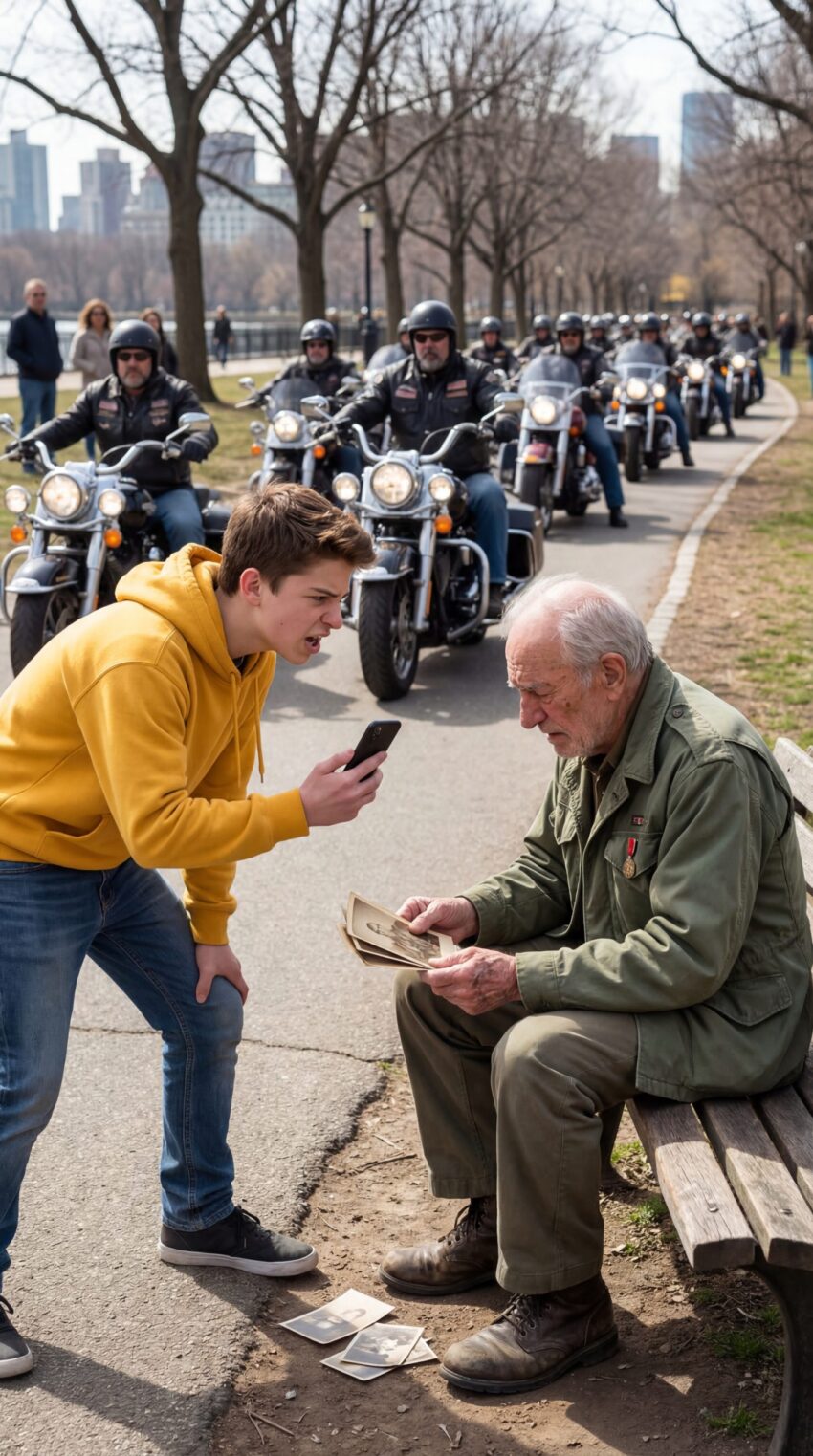
He was eighty years old now. Time had thinned his frame and bent his shoulders, but it had never taken the steadiness from his eyes. He wore a faded army jacket, carefully cleaned though badly worn at the cuffs. Pinned near his chest was a small medal he never spoke much about. Beside him rested a weathered canvas bag that held the few things he always carried with him: a metal thermos of coffee, a Bible with a soft cracked cover, and a stack of old photographs of his late wife, June.
Every Tuesday, he came to that bench to sit in the shade and remember her.
That afternoon, a group of teenagers came striding down the path, loud and careless, their phones already raised before they reached him. At the center of them was Cole Maddox, eighteen years old, dressed in expensive streetwear, moving with the easy arrogance of someone who had never been forced to think twice about the space he took from other people.
He pointed toward Walter’s bench and laughed. “That spot’s perfect.”
One of his friends glanced at Walter and smirked. “There’s already somebody there.”
Cole shrugged as if that detail meant nothing. He stopped in front of the bench and said, “Hey, sir, we need this spot. Move.”
Walter looked up at him slowly. “There are other benches, son. I’m not bothering anyone.”
Cole rolled his eyes, glancing at the camera aimed at him. “You are now.”
A few people nearby noticed the tone, but as often happens, they kept walking. Some slowed down. Some watched. None stepped forward.
Walter rested one hand on his bag. “I’ve been sitting here a long time. I’d like to stay a little longer.”
The answer embarrassed Cole in front of his friends, and embarrassment in people like him often turned quickly into cruelty. He reached down, grabbed the strap of Walter’s bag, and yanked it aside. Walter lost his balance and slipped off the bench onto the path. His glasses hit the ground. His shoulder struck the concrete. A few nearby voices gasped, but no one intervened.
Then the photos spilled out.
Pictures of June scattered across the ground, some sliding into a patch of wet dirt near the sprinkler line. One photo landed face up, her smile half-covered in mud.
Walter pushed himself up with shaking hands and whispered, “Please… not those.”
But Cole only laughed harder because the phones were still recording. “Relax,” he said. “It’s just old paper.”
The boys turned away still joking, leaving Walter kneeling on the path, trying to gather the wet photos before the dirt soaked deeper into them. His cheek ached. His hand trembled so badly he could barely hold the edges of the pictures. Yet what hurt most was not the fall. It was the casual way the moment had happened in front of other people, as if his dignity had no weight at all.
After a long breath, Walter reached into his jacket and took out a small flip phone. He stared at it for a second, then pressed one number.
The call connected quickly.
“Gramps?” came a deep voice. “You okay?”
Walter swallowed hard. “Nolan… I’m at the park. Some boys knocked me down. They ruined June’s pictures.”
There was silence on the other end, heavy and immediate.
Then the voice returned, quieter than before. “Stay there. I’m coming.”
The Call That Changed the Afternoon
Across town, in an old brick garage near the river, Nolan Mercer was finishing work on a motorcycle engine when the call came in. He was thirty years old, broad-shouldered, heavily tattooed, with the stillness of someone who had learned long ago not to waste words. He was the leader of a large motorcycle club called the Black Ravens. To outsiders, the club looked intimidating. To the people who truly knew them, they were men and women who protected their own with fierce loyalty.
Walter Harlan was more than Nolan’s grandfather. He was the man who had raised him.
When Nolan was a boy with nowhere steady to stand, Walter had given him a home, meals, rules, and a reason not to throw his life away. Walter had taught him to work with his hands, to look people in the eye, and to never mistake money for character. Half the riders in the club had once eaten at Walter’s table or received a kind word from him when no one else had bothered to see them.
So when Nolan heard what had happened, the whole garage seemed to go quiet.
He set down the wrench in his hand and looked at the room. Men stopped what they were doing. A woman named Reese, one of the best riders in the club, stepped forward first. “What happened?”
Nolan answered without raising his voice. “Some rich kid humiliated my grandfather in the park.”
That was all he needed to say.
Within minutes, texts and calls went out across the city. Riders left job sites, repair shops, warehouses, and bars. Engines started one after another until the whole block hummed with the deep thunder of motorcycles coming to life. Nolan pulled on his cut, stepped outside, and saw row after row of bikes already filling the lot.
Nobody shouted. Nobody celebrated. The mood was too serious for that.
Nolan swung onto his black Harley and said only one sentence before the group rolled out.
“We are going there for respect, not chaos—but nobody forgets what was done to him.”
Hundreds of engines answered at once.
The Street Falls Silent
Back in the wealthy district, Cole and his friends had moved from the park to a fashionable café overlooking the main promenade. They were replaying the video, laughing at the comments already piling up online, speaking with the reckless confidence of people who had mistaken public attention for approval.
Cole leaned back in his chair and grinned. “It’s blowing up already.
His friend laughed. “You went viral in like twenty minutes.”
Cole took a sip of his drink and said, “People like that shouldn’t be out here making the place look miserable.”
Then the vibration started.
At first it was faint, like a distant storm. Glasses on the café tables trembled. Heads turned. The sound grew louder, deeper, rolling up the avenue in a wave that swallowed conversation, traffic, and music alike. People stood up. Patio chairs scraped back. The polished street suddenly felt much smaller.
Then the motorcycles appeared.
They came in long formation, headlights bright beneath the afternoon sun, filling the avenue with chrome, leather, and absolute purpose. There were not ten of them, or twenty. There were hundreds.
The sound alone stripped the smile from Cole’s face.
At the front rode Nolan Mercer, his expression unreadable, his gaze locked ahead. The riders did not speed recklessly. They advanced slowly, deliberately, until the whole block understood they had come for one reason and one reason only.
Cole stood up too fast and nearly knocked over his chair. “Why are they here?” one of his friends asked.
No one answered.
The motorcycles stopped along the street and around the park entrance until it seemed the whole area had been surrounded by thunder. Riders stepped off their bikes and formed a line, silent and steady. Nolan walked forward through the center of them, and something about the calmness in his face frightened people more than yelling ever could.
He stopped at the edge of the café patio and asked, “Which one of you is Cole Maddox?”
Nobody spoke. One friend took a step back. Another lowered his phone.
Then Reese held up a screen showing the video Cole himself had posted. The sound played clearly enough for the whole patio to hear—Walter’s fall, the laughter, the careless words.
Nolan’s eyes moved from the screen to Cole’s white sneakers.
“You did that to my grandfather,” he said.
Cole tried to speak, but his voice caught. “I didn’t know who he was.”
Nolan took one step closer. “You should not need to know who a man is before treating him like a human being.”
The sentence landed harder than a threat.
Cole’s father, Preston Maddox, had built a reputation in that district as a developer with money, influence, and the habit of making problems disappear. Cole had grown up watching adults bend around that power. So even while trembling, he still tried the one language he understood.
“My dad can fix this,” he muttered. “He can pay for whatever—”
Nolan cut him off. “This was never about money.”
Then he pointed back toward the park. “You’re coming with us, and you’re going to face the man you disrespected.”
The Man on the Bench
By the time the riders returned to the elm tree, the park had fallen into a strange hush. People stood at a distance, watching. Walter was still on the bench, his bag beside him, one damp photograph in his hand.
When Nolan reached him, the anger in his face softened at once. He removed his gloves, knelt in front of his grandfather, and said quietly, “I’m here.”
Walter looked at him and gave a tired nod. “You brought half the city.”
A faint, sad smile touched Nolan’s face. “The half that remembers you.”
Walter looked down at the photo of June. “They laughed at her, Nolan.”
That sentence hurt more than anything else said that day.
A moment later Cole was brought forward. He did not look confident anymore. His hoodie was wrinkled, his face pale, and his eyes red with panic. For the first time in his life, he seemed to understand that attention could turn into shame just as quickly as applause.
Nolan stood back and let the silence do its work.
Walter raised his eyes to the boy and asked, “What is your name?”
Cole swallowed. “Cole.”
Walter nodded slowly. “Cole, do you know who she is?” He lifted the muddy photograph. “That’s my wife, June. She worked as a nurse for most of her life. She cared for people who had nothing to offer her in return. She believed every person deserved gentleness, even on their worst day.”
Cole stared at the photo and said nothing.
Walter continued, his voice calm but deeply worn. “I served my country when I was young, and I spent the rest of my life working with my hands. I am not telling you that because I want praise. I’m telling you because you looked at me and decided I was worth less than your entertainment.”
Cole’s shoulders began to shake.
Walter held the photo closer to his chest. “Young man, the deepest injury is not the bruise. It is when another person looks at your age, your clothes, your weakness, your poverty, or your loneliness and decides you no longer deserve respect.”
Cole started crying then, not dramatically, not for show, but with the broken confusion of someone hearing the truth about himself for the first time.
“I’m sorry,” he whispered.
Walter answered him gently, but without softness. “You are sorry because consequences arrived. I hope one day you become sorry because your heart changed.”
When Power Meets a Greater Memory
The sound of tires on the road announced the arrival of Preston Maddox before he even stepped into view. Black SUVs pulled up along the curb, and men in dark suits moved quickly around him. Preston came striding into the park furious, demanding his son be released, demanding the riders back off, demanding control of a moment that had already slipped beyond his reach.
“Do you have any idea who I am?” he shouted.
Nolan turned and looked at him. “That question is part of the problem.”
Preston pointed toward Walter as if the answer were obvious. “This whole thing is about him?”
Before Nolan could reply, another convoy arrived—police vehicles this time. Officers moved into the park, and for a breathless moment everyone thought the day might collapse into something even worse.
Then Police Chief Daniel Keane stepped out.
He was a large man in his late fifties, stern-faced, sharp-eyed, carrying the kind of authority that did not need to announce itself. He crossed the grass, took one look at Walter Harlan, and removed his cap.
Then he stood straight and said, “Mr. Harlan.”
Walter blinked in surprise. “Danny Keane?”
The chief gave a brief nod. “Yes, sir. You kept the youth center open on Grant Street when half of us had nowhere else to go. You bought my first academy boots when my family couldn’t.”
The park went silent again, but in a different way now.
Preston’s expression changed. For the first time, uncertainty entered his face.
Chief Keane turned toward him and said, “We have video evidence of your son knocking down an elderly man and damaging personal property. We also have multiple witnesses. That matters more to me than your name.”
Preston stepped forward angrily. “You don’t understand who you’re talking to.”
The chief replied, “Today, you should be more concerned with who you are talking about.”
Cole was taken gently but firmly into custody. Preston tried to protest, but the words no longer had force behind them. The old structures he trusted—money, influence, intimidation—had all weakened in the presence of something they could not erase: memory, loyalty, and public truth.
Walter remained seated through it all, his hand resting over June’s photograph.
The Ride Home
When the police left and the tension finally began to drain out of the park, Nolan sat beside his grandfather on the bench. The riders remained nearby, some standing quietly, some watching the street, all of them keeping respectful distance.
Walter looked at the path where the teenagers had first appeared. “The city changed,” he said softly. “Sometimes I wonder if people still see each other at all.”
Nolan answered, “Some do. Some forgot. But not everybody.”
Walter nodded and looked at the riders lining the park. Men and women with scarred hands, weathered faces, and rough reputations. People many would judge in a second and misunderstand for a lifetime. Yet they had come without hesitation for one old man with a broken afternoon and a handful of muddy photographs.
He smiled faintly. “Your grandmother would have fed every one of them.”
Nolan laughed under his breath. “I know.”
Then he reached for the canvas bag and carefully placed the photographs back inside, one by one, as if each deserved ceremony. When he was done, he stood and offered Walter his arm.
“Let’s go home, Gramps.”
Walter took it and rose slowly. Together they walked toward the waiting motorcycle with the sidecar, while the club around them started their engines one more time. The sound rolled through the park like distant thunder, but now it no longer felt like a warning. It felt like a shield.
And long after the last bike had disappeared down the road, the people who had watched that afternoon would remember one thing clearly:
a quiet old man on a bench had not been forgotten after all.
Ten Closing Messages
A society begins to lose its soul the moment it teaches young people to admire status more than kindness, because once that happens, cruelty starts dressing itself like confidence and too many people mistake it for strength.
Real dignity is not measured by the price of a jacket, the neighborhood someone lives in, or the number of people watching online, but by the way a person treats the weak, the old, the poor, and the forgotten when there is nothing to gain from being decent.
The most dangerous kind of pride is the kind that grows in comfort without correction, because it creates adults who believe apology can be outsourced, compassion can be delayed, and damage can always be covered by money.
There is something deeply sacred about the small things elderly people carry with them, because what looks ordinary to the world may actually be the last living bridge to the people they loved, the years they survived, and the memories that keep them company.
A man’s worth does not shrink just because his hands tremble, his clothes are old, or his voice is quiet, and any culture that forgets this truth will eventually raise children who know how to consume attention but never how to honor humanity.
Sometimes the strongest people in a city are not the ones with power, titles, or influence, but the ones who quietly fed others, sheltered others, taught others, and planted goodness so deeply that loyalty still rises years later when they need it most.
Respect should never depend on biography, because no one should have to prove military service, sacrifice, parenthood, grief, or usefulness before being treated like a human being in a public place.
The people the world dismisses as rough, ordinary, or unimportant are often the very people who still remember gratitude, still recognize character, and still show up when it matters, while those with polished lives sometimes disappear at the first cost.
Every cruel act leaves two wounds behind: one on the person who suffers it, and another inside the person who commits it, because each time someone chooses humiliation over mercy, they become smaller than they were before.
In the end, the truest measure of a community is not how beautiful its streets look in the afternoon light, but whether an old man can sit in peace beneath a tree without being made to feel like he no longer belongs to the world he helped build.