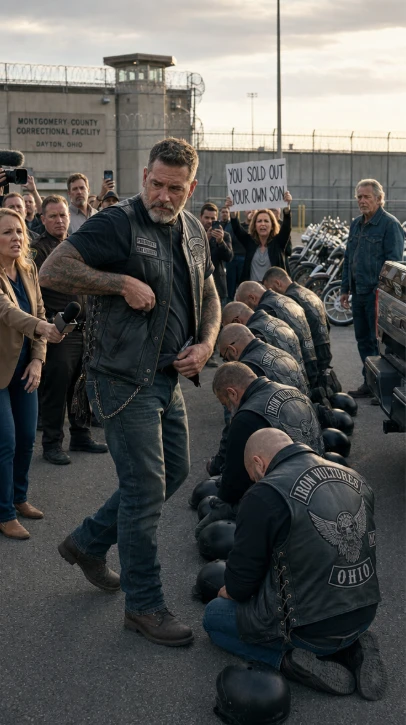
When fifteen bikers cut their engines outside the county prison and dropped to their knees in silence, the crowd thought it was a protest — until someone whispered, “That’s the boy’s father.”
It was 3:18 p.m. outside Montgomery County Correctional Facility in Ohio.
The sentencing had just ended.
A seventeen-year-old kid — Marcus Hale — was led through the side entrance in shackles. News cameras were still packing up. A few local activists lingered near the gates, murmuring about justice and wasted youth.
Then we heard it.
Engines.
Low.
Measured.
Not revving.
Just arriving.
Fifteen motorcycles rolled into the parking lot in formation and parked facing the prison gates. The sound died at once as if someone had cut a single cord.
Helmets came off.
Leather vests.
Boots on pavement.
And without a word, every one of them turned toward the prison entrance and went down on one knee.
Gasps rippled through the small crowd.
“What is this, intimidation?”
“Are they trying to pressure the judge?”
“I heard he’s one of theirs.”
I felt my throat tighten.
Because I knew two things the crowd didn’t.
First — Marcus had been hanging around the club for the past year. They’d tried to keep him busy, keep him off certain corners, away from certain friends.
Second — the man kneeling at the front of that line, gray beard, tattooed arms, hands resting steady on his thighs…
That was Marcus’s father.
And the rumor spreading through the crowd was wrong.
They weren’t here to fight the sentence.
They were here because someone inside that prison had made a decision that none of us were prepared to understand.
The first accusation came from a woman holding a handmade sign.
“This is disgusting!” she shouted. “You’re glamorizing crime!”
A few bystanders nodded. Phones lifted. Cameras turned back on.
From the outside, it looked exactly like what everyone assumed — a biker club showing up to support one of their own after he’d been sentenced for armed robbery tied to a street gang dispute.
Marcus had been caught on camera.
Mask half-down.
Gun visible.
Seventeen years old.
The judge had been firm.
Accountability.
Consequences.
Rehabilitation.
Five years in juvenile custody.
The crowd expected outrage from the bikers.
Instead, they knelt.
No chanting.
No signs.
No confrontation.
Just fifteen grown men in leather vests bowing their heads toward concrete walls and barbed wire.
That silence made people more uncomfortable than shouting would have.
A deputy stepped closer, hand near his belt.
“You can’t block the entrance,” he warned.
The gray-bearded biker at the front looked up calmly.
“We’re not blocking anything,” he said.
His voice wasn’t loud.
It was steady.
And that steadiness irritated people.
Because protest is easier to categorize than restraint.
A reporter pushed forward. “Are you here to oppose the sentencing?”
No answer.
Another man yelled, “You failed that kid!”
The gray-bearded biker didn’t flinch.
He kept his eyes on the prison gates.
I stood a few feet behind them, heart pounding. I had watched Marcus grow up. I had watched his father — Caleb — try to pull him out of something darker than our club.
The irony made my chest ache.
Caleb had been the first to drag Marcus out of a street fight.
The first to confiscate his phone when certain numbers showed up.
The first to threaten to cut him off financially if he kept running with the wrong crowd.
And now Caleb was kneeling outside the prison where his own son had just been locked away.
“Cowards,” someone muttered.
The deputy’s radio crackled.
“Clear the area if this escalates.”
But nothing escalated.
Because the most dangerous part wasn’t anger.
It was what Caleb had done before this sentencing even happened.
And the crowd didn’t know that yet.
They thought these men were here to shield Marcus from consequences.
They had no idea that the first call to the police… had come from the man kneeling in front.
And as reporters kept asking questions, Caleb finally spoke one sentence that silenced more than the engines ever could.
“He’s where he needs to be.”
No one understood what that meant.
Yet.
When Caleb said, “He’s where he needs to be,” the crowd didn’t hear discipline.
They heard betrayal.
“You’re his father!” someone shouted.
A woman near the fence shook her head. “What kind of man kneels while his son goes to prison?”
The words hit hard because they were simple.
And simple accusations always travel faster than complicated truths.
Caleb didn’t argue.
He didn’t raise his voice.
He stayed on one knee.
Back straight.
Hands resting calmly on his thighs.
The other bikers mirrored him — not defiant, not performative — just a line of men choosing stillness over spectacle.
From the outside, it looked theatrical.
From where I stood, it felt like a public confession without words.
A local news crew edged closer. Microphones extended. A deputy walked forward again, more cautiously this time.
“Sir,” the deputy said, “if this turns into a protest, we’ll have to clear the lot.”
Caleb shook his head slowly. “We’re not protesting.”
“Then what is this?”
He didn’t answer immediately.
Instead, he reached into the inside pocket of his leather vest.
Every camera lens tightened.
Every shoulder stiffened.
The crowd braced for something symbolic — a patch, a banner, a statement blaming the system.
Caleb pulled out his phone.
Nothing dramatic.
No speech.
He typed something.
Three words.
Then he hit send.
I didn’t see who it went to.
He slid the phone back into his vest.
The silence stretched.
Behind the prison gates, Marcus had already been processed. Intake complete. Fingerprints logged. Personal items sealed in a plastic bag.
Five years.
A teenager.
Barbed wire glinting in the afternoon light.
And here was his father — a biker, leather vest, reputation built on toughness — kneeling in front of concrete walls and admitting without saying it out loud that he had allowed this to happen.
More than that.
That he had caused it.
I remembered the night the robbery happened.
Marcus had stormed out of Caleb’s house after an argument. Shouting. Doors slamming. Accusations flying about control and pride.
An hour later, Caleb had received a text from one of the younger guys in the club.
He’s with them again.
Caleb didn’t jump on his bike.
He didn’t go drag Marcus home.
He made a different call.
And now we were standing in the consequences of that decision.
The deputy studied Caleb’s face carefully.
“You knew,” he said quietly.
Caleb nodded once.
That nod was louder than any engine.
The crowd started connecting pieces in the worst possible way.
“You set him up.”
“You turned him in.”
“You’re no father.”
The words cut.
But Caleb didn’t move.
He stayed kneeling.
And that stillness was beginning to make even the deputies uneasy.
Because anger you can disperse.
Silence you have to sit with.
Then, from beyond the parking lot entrance, came another sound.
Not sirens.
Not shouting.
Engines.
But not the kind people expected.
Different.
Heavier.
Older.
And the deputy’s radio crackled again.
Whatever Caleb had texted… it wasn’t about protest.
It was about accountability.
And it was about to shift the entire tone of the afternoon.
The engines that rolled into the lot next weren’t reckless.
They weren’t loud.
They came in slow, deliberate formation — older Harleys, paint faded by years rather than polished for show.
Six more bikes.
Then two trucks behind them.
The crowd turned.
Deputies stiffened.
The first rider to remove his helmet wasn’t young.
He was mid-sixties.
Graying hair. Deep-set eyes. Denim jacket instead of leather.
He walked straight toward Caleb without urgency.
The bikers who had been kneeling didn’t stand.
They didn’t break formation.
They simply waited.
The older man stopped in front of Caleb.
For a moment, no one spoke.
Then Caleb rose slowly to his feet.
Not aggressive.
Not proud.
Just present.
The older man looked at him for a long second.
Then he turned toward the crowd.
“My name is Thomas Hale,” he said evenly. “I’m Marcus’s grandfather.”
The murmurs shifted.
He gestured toward Caleb.
“My son called the police the night of the robbery.”
A wave of disbelief rippled through the parking lot.
“No,” someone whispered.
Thomas continued calmly. “He told them where Marcus would be. Told them what he was carrying.”
The reporter’s microphone trembled slightly.
“Why would you do that?” someone demanded.
Caleb answered this time.
“Because I couldn’t bury him,” he said.
The words hung in the air.
He swallowed once.
“I watched too many kids go from juvenile to coffin. I wasn’t going to pretend I didn’t see it coming.”
There was no self-righteousness in his voice.
Only exhaustion.
A kind of grief that had started before the sentence was even handed down.
The deputy lowered his hand from his belt.
The tension shifted from suspicion to something heavier.
Understanding.
The older bikers who had just arrived weren’t there to support defiance.
They were there to support a father who had chosen consequence over denial.
Thomas opened the back of one of the trucks.
Inside were boxes.
Not protest signs.
Not banners.
Boxes labeled with the name of a youth outreach program the club had quietly funded for years.
Caleb turned back toward the prison gates.
He dropped to one knee again.
This time, the men behind him didn’t just mirror him.
They placed their helmets on the pavement.
Heads bowed.
No chanting.
No slogans.
Just a line of leather and regret facing concrete walls.
The cameras stopped searching for conflict.
Because there wasn’t any.
Only something far more uncomfortable.
A father who had reported his own son.
A club that refused to excuse him.
And a crowd forced to rethink everything they thought they knew about bikers and loyalty.
The engines were silent.
But the message was louder than any roar.
No one clapped.
No one cheered.
There was no triumphant speech, no dramatic music swelling in the background. Just the late afternoon sun casting long shadows across the prison lot and a line of men kneeling on hot pavement.
Caleb stayed there longer than the others.
Helmet resting beside his boot. Hands steady. Eyes fixed on the concrete gate that had just swallowed his son.
From the outside, it might have looked like protest.
But it wasn’t defiance.
It was surrender to consequence.
I stepped closer, unsure whether to speak. The crowd had gone quiet now — not because they agreed, but because certainty had been replaced by discomfort.
A reporter lowered her microphone.
The woman with the protest sign folded it in half.
The deputy who had been ready to clear the lot stood with his arms relaxed at his sides.
Caleb finally stood.
Not with relief.
Not with pride.
With something else.
Acceptance.
A younger biker beside him — maybe twenty-two — looked shaken. “You didn’t have to call,” he muttered under his breath.
Caleb turned to him calmly.
“Yes, I did.”
No lecture.
No sermon.
Just three words that carried the weight of fatherhood.
He didn’t try to justify it further. He didn’t frame it as heroism. There was no satisfaction in his eyes — only the quiet ache of someone who chose the harder road.
Thomas stepped forward again, resting a hand briefly on his son’s shoulder.
“We don’t protect each other from consequences,” he said quietly. “We protect each other from becoming worse.”
That was the closest anyone came to philosophy.
And even that felt more like memory than advice.
The boxes in the truck were unloaded slowly. Not for publicity. Not for optics. They were headed to the outreach center down the street — the same one Marcus had attended years earlier before drifting back toward the wrong crowd.
No one announced that part.
It just happened.
The bikers put their helmets back on without revving their engines. They rolled out of the lot the same way they arrived — slow, disciplined, deliberate.
No show.
No swagger.
Just departure.
I stayed behind with Caleb for a moment.
“Do you think he’ll forgive you?” I asked quietly.
Caleb looked at the prison gate.
“I don’t need him to forgive me today,” he said. “I need him alive in five years.”
There it was.
Not toughness.
Not control.
Just fear of a different ending.
The kind that ends in sirens and folded flags instead of sentencing paperwork.
As the sun dipped lower, the prison gates closed again with a heavy metallic sound.
And the lot returned to normal.
But something had shifted.
The crowd that came expecting chaos had witnessed restraint.
The people who assumed loyalty meant shielding crime had seen a father choose responsibility over reputation.
And the men in leather — the ones everyone had labeled reckless — had knelt not to demand mercy, but to acknowledge truth.
That image stayed with me long after the engines faded down the road.
Because sometimes strength isn’t about standing taller than everyone else.
Sometimes it’s about kneeling when it would be easier to roar.
Dozens of Bikers Raised One Hand Outside a Prison — Guards Feared a Signal Until the Truth Stopped Everyone Cold
Dozens of Bikers Raised One Hand Outside a Prison — Guards Feared a Signal Until the Truth Stopped Everyone Cold
Engines thundered past the prison walls as dozens of bikers lifted one hand in eerie unison—guards reached for alarms, rifles angled downrange, and inside a lonely cell, a teenager stopped breathing for a different reason.
Thursday, 5:12 p.m.
Redstone Correctional Facility, western Pennsylvania.
Shift change had just begun. The sky hung low and gray, the kind of evening that made razor wire look sharper. A cold wind pushed dust along the perimeter road. Guards moved with routine efficiency—clipboards tucked under arms, radios murmuring updates, boots crunching gravel in steady rhythm.
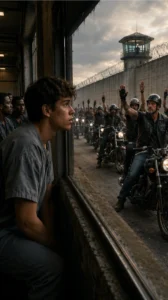
Inside Cell Block C, seventeen-year-old Mateo Ruiz sat on the lower bunk, elbows on knees, staring at the thin slit of sky framed by reinforced glass. The air felt heavier than usual, like the building itself knew something was off. He had learned to read silences here. They carried weight.
Down the tier, voices echoed. Metal doors clanged. Someone laughed too loudly. Someone else cursed under their breath. Life inside continued with the numb choreography of confinement.
Then came the sound.
Low at first.
A distant vibration.
A mechanical growl rolling across the concrete like a coming storm.
Mateo looked up.
Engines.
More than a few. Not random traffic. Synchronized. Intentional. Approaching.
A guard paused mid-step near the control station. Another turned toward the yard. Radios crackled. Eyes narrowed.
Outside the main gate, motorcycles appeared one by one, chrome catching the fading light. Riders in leather. Helmets dark. Formation tight. No revving theatrics. No reckless swerves. Just disciplined movement.
“They can’t gather here,” one officer muttered.
“Call it in.”
The bikes cruised along the outer road that paralleled the prison wall. Slow. Measured. Like they had somewhere to be—but not in a hurry to get there.
Inmates pressed closer to narrow windows. Word traveled fast inside.
“Bikers.”
“Outside the fence.”
“Something’s happening.”
Mateo stood, heart tapping harder against his ribs.
He didn’t know why.
He just felt it.
Then, as the lead riders reached the longest stretch of wall facing Cell Block C—
They raised one hand.
All of them.
At the exact same moment.
A silent gesture. Perfectly synchronized. Unmistakable.
From the guard tower, it looked like a signal.
From the yard, it looked like coordination.
From inside a locked cell, it felt like something else entirely.
Alarms weren’t triggered.
But hands hovered close.
Because no one knew what it meant.
And no one liked not knowing.
The formation rolled forward.
One rider at the front slowed slightly.
Broad shoulders.
Short sleeves.
Ink along his forearm.
Posture steady as steel under strain.
He kept his eyes on the wall.
No one knew who he was.
Or why he had come.
The outer perimeter road wasn’t built for parades. It was narrow, functional, bordered by fencing and warning signs that didn’t invite spectators. Yet the riders moved through it with quiet precision, engines humming in low harmony.
From Tower Three, Officer Lang squinted through binoculars. “They’re signaling.”
“Signaling who?” dispatch asked.
Lang didn’t answer right away. Because the truth was—he didn’t know.
The raised hands weren’t fists. Not waves. Not peace signs. Just palms forward, lifted chest-high. Uniform. Intentional. Controlled.
It felt coded.
“Possible gang coordination,” another guard said. “Could be communication with inmates.”
Radios buzzed. Protocols surfaced.
“Notify command.”
“Lock external movement.”
“Monitor Block C.”
Inside, tension rippled like a dropped stone in still water. Inmates leaned toward windows. Conversations shrank to whispers. Guards stiffened their posture, scanning faces for unusual reactions.
Mateo stepped onto his bunk for a clearer view through the reinforced slit. He could barely see the road, just flashes of chrome and motion. But something about the formation tugged at memory.
A feeling before a thought.
Down the corridor, a correctional officer barked, “Back from the doors.”
No one moved fast enough.
Outside, the lead biker eased off the throttle. His machine rolled almost silently now. He turned his helmet slightly toward the prison wall—toward Cell Block C.
Then he raised his hand again.
Slower this time.
Deliberate.
Officer Lang’s jaw tightened. “That’s a second signal.”
“Sirens?” someone asked.
“Hold.”
Because escalation had consequences.
And guesses weren’t evidence.
A prison administrator arrived breathless, suit jacket flapping in the wind. “What’s happening?”
“Motorcycle group. Coordinated gestures. Unknown intent.”
She watched through the glass. The riders didn’t look chaotic. No shouting. No flags. No attempt to breach. Just movement—disciplined, contained.
Still, perception mattered.
“Get local PD ready,” she said quietly.
Inside Cell Block C, Mateo felt something shift in his chest. Not fear exactly. Not hope either. Recognition without clarity.
He pressed closer to the glass.
A memory flickered—sirens, flashing lights, a street corner three years ago. A night he tried not to replay. A decision made in seconds that changed everything after.
“Ruiz!” a guard snapped. “Step down.”
Mateo obeyed. Slowly.
Outside, the riders continued their pass along the wall. One by one, each lifted a hand at the same point—precise as mile markers. The gesture wasn’t aggressive. But it wasn’t casual either.
It meant something.
To them.
To someone.
Officer Lang spoke into his radio. “If this is intimidation, it’s subtle.”
“Or respectful,” another voice offered.
Lang didn’t reply.
Because respect doesn’t usually arrive on engines.
The lead biker drifted to the shoulder briefly. Boots touched pavement. He removed one glove with his teeth, reached into his vest, and pulled out a phone.
Guards tensed.
He typed.
Short.
Efficient.
Then he looked up at the wall again.
Not scanning.
Not searching.
Looking for a specific window.
Mateo felt his breath hitch.
The biker slid the phone away, pulled his glove back on, and nodded once to the riders behind him.
No speech.
No theatrics.
Just a signal too quiet for microphones.
Inside, orders moved faster.
“Restrict inmate movement.”
“Clear yard access.”
“Eyes on Ruiz.”
Mateo’s pulse roared in his ears. Confusion tangled with memory.
He didn’t understand.
But somehow—
he felt seen.
And outside, the engines kept rolling.
The order moved down the corridor faster than footsteps.
“Ruiz, step away from the window. Now.”
Mateo lowered himself from the bunk slowly. Not resisting. Not arguing. Just tired of being treated like a threat. His palms rested against the cool concrete wall as a guard approached, posture stiff, keys rattling like a warning.
Outside, the engines faded… then returned, circling back along the perimeter road.
Officer Lang watched from Tower Three, unease settling deep in his chest. “They’re looping.”
“Confirmed,” dispatch replied. “Local PD en route.”
The late-afternoon light thinned into steel gray. Wind dragged dry leaves along the fence line. Everything felt suspended between routine and rupture.
In Cell Block C, inmates murmured behind half-closed doors. Curiosity turned sharp. Suspicion sharpened further.
“Why him?” someone whispered.
“What did Ruiz do?”
“Who are those riders?”
Mateo didn’t answer. He didn’t know how.
He sat on the edge of his bunk, hands clasped, eyes lowered. A kid forced to grow older than his years, shoulders carrying a sentence that still didn’t make sense to him.
A correctional officer stepped closer. “You expecting visitors?”
Mateo shook his head.
“Any gang affiliation?”
“No, sir.”
The officer studied him, searching for cracks in the story. Found none. Just a quiet boy folded inward by circumstance.
Outside the wall, the lead biker slowed again at the same stretch of road. Boots down. Engine idling low. His helmet visor reflected coils of razor wire and a sliver of sky turning darker by the minute.
He reached into his vest.
Hands twitched near holsters in the tower.
But he only pulled out his phone.
One message.
Short.
Deliberate.
He lifted the device to his ear this time.
“Yeah,” he said calmly. “We’re here.”
Nothing more.
No names.
No explanations.
Just certainty.
He ended the call and remained still, gaze fixed on the prison wall like he was holding a place in the world that couldn’t afford to move.
Officer Lang exhaled slowly. “They’re coordinating.”
“Intervention?” dispatch asked.
“Or escalation.”
Lang didn’t like either option.
On the tier below, a lieutenant arrived with two more officers. “Isolate Ruiz,” he ordered quietly. “Precaution.”
Metal scraped. Locks turned. Mateo stood as the cell door opened.
“What did I do?” he asked, voice small but steady.
“Procedure.”
They escorted him down the corridor. Inmates watched through narrow glass panels, faces flattened by reflection. No one cheered. No one jeered. Just silence thick enough to swallow sound.
Mateo’s sneakers squeaked against polished concrete. Each step echoed.
Outside, the riders remained.
Not leaving.
Not advancing.
Just present.
Like witnesses refusing to blink.
And as Mateo disappeared around the corner toward administrative holding, the waiting became unbearable.
It started with sound.
Not sirens.
Not shouting.
A deeper vibration rolling across asphalt like thunder that chose discipline over chaos.
Officer Lang turned toward the far end of the access road. Beyond the first formation of riders, more headlights emerged through the falling dusk. Steady. Evenly spaced. Approaching without haste.
“Additional units?” dispatch asked.
“Negative,” Lang replied. “Different group.”
Engines multiplied. Not loud. Not aggressive. A layered mechanical hum that carried intention.
The first formation didn’t react dramatically. No waves. No gestures. Just subtle shifts—small nods, slight repositioning of bikes along the shoulder. Order without commands.
The new riders arrived in pairs. Men and women. Middle-aged mostly. American and European faces. Worn leather. Faded denim. Gloves creased by long miles. They parked with careful spacing along the outer fence, engines shutting down one after another.
Silence followed.
Helmets came off.
Gray hair. Weathered lines. Eyes steady.
No one approached the gate.
No one crossed barriers.
No one raised a voice.
They simply stood facing the prison wall.
Officer Lang felt the shift immediately. The tension changed texture—less volatile, more grounded. “They’re not posturing,” he murmured.
Below, the prison administrator stepped outside flanked by two officers. She watched the scene unfold with cautious disbelief.
“This isn’t a protest,” she said quietly.
Because protests demand attention.
This demanded acknowledgment.
The lead biker removed his helmet slowly. Mid-forties. Broad shoulders. Sleeve tattoos faded by time. A face shaped by hard roads and harder restraint.
He didn’t step forward.
He didn’t need to.
One by one, the newly arrived riders lifted a hand.
Not high.
Not dramatic.
Just chest level.
Palms open.
Facing the wall.
The first group followed.
Dozens of hands raised in quiet unison as daylight thinned into evening.
From the towers, it no longer looked like a signal.
It looked like recognition.
Like presence.
Like a message meant for someone specific—not the system, not the cameras, not the crowd.
Inside administrative holding, Mateo sat alone on a metal bench. Fluorescent lights buzzed overhead. A guard watched through reinforced glass.
Then Mateo noticed movement beyond the narrow exterior window.
Shadows.
Helmets.
Stillness.
And hands.
Raised.
For him.
He didn’t understand how.
Or why.
But something in his chest loosened for the first time in years.
Outside, no one chanted. No one demanded. No one argued law.
They just stood there in disciplined silence, engines cooling behind them, holding space like it mattered.
Authority didn’t vanish.
It recalibrated.
Because force meets resistance.
But presence invites truth.
And as the sky dimmed into deep blue,
the balance quietly shifted.
The truth didn’t arrive with a speech.
It arrived with paperwork.
With phone calls returned.
With names spoken carefully across secure lines.
Inside the administrative office, fluorescent lights hummed above a clutter of incident reports and intake forms. The prison administrator stood beside a metal desk while a state public defender scrolled through documents on a tablet, jaw tightening with each page.
Officer Lang watched from the doorway.
“So this isn’t a demonstration?” he asked quietly.
The defender shook her head. “No, sir. It’s a witness request.”
She turned the screen.
A digital affidavit.
Time-stamped.
Filed months ago, buried under backlog.
Attached: traffic cam stills. Store surveillance. A sworn statement.
The administrator frowned. “And the riders?”
“They’re not signaling inmates,” the defender said. “They’re honoring one.”
Lang blinked. “Honoring?”
A pause.
Then the defender read aloud.
“Three years ago. Allegheny Avenue. Attempted armed robbery. Civilian teenager intervened. Pulled a weapon aside. Prevented discharge. Suspect fled. Eyewitness confusion led to wrongful arrest. Teen later charged as accomplice.”
Silence thickened the room.
“The suspect,” she continued, “was a patched member of a regional motorcycle club.”
Lang exhaled slowly. “And the teen?”
“Mateo Ruiz.”
The name settled like dust after collapse.
The administrator looked toward the corridor that led to holding. “You’re telling me—”
“They came to stand for him,” the defender said softly. “Because he stopped one of their own from making a terrible mistake.”
No dramatics.
No speeches.
Just consequence meeting memory.
Outside the prison wall, dusk deepened into indigo. The riders remained in quiet formation, palms lowered now, helmets resting against fuel tanks. No chants. No banners. Just presence that refused to look away.
The lead biker stepped forward when the gate opened. He didn’t rush. Didn’t posture. Just removed his gloves and waited as two officials approached.
The administrator spoke first. “We misread your intent.”
The biker gave a small nod. Not vindicated. Not bitter. Just tired in a way that comes from carrying history without applause.
“He saved a life,” the defender added. “And lost his future for it.”
The biker glanced at the wall. “We know.”
No anger.
No grandstanding.
Only certainty.
Inside holding, Mateo sat motionless when the door opened again. He expected another transfer. Another instruction. Another day erased.
Instead, the lieutenant cleared his throat. “You have visitors.”
Mateo frowned. “Visitors?”
“Not inside. Just… look.”
He was escorted to a narrow administrative window facing the outer yard. The glass was thick, wired, unkind to detail.
But he saw enough.
Motorcycles lined the fence.
Riders standing shoulder to shoulder.
Helmets off. Heads uncovered.
Waiting.
For him.
Mateo’s throat tightened. He lifted a hand without thinking.
Outside, the lead biker saw it.
He raised his own hand in return.
Not high.
Not dramatic.
Just chest level.
Palm open.
A gesture that carried distance without abandoning connection.
Respect without noise.
Paperwork moved faster after that. Appeals resurfaced. Witnesses contacted. Evidence reexamined. Not because of pressure—but because someone finally looked twice.
The riders didn’t celebrate.
Didn’t linger for cameras.
Didn’t claim credit.
Engines started one by one, low and steady. Headlights blinked on. Formation tightened.
The lead biker placed his helmet on, paused, then rested a gloved hand briefly against the cold fence.
Metal. Concrete. Memory.
Then he turned away.
Inside, Mateo remained by the window long after the road emptied. A guard eventually touched his shoulder gently.
Time to go.
But something had shifted.
Not freedom yet.
Not justice complete.
Just a quiet certainty that he hadn’t been forgotten.
And on the darkening road beyond the prison walls, red tail lights faded into night—
like a promise carried forward without needing to be seen