CHAPTER 1: The Forty-Second Sentence
The fluorescent lights of the Evergreen Logistics Warehouse didn’t just illuminate the aisles; they buzzed with a relentless, surgical frequency that ate away at your nerves. It was 6:05 a.m. I was leaning against a stack of boxed electronics, my bones heavy with the kind of exhaustion that sleep can’t touch—the bone-deep fatigue of a single father wondering how to stretch a paycheck into a life.
I moved toward the far corner of Sector 4, my boots echoing against the cold concrete. That’s when I saw him. A shadow slumped against a crate of heavy machinery. At first, I thought it was a mechanical malfunction or a fallen pallet, but as I drew closer, the shadow took the shape of a man.
arrow_forward_iosĐọc thêm
Pause
00:00
01:09
01:58
Mute
He was a biker, his leather vest shredded at the shoulder, dark blood crusting against his collarbone. One eye was swollen shut, a vibrant shade of midnight purple, but his posture remained defiant. He didn’t beg. He didn’t even look at me. He just breathed in shallow, jagged rasps.
I knew the rules. Rule number one: Report all intruders immediately. Rule number two: Never engage. But as I looked at him, I didn’t see a threat. I saw a man who was hurting. I reached into my lunch bag and pulled out my thermos and a bottle of water. I knelt, ignoring the security camera I knew was angled just high enough to miss this specific alcove.
No words were exchanged. I handed him the water; his hands shook as he took it. For exactly forty seconds, we occupied the same pocket of space. He nodded once—a silent acknowledgment of a shared humanity—and then he was gone, disappearing into the pre-dawn mist outside the loading docks.
I thought that was the end of it. I was wrong.
Three days later, I walked into my shift wearing the cap my daughter, Lily, had embroidered for me with crooked red thread. My Hero, it said. I was halfway down the main aisle when I saw him—Todd Coleman, the warehouse manager. He was flanked by two security guards, his clipboard clutched against his chest like a holy shield.
“Adam Rivers,” Todd said, his voice as flat as the concrete floor. “We need to discuss your recent violation of safety protocols.”
“I gave a man water, Todd,” I replied, my heart starting to thud against my ribs. “He was bleeding.”
“You aided an unidentified intruder and failed to report the breach. That’s negligence, Adam. In this company, we value policy over sentiment.” He didn’t even look me in the eye when he delivered the blow. “You’re terminated, effective immediately.”
They escorted me out as if I were a common thief. No handshake for a decade of service. No “thank you” for the double shifts. Just the biting chill of the wind and the silence of an empty parking lot.
I sat on the curb, staring at my hands. How was I going to tell a ten-year-old girl that our “we”—the team of two that had survived everything since her mother died—was now facing a famine?
I trudged home in the rain, unaware that as I walked through my front door, a low, rhythmic thrumming was already beginning to vibrate through the foundations of our neighborhood—a sound like approaching thunder on a cloudless night.
CHAPTER 2: The Steel Horses of Sycamore Street
Lily was sitting behind her coloring book when I walked in, her eyes wide as she registered my damp clothes and the early hour. I tried to manufacture a smile, but she saw right through the structural flaws of my expression.
“Are you sick, Daddy?” she asked, her brow furrowed.
“No, bug. Just… wanted to spend the day with you.”
She went quiet. Then, in a voice far too small for a girl her age, she asked, “Did we get fired?”
My heart didn’t just break; it pulverized. She always said we. I nodded slowly, and she was out of her chair in a heartbeat, burying her face in my waist. “It’s okay,” she whispered. “You’re still my hero.”
That night, as Lily slept beneath her glow-in-the-dark ceiling stars, I sat at the kitchen table staring at a stack of unopened bills. I felt like a ghost in my own home. Then, I heard it. A distant, guttural rumble. It started as a hum and grew into a roaring chorus that shook the windowpanes.
I walked to the window, expecting a protest or a riot. Instead, I saw headlights—dozens of them—lining up along the curb of our quiet street. By dawn, the entire block was buzzing.
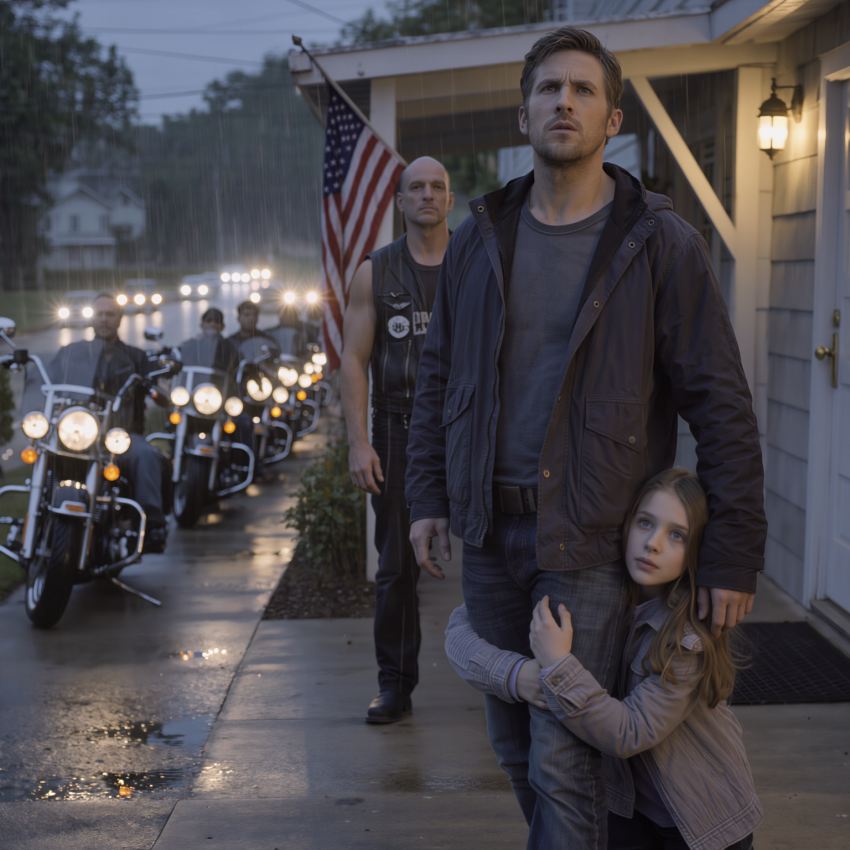
Outside, more than forty motorcycles sat like chrome sentinels. The riders were massive, leather-clad men with insignias that commanded the asphalt. I stepped onto the porch, shielding Lily behind my legs. My hands were trembling, not with fear, but with the sheer gravity of the moment.
The biker from the warehouse stepped forward. He was clean-shaven now, his eyes sharp and clear. Beside him stood an older man with a flowing silver beard and a vest marked with AFFA.
“You helped one of ours,” the silver-bearded leader said, his voice a low-frequency growl. “I’m Ridge. This is my chapter.”
“I just gave him a bottle of water,” I stammered.
“Exactly,” Ridge replied, a small smile playing on his lips. “And in a world of people who look away, you looked. That makes you a man we ride for.”
He pulled a gleaming silver key from his pocket and held it out. “Come with us, Adam. There’s a legacy waiting for you.”
Lily peeked out from behind my leg. “Are you superheroes?”
The man chuckled, a deep sound like gravel in a blender. “No, kid. We’re just people who don’t forget a debt.”
They led us to a black van at the end of the row. When the doors slid open, my breath hitched. Inside was a fully rebuilt Harley-Davidson, matte black with crimson trim, polished to a mirror finish.
“I don’t ride,” I said, confused.
“You don’t have to,” Ridge said softly. “But your father did. Your dad was Rusty Rivers. He rode with us in the eighties. He was the best mechanic we ever knew—saved my brother’s life with nothing but duct tape and a stubborn streak on a frozen highway in Phoenix.”
He handed me a faded photograph. It was my father, smiling with grease-stained hands, standing beside a younger Ridge. “That bike was his. We’ve been looking for you for a long time, Adam. We just didn’t know you were right here until one of our own came back talking about a man who gave him water when he was invisible.”
As the bikers gestured for us to get into the van, Ridge leaned in and whispered, “The bike is just the beginning. We’re taking you to the shop, Adam. Your father’s shop.”
CHAPTER 3: The Sanctuary of Rivers Customs
We pulled into a dusty lot on the outskirts of town, stopping before a garage that looked like a relic of a different era. But as the doors swung open, the scent of fresh pine, motor oil, and steel hit me like a physical memory.
Above the door hung a brand-new sign: RIVERS CUSTOMS.
“What is this?” I asked, my voice cracking.
“Your new beginning,” Ridge said. “Your dad taught half this chapter how to turn a wrench. Now, it’s our turn to pay the tuition. This shop is yours, Adam. Deeds, permits, and a line of customers waiting at the gate.”
Lily ran through the garage, her eyes lit with a joy I hadn’t seen since we lost her mother. “Daddy’s shop!” she shrieked.
I walked to a dusty pegboard where a single tool belt hung, marked with my father’s initials. When I strapped it on, it didn’t feel heavy; it felt like an anchor. For the first time in weeks, the knot in my chest unraveled. I wasn’t a “negligent” employee anymore. I was a craftsman with a tribe.
The business didn’t just grow; it exploded. We repaired bikes, sure, but we fixed people, too. I met Serena, a widow who couldn’t afford a dealer; I met Eli, a homeless teen who just needed a chance to prove he wasn’t trash. I gave him a wrench and a job sweeping the lot.
“Some people don’t need a lecture,” I told Ridge one afternoon as we watched Eli work. “They just need someone to hand them a tool.”
Then, on a Tuesday in the fourth week, a black sedan rolled into the lot. Todd Coleman stepped out, looking smaller than I remembered. He looked at the forty bikes parked outside, then at me.
“I came to apologize,” Todd muttered, his eyes on his shoes. “Corporate reviewed the footage. They said I acted too fast. You lost your job for being a decent human being.”
I looked at Ridge, then at Lily, who was busy sketching a new logo on the shop window.
“Thanks for saying it, Todd,” I said calmly. “But I think I’m exactly where I’m supposed to be.”
As Todd drove away, Ridge handed me a leather jacket with a new patch on the back. “One last ride tonight, Adam. Just the two of us. It’s time to visit the stone.”
CHAPTER 4: The Sound of Redemption
The ride to my father’s memorial was silent, the wind whipping past us as we carved through the winding hills. We stopped at a small clearing where wild flowers danced in the breeze. A simple stone stood there: RUSTY RIVERS.
“We rebuilt this, too,” Ridge said, placing a glove on the marker. “He’d be proud of the man you are, Adam. You fixed what people gave up on.”
I knelt and placed Lily’s latest drawing—a picture of us in the shop—beside the stone. I finally believed it. I wasn’t just a shadow. I was a light.
The months that followed were a whirlwind of viral fame and community awards. The city council honored me for “moral courage,” but the real reward came on Christmas Eve.
I was closing up when the familiar rumble returned. Forty engines. But this time, the riders wore Santa hats and tinsel. They had a gift for Lily—a custom pink leather jacket and a bedazzled helmet.
“Little Rivers,” Ridge said, kneeling before her. “You’re part of the pack now.”
Lily hugged him so tight I thought he might actually shed a tear. Looking at those forty men—men the world had judged as monsters—I realized that kindness isn’t a weakness. It’s the highest form of power. It’s the alchemy that turns a bottle of water into a kingdom.
Today, Rivers Customs is more than a garage; it’s a landmark. A sign hangs inside the lobby, framed in gold. It’s a simple drawing by Lily that says: Built on Kindness.
I still fix bikes. I still drink burnt coffee with Ridge. And every Tuesday, I make sure there’s a cold bottle of water sitting on the counter, just in case someone invisible walks through the door.
My name is Adam Rivers. I was a ghost who became a hero, not because I fought a war, but because I refused to look away.
If you want more stories like this, or if you’d like to share your thoughts about what you would have done in my situation, I’d love to hear from you. Your perspective helps these stories reach more people, so don’t be shy about commenting or sharing.