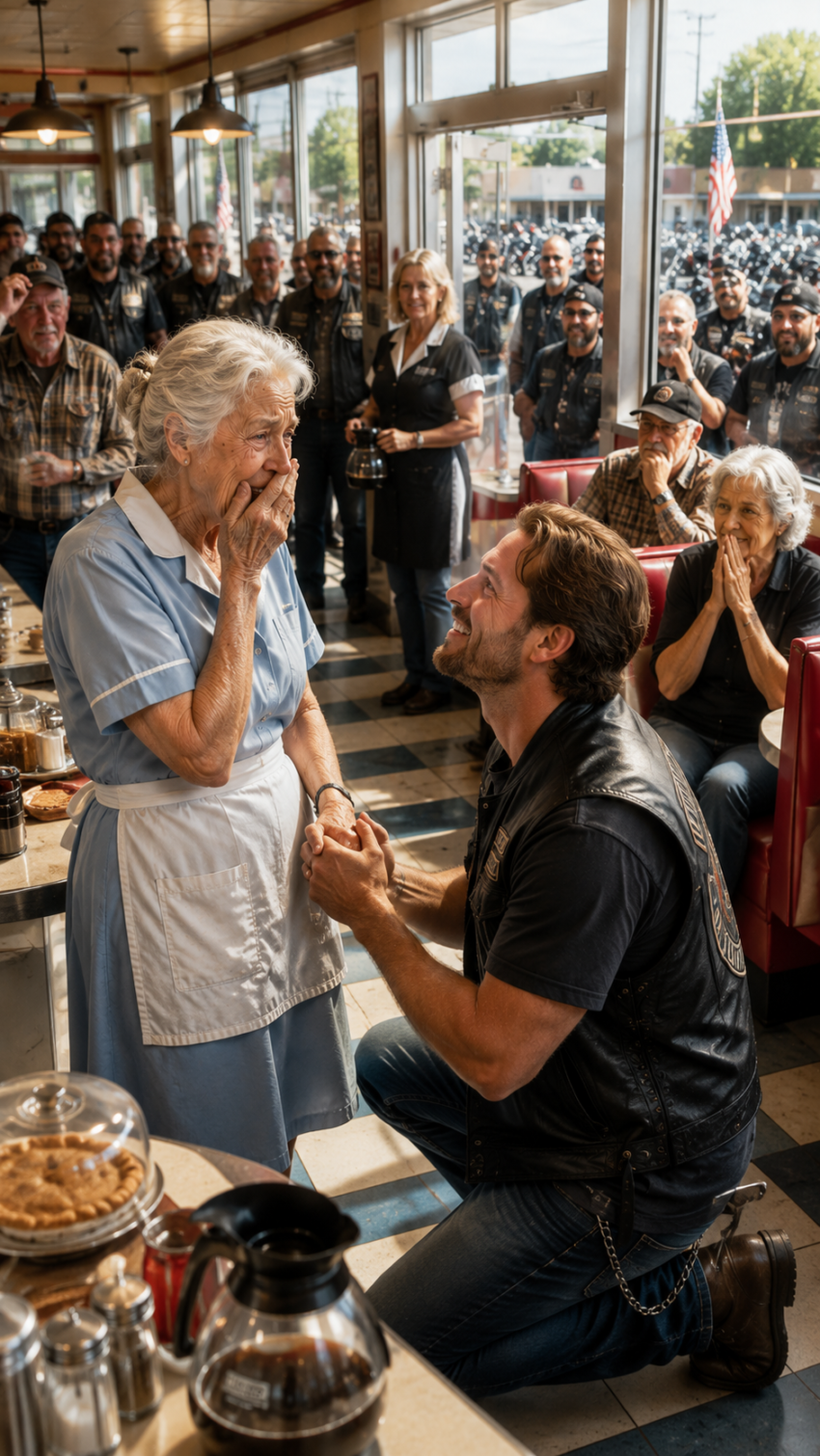
The Morning Ninety-Seven Riders Came Back
The first sound came before anyone saw them.
It was low at first, like distant thunder moving across the flat roads outside Ashford Creek, Ohio. Then it grew deeper, rolling past the feed store, the old post office, and the little gas station on the corner until the front windows of Juniper’s Table began to tremble softly.
Inside the diner, June Merritt paused with a coffee pot in her hand.
She had owned the place for almost thirty years. She knew every regular truck, every delivery van, every school bus that passed by on County Road 18. But this sound was different.
One headlight appeared at the bend.
Then another.
Then another.
Within moments, motorcycles filled the road in front of her diner.
They did not speed. They did not show off. They moved slowly, respectfully, as if they were part of a quiet parade that already knew where it belonged.
The customers stopped eating.
A retired mailman lowered his newspaper. Two old friends in the corner booth forgot their checkers game. A young waitress named Ruby stood near the pie case with her mouth slightly open.
June set the coffee pot down.
Outside, the motorcycles parked one by one. The line stretched farther than the windows could show.
Someone whispered, “There must be almost a hundred of them.”
June did not count.
She only watched as the riders climbed off their bikes and stood in front of her little diner, helmets tucked under their arms.
Then one man stepped forward.
He was tall, broad-shouldered, and probably in his mid-thirties. His dark jacket was worn from years on the road. His boots carried dust. His expression was calm, but his eyes were full of something June could not name yet.
He opened the diner door.
The bell above it gave its familiar little ring.
For some reason, that tiny sound made June’s heart tighten.
A Stranger Who Remembered Everything
The man stood just inside the doorway and looked around.
He did not look dangerous. He did not look angry. He looked careful, almost gentle, as if he had stepped into a place he had carried in his memory for a very long time.
His eyes moved to the window booth near the front.
June followed his gaze.
That booth had been repaired more than once. The vinyl seat had a small patch near the edge. The table had a tiny wobble unless someone folded a napkin under one leg. But it was still the same booth she had wiped clean thousands of times.
The man looked back at her.
Then he said softly, “You gave me breakfast when I had nowhere else to go.”
The diner fell completely silent.
June’s hand moved to the edge of the counter.
She studied his face. The strong jaw. The road-weathered skin. The careful eyes.
And then, beneath the man standing before her, she saw the boy.
A thin boy in a faded hoodie.
A boy with wet shoes.
A boy who had stood outside that same window many years ago, too hungry to leave and too proud to ask.
June’s voice broke when she whispered, “It was you.”
The man nodded.
“Yes, ma’am. It was me.”
The Boy Outside the Window
Twenty-two years earlier, Ashford Creek had been even quieter than it was now.
Juniper’s Table was never fancy. The sign above the door had faded from red to pink. The floor creaked near the register. The jukebox in the back worked only when it wanted to. But people came because the coffee was hot, the food was honest, and June treated everyone like they mattered.
She had one rule.
No one left hungry if she could help it.
She never put that rule on a sign. She never made speeches about kindness. She simply lived it.
If a farmer’s payment came late, she wrote his meal down and pretended to forget. If a high school student counted change too carefully, she added extra toast without saying a word. If a tired driver looked like he had been awake all night, she filled his cup before he asked.
Then, one gray October morning, she saw the boy.
He stood outside the diner window in a hoodie that was too big for him. His jeans were damp at the cuffs. His sneakers looked nearly worn through. He stared at the door, looked away, then stared again.
June knew that look.
It was not only hunger.
It was hunger mixed with shame.
She did not rush outside. She did not wave him in where everyone could see. She only kept wiping the counter and gave him time to decide for himself.
Finally, the bell above the door rang.
The boy stepped inside.
He stopped near the entrance like he expected someone to tell him he did not belong.
June smiled at him.
“Morning, honey. Looking for somebody?”
The boy kept his eyes low.
“No, ma’am. Just looking.”
June nodded toward the menu board.
“Well, that board has been stared at by half the county. You might as well sit down while you look.”
He swallowed.
“I don’t have money.”
There was no trick in his voice. No excuse. Just the truth, spoken like he already knew what came next.
But June did not point to the door.
She picked up a menu and said, “Good thing I asked if you were hungry, not if you were rich.”
His eyes lifted.
For the first time, he looked directly at her.
A Plate Given With Dignity
The boy slid into the window booth slowly, as if he still might be asked to leave.
June came over with her notepad.
“What sounds good?”
His eyes moved across the menu, but June could tell he was not reading the food. He was reading the prices.
After a long moment, he said, “Whatever costs the least.”
That sentence stayed with June for the rest of her life.
She clicked her pen and wrote down an order.
“One full country breakfast.”
His head snapped up.
“No, ma’am. That’s too much.”
June looked at him gently.
“Then you’ll have something left for later.”
His face tightened.
“I’m not asking for charity.”
June’s voice stayed soft.
“I know. You haven’t asked for anything. That’s what worries me.”
The boy looked down at his hands.
They were thin, red from the cold, and folded tightly together on the table.
A few minutes later, June carried out a plate with eggs, toast, pancakes, potatoes, and bacon. She set it in front of him like it was the most normal thing in the world.
The boy stared at the food.
For a second, June thought he might cry.
He did not.
He picked up his fork and began to eat slowly at first. Then hunger took over. He tried to stay polite, but every bite showed how long it had been since someone had put a real meal in front of him.
June kept working so he would not feel watched.
She refilled coffee. She brought napkins to another table. She checked the grill. But from the corner of her eye, she saw him listening to the diner sounds around him.
Plates clinking.
Rain tapping the glass.
People laughing softly at the counter.
For one meal, he was not outside looking in.
He was simply a boy in a warm booth with food in front of him.
When he finished, June brought a small takeout box and placed it on the table.
“For later,” she said.
The boy held the box with both hands.
“Thank you,” he whispered.
June gave him a small smile.
“You take care of yourself, sweetheart.”
He left in the rain.
And life moved on.
Years That Passed Quietly
June thought about that boy many times over the years.
Not every day, but often enough.
Sometimes she wondered where he had slept that night. Sometimes she wondered if the leftovers had lasted until morning. Sometimes she wondered whether anyone in the world knew how tired his eyes had looked.
But there was always another bill to pay, another pie to bake, another customer to serve.
The diner aged with her.
The sign outside grew dimmer. The booths grew softer. The walls collected more photographs. Some regulars passed away. New faces took their places. Ruby, who once came in for milkshakes after school, eventually became June’s best waitress.
June’s hair turned silver.
Her hands became slower.
Still, every morning, she unlocked the front door.
She believed small places mattered. She believed warm meals mattered. She believed that if the world could not be fixed all at once, it could at least be made gentler for one person at a time.
She never imagined that one quiet breakfast would come back to her.
She never imagined it would come back with ninety-seven motorcycles.
The Man He Became
The rider standing in front of her that morning removed his gloves and held them in one hand.
“My name is Caleb Rowe,” he said. “Back then, I wasn’t sure anybody would remember me.”
June shook her head.
“I remembered.”
His face changed at that.
Not much, but enough.
His eyes softened.
“I was thirteen,” he said. “I had been moving from one place to another. I was tired. I was hungry. And I was trying very hard not to look like either one.”
June pressed one hand to her chest.
Caleb looked toward the booth.
“I remember that seat. I remember the rain on the window. I remember telling you I could only order the cheapest thing. And I remember you acting like giving me a full plate was not a big deal.”
His voice grew quieter.
“But it was a big deal to me.”
No one in the diner moved.
Even the grill seemed to go quiet.
Caleb continued, “You didn’t ask me to explain my whole life. You didn’t make me feel small. You didn’t tell me what I should have done differently. You just fed me like I was worth feeding.”
June covered her mouth.
The old mailman took off his cap.
Ruby wiped her eyes with the back of her hand.
Outside, the riders stood patiently in the morning light.
A Family Built From Hard Roads
Caleb glanced through the window at the group behind him.
“Those people out there are my family,” he said. “Not all by blood, but by choice.”
June looked past him.
Some of the riders were young. Some were older. A few had gray beards. Some looked tough at first glance, but their faces were respectful and calm. They stood back from the door, waiting.
Caleb said, “A lot of us know what it feels like to be judged too quickly. Some of us came from hard homes. Some had hard years. Some just needed one person to believe there was still good ahead.”
He looked at June again.
“For me, that person was you.”
June’s eyes filled.
“I only gave you breakfast.”
Caleb shook his head.
“No, ma’am. You gave me a memory that did not hurt.”
That was when June began to cry.
Not loudly.
Just enough for her shoulders to tremble.Caleb stepped closer, but he waited. He gave her the choice, just as she had once given him the choice to come inside.
June walked around the counter.
She reached for his arms.
For a moment, they simply looked at each other.
Then Caleb bent his head, and June hugged him.
The diner seemed to breathe around them.
Ninety-Seven Thank-Yous
When June stepped back, Caleb turned toward the door and gave a small nod.
The first few riders came inside carefully. They did not crowd the room. They spoke politely. They removed their hats. They greeted June like she was someone important.
One older rider said, “Ma’am, we’ve heard about your diner for years.”
Another smiled and added, “Caleb said this place served the best breakfast in Ohio.”
June laughed through her tears.
“Well, I hope you’re all patient. My grill is not used to feeding a small army.”
From the kitchen, her cook, Marvin, leaned out and stared at the motorcycles.
“June,” he said, “we are going to need more eggs.”
The whole diner laughed.
The sound was warm and shaky and full of relief.
For the next few hours, Juniper’s Table became the heart of Ashford Creek.
People from nearby shops walked over to see what was happening. Cars slowed down. Phones came out, but not in a cruel way. Everyone seemed to understand they were witnessing something rare.
June served coffee until her hands ached.
Ruby carried plates as quickly as she could.
Marvin worked the grill like a man facing the biggest breakfast rush of his life.
And Caleb sat in the same window booth where he had once been a hungry boy.
When his food arrived, June brought it herself.
Eggs. Toast. Pancakes. Potatoes. Bacon.
A full breakfast.
Just like before.
Caleb looked down at the plate for a long moment.
Then he looked up at June.
“I used to think nobody saw me.”
June’s voice trembled.
“I saw you.”
He nodded.
“I know. That is why I came back.”
What Kindness Leaves Behind
By noon, the story had spread through the town.
But June was not thinking about attention.
She was thinking about a boy in wet sneakers holding a takeout box like it was something precious.
She was thinking about all the small moments people forget because they seem too ordinary to matter.
A warm meal.
A kind voice.
A door left open.
A person allowed to keep their dignity.
June had spent most of her life believing that kindness did not need applause. She still believed that. But now she understood something else too.
Kindness may be quiet when it is given, but it does not always stay quiet forever.
Sometimes it grows in the dark.
Sometimes it travels farther than anyone knows.
Sometimes it becomes the reason a person keeps going.
And sometimes, after more than twenty years, it returns to a little diner on a bright Ohio morning with ninety-seven riders standing outside, all because one woman once decided that a hungry child deserved more than the cheapest thing on the menu.
Before Caleb left, he placed an envelope beside the register.
June frowned.
“What is this?”
Caleb smiled.
“Enough to fix the sign, repair the booths, and keep feeding people who need a little help.”
June shook her head.
“Caleb, I can’t take this.”
His answer was gentle.
“You already gave it to me first.”
June held the envelope with trembling hands.
Outside, the motorcycles started one by one.
The sound filled the street again, but this time nobody in Ashford Creek felt afraid.
They watched as the riders pulled away slowly, respectfully, leaving behind tire marks, warm memories, and a diner full of people who would never tell the story the same way twice.
June stood in the doorway until the last bike disappeared around the bend.
Then she turned back inside.
The bell above the door jingled softly.
Ruby looked at her and asked, “Are you all right?”
June wiped her cheeks and smiled.
“Yes,” she said. “I think I just learned that no good thing is ever really lost.”
A simple act of kindness may feel small in the moment, but to someone who is tired, hungry, lonely, or unseen, it can become the memory that helps them believe life still has a gentle side.
The greatest help is not always the biggest gift; sometimes it is the quiet way we protect another person’s dignity when they are too proud or too wounded to ask for what they need.
We never truly know what someone is carrying when they walk through our door, so the way we speak, smile, listen, and offer help may matter far more than we realize.
Kindness does not need to be loud, expensive, or perfect to change a life; it only needs to be sincere enough to make one hurting person feel seen.
A meal can be more than food, a seat can be more than shelter, and a kind voice can become proof that the world has not completely forgotten someone.
The people we help may leave our lives quickly, but the way we made them feel can stay with them for years, shaping who they become and how they treat others.
Never underestimate the power of doing the right thing when no one is watching, because the quiet good we give often travels farther than praise ever could.
When we help someone without making them feel ashamed, we give them more than comfort; we give them back a piece of their confidence.
Some blessings return years later in forms we never expected, reminding us that compassion is never wasted even when we do not see the results right away.
The world becomes softer every time one person chooses mercy over judgment, patience over suspicion, and generosity over turning away.