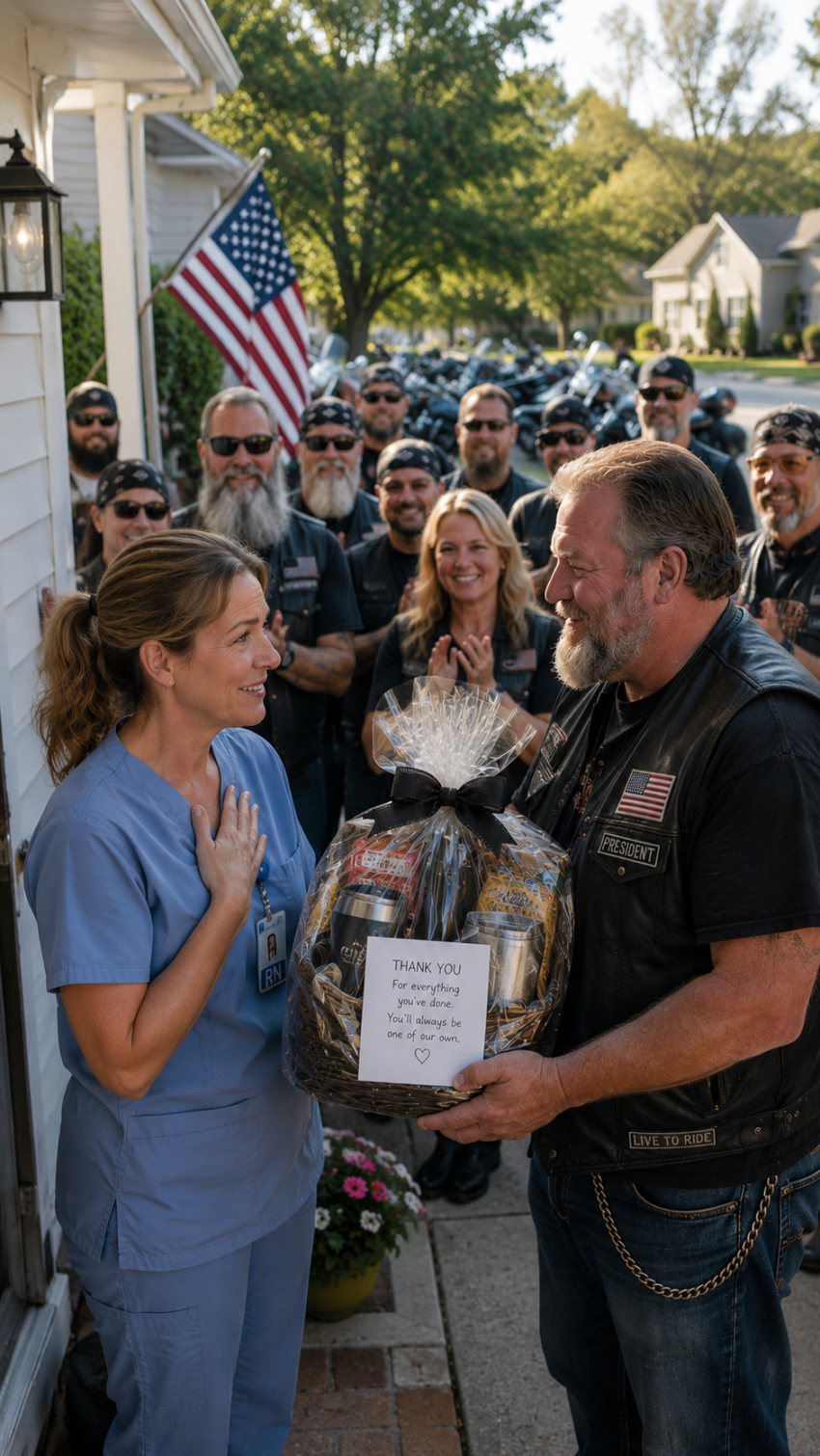
The Morning Her Name Disappeared From The Board
For twenty-six years, Marian Huxley had walked the pediatric halls of Briarwood Children’s Hospital in Madison, Wisconsin, with the quiet steadiness of someone who knew how to bring calm into a room before saying a single word.
At fifty-four, Marian was not the loudest nurse on the floor. She was not the one who tried to make every moment about herself. She was the one parents looked for when their voices started to shake. She was the one children trusted even when they were too young to explain what hurt.
She remembered which little boy needed the blinds half-closed. She knew which teenage girl hated being called brave. She could tell when a mother needed instructions and when she simply needed someone to stand beside her for one more minute.
That Tuesday morning began like any other.
Marian clipped her badge to her pale blue scrub top, tied her silver-brown hair back, and started rounds with a paper cup of coffee that had gone cold before she took the second sip.
By noon, everything she had built was gone.
Advertisements
A message appeared on the nurses’ station phone asking her to report to administration.
Marian rarely went upstairs. The administrative wing always felt too polished, too silent, too far away from the real work of the hospital. When she stepped into the office, a woman in a cream blazer sat behind a glass desk with a folder open in front of her.
Her nameplate read: Celeste Harrow, Human Resources Director.
Celeste did not smile.
“Marian Huxley, due to an internal review, your position is being ended effective today.”
For a moment, Marian simply stared at her.
“I’m sorry,” Marian said slowly. “There must be a mistake.”
Celeste folded her hands. “There is no mistake.”
“I have worked here for twenty-six years. My evaluations have always been strong. If there is a concern, I have the right to know what it is.”
Celeste looked down at the folder, but Marian had the strange feeling the woman was not really reading.
“A family raised a serious concern regarding your conduct.”
Marian’s face went still.
“Then let me answer it.”
“The details are confidential.”
“So I am losing my job over a complaint I am not allowed to see?”
Celeste’s voice softened in a way that did not feel kind.
“You may appeal the decision, but until then, you are not permitted on hospital property. I would also advise you to leave quietly. Making this difficult could affect future references.”
That was when Marian understood.
This was not a conversation.
It was a door being closed while someone smiled politely from the other side.
A Box Full Of Twenty-Six Years
A security guard walked Marian back to her locker.
He was young enough to have been trained by her once. He kept his eyes on the floor.
At the nurses’ station, the schedule board had already changed. Her name was gone. Not crossed out. Not marked absent. Gone.
That hurt more than Marian expected.
Her life at Briarwood now fit into a cardboard box: a worn stethoscope, a coffee mug painted with tiny yellow stars, a framed photo of her parents, two thank-you cards from former patients, and a pair of pediatric clogs with small clouds on them.
Children had always smiled at those shoes.
No one stopped her. No one asked what happened. Some looked away because they were afraid. Some looked away because it was easier.
Outside, Marian placed the box on the passenger seat of her old gray Toyota and sat behind the wheel until her hands stopped trembling.
Then she cried.
Not loudly. Not dramatically. Just the quiet kind of crying that comes when a person has held herself together for too long.
She had four hundred and seventy-eight dollars in her checking account. Rent was due in eleven days. Her parents were gone. Her marriage had ended years earlier. She had no children of her own, though she had spent her life caring for everyone else’s.
Briarwood had been more than her workplace.
It had been the place where she still felt useful.
And now, someone had taken even that.
The Seat She Should Not Have Bought
That afternoon, Marian drove without thinking until she reached the interstate bus station downtown.
Her younger sister’s old house in Cedar Falls, Iowa, was nearly four hours away. The house was empty now, but Marian still had a key. She had not been there in months. Suddenly, she wanted walls that knew her before the hospital did.
At the ticket counter, she asked for the next bus heading west.
“Standard seat is fifty-two dollars,” the clerk said.
Marian nodded.
Then she noticed another option on the screen.
Premium section.
Quiet cabin. Wider seats. Extra space.
Two hundred and forty-one dollars.
It made no sense.
She had just lost her job. She needed to save every dollar. She should have chosen the cheapest seat and been grateful for it.
But something inside her was exhausted from always choosing the hard thing.
For once, Marian wanted comfort without apologizing for needing it.
“I’ll take the premium seat,” she said.
The clerk glanced at her, tapped the keys, and handed over the ticket.
When Marian boarded the bus and found seat 1B, she sank into the soft leather like her body had been waiting all day to stop pretending it was fine.
For a little while, the bus was quiet.
No hospital alarms.
No sharp voices.
No polite threats.
Only the low hum of the engine and the warm afternoon light falling across the window.
Then a tense voice rose from behind the curtain that separated premium from the rest of the bus.
The Man Everyone Was Watching
Marian pulled the curtain back.
In the regular section, a large man was trying to fit himself into a narrow aisle seat. He looked to be in his late fifties, maybe older, with broad shoulders, graying hair, and a weathered leather vest over a dark shirt.
His movements were slow and careful.
Not because he was weak.
Because he was hurting.
Faint, healed marks ran along one side of his neck and disappeared beneath his collar. His right hand stiffened as he reached for the seat belt. The seat was too tight. The armrest pressed against him. His face had gone pale with effort.
The driver stood near him, impatient.
“Sir, we can’t leave unless you’re seated safely.”
The man’s jaw tightened.
“I paid for my seat. I’ll make it work.”
A few passengers stared. One woman whispered something to the person beside her. The man heard it. Marian saw his eyes lower.
She knew that look.
It was not anger.
It was embarrassment.
And Marian had spent her whole career recognizing pain that people tried to hide.
She stepped into the aisle.
“I’m a nurse,” she said gently. “May I help?”
The man looked at her, guarded and tired.
“I don’t need anyone feeling sorry for me.”
Marian’s voice stayed calm.
“Good. I’m not offering pity.”
The driver sighed.
“Ma’am, we need to get moving.”
Marian looked back toward her premium seat, then at the man again.
“Take my seat.”
His eyes narrowed.
“No.”
“Yes.”
“I’m not taking a seat you paid extra for.”
“You are, because I’m asking you to.”
He shook his head.
“Lady, I don’t even know you.”
Marian gave a small, tired smile.
“That may be the only reason you’ll let me help.”
The man stared at her.
She lowered her voice so only he could hear.
“Today was one of the worst days of my life. Please let me end it by doing one decent thing.”
Something in his face changed.
The driver adjusted the tickets. Marian moved to the regular section. The man accepted the premium seat like it was not just comfort, but dignity returned to him by a stranger.
Before he went through the curtain, he paused.
“Name’s Silas Boone.”
“Marian Huxley.”
He nodded once.
“I won’t forget this.”
A Quiet Conversation On A Long Road
About an hour into the ride, Silas came back to check on her.
He stood in the aisle, one hand on the seatback for balance.
“You doing all right back here?”
Advertisements
Marian almost laughed.
“You’re asking me that?”
“Seems fair.”
She smiled for the first time that day.
The seat beside her was empty, so he lowered himself into it carefully. The bus rolled through the fading light while fields stretched past the windows.
Silas told her he had once owned a small repair garage outside Eau Claire. He had ridden motorcycles most of his life. He belonged to a close group of riders who called themselves the North Star Riders, though he said they were more like a strange family than a club.
Two years earlier, a house fire had changed everything.
His wife, Lydia, and their little granddaughter, June, had not survived. Silas had. His body had healed unevenly. His heart had not healed at all.
He did not tell the story for sympathy. He told it like a man who had carried silence too long and finally found someone who knew how to listen.
Marian listened without interrupting.
When he finished, she looked down at her hands.
“I lost my job today.”
Silas turned toward her.
“What happened?”
“I was told there was a complaint. They would not show it to me. They would not let me answer it.”
His eyes sharpened.
“That sounds like someone needed you quiet.”
Marian swallowed.
“I’m afraid that may be true.”
Silas reached inside his vest and pulled out a small card. On the front was a simple compass star and the words North Star Riders. On the back, he wrote something with stiff fingers before handing it to her.
Marian read the words.
Kindness given in the dark still finds its way home.
She looked up, her eyes burning.
“It was only a seat.”
Silas shook his head.
“No, ma’am. You looked at me like I was still a man. That is never only anything.”
The Phone Call That Changed The Air
The next morning, Marian woke in her sister’s quiet old house in Cedar Falls.
The kitchen smelled faintly of dust and lemon cleaner. Sunlight slipped through thin curtains. Bills, job listings, and a notebook sat open on the table.
Her problems had not disappeared.
At nine-thirty, her phone rang.
It was Tessa, a nurse from Briarwood.
Her voice was low.
“Marian, I should not be calling, but you need to know what Celeste is saying.”
Marian gripped the phone.
“What is she saying?”
“That you became emotional with a family. That people were worried about your judgment. None of us believe it, but people are scared.”
Marian closed her eyes.
“Thank you for telling me.”
After the call ended, Marian stood at the sink and looked out at the empty driveway.
She had given her life to that hospital. Now someone was trying to turn her kindness into a weakness and her silence into proof.
Then her phone rang again.
Unknown number.
She almost ignored it.
“Hello?”
A deep woman’s voice answered.
“Ms. Huxley, my name is Ruth Callister. I ride with Silas Boone. He told us what you did yesterday.”
Marian blinked.
“I only changed seats.”
“That is not how he tells it.”
There was a pause.
“Would you meet me at Miller’s Diner at noon?”
Marian hesitated.
“Why?”
Ruth’s voice warmed.
“Because some people believe gratitude should have hands and feet.”
The Riders At The Diner
At noon, Marian walked into Miller’s Diner near the town square.
A line of motorcycles stood outside, shining under the pale winter sun. Inside, several riders sat in booths, their leather vests marked with the same compass star from Silas’s card.
They were not loud. They were not careless. They were calm, watchful, and respectful in a way that made the whole diner seem quieter.
Ruth Callister stood when Marian approached.
She was around sixty, with silver hair cut to her chin and kind eyes that missed very little.
“Marian?”
“Yes.”
Ruth opened her arms slightly, not forcing a hug, only offering one. Marian accepted before she could talk herself out of it.
For a moment, she let a stranger hold her.
Then Ruth guided her to a booth.
“Silas said you gave up a seat after losing almost everything that morning.”
Marian looked down.
“I did not lose everything.”
“No,” Ruth said softly. “But you lost enough.”
Marian tried to smile.
“I don’t know what he expects you to do.”
“He expects us to remember.”
Ruth leaned forward.
“Tell me what you need most right now.”
Marian wanted to say she was fine. She wanted to protect her pride. She wanted to pretend she had a plan.
But the truth was too heavy to keep carrying alone.
“I need work,” she whispered. “I need my name cleared. I need to pay my rent. I need one honest chance.”
Ruth nodded as if she had been waiting only for honesty.
“Be at the house tomorrow morning at eight.”
Marian frowned.
“For what?”
Ruth smiled gently.
“For the sound of people keeping their word.”
When The Street Began To Shake
At 7:54 the next morning, Marian stood in her sister’s front room wearing a cardigan over her pajamas, holding a cup of coffee she had forgotten to drink.
At first, the sound was faint.
A low vibration beneath the floor.
Then it grew deeper.
Layer by layer.
Engine after engine.
Marian stepped onto the porch just as the first motorcycle turned onto the street.
Then another.
Then ten more.
Then so many that the quiet neighborhood seemed to hold its breath.
By the time the engines stopped, seventy-six motorcycles lined both sides of the road. Neighbors opened curtains. A man walking his dog stopped at the corner. A little boy pressed both hands to his front window and stared.
Ruth walked up the path with Silas beside her.
Silas moved slowly, but his face was steady.
In Ruth’s hands were two envelopes.
Marian’s voice shook.
“What is all this?”
Ruth handed her the first envelope.
“The truth arriving louder than a rumor.”
Inside were printed emails, witness statements, and a letter from Briarwood’s legal office.
Celeste Harrow had been removed from her position pending a formal investigation. The so-called complaint against Marian had been exaggerated and used to distract from missing donor funds and falsified reports. Three staff members had come forward. A board member had requested an immediate review of every action Celeste had taken in the past year.
Advertisements
Marian read the words twice.
Her knees nearly weakened.
“They knew?”
Ruth’s expression hardened, though her voice stayed gentle.
“Some suspected. Yesterday, they finally had reason to speak.”
Silas handed Marian the second envelope.
Inside was a cashier’s check, receipts showing her next month’s rent paid, and a grocery card from the town market.
Marian shook her head.
“No. I can’t accept this.”
Silas looked at her with quiet firmness.
“You already gave first.”
“That was different.”
“No,” he said. “You had almost nothing that day, and you still made room for me. Let us make room for you.”
Marian covered her mouth as tears filled her eyes.
For the first time since leaving the hospital, she did not feel alone.
The Door Opened Again
Three days later, Marian received a call from Briarwood Children’s Hospital.
Not from Human Resources.
From the board chair.
The apology was formal at first. Careful. Legal. Full of polished language.
Then the man’s voice softened.
“Ms. Huxley, what happened to you was wrong. Your record has been restored. Your lost pay will be covered. We would be honored if you would return.”
Marian sat at the kitchen table, staring at the compass card Silas had given her.
“As a floor nurse?”
There was a pause.
“As interim pediatric care supervisor. The staff requested your name before we even asked.”
Marian closed her eyes.
She thought about the hallway where no one had spoken. The board where her name disappeared. The office where a stranger had told her to leave quietly.
Then she thought about the children.
The parents.
The young nurses who still needed someone steady beside them.
“I will come back,” Marian said. “But not to pretend nothing happened.”
“We understand.”
“No,” she said, her voice stronger now. “You will need to prove that you understand.”
The Same Hallway, A Different Woman
The following Monday, Marian walked through Briarwood’s front doors again.
This time, no security guard stood beside her.
This time, her badge worked.
This time, people said her name.
Some apologized. Some cried. Some could not meet her eyes. Marian accepted what was sincere and let the rest pass by.
She was not the same woman who had left with a cardboard box.
She was softer in some places, stronger in others, and no longer willing to confuse politeness with peace.
When she stepped onto the pediatric floor, a little boy in dinosaur pajamas looked up from his bed.
“Nurse Marian?”
Her heart tightened.
“Yes, sweetheart.”
“You came back.”
Marian smiled.
“I did.”
He held up a stuffed turtle with one missing eye.
“He missed you.”
Marian walked to the bedside, adjusted his blanket, and touched the turtle’s worn head.
“Tell him I missed him too.”
Across the room, a young nurse wiped her eyes and turned away.
Marian did not say anything.
She simply went back to work.
What Kindness Built
Months later, people in Cedar Falls still talked about the morning the motorcycles came down Marian’s street.
Some remembered the sound.
Some remembered the sight of seventy-six riders standing silently in front of a small white house.
Marian remembered something else.
She remembered a man trying to sit in a seat too small for his pain.
She remembered how easily the world looked away.
She remembered being tired, frightened, and nearly broke, yet still choosing to help because someone’s dignity mattered more than her comfort.
That choice had not fixed her life immediately.
It had not paid her bills in that moment.
It had not erased the fear.
But it had traveled farther than she could see.
Silas and Marian stayed friends. Ruth became family in the strange, unexpected way some people do when they enter your life through a door you never meant to open.
Together, they started a small fund for patients and families who needed safe, comfortable travel during long medical seasons. They called it The Open Seat Fund.
The first donation came from the North Star Riders.
The second came from a mother whose child Marian had cared for ten years earlier.
Then more came.
Small checks. Large checks. Notes from strangers. Envelopes with no return address.
Every time Marian saw the fund help someone travel with dignity, she thought of that day on the bus.
A seat.
A stranger.
A choice.
Sometimes that is all grace needs to begin.
The Lesson Marian Never Forgot
Marian never became famous.
She did not want to.
She returned to the work she loved, but she returned with clearer eyes. She learned that good people can be treated unfairly. She learned that silence can protect the wrong person if everyone is too afraid to speak. She learned that kindness is not weakness, and dignity is not a luxury.
Most of all, she learned that a person can lose a title, a place, a paycheck, even the confidence she once had in the people around her, and still not lose herself.
Because the deepest part of Marian had not been written on a schedule board.
It had not been printed on a badge.
It had not belonged to Celeste Harrow or Briarwood Children’s Hospital.
It had lived in every quiet choice Marian made when no one important seemed to be watching.
And one day, when her own world felt empty, that kindness came back with the sound of engines, the loyalty of strangers, and a reminder strong enough to shake an entire street.
Words To Carry With You
There are seasons when life removes the place where you felt most needed, but that does not mean your purpose has disappeared; sometimes it only means your heart is being led toward a new room where your kindness will matter in a deeper way.
A single act of compassion may look small to the person giving it, but to the person receiving it, it can feel like the first warm light after a long and lonely night.
Never assume that someone with scars is asking for pity, because many people who carry visible pain are only hoping to be treated with the same respect they had before life changed them.
Dignity is one of the most powerful gifts we can give another person, because when someone feels seen instead of judged, they begin to remember that they still belong in the world.
When people try to erase your name, your value, or your years of honest work, remember that truth may move slowly, but it has a way of arriving with a strength that rumors cannot survive.
Kindness given during your own difficult season carries a special kind of power, because it proves that hardship has not made your heart smaller.
The people who show up for you may not always be the ones with polished offices, perfect words, or impressive titles; sometimes they are the ones who know pain well enough to recognize yours.
A closed door can feel like rejection, but sometimes it becomes the moment that reveals who was false, who was faithful, and who was waiting nearby with an open hand.
Real gratitude is not just spoken; it is shown through action, loyalty, protection, and the choice to remember someone when the rest of the world has moved on.
If you ever wonder whether one small choice can change anything, remember that a simple act of making room for another person can return one day as a blessing too large to ignore.