The Shift That Ended Too Quietly
For twenty-six years, Janet Holloway had believed that St. Bridget Children’s Hospital in Louisville, Kentucky, was more than a place where she worked.
It was the place where she had held small hands through long nights, whispered comfort to worried parents, and learned how to smile even when her own heart felt tired. At fifty-six, Janet was not the youngest nurse on the pediatric floor, but she was the one families remembered.
Children loved the little blue stars on her shoes. Parents trusted her calm voice. New nurses followed her because she never made them feel small for asking questions.
So when Janet was called into a private office on a rainy Monday afternoon, she thought it was about scheduling.
Instead, a woman named Meredith Slane sat behind the desk with a folder already open.
Meredith did not ask Janet to sit with kindness. She pointed to the chair like the conversation had already been decided.
Advertisements
“Janet,” Meredith said, her voice smooth and empty, “the hospital is making changes. Your position has been removed, effective today.”
Janet stared at her. “Removed? I don’t understand. I’ve never had a serious complaint in all my years here.”
Meredith looked down at the folder. “A concern was brought to administration.”
Janet’s hands went cold. “Then I would like to know what the concern was.”
Meredith gave a small smile that did not feel human. “That information is private.”
Janet sat straighter. “If someone questioned my work, I deserve a chance to answer.”
Meredith closed the folder. “You may file a formal appeal, but during that process, you will not be allowed on hospital property. And I would advise you to think carefully before making this difficult.”
Janet understood the meaning beneath the words.
Be quiet.
Walk away.
Do not fight.
Less than fifteen minutes later, a quiet security guard walked her to her locker. He was polite, but he would not meet her eyes. Nurses Janet had trained looked away. One of the younger girls pressed a hand to her mouth like she wanted to cry, but fear kept her silent.
Janet packed her life into a cardboard box.
A framed photo of her late mother.
Her old stethoscope.
A stack of thank-you cards from children who had once called her “Miss Jan.”
By the time she reached her small silver car, the rain had turned heavy. Janet sat behind the wheel and cried with both hands covering her face.
She had given the hospital most of her life.
And now it had let her leave like she had never mattered.
A Ticket She Could Barely Afford
Janet should have driven home, but she could not make herself turn the key.
Her car needed repairs. Her mind was spinning. Her apartment in Shepherdsville felt too quiet to return to. So she left the car in the staff lot, walked through the rain, and took a rideshare to the bus station.
She told herself the bus ride would give her time to breathe.
Inside the station, the air smelled like wet coats, old coffee, and tired travelers. Janet stood in line with her cardboard box pressed against her chest.
When she reached the counter, the clerk barely looked up.
“One-way to Shepherdsville?” he asked.
Janet nodded. “Yes, please.”
“Regular seat is forty-two dollars.”
Janet opened her wallet, then paused.
She had rent due in twelve days. Her checking account was already too low. She needed groceries. She needed gas. She needed to think like someone who had just lost her income.
Then she noticed a small sign beside the counter.
Premium quiet seating. Wider chairs. Extra space.
Two hundred thirty-nine dollars.
Janet almost laughed at herself. It was foolish. It was unnecessary. It was exactly the kind of thing she never allowed herself.
For more than two decades, she had chosen everyone else first.
That day, after being dismissed like an inconvenience, she wanted one small piece of comfort.
The clerk glanced at her. “Ma’am?”
Janet swallowed. “I’ll take the premium seat.”
He raised his eyebrows. “Are you sure?”
Janet looked down at the cardboard box in her arms.
“Just this once,” she whispered.
When she stepped onto the bus, Janet found seat 1A behind a soft gray curtain. The chair was wide. The window was clean. The space felt almost peaceful.
She placed her box beside her feet, leaned back, and closed her eyes.
For the first time that day, she let herself breathe.
The Man In The Aisle
The peace lasted less than an hour.
Janet heard the voices first.
A driver trying to stay patient.
A man answering in a low, strained tone.
Passengers shifting in their seats, pretending not to watch while watching everything.
Janet opened her eyes and pulled back the curtain.
In the regular seating area, a tall man in a black leather vest was trying to lower himself into a narrow bus seat. He looked to be in his late forties, broad-shouldered, with close-cropped dark hair and a beard touched with gray.
His movements were careful, almost painful. One side of his neck and arm showed old injury marks, the kind that told a story no stranger had the right to demand.
The driver stood nearby with his hand on the seat.
“Sir, I need you seated properly before we can leave.”
The man gripped the armrest. “I’m trying.”
“If the belt will not fit and you cannot sit safely, I can’t let you ride.”
The man’s face tightened, not with anger, but with humiliation.
Janet knew that look.
She had seen it on children after difficult treatments. She had seen it on parents who hated needing help. She had seen it in her own reflection that afternoon.
Before she could talk herself out of it, she stepped forward.
“Excuse me,” Janet said gently. “I’m a nurse. May I help?”
The man looked at her quickly. His eyes were guarded.
“I’m all right, ma’am.”
Janet did not move closer without permission. “I believe you. But that seat is too tight for you.”
He looked away. “I paid for my ticket. I’ll make it work.”
The driver sighed. “Sir—”
Janet turned to him. “Can he sit in my seat?”
The driver blinked. “Your premium seat?”
Janet nodded. “Yes.”
The man shook his head immediately. “No. I’m not taking your seat.”
“You’re not taking it,” Janet said. “I’m offering it.”
His jaw flexed. “I don’t need pity.”
Janet’s voice softened. “This is not pity. I had a terrible day, and I need to do one decent thing before I go home and feel sorry for myself.”
The man stared at her.
The bus grew quiet.
Finally, Janet held out the ticket.
“Please,” she said. “Let me help you keep your dignity.”
Something changed in his face. Not much. Just enough.
His eyes lowered to the ticket, then back to her.
“You don’t even know me,” he said.
Janet smiled sadly. “No. But I know what it feels like when a room decides you don’t matter.”
The man accepted the ticket with both hands.
“My name is Owen,” he said quietly. “Owen Maddox.”
“Janet Holloway.”
He nodded once. “Janet… I won’t forget this.”
The Card In Her Purse
Janet helped Owen settle into the wider seat. She adjusted the recliner so his shoulder would not pull uncomfortably. She placed his small travel bag where he could reach it.
For the first time, the deep tension in his face eased.
“Thank you,” he murmured.
Janet gave him a small nod. “You’re welcome.”
Before she moved back to the regular section, Owen reached into his vest pocket and pulled out a worn black card. There was an emblem on the front: a silver road, two wings, and the words Iron Harbor Riders.
He wrote something on the back slowly, his fingers stiff but determined.
Then he handed it to her.
“Keep this.”
Janet looked at it. “What is it?”
“A promise,” Owen said. “If you ever need help, call that number.”
Janet tried to hand it back. “Owen, that’s kind, but I didn’t do this for anything.”
His eyes met hers, steady and serious.
“That’s why it matters.”
Janet did not know what to say.
Owen looked out the window for a moment, then spoke more softly.“A few years ago, I went through something that changed my body and my life. People stare. Some mean to. Some don’t. But after a while, you start feeling like you enter every room as a problem.”
Janet’s throat tightened.
“Today,” he continued, “you made me feel like a person again.”
Janet folded her fingers around the card.
“I’m just a nurse,” she said.
Owen shook his head.
Advertisements
“No. You’re someone who still stops when another person is hurting.”
Janet walked back to her new seat near the middle of the bus. It was smaller. The armrest was loose. A child behind her kicked the seat twice.
But Janet did not regret the trade.
She tucked Owen’s card into her purse, beside her empty wallet and hospital badge, and held it there like a little piece of proof that the day had not taken everything from her.
The Call That Came The Next Morning
The next morning, Janet woke at 5:40 out of habit.
For a few seconds, she reached for her scrubs.
Then she remembered.
There was no shift.
No pediatric floor.
No children waiting for her stickers.
No reason to hurry.
She sat on the edge of the bed and felt the quiet press against her chest.
By nine, she had applied to four jobs. By ten, two had asked for references. By eleven, a former coworker sent a short message:
I’m sorry, Jan. Meredith told everyone not to speak with you until further notice.
Janet read it twice, then placed the phone face down.
Her whole career had been placed in someone else’s hands, and those hands were squeezing.
Then the phone rang.
Unknown number.
Janet almost ignored it.
It rang again.
And again.
Finally, she answered.
“Hello?”
A man’s voice came through, deep but respectful.
“Is this Janet Holloway?”
“Yes.”
“My name is Sawyer Bennett. I ride with Owen Maddox. He told us what you did yesterday.”
Janet closed her eyes. “It was only a seat.”
There was a pause.
“Not to him.”
Janet sat down slowly.
Sawyer continued, “Owen does not ask for much. When he called us last night, he said a woman on a bus reminded him that he was still worth seeing. That means something to us.”
Janet pressed a hand against her chest.
“I don’t know what to say.”
“You don’t have to say anything,” Sawyer replied. “But I would like to meet you today, if you are comfortable. There’s a diner on Maple Street. We’ll be respectful.”
Janet looked around her small kitchen. Bills sat on the table. Her hospital box waited by the door.
She almost said no.
Then she thought of Owen’s eyes when he accepted the ticket.
“All right,” she said. “Noon.”
“Thank you, ma’am,” Sawyer answered. “We’ll see you then.”
The Diner Full Of Leather Vests
Maple Street Diner had red booths, old photographs on the walls, and coffee strong enough to wake the lonely.
Janet arrived early and chose a booth near the window.
At 11:58, she heard motorcycles.
Not one.
Not two.
Many.
The sound rolled down the street like distant thunder. Customers turned toward the windows as twelve motorcycles pulled into the parking lot in a neat line.
The riders stepped off carefully. They were large men and a few women, all in leather vests, but they did not act loud or wild. They moved with quiet respect, like people who knew their presence filled a room before they even spoke.
A tall man with silver hair and kind eyes came inside first.
He removed his sunglasses.
“Janet Holloway?”
She nodded.
“Sawyer Bennett.”
He sat across from her, leaving space between them.
“Thank you for meeting us.”
Janet glanced at the others. “I’ll admit, I wasn’t expecting this many people.”
Sawyer gave a small smile. “This is us being subtle.”
Despite herself, Janet laughed.
The sound surprised her.
Sawyer leaned forward, his tone gentle.
“Owen is family to us. He went through a very hard season, and some days he still has to fight to believe he belongs in ordinary places. You gave him something back yesterday.”
Janet looked down at her coffee.
“I didn’t do anything special.”
“Good people never think they do,” Sawyer said. “That’s why we pay attention.”
Janet’s eyes filled, and she hated how quickly it happened.
Sawyer did not rush her.
After a moment, he asked, “What happened to you yesterday?”
The question was simple, but it opened something in her.
Janet told him everything.
The office.
The folder.
The warning.
The way people looked away.
The fear that she would never find work again because someone with more power had decided to make her small.
When she finished, her napkin was twisted in her hands.
Sawyer’s expression had changed.
Not angry in a loud way.
Focused.
“Be home tomorrow morning at eight,” he said.
Janet blinked. “Why?”
Sawyer stood.
“Because kindness should not be the only thing that costs people.”
Ninety Riders On A Quiet Street
The next morning, Janet stood behind her front curtain before the clock reached eight.
She told herself not to expect anything.
Maybe Sawyer would bring groceries.
Maybe he knew someone hiring.
Maybe nothing would happen, and she would feel foolish for hoping.
At 7:57, the sound began.
A low rumble.
Then louder.
Then stronger.
Janet opened the front door.
Motorcycles turned onto her quiet street one after another until the road looked filled with chrome, black leather, and morning light.
Neighbors stepped onto porches.
Dogs barked.
Curtains moved.
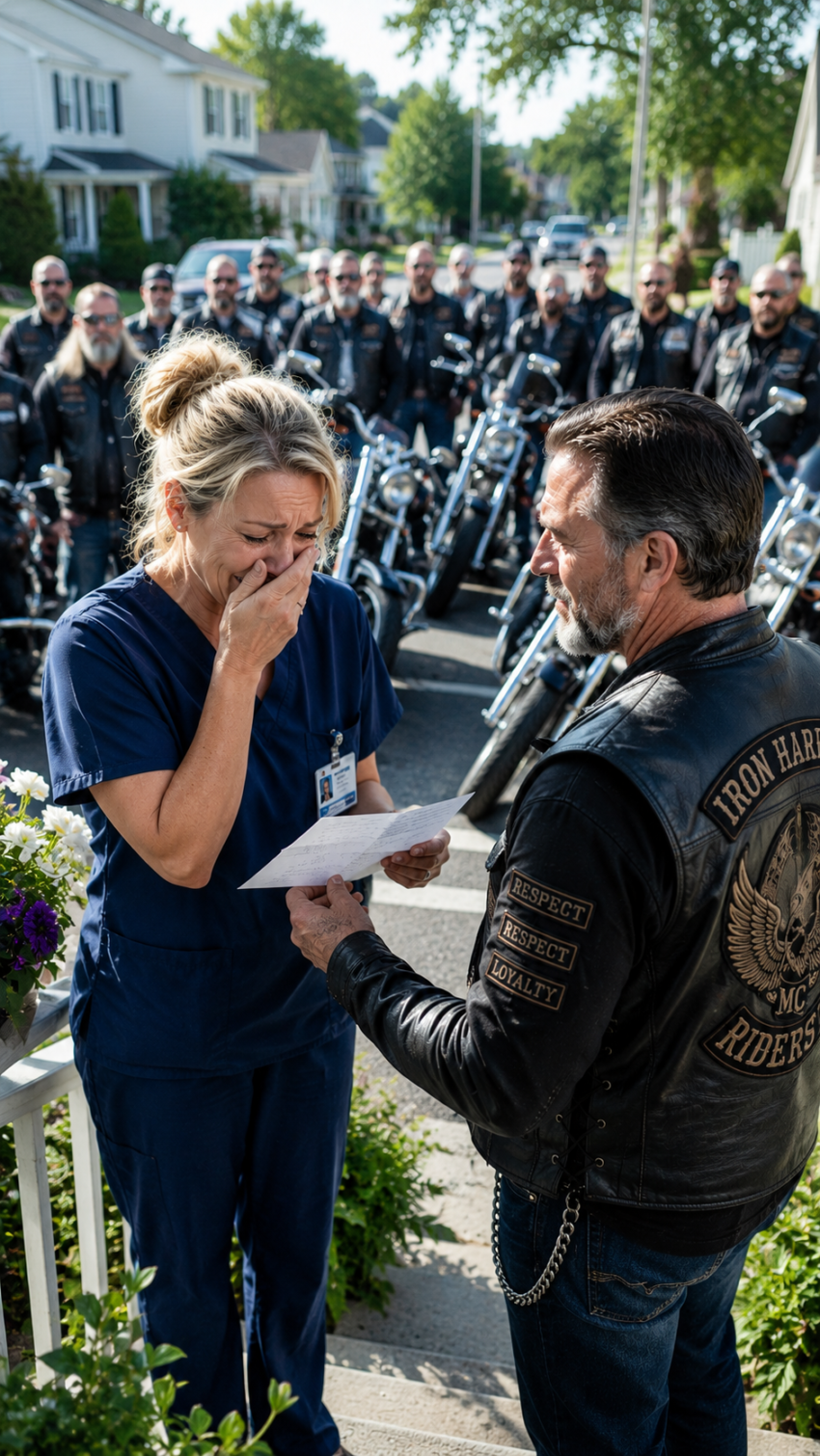
Ninety riders parked in careful rows outside Janet’s small duplex.
No one shouted. No one revved for attention.
They simply arrived.Sawyer stepped forward with a folder in his hand.
“Janet Holloway,” he said, loud enough for the street to hear, “we came to return the respect you gave our brother.”
Janet stood frozen on the porch.
“I don’t understand.”
A woman rider named Brooke stepped beside Sawyer.
“Some of us work in finance. Some in law. Some in hospital administration. Some know how to ask the right questions.”
Advertisements
Sawyer lifted the folder.
“The complaint used against you was not honest.”
Janet’s knees weakened.
Brooke continued, “There were records showing that funds meant to support children’s care had been handled improperly. You were removed because you asked questions and because families trusted you.”
Janet covered her mouth.
Sawyer’s voice softened.
“The hospital board has been notified. Local officials are reviewing the matter. Meredith Slane is no longer making decisions there.”
Janet sat down on the porch step because her legs could not hold her.
For a long moment, she could only cry.
Not the hopeless crying from the hospital parking lot.
This was different.
This was the sound of someone realizing she had not been erased after all.
Then Sawyer handed her an envelope.
“Your rent is covered for six months.”
Another rider stepped forward.
“Car repairs are covered.”
Another.
“Utilities and insurance are caught up.”
Janet shook her head through tears. “I can’t accept all this.”
Sawyer crouched slightly so his eyes were level with hers.
“You can. Because yesterday you gave Owen comfort when comfort cost you something.”
Then he handed her one final envelope.
“This one is from him.”
Inside was a handwritten note.
Janet read it with shaking hands.
Owen had written that he had spent years feeling like the world noticed only what had happened to him, not who he still was. He wrote that one nurse on one bus had reminded him that dignity could be handed back in a simple act. He wrote that he wanted her to know she was not alone.
At the bottom, he had written one line:
“You gave me a seat, Janet. Let us give you ground to stand on.”
Janet pressed the note to her heart.
One by one, the riders placed white roses along her porch.
Ninety roses.
Ninety quiet witnesses.
Ninety reminders that goodness can travel farther than fear.
Walking Back With Her Head High
Three days later, Janet received a call from St. Bridget Children’s Hospital.
This time, it was not Meredith.
It was the hospital director.
His voice sounded tired and careful.
“Mrs. Holloway, we owe you an apology.”
Janet sat very still.
He continued, “You were treated unfairly. Your record has been restored. We would like you to return as Director of Pediatric Family Care, with back pay and a public correction.”
Janet closed her eyes.
For a moment, she saw herself carrying that cardboard box in the rain.
Then she saw the roses on her porch.
She opened her eyes.
“I will return,” she said, “but only if the staff who were afraid to speak are protected, and only if the families who needed those support funds receive what they were promised.”
There was a pause.
Then the director said, “Agreed.”
When Janet walked back into the hospital the following Monday, she wore clean navy scrubs and the same blue-star shoes the children loved.
The lobby was full.
Nurses stood near the entrance. Parents waited with flowers. A little boy in a wheelchair waved both hands when he saw her.
The hospital director stepped forward.
“Janet Holloway,” he said in front of everyone, “this hospital failed you. Today, we publicly correct that failure and welcome you back with the respect you earned long before this moment.”
Applause filled the lobby.
Janet did not feel proud in a sharp way.
She felt grateful.
She felt steady.
She felt like the part of her life someone tried to take had been placed back into her hands.
A little girl called from the pediatric hallway, “Miss Jan, you came back!”
Janet walked to her, bent down, and took her small hand.
“Yes, sweetheart,” she whispered. “I came back.”
The Fund That Began With One Seat
That evening, Janet sat at her kitchen table, looking at Owen’s card.
Then her phone rang.
It was him.
“Janet?”
She smiled through sudden tears. “Owen.”
His voice was rough, but warmer than before.
“I heard you got your job back.”
“I did,” Janet said. “And I heard your friends are very hard to say no to.”
He chuckled softly.
“They mean well.”
Janet looked toward the porch, where the roses still stood in jars and cups because she could not bear to throw any away.
“They saved me,” she said.
Owen was quiet for a moment.
“No,” he answered. “You reminded us what saving looks like.”
They talked for nearly an hour. About healing. About work. About lonely houses and unexpected kindness. About how people sometimes need help the most when they are trying hardest to look fine.
Then Owen said, “I keep thinking about people traveling for medical care. People who need room. Comfort. Privacy. People who can’t afford the seat that lets them feel human.”
Janet sat up slowly.
“A travel fund,” she said.
“That’s what I was thinking.”
Janet smiled.
“Then let’s build it.”
Six months later, the first patient rode to treatment in a comfortable medical transport paid for by the Holloway-Maddox Dignity Fund.
Janet stood outside the hospital watching the vehicle pull away.
Owen stood beside her, hands tucked into his vest pockets.
“All this from one bus seat,” he said.
Janet looked at him.
“No,” she said softly. “All this from choosing not to look away.”
Owen nodded.
And for the first time in a long time, both of them believed the road ahead might still hold something gentle.
If the world has ever made you feel replaceable, remember that a title can be taken, a door can be closed, and a room can turn cold, but none of those things can erase the love you have already placed into other people’s lives.
Sometimes the smallest kindness is not small at all, because to the person receiving it, that one moment may be the first proof in a long time that they are still seen, still valued, and still welcome in the world.
When someone uses power to make you feel afraid, do not mistake their confidence for truth, because many people sound strongest right before the truth finally reaches the light.
A good heart may cost you comfort sometimes, but it will never make you poor in the ways that truly matter, because compassion has a way of returning through doors you never knew existed.
You may not see the full result of your kindness on the day you give it, but that does not mean it disappeared; sometimes it travels quietly through another person’s life until it becomes courage, loyalty, and hope.
Never believe that starting over means you failed, because sometimes starting over is simply the moment your life removes you from a place that no longer deserves the best parts of you.
The people who look away when you are hurting may make you feel alone, but they are not the whole world; there are still people who notice, people who remember, and people who show up when it matters.
Dignity is one of the greatest gifts we can offer another person, because it tells them they are more than their pain, more than their past, and more than the way strangers have judged them.
If you are tired from always being the strong one, let this be your reminder that even helpers need help, even caregivers need care, and even the kindest hearts deserve somewhere safe to rest.
And when you wonder whether goodness still matters, remember this story: one woman gave up a seat, one man remembered her kindness, and a whole road of people came together to prove that compassion can still change a life