The Town That Looked Away
Fairview Falls, Missouri, was the kind of town people praised before they truly knew it.
The lawns were trimmed. The porches had hanging flowers. The bakery on Main Street always smelled like cinnamon rolls, and every Sunday morning, church bells floated over the rooftops like a promise that everything here was good.
Every July, the town prepared for Founders Weekend.
There were paper banners across the streets, lemonade stands in front of the library, music rehearsals at the high school, and smiling speeches about tradition, kindness, and family values.
But Fairview Falls had another tradition too.
It knew how to look away.
Advertisements
If a child came to school too quiet, people called her shy. If a woman lowered her eyes too often, people called her private. If strange things happened behind closed doors, neighbors said it was not their place to ask.
The town protected its image better than it protected its people.
At the edge of Fairview Falls, past the last diner and the broken railroad crossing, stood a wide metal garage called Iron Haven Customs.
Most people in town pretended not to notice it.
They saw the motorcycles parked outside and made assumptions. They saw leather jackets, gray beards, tattoos, and heavy boots, and decided the people inside were not the kind of neighbors worth greeting.
But inside Iron Haven, people listened.
They fixed engines. They shared coffee. They helped each other quietly. They did not need perfect reputations to know the difference between right and wrong.
That hot Friday afternoon, Warren “Bear” Callahan was tightening a bolt on an old motorcycle when he heard something strange near the open garage door.
It was not an engine.
It was not a voice.
It was the soft scrape of a shoe dragging across concrete.
He looked up.
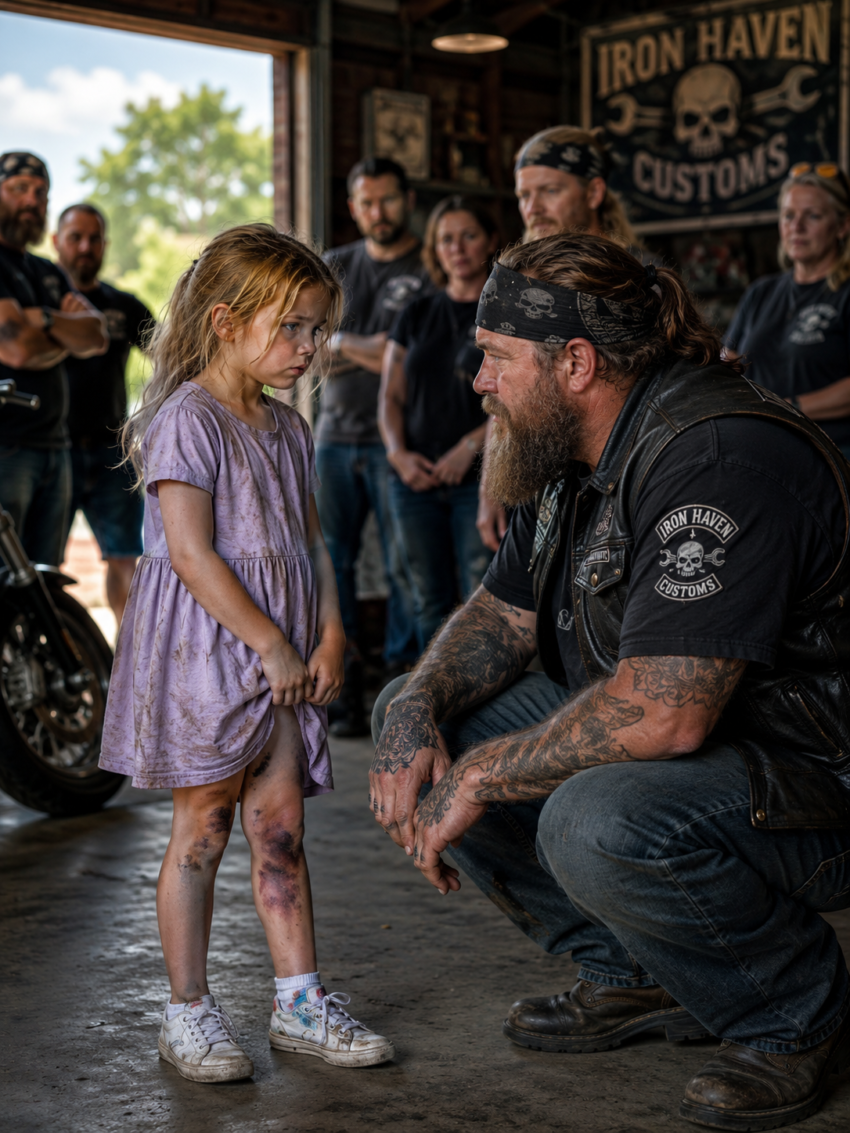
A little girl stood in the sunlight.
She could not have been more than seven. Her blonde hair stuck to her damp forehead, and her pale blue dress was wrinkled and dusty. One sneaker was missing. The other was untied.
She tried to step forward, but her left leg would not move right.
Drag.
Pause.
Drag.
Warren set down his wrench and slowly lowered himself into a crouch.
He did not rush toward her. He did not raise his voice.
He simply opened his hands and said gently, “Hey, sweetheart. You’re safe here. What’s your name?”
The little girl looked around the garage as if she expected someone to yell at her for being there.
Then she whispered, “My name is Avery.”
The whole garage went quiet.
A Small Voice In A Loud World
A woman named Reese Miller stepped closer from the office, holding a clean towel and a bottle of water.
Reese had worked with veterans, foster families, and scared children long enough to recognize when silence meant more than shyness.
She knelt a few feet away from Avery.
“Hi, Avery. I’m Reese. Can I give you some water?”
Avery nodded, but her hands trembled when she took the bottle.
Warren watched her carefully. Her face was too calm for a child who had clearly walked a long way in pain. It was the kind of calm children wore when they had learned that crying did not always bring help.
Warren kept his voice soft.
“Does your leg hurt?”
Avery swallowed and nodded.
“It hurts when I move it.”
Reese glanced at Warren, then looked back at Avery.
“Did you fall?”
Avery’s eyes dropped to the floor.
For a moment, nobody breathed.
Then she said, “No. Someone shoved me.”
Warren felt the words hit him like cold water.
He had heard many hard stories in his life. He had seen grown men break down over memories they could barely speak. But nothing made the room colder than a child explaining pain like it was normal.
Reese asked carefully, “Who shoved you, honey?”
Avery’s small fingers tightened around the water bottle.
“My mom’s boyfriend,” she whispered. “He said I was in the way.”
The garage stayed silent.
No one cursed. No one shouted. No one made a dramatic move.
Because every adult in that room understood something important.
Avery did not need more fear.
She needed steadiness.
Warren nodded once, slow and firm.
“You did the right thing coming here.”
Avery looked up at him with eyes that were far too tired.
“Am I going to get in trouble?”
Warren’s throat tightened.
“No,” he said. “Not with us.”
What The Town Refused To See
Reese asked Avery for permission before checking her leg.
The little girl nodded, stiff with fear, as Reese gently looked at the bruising near her knee and upper leg. The marks were not new. Some were fading. Some were darker. Together, they told a story that no child should have to carry alone.
Reese’s expression changed, but only for a second.
Then she became calm again.
“Avery,” she said, “has anyone taken you to a doctor?”
Avery shook her head.
“They said I was being dramatic.”
Warren stood up slowly and turned away for a moment.
He needed one second to control his anger.
Because he could imagine it all too clearly.
Avery limping through a grocery store while adults pretended not to notice. Avery sitting in a classroom too quiet while teachers told themselves someone else would ask. Avery standing in a house where grown people chose comfort over courage.
Fairview Falls had seen this child.
Maybe not everything.
But enough.
Enough to wonder.
Enough to ask.
Enough to do something.
And still, the town had stayed polite.
Reese wrapped Avery’s leg carefully to keep it stable until she could be examined properly. Another mechanic, Clay, brought a clean hoodie from his truck and placed it around Avery’s shoulders.
Avery looked confused by the kindness.
“Why are you helping me?” she asked.
Warren looked down at her.
“Because kids are supposed to be protected.”
Advertisements
Her lip trembled.
“People always say that.”
Warren nodded.
“Then today, we’re going to mean it.”
The Calls That Changed Everything
Warren did not act reckless.
He did not storm down the street.
He did not turn Avery’s pain into a public scene.
Instead, he did what responsible adults do when a child needs real help.
He made calls.
Reese contacted a child advocate from the next county, someone she trusted. Clay called a nurse at a hospital forty minutes away. Warren called a retired officer who still knew which official doors opened fastest when a child’s safety was involved.
Every call was calm.
Every word was careful.
They wrote down what Avery said without forcing her to repeat more than she could handle. They asked gentle questions. They gave her food. They let her sit where she could see every exit, because children who have been scared often need to know they can leave.
As evening settled over Fairview Falls, fireworks popped in the distance.
Founders Weekend had begun.
The town was decorating itself in red, white, and blue while one little girl sat in a garage, learning that not every adult would ignore her.
Avery stared toward the open door.
“They told me nobody would believe me.”
Reese sat beside her.
“That was not the truth.”
Avery’s voice became smaller.
“They said people like me ruin things.”
Warren crouched in front of her again.
“No, sweetheart. People who hurt children ruin things. Telling the truth is not ruining anything.”
For the first time, Avery cried.
Not loudly.
Not dramatically.
Just silent tears slipping down her cheeks as if her body had finally found a safe place to let go.
Founders Weekend
The next morning, Fairview Falls looked perfect.
Main Street was full of families, flags, folding chairs, food trucks, and music. Children carried balloons. The mayor stood on a small stage near the courthouse, ready to give his yearly speech about unity and hometown pride.
Then the motorcycles came.
One by one, they turned onto Main Street.
They did not race.
They did not threaten.
They simply arrived.
Twenty-eight motorcycles rolled slowly along the curb and parked in a clean line. Engines went quiet, and the sudden silence made everyone turn.
Warren removed his helmet.
Reese stood beside him.
Avery was not placed in front of the crowd. She was kept safely in the shade with an advocate and a nurse, wrapped in a soft blanket, holding a small stuffed bear someone had bought from a festival booth.
This was not about using her pain.
This was about ending the town’s silence.
The mayor’s smile froze.
“Bear,” he said into the microphone, trying to sound friendly, “is this part of the parade?”
Warren stepped forward.
“No.”
The crowd murmured.
Warren took the microphone only after the mayor lowered it.
He looked out at the teachers, neighbors, store owners, parents, and officials who loved to call Fairview Falls a family town.
Then he spoke.
“This town has spent all week preparing to celebrate its values.”
People shifted uncomfortably.
“But yesterday, a little girl came into my garage because she was hurt, scared, and convinced nobody in Fairview Falls would care enough to ask why.”
The crowd went still.
Warren did not name names. He did not point to anyone. He did not turn justice into gossip.
He simply told the truth.
“A child should never have to drag herself across town to find adults willing to listen.”
Near the back of the crowd, a man in a stained baseball cap turned pale. His eyes moved quickly, searching for a way out.
But this time, people saw him.
This time, they did not look away.
When Silence Finally Broke
Two officers moved through the crowd with quiet purpose.
A child advocate stood nearby, speaking with hospital staff on the phone. Reese stayed close to Avery, one hand resting on the back of her chair.
The festival music had stopped.
The marching band lowered its instruments.
The mayor looked like he wanted to disappear inside his own suit.
Avery watched from the shade, clutching her stuffed bear.
“Did I ruin the day?” she whispered.
Reese bent down beside her.
“No, honey. You helped people see what they should have seen before.”
Avery looked at Warren.
“Are they mad at me?”
Warren walked over and knelt carefully.
“Some people may be uncomfortable,” he said. “But uncomfortable is not the same as hurt. You are the one who needed help.”
Her eyes filled again.
“I tried to be quiet.”
Warren shook his head.
“You never should have had to be.”
That sentence moved through Reese like a prayer.
Because sometimes healing begins with one adult saying the thing a child has needed to hear all along.
A Hospital Room Full Of Gentle Voices
By that evening, Avery was in a children’s hospital in Springfield.
Her leg was braced. Her body was being cared for. Her story was being handled by people trained to protect children properly.
Advertisements
The room was bright, clean, and quiet.
Reese sat near the bed filling out paperwork. Warren sat in a chair by the window, his large hands folded, his leather vest hanging over the back of the chair.
Avery’s mother arrived later, pale and shaking, still in her work uniform. She looked at her daughter, then at the brace, then at the advocate standing nearby.
Her face crumpled.
“Baby, I didn’t know it was this bad.”
Avery looked away.
The room held its breath.
Reese did not judge out loud. Warren did not speak. This was not the moment for anger to take center stage.
It was the moment for accountability.
Avery’s mother sat carefully beside the bed and whispered, “I should have listened sooner.”
Avery’s small hand moved under the blanket.
Her mother took it and cried quietly.
Warren looked out the window at the darkening sky.
Some families broke because no one told the truth.
Others only had a chance to heal after the truth finally entered the room.
The New Rule
Late that night, Avery woke from a light sleep.
The stuffed bear was tucked beneath her arm. Her hair had been brushed back from her face. She looked younger now, less like a child carrying a secret and more like a little girl who was finally allowed to rest.
She turned her head toward Warren.
“Are you still here?”
Warren leaned forward.
“I’m still here.”
“Why?”
He smiled gently.
“Because I said you wouldn’t be alone.”
Avery studied him for a long moment.
“Do grown-ups really stay?”
The question nearly broke him.
Warren nodded.
“The good ones do.”
Avery blinked slowly.
“I want to be brave.”
Reese looked up from her papers.
“You already were.”
Avery shook her head a little.
“I was scared.”
Warren’s voice softened.
“Being brave does not mean you were not scared. It means you told the truth even while you were scared.”
Avery held her bear tighter.
For the first time since she had walked into Iron Haven Customs, her face relaxed.
Not completely.
Healing would take time.
Trust would take time.
Safety would take more than one speech, one hospital visit, or one dramatic morning on Main Street.
But a new rule had been spoken into her life.
She was not trouble.
She was not dramatic.
She was not ruining anything.
She was a child.
And she deserved to be safe.
What Fairview Falls Learned
Founders Weekend was never the same after that.
The banners still went up the next year. The band still played. The bakery still sold cinnamon rolls. The mayor still gave a speech, though it was shorter and far less polished.
But something had changed.
Teachers began asking harder questions.
Neighbors stopped treating concern like an insult.
The library started hosting safety workshops. The church posted real resource numbers, not just comforting quotes. The school hired another counselor.
And Iron Haven Customs was no longer something people pretended not to see.
Some still whispered about Warren and his crew.
But others brought coffee. Some brought thank-you cards. A few brought old motorcycles that did not need much fixing, just so they could say they were sorry for judging people they never tried to know.
Warren never cared much for praise.
When people called him a hero, he shook his head.
“Avery was the brave one,” he always said. “We just finally listened.”
And maybe that was the lesson Fairview Falls needed most.
A good town is not a town with perfect streets, smiling festivals, and pretty speeches.
A good town is a place where someone small can speak and someone strong chooses to hear.
A community is not measured by how beautiful it looks during a celebration, but by how quickly it protects the people who are scared, quiet, and easiest to overlook.
When a child speaks about pain, the first response should never be doubt, shame, or inconvenience; it should be calm listening, careful action, and a promise that they will not have to carry the truth alone.
Silence may feel peaceful to the people who are comfortable, but to someone who is suffering, silence can feel like a locked door with no one on the other side.
Sometimes the people judged by appearances are the very ones with the strongest hearts, because they know what it feels like to be misunderstood and still choose to stand up for someone else.
Courage does not always arrive loudly; sometimes it looks like a small child taking one painful step into a garage and whispering the truth to strangers because she has run out of places to feel safe.
Adults do not need perfect words to help a child in trouble, but they do need patience, honesty, and the willingness to take responsible action when staying quiet would be easier.
A town that values its reputation more than its children has already lost its way, because no parade, speech, or tradition is more important than a young life feeling protected.
Looking away is never as harmless as people pretend it is, because every ignored sign teaches someone vulnerable that their pain is invisible.
Real kindness is not just smiling at neighbors on a sunny street; it is asking hard questions, making difficult calls, and standing beside someone when the truth makes everyone uncomfortable.
If you have ever been taught to stay silent, please remember that your voice still matters, your story deserves care, and the right people will not blame you for needing help.