The Yellow Dress That Meant More Than Anyone Knew
When Everett Boone stepped into the house carrying a small paper bag, his wife immediately sensed that something important had happened.
The bag did not come from an expensive boutique. There was no jewelry hidden inside, no anniversary present, and nothing that would have attracted much attention from anyone else.
Inside was a bright yellow dress made for a six-year-old girl.
It had short sleeves, a soft cotton lining, and a row of tiny embroidered flowers near the bottom. Under the store lights, it had probably looked like an ordinary children’s dress.
But inside the Boones’ quiet home in Chattanooga, Tennessee, it carried the weight of a promise.
Everett stood near the doorway, rainwater still shining on his motorcycle jacket. His beard was streaked with silver, and his heavy boots left small marks on the entryway rug.
Advertisements
People often formed an opinion about him before he spoke.
They noticed the leather vest, the broad shoulders, the faded tattoos, and the old motorcycle parked in the driveway. They assumed he was impatient, intimidating, or difficult to approach.
His wife, Laurel, knew a completely different man.
Everett was the kind of person who stopped traffic to help a turtle cross the road. He repaired bicycles for neighborhood children without accepting payment. Whenever he met a frightened child, he lowered his voice and moved slowly so he would not make them uncomfortable.
He also remembered small wishes.
That evening, the small wish belonged to a little girl named Tessa.
The Child Who Kept Her Backpack Ready
Tessa was six years old when she came to stay with Everett and Laurel.
She arrived carrying a faded purple backpack, two shirts, a pair of worn sneakers, and a stuffed rabbit with one missing ear.
She did not cry when the social worker left.
She did not ask where she would sleep or what they would have for dinner.
Instead, she stood near the front door and quietly studied the room. Her eyes moved from the hallway to the windows and then back to the door, as though she needed to remember every possible way out.
Laurel had welcomed children into her home before. She understood that fear did not always arrive with tears or loud protests.
Sometimes fear was almost invisible.
Sometimes it looked like a child who never complained.
Before coming to the Boones, Tessa had spent several months moving from place to place with her mother. For a time, they had slept in an aging sedan parked behind grocery stores and roadside rest areas.
Her mother had cared about her, but affection had not been enough to create stability. One difficult month had followed another until the car became their bedroom, dining room, and shelter from the world.
Tessa had learned how to sleep with her knees pulled toward her chest.
She knew how to keep her belongings together.
She knew how to listen to an adult’s tone and recognize when plans were about to change.
What she did not know was how to believe that a home could remain hers.
During her first weeks with Everett and Laurel, she behaved like a guest who expected to leave at any moment.
Every morning, she folded her pajamas and placed them inside her backpack.
She asked before opening the refrigerator.
She carried her stuffed rabbit from room to room because she did not want to leave it behind.
When Laurel gave her a new toothbrush, Tessa held it carefully and asked, “Should I keep it in my backpack?”
Laurel felt a quiet ache in her chest.
She knelt beside the child and replied, “You can leave it in the bathroom, sweetheart. It belongs here.”
Tessa stared at the toothbrush.
“What if I have to go somewhere else?”
Laurel gently touched her shoulder.
“Then we will talk about it together. You will never have to guess alone.”
Tessa nodded, but she still placed the toothbrush inside her backpack that night.
The Color That Looked Like Warmth
For several weeks, Tessa refused to say what she liked.
Whenever Laurel asked which cereal she preferred, she answered, “Whichever one is easier.”
When Everett offered to let her choose a movie, she whispered, “You can pick.”
If they passed a toy store, she never slowed down to look through the window.
Tessa had learned that wanting something could lead to disappointment. It felt safer to pretend that everything was equally acceptable.
Then one Saturday afternoon, Laurel found her sitting on the living room floor with an old family photo album.
Tessa was staring at a picture of Laurel’s niece standing beside a birthday cake. The girl in the photograph wore a blue party dress and a paper crown.
Tessa touched the edge of the picture.
“Why was she dressed like that?”
Laurel sat beside her.
“It was her seventh birthday. We had a party for her.”
Tessa continued studying the picture.
“Did everyone take pictures because she was important?”
Laurel paused before answering.
“They took pictures because they wanted her to remember that she was loved.”
Tessa became quiet.
Over the next few days, Laurel learned that the little girl had never had a birthday party of her own. She did not remember standing beside a cake or choosing a special outfit.
One evening, while Everett repaired a loose drawer in the kitchen, Tessa sat at the table with a coloring book.
She was coloring a picture of a princess. Almost everything on the page was yellow: the dress, the shoes, the crown, and even the curtains behind her.
Everett glanced over.
“That is a lot of yellow.”
Tessa looked down at the picture.
“Yellow looks warm.”
He set down his screwdriver.
“Do you like warm colors?”
She nodded.
“I think a yellow dress would make someone look like sunshine.”
Everett smiled gently.
“Would you like to wear one someday?”
Tessa pressed the yellow crayon against the page until the paper nearly tore.
“Maybe. Just once.”
Later that night, Laurel told Everett what she had discovered about Tessa’s birthdays.
She explained how the child looked at family photographs and wondered whether pretty clothes made someone important enough to remember.
Everett listened without interrupting.
Then he stood, reached for his motorcycle keys, and said, “What size does she wear?”
A Biker Among the Children’s Clothes
The following evening, Everett left the metalworking shop where he had worked for more than twenty years and rode across town.
Tessa’s clothing size was written on a piece of cardboard tucked inside his wallet.
He entered the first department store wearing his work clothes, leather vest, and rain-spotted boots.
Several shoppers glanced at him.
Everett ignored them.
He walked directly to the children’s section and stopped in front of rows of pink, lavender, blue, and cream-colored dresses.
A young employee approached him.
“Can I help you find something, sir?”
“I need a yellow dress for a six-year-old.”
The employee began checking the racks.“Is it for a birthday?”
Everett thought about the question.
“It is for a child who needs to know she matters.”
The employee’s expression softened.
They found several dresses, but none was right. One was pale yellow. Another had too many decorations. A third looked uncomfortable and stiff.
Everett visited a second store and then a third.
Advertisements
By the time he reached the fourth shop, evening rain had begun falling across the parking lot. The store was preparing to close, and an employee was already straightening the final racks.
Everett stepped inside.
An older saleswoman noticed him studying each yellow dress with unusual seriousness.
“You are looking for something very specific, aren’t you?”
Everett nodded.
“Sunshine yellow. Size six. Soft enough for a child to feel comfortable.”
The woman did not ask unnecessary questions.
She walked with him toward a clearance rack near the back of the store. Together, they searched between pastel sweaters and summer outfits.
Then she pulled out a dress that had been hidden behind a white cardigan.
It was bright yellow, simple, and soft. Small white flowers were stitched along the hem.
Everett held it beneath the ceiling lights.
For a moment, he imagined Tessa wearing it.
He imagined her standing in front of a birthday cake. He imagined her laughing without checking the adults around her first. He imagined her finally understanding that she was allowed to take up space in a family photograph.
The saleswoman noticed the emotion in his eyes and politely looked away.
Everett cleared his throat.
“That is the one.”
The Question Hidden Beneath the Dress
Tessa was sitting at the kitchen table when Everett returned home.
She had her coloring book open in front of her. Another yellow-dressed girl filled the page.
Laurel turned away from the sink when she heard the door.
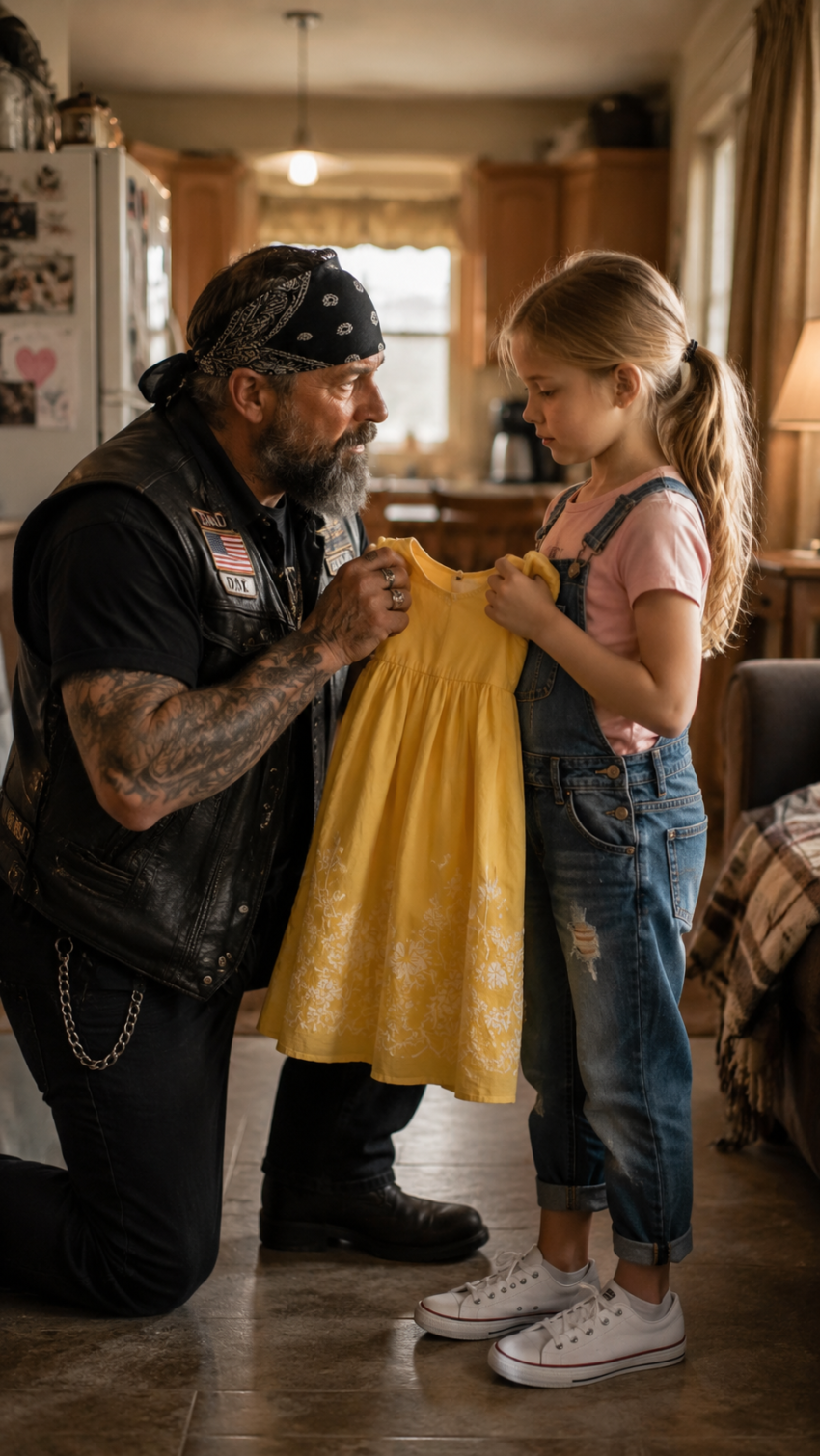
Everett removed the dress from the shopping bag and held it up.
“I brought you something, Tess.”
The child’s eyes widened.
For a brief second, excitement replaced every careful expression she had worn since arriving.
She looked like any other six-year-old who had just received a surprise.
Everett smiled.
“You said yellow looked like sunshine. I thought we could use a little more sunshine around here.”
Tessa slowly rose from her chair.
She touched the fabric with both hands, almost as though she feared it might disappear.
“Is this really for me?”
“Every bit of it.”
She held the dress against her body and looked down.
Everett expected her to smile or ask to try it on.
Instead, her shoulders grew tense.
Her fingers tightened around the fabric.
When she finally looked up, the happiness in her eyes had been replaced by uncertainty.
“If I look pretty in it, will you let me stay?”
The entire kitchen seemed to become still.
The rain tapped against the windows. Water dripped from Everett’s jacket onto the floor. The refrigerator hummed softly in the silence.
Laurel placed one hand over her mouth.
At that moment, both adults understood that the dress had never been only about its color.
Tessa believed staying was something she had to earn.
She thought that if she looked beautiful enough, behaved carefully enough, and smiled at the correct moments, Everett and Laurel might decide she was worthy of keeping.
In her world, love had always felt temporary.
The yellow dress was her attempt to become unforgettable.
The Answer She Needed to Hear
Everett carefully placed the shopping bag on the table.
Then he lowered himself onto one knee in front of Tessa.
He did not reach for her immediately. He knew she needed room to listen.
“Tessa, look at me.”
She raised her eyes, still clutching the dress.
Everett took a slow breath.
“I would choose you in pajamas too.”
Tessa blinked.
He continued in the same calm voice.
“You do not have to wear a beautiful dress to belong here. You do not have to smile every minute. You do not have to keep your room perfect or make yourself easy for us. You can be tired, worried, noisy, confused, or upset. None of those things will make you less important.”
Her chin began to tremble.
“What if I break something?”
“Then we clean it up or repair it together.”
“What if I have a bad day?”
“Then you will not face it alone.”
“What if I get scared and hide my things?”
Everett’s eyes filled with tears.
“Then we will keep reminding you that your things are safe here.”
Tessa looked down at the dress.
“I do not always know how to be good.”
Everett gently shook his head.
“No one gets everything right all the time. Families are not built from perfect people. They are built from people who stay, listen, forgive, and keep trying together.”
Tessa stared at him for several seconds.
Then she stepped forward.
Everett opened his arms, and she pressed herself against his chest.
For the first time since entering their home, Tessa cried openly.
Everett held her without rushing her.
Laurel turned toward the sink to wipe away her own tears.
Everett rested his cheek against the top of Tessa’s head.
“Yellow dress or purple pajamas, you matter exactly the same.”
The First Time She Twirled
Later that evening, Tessa asked Laurel to help her try on the dress.
Laurel fastened the small buttons while Everett waited in the hallway.
When the bedroom door opened, Tessa stepped out barefoot.
The yellow dress fit perfectly.For a moment, she stood completely still, looking down at the soft fabric around her knees.
Then she looked toward Everett.
He placed a hand over his heart.
“There is our sunshine.”
Tessa smiled.
It was not the careful smile she usually gave adults. It was wide, surprised, and completely real.
Advertisements
She turned slowly, watching the skirt move around her.
Then she spun again, faster this time.
A small laugh escaped her.
Laurel laughed with her, and Everett immediately reached for his phone.
He took photographs of Tessa twirling in the hallway, standing beside the kitchen table, and sitting proudly on the stationary motorcycle in the garage while he remained close enough to steady her.
None of the photographs was perfectly posed.
Her hair was slightly messy. One sleeve folded beneath her shoulder. In one picture, her eyes were closed because she was laughing too hard.
Yet those were the most beautiful photographs the Boones had ever taken.
The final picture of the evening showed Tessa asleep on the couch beside Everett. A blanket covered her legs, and one hand still rested on the yellow fabric.
Laurel took the photograph without waking them.
Later, she printed it and wrote one sentence on the back:
The night she learned love was not something she had to earn.
The Home She Slowly Learned to Trust
Change did not happen overnight.
Tessa still placed her stuffed rabbit inside her backpack for several more weeks.
She still asked whether she could take food from the refrigerator.
She still became quiet whenever unfamiliar cars stopped near the house.
But Everett and Laurel did not pressure her.
They answered the same questions as many times as necessary.
Gradually, Tessa began leaving her belongings around the house.
Crayons appeared beneath the coffee table.
Her shoes remained near the front door.
Her toothbrush finally stayed in the bathroom.
One morning, she came downstairs wearing mismatched socks, tangled hair, and purple pajamas with a loose button.
Everett looked up from his coffee.
“Good morning, sunshine.”
Tessa glanced down at herself.
“I am not wearing my yellow dress.”
“I noticed.”
“Then why did you call me sunshine?”
Everett smiled.
“Because the dress was never the sunshine.”
She stood quietly for a moment before climbing into the chair beside him.
That was when Laurel realized Everett’s words had finally reached the frightened part of Tessa’s heart.
The Day the Promise Became Permanent
The yellow dress remained special.
Tessa wore it to her first birthday party in the Boones’ backyard. There were six candles on a lemon cake, paper decorations in the trees, and several children from the neighborhood gathered around her.
When everyone began singing, Tessa looked overwhelmed.
She reached for Everett’s hand beneath the table.
He squeezed her fingers and whispered, “You do not have to perform. Just enjoy your day.”
She closed her eyes, made a wish, and blew out the candles.
Several months later, Everett and Laurel were given the opportunity to adopt her permanently.
On the morning of the court hearing, Tessa chose the yellow dress and wore a white cardigan over it.
After the paperwork was completed, the judge smiled and officially declared her a member of the Boone family.
Tessa looked up at Everett.
“So this means you really kept me?”
Everett’s mouth trembled.
He pulled her close.
“We did not keep you because you wore the dress, sweetheart. We kept choosing you because you became part of our hearts.”
Tessa wrapped both arms around his neck.
“I choose you too.”
The Photograph He Carried Over His Heart
People in Chattanooga continued to notice Everett’s motorcycle, his tattoos, and his weathered leather vest.
Some still crossed the street when they saw him approaching.
They did not know that inside one of his vest pockets, he carried a small photograph.
It showed Tessa in her yellow dress, spinning in the hallway with her eyes closed and a joyful smile across her face.
On the back were Laurel’s handwritten words:
The night she learned love was not something she had to earn.
Everett rarely showed the photograph to anyone.
He simply kept it close to his heart.
The dress had taught all three of them something.
It taught Laurel that children sometimes ask simple questions because they do not yet have the words to explain their deepest fears.
It taught Everett that fatherhood did not always require grand gestures. Sometimes it meant driving through the rain to find the right color dress. Sometimes it meant kneeling on a kitchen floor and offering a frightened child one clear, honest promise.
Most importantly, it taught Tessa that real love did not require an audition.
She belonged in the yellow dress.
She belonged in mismatched socks.
She belonged when she laughed, worried, made mistakes, asked difficult questions, or needed reassurance for the hundredth time.
The dress looked like sunshine.
But the real warmth came from finally knowing that she had a home where she no longer needed to prove she deserved to stay.
Children rarely have the perfect words to explain their deepest fears, so when they ask about a dress, a birthday cake, a bedroom, or whether they can leave their toothbrush behind, adults must listen carefully for the larger question hidden beneath those ordinary things.
A child who has experienced uncertainty may test love many times, not because they are ungrateful, but because their heart is trying to discover whether this new safety will remain after a difficult day, an honest mistake, or an imperfect moment.
The greatest gift Everett gave Tessa was not the yellow dress itself, but the calm assurance that she did not need to become prettier, quieter, easier, or more pleasing in order to deserve a permanent place in his family.
People who appear strong, rough, or intimidating on the outside may carry extraordinary tenderness within them, and we should be careful not to judge a person’s capacity for kindness by their clothes, tattoos, occupation, or appearance.
A real home is more than a roof, a bed, and food on the table; it is a place where a child can leave their belongings behind, wake up with messy hair, speak honestly about fear, and still know they will be welcomed the following morning.
Loving a child means repeating reassurance patiently, because a promise offered once may not immediately reach a heart that has spent years preparing for disappointment, but steady actions can eventually make those words feel believable.
No child should grow up thinking affection is a reward for excellent behavior, attractive clothes, perfect grades, or constant obedience, because genuine family love leaves room for questions, mistakes, growth, healing, and second chances.
Small acts of kindness can become lifelong memories when they reach someone at the exact place where they have been quietly hurting, and for Tessa, a simple yellow dress became the beginning of believing that she was visible, valued, and chosen.
Parenthood is not defined only by biology or legal documents; it is revealed through the person who notices a child’s unspoken fear, lowers themselves instead of towering over them, listens without judgment, and remains steady when reassurance is needed again.
Somewhere in the world, a child still believes they must shine brightly every day to deserve love, and that child needs to hear the same truth Everett gave Tessa: you are worthy in your finest clothes, in your oldest pajamas, on your happiest days, and during every difficult moment in between.