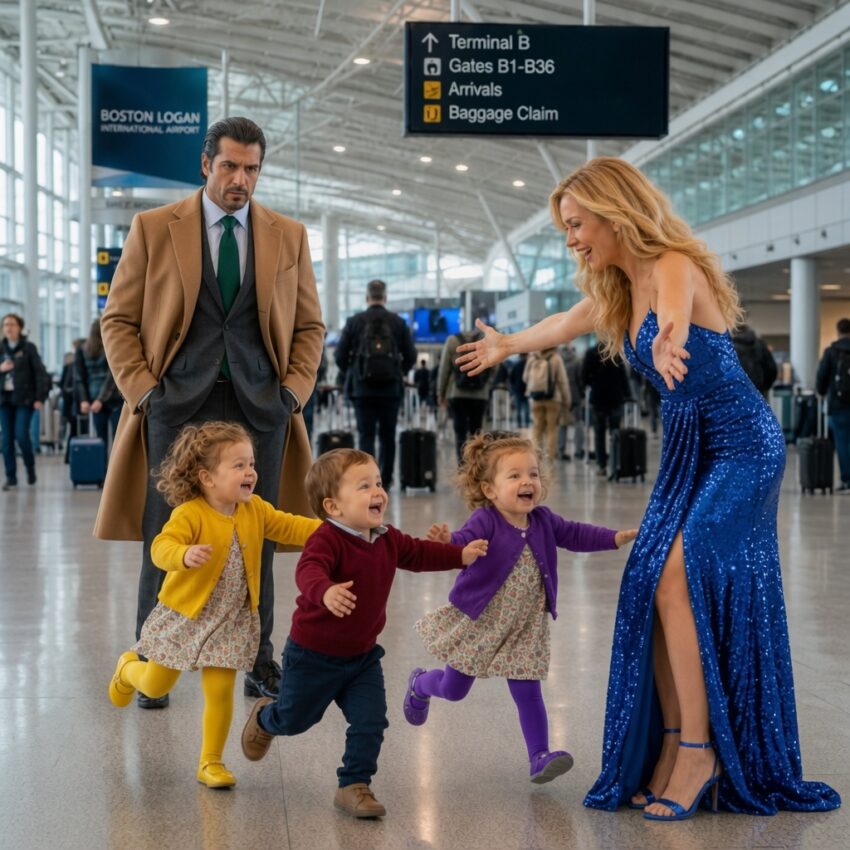
For two years after the triplets stood with Graham Whitaker inside Boston Logan Airport and laughed about the phone he had once dropped in shock, I believed the hardest part of our story was behind us.
That was naïve.
Not foolish.
Just hopeful.
There is a difference.
By the time Ava, Ben, and Noah turned ten, Graham had become something I never expected him to become.
Steady.
Not perfect.
Not forgiven in some clean, cinematic way.
Steady.
He showed up for parent-teacher conferences with notes in his phone. He learned the difference between Ava’s performance anxiety and Ben’s theatrical complaints. He knew Noah needed advance warning before loud events. He stopped buying expensive gifts unless he asked me first, and even then, he had learned that children usually cared more about who built the Lego set than who paid for it.
Ava still called him “Airport Dad” when she wanted to tease him.
Ben called him “Graham” whenever he was trying to sound older than ten.
Noah called him Dad only after three full years of watching him leave and come back on time.
That first Dad from Noah nearly broke Graham in half.
To his credit, he did not make the moment about himself.
He only said, “I’m here,” and kept tying Noah’s cleats.
That was growth.
Eleanor Whitaker became Grandma Elle slowly, cautiously, always with permission.
She never forgot what she had failed to do when Graham first told her I had “invented” a pregnancy claim.
She once told me, “Regret is not useful unless it changes who gets protected next.”
I respected that sentence.
I did not fully trust the world it came from.
The Whitakers were old Boston money.
Old money does not die just because one son learns humility.
It waits.
It rearranges itself.
It finds another doorway.
The doorway arrived in a navy envelope two weeks before the children’s tenth birthday.
The paper was thick.
The ink was silver.
The address was handwritten.
Ms. Emily Hart
Regarding Ava, Benjamin, and Noah Whitaker
I stood in my kitchen staring at the last name.
Whitaker.
Not Hart.
Not Hart-Whitaker.
Not the legal names on their birth certificates.
Whitaker.
My body reacted before my mind did.
Shoulders tight.
Breath shallow.
Jaw locked.
There are certain names that do not simply appear on paper.
They enter the room.
Graham was at the kitchen island helping Ben build a model airport out of cereal boxes. Ava sat on the floor writing a song about a dragon with trust issues. Noah was under the table reading a book about suspension bridges.
Graham saw my face.
“What is it?”
I handed him the envelope.
He read the front.
Something dark moved across his expression.
“I didn’t send this.”
“I know.”
His eyes lifted.
“Do you?”
“If you had sent it, you wouldn’t still be standing in my kitchen.”
Ava looked up.
“Mom has the calm voice.”
Ben whispered, “Court voice.”
Noah slid out from under the table.
“Do we need Ruth?”
My children had grown up with too many lawyers.
Useful.
Still sad.
Graham opened the envelope.
Inside was a formal invitation to the Whitaker Family Heritage Weekend at their old estate in Newport.
Three days of private dinners, foundation photographs, youth leadership activities, and a “Next Generation Recognition Ceremony.”
At the bottom, in elegant script, was the line that made the room go still.
Ava Whitaker, Benjamin Whitaker, and Noah Whitaker will be formally welcomed as legacy heirs of the Whitaker family.
Ben frowned.
“Benjamin?”
Ava made a face.
“They spelled future lawsuit wrong.”
Noah looked at Graham.
“Are we heirs?”
Graham closed his eyes.
The question was simple.
The answer was not.
“You are children,” he said finally. “That comes first.”
Good answer.
But not enough.
I took the papers from him.
There was more.
A proposed trust summary.
The Whitaker Descendant Stewardship Trust.
Education funds.
Healthcare coverage.
International travel.
Future housing.
Equity participation in Whitaker family charitable initiatives.
And conditions.
Of course there were conditions.
Attendance at annual family events.
Use of the Whitaker name in foundation contexts.
Professional portraits.
Public acknowledgment of “restored family unity.”
Media training beginning at age thirteen.
Ben stared at the page.
“Media training?”
Ava crossed her arms.
“I’m not saying anything for old people.”
Noah’s voice was quiet.
“Do they want us, or do they want pictures of us?”
No one answered quickly enough.
Because he had already answered himself.
Graham placed both hands on the counter and leaned forward.
“I’ll handle it.”
I looked at him.
“No.”
His head lifted.
“I mean I’ll shut it down.”
“I know what you mean.”
“Emily.”
“No,” I repeated. “You do not handle this privately with your family. That is how this started ten years ago. Private rooms. Private explanations. Private versions of truth.”
He absorbed that.
Then nodded.
“You’re right.”
It still surprised me sometimes when he said that without turning it into a debate.
“What do we do?” he asked.
“We call Ruth.”
Ruth Delgado arrived that evening with reading glasses, two legal pads, and the expression of a woman who had missed dinner because rich people insisted on using children as documents.
She read the invitation.
Then the trust summary.
Then the conditions.
By the third page, her mouth had become a straight line.
“Who sent it?”
Graham answered. “My uncle.”
That was new.
“Which uncle?” I asked.
“Sebastian Whitaker. My father’s younger brother. He sits on the family foundation board and controls part of the old trust structure.”
Eleanor had mentioned Sebastian only twice.
Both times with the tone people use for antiques that are valuable, fragile, and possibly cursed.
“He’s been pushing to restore the family foundation’s image,” Graham said. “After everything that happened at Logan, donors pulled back. Some board members blamed me.”
Ruth looked up.
“For abandoning the children?”
“No. For being seen abandoning them.”
Ava, listening from the hallway despite being told not to, shouted, “That is gross!”
Ruth called back, “Legally accurate.”
I looked at Graham.
“Does Eleanor know?”
“I don’t think so.”
Ruth closed the folder.
“Then we find out in writing.”
Within an hour, Ruth sent formal notice.
No attendance.
No use of names.
No image rights.
No public references.
No trust acceptance.
No contact with the children except through approved channels.
Graham sent his own message to Sebastian, copying Ruth and me.
Do not contact Emily or the children again. They are not available for legacy repair.
Sebastian replied in twelve minutes.
You always were sentimental after embarrassment. These children are Whitakers whether Ms. Hart likes it or not. The family will not be erased because you lost control of a private matter.
Private matter.
I stared at those words.
A man walking away from unborn children.
A mother raising triplets alone.
A public airport confrontation.
Court hearings.
Therapeutic reunification.
Years of careful rebuilding.
To Sebastian Whitaker, all of it was a private matter.
Because old families call harm private when accountability becomes inconvenient.
Eleanor came to my house the next morning.
Uninvited, but expected.
She stood on the porch in a wool coat, face pale with fury.
Not at me.
That was new too.
“May I come in?” she asked.
I stepped aside.
Graham was already there.
The children were at school.
Eleanor placed her handbag on the kitchen chair, then held out her phone.
“I did not authorize this.”
Ruth, on speakerphone from my laptop, said, “Good morning, Eleanor.”
“Ruth.”
That was all the greeting old money and lawyers required.
Eleanor turned to Graham.
“Sebastian has been courting donors behind my back. He believes the children could restore the foundation.”
Graham’s face hardened.
“They are not a restoration project.”
“No,” Eleanor said. “They are not.”
I watched her carefully.
“Why now?”
Eleanor looked at me.
“Because the foundation’s endowment review is next quarter. If Sebastian can show family continuity and public reconciliation, he can argue for control over several restricted accounts. He wants Graham publicly stable, the children publicly recognized, and you publicly grateful.”
I laughed once.
“Grateful.”
Her face tightened.
“I did not say I agreed.”
“No,” I said. “You only explained the mechanism.”
She accepted that without flinching.
That was why I could sit in a room with Eleanor now.
She had learned that shame was not fatal.
Sebastian’s next move came through the school.
Of course it did.
People who cannot reach a mother often try to reach around her.
The head of school called me at 11:20 on a Friday.
“Emily, the children are safe. But we need you to come in.”
I was already reaching for my coat.
“What happened?”
“A photographer arrived claiming to be with the Whitaker Family Foundation. He said he was scheduled to take portraits of Ava, Ben, and Noah for a scholarship announcement.”
My hand tightened around the phone.
“Were the children approached?”
“No. We stopped him at reception.”
“Good.”
Graham arrived at the school before I did.
Not because I asked.
Because the school called him too, as emergency contact.
When I walked in, he was standing in the lobby, controlled fury in every line of his body.
The photographer sat in a chair looking deeply regretful about his career choices.
Ruth was on the phone with the head of school.
Eleanor arrived five minutes later and said one sentence to the photographer.
“Who hired you?”
He swallowed.
“The foundation office.”
“Which office?”
“Mr. Sebastian Whitaker’s assistant.”
Graham stepped forward.
The photographer leaned back.
Ruth’s voice came through the phone.
“Graham, do not threaten the witness.”
Graham stopped.
“I wasn’t going to.”
“Your posture was.”
The head of school looked confused.
I said, “She knows him.”
The children found out that evening.
Not everything.
Enough.
Someone had tried to arrange photographs without permission.
The school protected them.
The adults were handling it legally.
Ava’s face went red.
“They wanted pictures of us for money?”
“For influence,” I said.
“What’s the difference?”
Ruth, still on speakerphone because apparently my kitchen had become a law office, said, “Usually the spelling.”
Ben asked, “Can we sue?”
Ruth sighed.
“Children should not sound that excited about litigation.”
Noah was quiet.
That worried me most.
Later, I found him in his room, sitting beside the window with his knees pulled up.
I knocked on the open door.
“Can I come in?”
He nodded.
I sat on the floor beside him.
For a while, we watched rain streak the glass.
Then he asked, “Does being a Whitaker mean people can keep trying?”
“No.”
“But they do.”
“Yes.”
He looked at me.
“Why?”
“Because some people confuse blood with ownership.”
He thought about that.
“Do you?”
“No.”
“Does Dad?”
I breathed carefully.
“No. Not anymore.”
Noah nodded.
“I believe him. But I don’t believe them.”
“That is allowed.”
He leaned against my shoulder.
“Can my name stay Hart?”
“Yes.”
“Even if they offer money?”
“Yes.”
“Even if it’s a lot?”
I kissed his hair.
“Especially then.”
Ruth filed for emergency protection of identity, image, and child privacy.
Sebastian responded by filing in probate court, arguing that as biological Whitaker descendants, the children had potential beneficial interests in family trusts and therefore required independent representation separate from me due to my alleged hostility toward the Whitaker family.
Hostility.
A useful word.
It makes a mother protecting children sound like a weather condition.
The hearing was set for the following week.
Sebastian entered court like a man who believed mahogany walls missed him when he left.
He was in his late sixties, silver-haired, tall, beautifully dressed, and entirely untouched by doubt.
Graham sat beside me.
Eleanor sat on my other side.
That alone made half the courtroom turn.
Sebastian noticed.
His expression soured.
Good.
Ruth began with the airport.
Not the drama.
The record.
Graham’s initial abandonment.
The notice letters.
The custody proceedings.
The therapeutic reunification.
The children’s established names, routines, medical providers, school, and emotional boundaries.
Then she introduced Sebastian’s invitation.
The trust conditions.
The media training.
The photographer at school.
The judge, Alan Pierce, read the documents carefully.
Then looked at Sebastian’s attorney.
“Why would ten-year-old children require media training?”
The attorney smiled politely.
“Your Honor, the Whitaker family’s charitable work involves public service. Preparing future generations for responsible civic presence is not unusual.”
Ruth stood.
“Future generations did not request civic presence. They requested lunchboxes and privacy.”
A few people coughed.
Judge Pierce’s mouth twitched.
Sebastian testified.
He said the children deserved family connection.
He said I had benefited from Graham’s wealth while alienating the children from their paternal heritage.
That was interesting, considering I had raised them alone for the hardest part of their lives while Graham’s wealth lived comfortably elsewhere.
He said the Whitaker name carried obligations larger than personal discomfort.
He said legacy required continuity.
Then Ruth cross-examined him.
“Mr. Whitaker, how many times have you met Ava, Ben, and Noah?”
“None.”
“How many birthday cards have you sent?”
“I was advised contact was unwelcome.”
“How many medical records did you review before deciding media training would benefit them?”
His attorney objected.
Overruled.
Sebastian’s jaw tightened.
“None.”
“How many child psychologists advised your proposal?”
“None.”
“How many donors received materials referencing the children before their mother consented?”
“I do not know.”
Ruth held up the prospectus.
“Would this refresh your memory?”
Sebastian looked away.
Ruth read aloud.
The appearance of Graham Whitaker’s children will provide a compelling symbol of reconciliation, continuity, and generational confidence.
The courtroom went silent.
Graham’s hand tightened into a fist on the table.
Eleanor closed her eyes.
I stared at the page.
Symbol.
Again.
Always symbol.
Never child.
Ruth looked at Sebastian.
“Did you approve that sentence?”
“It was drafted by communications staff.”
“Did you approve the packet?”
He hesitated.
“Yes.”
“Did you understand that Ava, Ben, and Noah had not consented to being used as symbols of generational confidence?”
“They are minors. Consent is managed by adults.”
Ruth’s voice sharpened.
“Exactly. Their mother did not consent.”
Sebastian’s face hardened.
“Their mother is not a Whitaker.”
Before Ruth could answer, Eleanor stood.
The courtroom turned.
Judge Pierce looked at her.
“Mrs. Whitaker?”
Eleanor’s voice was cold.
“No, Your Honor. I apologize. I will wait to be called.”
Ruth smiled slightly.
“I call Eleanor Whitaker.”
Eleanor took the stand.
Sebastian looked at her with pure betrayal.
She did not look back.
Under oath, Eleanor told the truth.
About Graham lying.
About her failure to verify my pregnancy.
About Logan Airport.
About the children’s gradual healing.
About Sebastian’s foundation pressure.
About the donor review.
Then Ruth asked, “Mrs. Whitaker, do you believe forced legacy recognition serves these children?”
“No.”
“Why?”
“Because legacy without relationship is branding.”
Sebastian’s mouth tightened.
Eleanor continued.
“And because I know what happens when this family teaches children that their names matter more than their character.”
Graham looked down.
She looked at him.
Then at me.
“I watched that nearly destroy my son. I will not help it reach his children.”
Something in my chest loosened.
Not enough to erase the past.
Enough to let the present breathe.
Graham testified next.
He did not defend himself.
That was new.
He said, “I left Emily when she was pregnant. I did not ask enough questions. I lied to my mother. I allowed fear and pride to become decisions. Everything I have with Ava, Ben, and Noah now exists because Emily protected them first and because the court made me earn access slowly.”
His voice shook once.
Then steadied.
“My family does not get to enter through a side door I spent years earning the right to approach.”
Ruth asked, “Do you support Sebastian’s petition?”
“No.”
“Do you want the children recognized as Whitaker heirs through this trust?”
“No.”
“Why?”
“Because children should not be used to stabilize adult reputations.”
Sebastian muttered, “Pathetic.”
The judge heard him.
So did everyone else.
Judge Pierce looked over his glasses.
“Mr. Whitaker, if you have commentary, save it for the witness stand.”
Sebastian said nothing.
The child advocate’s report ended it.
Ava, Ben, and Noah had expressed a consistent desire to keep their names, avoid public events, and have no contact with Sebastian at that time.
Ava had said, “I am not an heir. I am in fifth grade.”
Ben had said, “Do they have snacks? Actually no, still no.”
Noah had said, “My family is who knows where I sit when the airport is loud.”
The judge quoted Noah in the order.
I cried when I read it later.
The petition was denied.
No forced trust involvement.
No recognition ceremony.
No use of names, images, likenesses, school information, medical history, or biological relationship for foundation materials.
Sebastian and the Whitaker Foundation were ordered to destroy unauthorized materials and issue corrected notices to donors.
The court appointed no separate guardian because, as Judge Pierce wrote, “The children’s mother has consistently acted to protect their legal, emotional, and developmental interests.”
I kept that sentence.
Not framed.
But saved.
Mothers of abandoned children rarely receive official acknowledgment that protection was work.
I wanted the record.
Sebastian lost more than the hearing.
The donor review exposed his larger plan.
He had been using the foundation to reposition Whitaker assets ahead of a family trust restructuring. If he could present Graham’s children as willing legacy participants, he could argue that family continuity justified moving control back toward his branch of the family.
The children were not just public relations.
They were leverage.
Eleanor removed him from the foundation board.
Graham supported the removal.
Several donors withdrew.
The Whitaker Family Foundation survived, but only after changing its structure completely.
Independent board.
No family majority.
No use of minors in donor campaigns.
No legacy events without consent and child welfare review.
Eleanor insisted on the last rule herself.
At the first meeting after the restructuring, she said, “We have confused inheritance with entitlement for too long.”
No one applauded.
Old money does not clap when it is being disciplined.
But the motion passed.
Graham came to my house that evening.
The children were upstairs.
He stood in the kitchen, hands in his coat pockets.
“I’m sorry,” he said.
“You didn’t file the petition.”
“No. But my name opened the door.”
I did not answer immediately.
That was true.
And not entirely.
“It opened one door,” I said. “You helped close it.”
He looked at me.
“I should have closed it before they reached you.”
“Yes.”
He accepted that.
Another new thing.
“I’m learning that repair is not only what I do after harm arrives,” he said. “It’s what I prevent before it gets to the children.”
I nodded.
“That’s fatherhood.”
His eyes shone.
“I know.”
I believed him.
Not completely.
Belief, for me, had become something built in layers.
But another layer settled that night.
The children stayed Hart.
They remained connected to Graham because he earned connection.
They remained connected to Eleanor because she respected the line.
They did not meet Sebastian.
At least not as children.
Years later, Ava would see him across a university donor event and say, “Is that the man who tried to turn us into brochures?”
I said yes.
She said, “He looks exactly like a brochure.”
I had to walk away because laughing would have been rude.
Ben grew into a teenager who could smell manipulation before breakfast.
Noah became the kind of boy who watched exits in crowded rooms, then quietly made sure everyone else knew where they were too.
The old airport story followed us for years.
Not publicly.
Family stories do not need audiences to become myth.
At thirteen, the triplets asked to see the original court documents from the custody case.
Ruth said they were old enough with support.
So we sat at the round kitchen table.
Me.
Graham.
Eleanor.
Ruth.
Ava, Ben, and Noah.
They read the texts.
The early letters.
The line where Graham had said, “You are having a baby.”
Ava stared at it.
“One baby,” she said.
Graham nodded.
“Yes.”
“And you still left.”
“Yes.”
Ben looked at him.
“Did you think money made leaving less bad?”
Graham swallowed.
“Yes.”
Noah asked, “What changed?”
Graham looked at him for a long time.
“You did. Your mother did. The court did. Therapy did. But mostly, I stopped asking how to feel less ashamed and started asking what would make you safer.”
Noah nodded slowly.
“That’s a good answer.”
Graham’s face almost broke.
“Thank you.”
Eleanor read her own sworn testimony aloud when Ava asked.
At the sentence, I chose to believe the answer that protected my son from inconvenience, her voice cracked.
Ava reached across the table and touched her hand.
“You did better later.”
Eleanor closed her eyes.
“Yes,” she whispered. “I tried.”
That was what I wanted my children to understand.
Not that people never fail.
People fail.
Sometimes terribly.
What matters is whether they turn the failure into another demand, or into protection for someone else.
Sebastian never apologized.
That was fine.
Not every villain deserves a redemption arc.
Some serve best as caution signs.
The Whitaker Descendant Stewardship Trust was dissolved after the court order. The clean funds were redirected, at Graham and Eleanor’s request, into a new program supporting single parents of multiples during the first two years after birth.
No mention of Whitaker heirs.
No donor photos of crying mothers.
No children used as symbols.
The program was called The Third Hand Fund because, as Ben once said when he was four, “One mommy needs more hands for three babies.”
I cried when Graham told me the name.
Then I pretended not to.
Everyone politely allowed the lie.
At the opening, I gave a short speech.
I did not mention Sebastian.
I did not mention the airport.
I simply said, “Help should arrive before survival becomes a miracle.”
Graham stood in the back with the children.
Not on stage.
That was his choice.
Ava whispered something to him.
He laughed.
Ben leaned against his side.
Noah held Eleanor’s hand.
For one second, I saw the family we could have been if Graham had been brave sooner.
Then I let that thought pass.
Grief for the alternate life is real.
But it is not a map.
The life we had was built from truth.
Harder.
Slower.
More honest.
Years later, people still said Graham Whitaker saw three toddlers at Boston Logan Airport and realized what he had lost.
They said his mother found out he had lied.
They said his fiancée left.
They said Emily Hart made him earn every inch of fatherhood.
All true.
But the next chapter mattered more.
Because once the father began to change, the family name came hunting.
The Whitakers did not want to know Ava, Ben, and Noah.
They wanted to display them.
To rename them.
To photograph them.
To fold them into a legacy they had survived without.
And this time, Graham did not stand on the wrong side.
That mattered.
Not because it erased what he had done.
It did not.
But because children need more than apologies from parents who failed them.
They need protection from the world that taught those parents to fail.
On the triplets’ sixteenth birthday, we returned to Logan Airport again.
It had become a strange tradition by then.
Ava brought crackers as a joke.
Ben priced nearby phones online and announced inflation had made Graham’s original drop “even more financially irresponsible.”
Noah stood near the window watching planes push back from the gates.
Graham came to stand beside him.
Noah was taller than me now.
Nearly as tall as Graham.
For a while, neither spoke.
Then Noah said, “This is where you first saw us.”
“Yes.”
“And where everything changed.”
Graham nodded.
“Yes.”
Noah looked at him.
“You know Mom was already everything before you saw us, right?”
Graham’s eyes moved to me.
I stood a few feet away with Ava and Ben, pretending not to listen and failing completely.
“Yes,” Graham said. “I know that now.”
Noah nodded.
“Good.”
Then he handed Graham a cracker.
Ava shouted, “Full circle!”
Ben groaned.
“That phrase is banned.”
We all laughed.
In an airport.
In the same terminal where Graham once dropped his phone and looked at three toddlers like ghosts.
They were not ghosts now.
They were teenagers.
Loud.
Complicated.
Kind.
Funny.
Free.
They carried his eyes.
My stubbornness.
Eleanor’s restraint, maybe.
Daniel’s sarcasm, unfortunately.
And something entirely their own.
That was the point.
Children are not proof of lineage.
They are not evidence of redemption.
They are not bridges adults get to cross without permission.
They are not names waiting for old families to reclaim.
Ava, Ben, and Noah were never the Whitaker future.
They were their own.
And if Graham learned anything from the years after Logan, it was this:
The family you lose through fear does not become yours again because you regret leaving.
It becomes possible only when you stop trying to own the door and start proving you can be trusted near it.
For a long time, Graham stood outside.
Then he knocked.