The Biker Everyone Blamed at a Sheriff’s Funeral
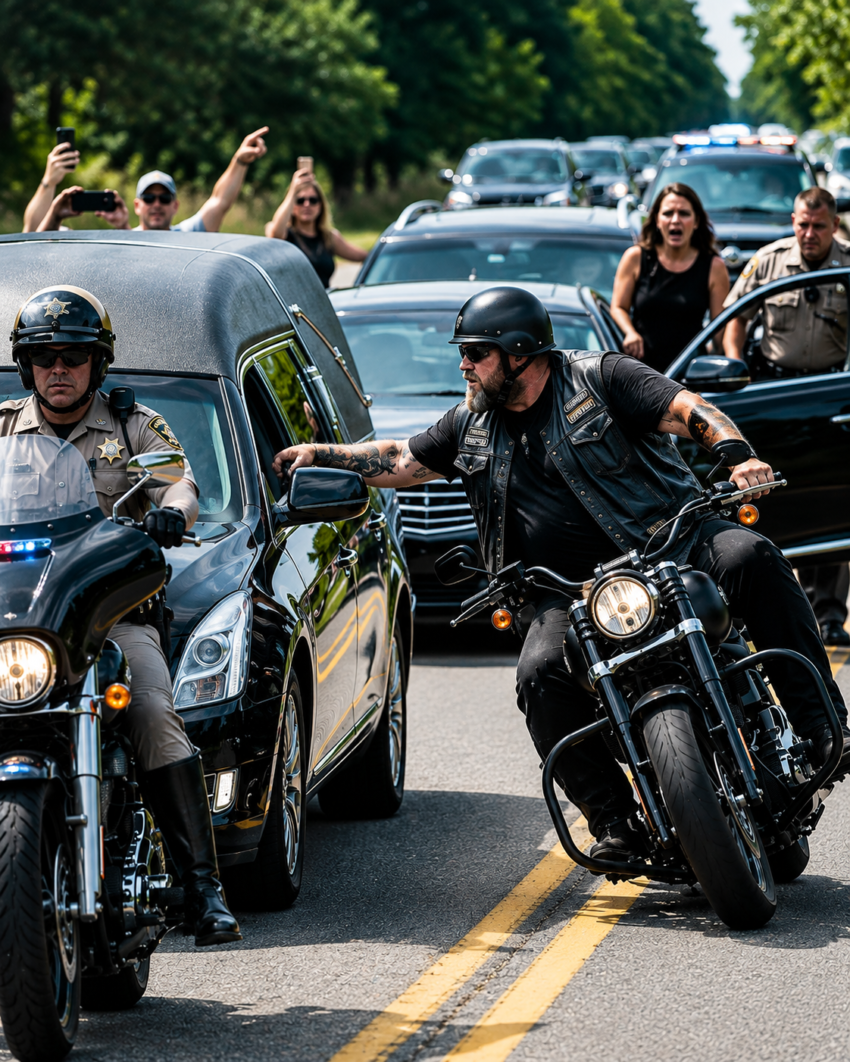
Nearly eighty people had their phones raised when a large biker suddenly rode against traffic toward my father’s funeral procession.
Every camera captured him.
Almost none captured the white pickup coming around the curve behind him.
My name is Nora Halstead, and until that afternoon outside Prescott, Arizona, I believed I already knew who Gideon Rourke was.
He was the man from one of my father’s oldest stories.
Twenty-six years earlier, my father, Sheriff Calvin Halstead, had stopped Gideon after a dangerous night on a rural highway. Gideon had been young, angry, and unwilling to accept responsibility for the choices that had nearly changed several families forever.
According to the version people in town remembered, Gideon had looked directly at my father afterward and said:
“One day, Calvin, I’ll meet you on the road when you’re not hiding behind that badge.”
The sentence followed him for years.
So when Gideon’s dark touring motorcycle appeared in the opposite lane during my father’s funeral, people immediately believed the old promise had finally come due.
They were wrong.
But by the time we understood that, Gideon’s motorcycle was already lying beneath the front of a pickup, my brother was standing speechless beside the road, and my mother had discovered that the man we had considered our father’s enemy had secretly been part of his life for more than two decades.
The Man Riding Toward the Hearse
My father’s funeral procession stretched along a two-lane highway west of Prescott beneath a bright Arizona sky.
His hearse moved slowly at the front. Family vehicles followed behind it, then several patrol cars and friends from neighboring counties. Small funeral flags fluttered from windows while headlights glowed in the afternoon sun.
My mother, Elaine, sat in the vehicle ahead of mine.
My younger brother, Wesley, was beside me.
We were approaching a long bend bordered by rocky ground on one side and a steep drainage slope on the other when people began sounding their horns.
A motorcycle was coming directly toward us.
The rider was impossible to miss.
Gideon was a huge man in his late fifties, with a gray-streaked beard, weathered skin, tattooed forearms, heavy riding boots, and a faded leather vest marked with the patch of the Iron Mesa Riders.
Even from a distance, I recognized him from an old newspaper photograph.
Wesley leaned forward.
“Is that Rourke?”
I felt my stomach tighten.
“I think so.”
The motorcycle passed a deputy who had moved ahead to intercept him.
Gideon did not stop.
He accelerated toward the hearse.
Then he reached out and slapped one open palm against its roof.
The hearse driver immediately pressed the brakes.
Cars behind it slowed sharply.
For several seconds, confusion spread through the entire procession.
Gideon turned his motorcycle sideways across the lane.
People began getting out of their cars.
Phones appeared everywhere.
Someone shouted that he was disrespecting the funeral.
Wesley opened our door before I could stop him.
“Wes, wait.”
He ignored me.
My brother had followed our father into law enforcement, and he remembered Gideon’s old reputation better than I did.
He marched toward him and grabbed the back of Gideon’s leather vest.
Gideon barely moved.
Instead, he stared beyond us toward the curve.
“Get your mother uphill,” he said.
Wesley tightened his grip.
“Don’t talk about my mother.”
Gideon finally turned his head.
“Then don’t listen to me. Look behind me.”
Wesley frowned.
“What are you talking about?”
Gideon pointed toward the bend.
“Pickup.”
At first, nobody understood.
Then we heard the horn.
The Vehicle Nobody Had Been Watching
The white pickup appeared around the curve far too fast.
It was moving unsteadily, drifting toward the center line before correcting back toward the shoulder.
Later, investigators reconstructed what had happened before Gideon reached us.
The pickup driver had left a roadside tavern several miles away after drinking more than he should have. On the way toward Prescott, he clipped a marker, continued driving, and repeatedly crossed toward the opposite lane.
Gideon had been riding several hundred yards ahead of him.
He noticed the truck in his mirrors.
At first, he slowed and waved for the driver to back off.
The pickup accelerated.
Gideon tried signaling again.
Nothing changed.
Then Gideon reached higher ground and saw our funeral procession approaching from the opposite direction.
He immediately understood the problem.
We were heading toward the narrowest part of the road.
The hearse would have almost no room to move.
The long line of vehicles behind it would compress if the front vehicle stopped unexpectedly.
Worse, mourners might step into the roadway if they believed there was some disturbance ahead.
Gideon tried calling for assistance, but reception in that stretch was unreliable.
He had no official lights.
No siren.
And almost no time.
So he made a decision that looked completely wrong from our perspective.
He raced ahead of the pickup.
Then he crossed the center line and rode directly toward my father’s hearse.
He knew people would think he was causing trouble.
He also knew the hearse would finally stop if he gave its driver no other choice.
That was why he struck the roof.
That was why he refused to move.
And that was why he kept looking beyond us instead of arguing with the people surrounding him.
The truck was coming.
Twenty Seconds That Changed Everything
The pickup entered the curve partly across our lane.
The people standing near the hearse finally saw it.
Everyone reacted at once.
Some moved toward the rocky shoulder.
Others froze.
My mother stood beside her car, still holding my father’s funeral program.Wesley released Gideon’s vest.
Gideon pushed him toward the safer side of the road.
“Move them back!”
A deputy shouted for everyone to clear the lane.
The pickup driver finally seemed to notice the stopped vehicles.
The truck began slowing, but it was still drifting toward the procession.
Gideon looked at his motorcycle.
Then at the truck.
He climbed back onto the bike and rolled it farther across the lane.
For one second I thought he planned to ride away.
Instead, he positioned the motorcycle directly between the truck and the front of the procession.
Then he stepped away from it.
The heavy bike tipped onto its side.
The pickup slowed hard, struck the motorcycle, and turned toward the gravel shoulder instead of continuing toward the hearse.
Metal scraped against pavement.
Dust rose around the front tires.
Then everything stopped.
Nobody in our procession suffered a serious injury.
The front of the pickup was damaged.
Gideon’s motorcycle was badly bent.
For several moments, nobody said anything.
The man we had believed was threatening my father’s funeral stood several yards away with scraped hands and dust covering his jeans.
He did not celebrate.
He simply looked toward my mother.
Wesley approached him slowly.
“You knew that truck was coming?”
Gideon nodded.
“Saw him three miles back.”
“Why didn’t you explain?”
Gideon looked toward the curve.
“Would you have stopped the hearse to listen?”
My brother had no answer.
The Secret Beneath His Leather Vest
Once the scene was under control, the truth became difficult to ignore.
Another driver had recorded Gideon signaling to the pickup before reaching our procession.
His incomplete call for help was found in the dispatch log.
The pickup driver was taken into custody after officers determined that he had been driving while seriously impaired.
One by one, the people who had recorded Gideon’s supposed attack lowered their phones.
My mother walked across the shoulder toward him.
She looked tiny beside him.
Gideon removed his sunglasses.
My mother studied his face.
“You’re Gideon Rourke.”
“Yes, ma’am.”
“You once told my husband you’d meet him on the road.”
Gideon glanced toward the hearse.
“I did.”
Wesley stepped closer.
I expected my mother to become angry.
Instead, she said something that surprised all of us.
“Calvin told me that part. He never told me what happened afterward.”
Something changed in Gideon’s expression.
He opened his leather vest.
Sewn on the inside was a thin dark strip of cloth.
Embroidered into it were my father’s old badge number and two small words:
CAL HALSTEAD.
Behind the cloth was a weathered piece of paper sealed inside clear plastic.
Gideon removed it carefully.
It was an old traffic citation.
My father’s handwriting covered the back.
You came within a few seconds of changing somebody else’s entire life. What you do next matters more than what you promise tonight.
My mother touched the edge of the plastic.
“How long have you carried this?”
Gideon answered quietly.
“Twenty-six years.”
That was when we realized the story our family knew was missing almost everything important.
What Happened After the Arrest
Gideon had been twenty-eight when my father first met him.
He had been drifting between jobs and spending too many evenings making choices he later regretted. After the highway incident, he expected my father to testify, complete the paperwork, and disappear.
Instead, my father visited him.
Gideon refused to see him twice.
On the third visit, Dad left the traffic citation behind.
Months later, Gideon entered a recovery program.
After his release, he returned to metalwork, repaired old motorcycles, and eventually opened a small garage called Rourke Fabrication & Cycle.
My father kept checking on him.
Not every week.
Not even every month.
But often enough that the two men slowly stopped being sheriff and offender.
Years later, my father asked Gideon to hire a young man who had recently completed a court program and needed stable work.
Gideon initially refused.
Dad reminded him:
“Somebody gave you more than one chance to show up.”
Gideon agreed to give the young man three days.
Three days became three years.
That became a quiet partnership neither man told anyone about.
Whenever my father met someone trying to rebuild his life and needing honest work, he occasionally sent that person to Gideon.
Gideon did not promise miracles.
He offered shop work.
Show up on time.
Tell the truth.
Learn something useful.
Some people lasted.
Some did not.
Over the years, more than a dozen men found steady employment through Gideon’s garage.
Our family knew nothing about it.
The town knew nothing about it.
Dad and Gideon preferred it that way.
Then my father retired.
Their relationship continued.
Every Thursday morning, Sheriff Calvin Halstead—without uniform, badge, or official car—drove to Gideon’s shop for coffee.
The old courtroom threat had technically come true.
Gideon had met my father on the road without his badge.
Only by then, neither man wanted a confrontation.
They wanted coffee, motorcycle arguments, and another list of people who needed work.
The Funeral Instruction We Almost Erased
After we returned home that evening, my mother unlocked the bottom drawer of Dad’s study.
Inside were letters.
Dozens of them.
Some were written on sheriff’s stationery.
Others were scribbled on repair invoices and workshop notepads.
They covered twenty-six years.
Dad had documented Gideon’s progress, setbacks, business problems, and the people they had tried to help.
Near the bottom was a photograph of both men standing beside Gideon’s motorcycle.
Dad was laughing.
Gideon looked annoyed by the camera.
On the back, my father had written:
He still believes smiling is a government conspiracy.
For the first time all day, my mother laughed.
Then Wesley found a typed page containing Dad’s funeral wishes.
Church service.
No unnecessarily long speeches.
Burial beside his parents.
No sirens during the procession.
At the bottom was one final instruction:
If Gideon is still riding when my time comes, put him at the rear of the procession. He knows what to watch for back there.
Wesley slowly sat down.
He had seen those instructions before.
He admitted he had removed Gideon’s name from the funeral plan because he believed Dad had made a mistake.
Gideon, standing in our kitchen, did not criticize him.
Wesley looked at him.
“I kept you out of my father’s funeral.”
Gideon shrugged.
“You were protecting your family with the information you had.”
“And you protected us anyway.”
Gideon looked uncomfortable.
“Your dad would’ve complained if I didn’t.”
My mother stepped closer.
“Then tomorrow, when we finish saying goodbye properly, you ride where Calvin put you.”
Gideon glanced outside toward the damaged motorcycle.
“Bike’s done.”
Wesley placed the keys to his own touring motorcycle on the kitchen table.
“Then take mine.”
The Rider at the Back
The following morning, our family returned to the cemetery for a private gathering.
Gideon rode Wesley’s motorcycle.
He stayed at the very rear.
Exactly where my father had wanted him.
Months later, members of the Iron Mesa Riders helped rebuild Gideon’s damaged bike. Wesley found replacement parts, local mechanics donated labor, and Gideon argued with everyone who tried to give him anything for free.
Eventually, the motorcycle returned to the road.
A bent piece from the original front assembly was mounted inside one saddlebag.
Gideon kept it there as a reminder.
The incident also led to something my father would have appreciated.
Our sheriff’s office, local riding groups, recovery organizations, and several funeral homes created a small road-safety program teaching procession drivers how to respond when unexpected danger appears ahead.
They called it The Last Mile Project.
At the first meeting, Gideon stood in front of the room holding the old citation my father had written on.
He did not call himself brave.
He did not tell people he had saved anyone.
He simply said:
“Sometimes the person who looks like the problem is the only one who saw the real problem coming.”
Then he folded the citation and put it back inside his vest.
Years have passed since my father’s funeral.
Gideon still rides.
When the Iron Mesa Riders escort a local funeral, he rarely takes the lead.
He chooses the final position.
I once asked why.
He looked toward the road behind us and smiled.
“Because trouble usually comes from the direction nobody is watching.”
Now, whenever I think about that afternoon, I no longer remember the image everyone recorded first—the giant biker racing toward my father’s hearse.
I remember what almost nobody filmed.
The pickup behind him.
The danger he noticed before we did.
The motorcycle he willingly gave up.
And the private friendship between two stubborn men who had started as enemies on a highway and somehow spent the next twenty-six years helping other people find a better road.
A person’s worst chapter may explain where they once stood, but it should never automatically decide who they are allowed to become after years of effort, accountability, and better choices.
Sometimes the person who appears to be creating chaos is actually responding to a danger that everyone else is too frightened, distracted, or certain of their own assumptions to notice.
Real change rarely happens because someone is repeatedly reminded of everything they did wrong; it often begins when responsibility is paired with one genuine opportunity to prove that tomorrow can look different from yesterday.
Helping someone rebuild their life does not mean pretending their past never happened, because the most meaningful second chances are built on honesty, consequences, patience, and the expectation that better choices must continue.
We should be careful about judging an entire person from a twenty-second video, a single photograph, or one frightening moment, because the truth may have begun years before the camera was ever raised.
Sheriff Calvin Halstead changed Gideon’s future not by excusing his mistakes, but by refusing to believe that one terrible night had to become the permanent definition of the man he would be for the rest of his life.
Gideon’s greatest repayment was not a speech, an apology, or a public promise; it was recognizing danger decades later and choosing to protect the family of the man who once forced him to face what his own choices could have cost others.
Some of the deepest friendships never need public recognition, because their value is found in ordinary acts repeated quietly over many years when nobody is watching, applauding, or posting about them.
Grief can make people protect old assumptions because certainty feels safer than unanswered questions, yet sometimes love for the person we lost requires us to discover that they understood someone far more deeply than we did.
The road behind us contains mistakes, misunderstandings, regrets, and moments we cannot change, but as long as there is still road ahead, there is also room to become the person our past once suggested we might never be.