While I Was Burying My Mother, My Husband Took His Children to the Beach and Left My 8-Year-Old Son Home Alone
The call came less than twenty-four hours after I buried my mother.
I was still in Louisville, Kentucky, surrounded by cardboard boxes filled with her photographs, old cookbooks, and clothes that somehow still carried the faint scent of her lavender detergent.
My name is Claire Whitmore. I was thirty-eight then, and I had spent nearly two weeks handling everything that follows the loss of a parent: paperwork, phone calls, family arrangements, and the impossible task of deciding which pieces of a person’s life could fit inside a few boxes.
My eight-year-old son, Theo, was supposed to be safely back home in Columbus, Ohio, with my husband, Grant Ellison.
That was what I believed.
Then an unfamiliar woman called me.
“Ma’am, I don’t want to alarm you, but your son has been sitting outside our grocery store for hours. He says there isn’t an adult at home.”
For a second, I thought she had the wrong number.
“My son?”
“Theo Whitmore. Eight years old. Brown hair, blue jacket.”
My hands went cold.
“Please put him on the phone.”
A few seconds later, I heard my son breathing.
“Mom?”
His voice was so small that something inside me immediately knew the truth was worse than I could imagine.
“Theo, sweetheart, where is Grant?”
There was a pause.
“At the beach.”
I stopped breathing.
“What beach?”
“South Carolina. With Hudson and Avery.”
Hudson was Grant’s twelve-year-old son from his first marriage. Avery was his ten-year-old daughter.
“When did they leave?”
Theo hesitated.
“Six days ago.”
I sat down on the edge of my mother’s bed.
“Who has been staying with you?”
Another pause.
Then Theo whispered the words that changed my marriage forever.
“Nobody.”
The Little Differences I Had Explained Away
Grant and I had been married for five years.
Theo’s biological father had passed away when Theo was still a toddler, and for years I believed that having Grant in our lives had given my son something important—a stable father figure, another adult who would protect him when I could not.
Grant had two children of his own.
Hudson and Avery lived primarily with their mother but spent school breaks and long weekends with us.
From the outside, we looked like a happy blended family.
We went to baseball games together. We took photographs in matching pajamas at Christmas. We spent summer evenings grilling burgers on our patio.
But looking back, there had always been small differences.
Grant took Hudson fishing when Hudson was eight.
When Theo turned eight and asked to go, Grant smiled and said, “Maybe when you’re a little older.”
That Christmas, Hudson received an expensive baseball glove.
Avery received a tablet.
Theo received a heated shoe dryer.
Grant called it practical.
Theo smiled politely and said, “This is cool. I can dry my gloves too.”
I remember watching him search for a reason to be grateful.
Instead of questioning Grant, I told myself that blended families were complicated.
I told myself Grant simply had different relationships with each child.
I told myself Theo was resilient.
What I did not realize was that my eight-year-old had become skilled at accepting less.
The Vacation That Was Supposed to Include Everyone
Three months before my mother passed away, Grant began planning a summer trip to Hilton Head Island.
He showed us photos of the hotel pool and talked about renting bicycles near the beach.
Theo was thrilled.
Every few days he asked how many weeks remained.
The original reservation included five people.
Grant.
Me.
Hudson.
Avery.
And Theo.
Then my mother passed unexpectedly.
I flew to Louisville almost immediately.
Before leaving, I told Grant something I would later regret.
“Please don’t call me about little household problems unless you really need me. I’m going to have a lot to handle.”
He kissed my forehead.
“Don’t worry about anything here. I’ve got the kids.”
Every evening, I asked about Theo.
Grant always had an answer.
“He’s great.”
“He already ate.”
“He’s watching a movie.”
“Go focus on your family. Everything is fine here.”
Theo sent short messages too.
“Love you, Mom.”
“Already ate.”
“Good night.”
I interpreted those messages as reassurance.
I did not understand that my son had been instructed not to tell me the truth.
“Grant Said You Already Had Enough Problems”
The grocery store manager who found Theo was named Denise Parker.
She told me he had been sitting on a bench outside the store since late afternoon.
At first, employees assumed someone was coming to pick him up.
Hours passed.
No one came.
Finally, Denise walked outside.
“Sweetheart, are you waiting for somebody?”
Theo shook his head.
“Where are your parents?”
“My mom is dealing with my grandma’s funeral.”
“What about your dad?”
Theo apparently looked down at his shoes.
“He’s not really my dad. He went to the beach.”
That was when Denise called me.
On the phone, I asked Theo why he had not contacted me earlier.
He immediately apologized.
“Grant told me not to bother you.”
My throat tightened.
“You could never bother me.”
“He said you already had enough problems and mine wasn’t important.”
I had to close my eyes.
My son had spent almost a week deciding that hunger, fear, and loneliness were not important enough to bring to his mother.
Six Days of Frozen Food and Silence
I booked the earliest flight back to Ohio.
Until I arrived, my aunt Deborah picked Theo up from the grocery store.
She lived about forty minutes away and had always been close to him.
When Deborah hugged him, she asked the obvious question.
“Why didn’t Grant bring you to me?”
Theo looked confused.
“He said you were visiting friends in Tennessee.”
Deborah stared at me through the video call.
She had not left Ohio.
That was the first moment I understood this had not been simple carelessness.
Grant had created separate stories.
He told me Theo was with him.
He told Theo that Deborah was out of town.
And he had told Deborah something completely different.
“Grant told me Theo was going on the vacation,” she said.
Three different people.
Three different stories.
All designed to prevent anyone from realizing an eight-year-old child had been left alone.
During those six days, Theo lived on frozen chicken strips, instant noodles, cereal, and crackers.
Grant had left three hundred dollars in cash.
But Theo had never used cash alone outside our neighborhood.
When the frozen meals ran out, he climbed onto a kitchen chair to reach food stored in the upper cabinets.
He called Grant twice.
Grant declined both calls.
Eventually Theo walked more than a mile to the grocery store.
He bought a hot dog and a small loaf of bread.
Then he sat outside because returning to an empty house frightened him more than sitting near strangers.
The Note on the Refrigerator
When I finally walked into our house, everything looked strangely normal.
The cushions were straight.
The floors were clean.
The television remote sat exactly where Grant always left it.
Then I noticed a sheet of paper attached to the refrigerator.
Grant had written instructions.
“Frozen meals: microwave three minutes.”
“Wi-Fi password downstairs.”
“Cash in kitchen drawer.”
At the bottom, underlined twice, were the words:
“DO NOT BOTHER MOM. SHE HAS ENOUGH TO DEAL WITH.”
I photographed the note.
Then I began searching.
Inside Grant’s desk, I found the travel documents.
The original Hilton Head reservation listed five travelers.
Two days after I left for Louisville, my reservation had been canceled.
That made sense.
Theo’s had been canceled too.
That did not.
I found another receipt.
The money from those two canceled bookings had been used to upgrade the hotel room, choose premium seats, and pay for activities for Grant, Hudson, and Avery.
My son had not accidentally been forgotten.
Grant had deliberately removed him from the vacation.
I Decided Not to Warn Him
Grant texted me later that evening.
“Kids are exhausted. We’ll probably come back Thursday instead of Friday.”
He had no idea I was home.
He had no idea Theo was with Deborah.
And he had no idea I had photographed everything.
I contacted an attorney before Grant returned.
She gave me simple advice.
“Don’t destroy anything. Don’t change the locks impulsively. Save every message and every document. Right now, you need clarity more than revenge.”
So I gathered the evidence.
The note.
The hotel records.
The canceled ticket.
Grant’s messages telling me Theo was fine.
The call history showing Theo’s unanswered calls.
And the report created after Denise contacted local authorities.
Then I waited.
“I Wanted Time With My Real Kids”
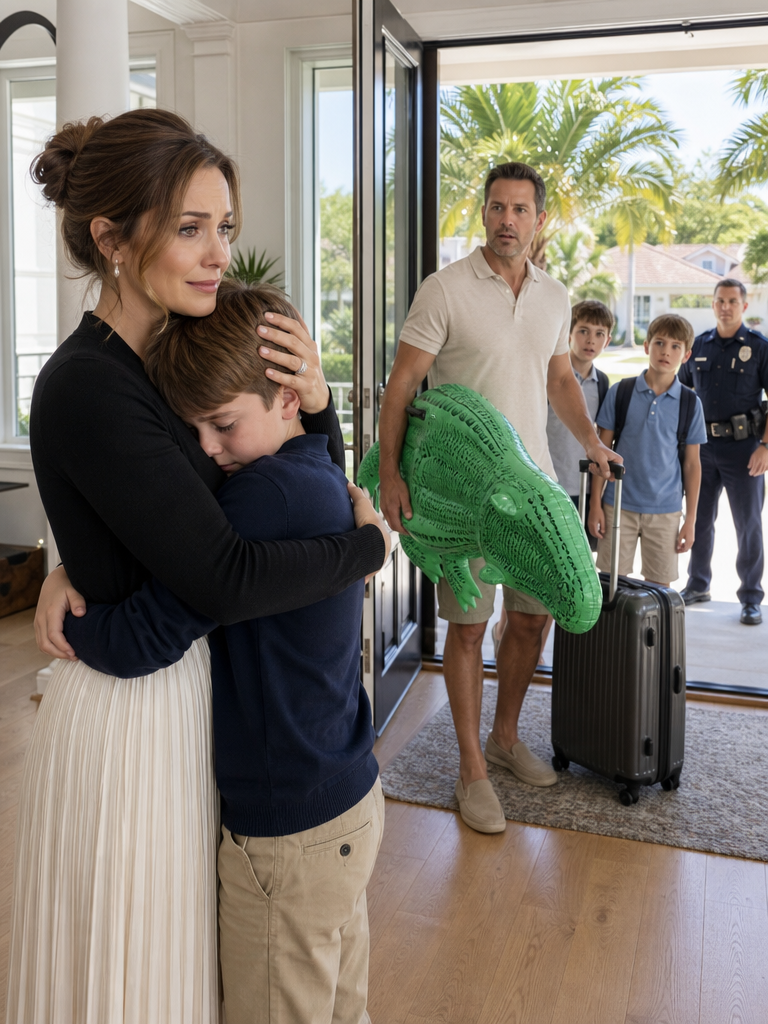
Grant came home carrying two suitcases, a beach bag, and an enormous inflatable dolphin.
Hudson and Avery entered first, excitedly talking about the ocean.
I did not involve them.
They were children too.
After they went upstairs, I placed the papers on the kitchen table.
Grant looked at me.
“Why are you home already?”
I ignored the question.
“Who stayed with Theo for the six days you were gone?”
Grant’s face changed.
“The neighbor was checking on him.”
“The neighbor has been visiting her sister in Arizona for two weeks.”
He looked away.
“Well, Deborah could have stopped by.”
“You told Deborah that Theo went with you.”
Silence.
Then he sighed.
“Claire, you’re making this sound worse than it was.”
“My eight-year-old son was alone for six days.”
“He had food.”
“It ran out.”
“He had money.”
“He’s eight.”
Grant rubbed his forehead.
“Theo is mature for his age.”
I stared at him.
“Do you understand why he is mature for his age? Because he has spent years learning how not to inconvenience you.”
Grant rolled his eyes.
“That is ridiculous.”
Then I showed him the canceled reservation.
His expression hardened.
“Plans changed.”
“You removed Theo from the trip two days after I left.”
“I wanted some time with Hudson and Avery.”
“Theo was supposed to be part of the family.”
Grant became frustrated.
And then he said the sentence that finally made everything clear.
“I wanted some time alone with my real kids.”
The room became completely silent.
“Your real kids?”
He immediately realized what he had said.
“You know what I mean.”
“Yes,” I said quietly. “I finally do.”
The Children Heard the Truth
A voice came from behind us.
“Dad?”
Hudson stood near the kitchen doorway.
Avery was behind him.
Hudson looked at the reservation.
“You said Theo didn’t want to come.”
Grant turned toward him.
“This is adult business.”
Avery looked confused.
“You told us Theo wanted to stay with Aunt Deborah.”
I shook my head.
“Theo never knew you were going to Hilton Head.”
Avery’s face fell.
She had collected seashells for him.
Hudson stared at his father.
“So you lied to us too?”
Grant became defensive.
“Enough. I made a mistake. Everyone is fine.”
But that was the problem.
Grant still believed the outcome excused the decision.
I looked at him and finally understood that I was not ending my marriage because of one terrible week.
That week had simply exposed five years of smaller choices I had spent too much time explaining away.
“I need you to stay somewhere else tonight,” I said.
Grant laughed nervously.
“You’re ending five years of marriage because of six days?”
“No. The six days just helped me understand the five years.”
The Question Grant Could Not Answer
A week later, Grant asked to apologize to Theo.
I allowed the meeting only because Theo agreed and Deborah remained with us.
Hudson and Avery came too.
Avery placed a bag of seashells in front of Theo.
“These were supposed to be for you.”
Theo picked up one shell.
“Thanks.”
Then Avery said, “Dad told us you didn’t want to go.”
Theo looked puzzled.
“Go where?”
Nobody moved.
Grant finally spoke.
“Theo, I made a terrible decision. I thought you would be okay because you’re responsible.”
Theo studied him for several seconds.
Then my eight-year-old asked the simplest question anyone had asked.
“Then why didn’t you leave Hudson home too?”
Grant had no answer.
He looked down.
Eventually he whispered, “Because I treated you unfairly.”
Theo nodded once.
“Okay.”
That quiet response hurt more than anger would have.
Because Theo was not shocked.
Some part of him had already known.
Forgiveness Did Not Mean Going Back
I filed for divorce soon afterward.
Grant apologized repeatedly.
Sometimes he sounded sincere.
Sometimes he sounded angry.
Sometimes he wanted me to explain to other people that Theo had food, money, Wi-Fi, and a phone.
I always answered the same way.
“I will tell them everything. Including that he was eight years old, that you created different stories to keep adults from checking on him, and that you declined his calls.”
Eventually, Theo and I moved into a smaller house close to his school.
There was nothing luxurious about it.
But on our first night there, Theo walked from room to room with excitement.
He stopped in the bathroom.
“Mom! There’s a window.”
“I can see that.”
“Do you know what this means?”
“Natural light?”
He looked horrified.
“No. I can check if it’s raining while I’m taking a shower.”
I laughed harder than I had laughed in months.
And in that moment, I realized something important.
My son was becoming a child again.
The Bench Outside the Grocery Store
Several months later, Theo asked to return to the grocery store where Denise had found him.
He brought her a box of chocolates.
When she recognized him, she hugged him tightly.
Outside, Theo noticed the same bench.
Someone had painted it blue.
He sat down.
I sat beside him.
For months, I had thought of that bench as proof that I had failed my son.
While he had been sitting there frightened and alone, I had been hundreds of miles away.
But slowly, I began to see the bench differently.
It was also the place where Theo finally stopped pretending he could handle everything by himself.
And where a stranger decided that a quiet child deserved to be noticed.
Theo looked at me.
“Mom, do you think Grant is a bad person?”
I thought carefully.
“I think Grant made a very bad choice.”
“That isn’t what I asked.”
I smiled sadly.
“I know.”
He waited.
“People can hurt someone deeply and still regret what they did. But their regret does not automatically restore trust.”
Theo swung his legs beneath the bench.
“Did you forgive him?”
“I’m working on it.”
“Then why did you divorce him?”
I reached for his hand.
“Because forgiving someone and trusting them with your life again are two completely different things.”
He thought about that.
Then he asked one final question.
“If I ever really need you again, will you come?”
I squeezed his fingers.
“From anywhere.”
“What if you’re in another state?”
“I’ll come.”
“Another country?”
“I’ll come.”
He grinned.
“What if I’m in Antarctica?”
“Then I’ll complain about the airfare while I’m packing.”
Theo laughed.
And this time, the sound did not carry fear.
A child should never have to become unusually independent simply because the adults around him have taught him that asking for help makes him inconvenient.
The most damaging unfairness inside a family is often not loud or obvious; sometimes it appears through small exclusions repeated so often that everyone slowly begins treating them as normal.
When someone consistently gives one child less love, fewer opportunities, and weaker protection, explanations such as “that’s just how they are” can eventually become excuses that allow the pattern to continue.
Children notice differences long before adults are ready to admit those differences exist, and many of them respond not by protesting but by learning to expect less.
Real family is not determined only by biology, marriage certificates, shared homes, or matching last names; it is revealed by who shows up when someone feels afraid, lonely, confused, or forgotten.
An apology can be meaningful and forgiveness can be sincere, but neither one requires a person to return to the same relationship or place their future in hands that already proved unreliable.
Sometimes one terrible event does not destroy a relationship by itself; instead, it shines enough light on years of smaller moments that a person can finally see the complete pattern.
Protecting peace does not always mean staying quiet, keeping a family together, or avoiding uncomfortable decisions; sometimes peace begins when someone finally refuses to keep translating disrespect into excuses.
Every child deserves to know that when they say, “I need you,” the adults who love them will not first ask whether their need is convenient, important enough, or arriving at a good time.
The safest families are not the ones that never make mistakes, but the ones where every person—especially every child—knows with certainty that their voice matters, their fear will be heard, and their place at the table never has to be earned.