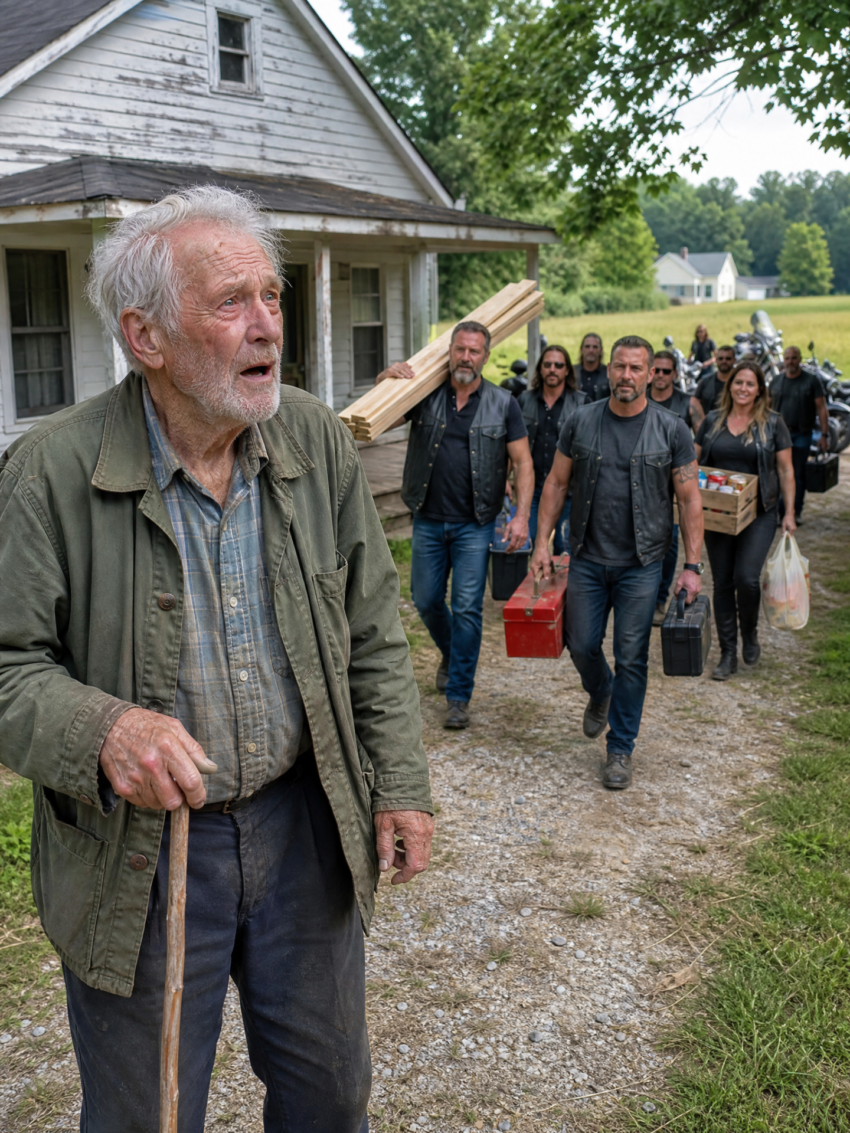
The Last Bill in His Wallet
By the end of November, the cold had settled over Fairmont, Pennsylvania, with the kind of stubbornness that made every old building feel even older.
Along Maple Avenue, wind slipped beneath apartment doors, rattled loose window frames, and pushed dry leaves against the curb. Most people hurried from one warm place to another without paying much attention to anyone they passed.
Eighty-one-year-old Everett Grady was sitting outside Dawson’s Diner when he noticed a stranger doing something unusual.
The man had been standing beside the diner window for nearly ten minutes.
He was broad-shouldered, somewhere in his early fifties, with a weathered leather motorcycle vest over a dark sweatshirt. His beard was streaked with silver, his boots were dusty, and his expression was serious enough that passing pedestrians naturally gave him space.
But Everett was not looking at his clothes.
He was watching the man’s eyes.
Every few moments, the biker glanced through the diner window at the plates being carried past the glass.
Then he looked away.
Everett recognized that look.
He had worn it himself years earlier, when his wife, Lorraine, was sick and medical expenses had swallowed nearly everything they had saved.
Everett reached into his coat pocket.
Inside his wallet was a single twenty-dollar bill.
That was all he had until his pension deposit arrived four days later.
Twenty dollars meant bread, canned soup, oatmeal, and perhaps enough milk to get him through the weekend.
Giving it away made absolutely no practical sense.
Everett stood anyway.
His knees protested as he crossed the sidewalk with his cane.
The biker noticed him immediately.
“Everything okay, sir?”
Everett pulled the folded bill from his wallet.
“I was about to ask you the same thing.”
The biker frowned.
Everett held out the money.
“Get yourself something warm to eat.”
The man stared at the bill, then at Everett.
“I appreciate it, but I can’t take your money.”
“Of course you can.”
“Sir, seriously. Keep it.”
Everett smiled.
“Son, I’ve been alive eighty-one years. You think I don’t recognize an empty stomach when I see one?”
The biker’s expression changed.
For the first time, some of the toughness disappeared from his face.
Everett placed the bill into his hand.
“Eat.”
“What about you?”
Everett shrugged.
“I’ve had lean weeks before.”
Before the stranger could object again, Everett turned and slowly walked away.
He never expected to see the man again.
He certainly never imagined that twenty-dollar bill would bring an entire street to his door.
The Man Everyone Called Rook
The biker’s real name was Garrett Danner.
His motorcycle friends called him Rook.
At fifty-three, Garrett had grown accustomed to people making decisions about him before hearing him speak. The leather vest, the motorcycles, the tattoos on his forearms, and his rough appearance often told strangers a story that had very little to do with the man he actually was.
Garrett rarely cared.
But Everett’s kindness bothered him.
Not because it offended him.
Because Garrett knew what sacrifice looked like.
The old man’s coat was carefully repaired near one cuff. His shoes were clean but worn. His cane had tape wrapped around the handle.
That twenty dollars had mattered.
Garrett walked into Dawson’s Diner and sat at the counter.
A waitress approached.
“What can I get you?”
“What’s the cheapest hot dinner?”
“Meatloaf special. Comes with potatoes and vegetables.”
Garrett nodded.
“I’ll take it.”
When the plate arrived, he stared at it.
He had barely eaten since the previous morning. An unexpected motorcycle repair had emptied what remained in his account, and he had been waiting for a friend to pick him up.
He should have finished the meal in minutes.
Instead, he thought about Everett.
Garrett looked through the window.
The old man was gone.
He pushed the plate away.
“Could you box this?”
The waitress looked surprised.
“Something wrong with it?”
“No.”
Garrett placed Everett’s twenty on the counter.
“I just realized I don’t want to eat it alone.”
Finding Apartment 3B
It took Garrett almost two hours to locate Everett.
A cashier at a nearby pharmacy remembered the elderly man. A delivery driver eventually pointed Garrett toward a faded brick apartment building three blocks from Maple Avenue.
Before going there, Garrett called one of his motorcycle club friends and borrowed a little money.
He bought groceries.
Bread. Eggs. Coffee. Apples. Soup. Pasta. Chicken. Oatmeal.
Then he added a small electric heater after noticing the temperature dropping.
When Everett opened the door of Apartment 3B, his mouth fell open.
“You.”
Garrett raised the grocery bags.
“Me.”
Everett stared at them.
“How did you find me?”
“You made the mistake of giving money to a stubborn man.”
Everett almost laughed.
“I gave you twenty dollars, not permission to investigate me.”
“Fair point.”
Garrett held up the boxed meal.
“But this belongs to both of us.”
Everett hesitated before opening the door wider.
The apartment told Garrett more than Everett ever would.
It was spotless, but nearly empty.
The refrigerator held milk, mustard, two eggs, and half a container of soup. The kitchen cupboards were similarly bare.
Near the window stood an old heater that seemed better at making noise than producing warmth.
Garrett quietly placed the groceries on the counter.
Everett watched him.
“You really didn’t need to do this.”
Garrett turned.
“You didn’t need to give me your last twenty either.”
Everett’s face became still.
“Who said it was my last?”
Garrett looked toward the empty cupboards.
He did not answer.
He did not need to.
Dinner for Two Strangers
They divided the meatloaf dinner between them.
As they ate, Garrett learned that Everett had spent thirty-four years repairing industrial equipment. Lorraine, his wife, had taught elementary school.
They had been married for fifty-four years.
She had been gone for three.
“This place feels different without her,” Everett admitted.
Garrett understood that kind of absence.
His own father had passed away years earlier after a long period of distance between them.
Garrett had always believed there would be time to repair their relationship.
There had not been.
That regret had followed him ever since.
As Everett spoke, Garrett noticed the curtain moving.
Cold air was coming through the window.
“That always happen?”
Everett followed his gaze.
“Building has character.”
“That’s not character. That’s a hole.”
Everett chuckled.Garrett pulled out his phone.
“What are you doing?”
“Calling somebody.”
Everett pointed at him.
“Don’t.”
Garrett was already dialing.
“Bring the toolbox,” he told the person who answered. “And whatever weather sealing you’ve got.”
Everett stared at him.
“Garrett.”
“Yes?”
“I said don’t.”
“I heard you.”
“And?”
Garrett smiled slightly.
“I’m terrible at following instructions.”
The Sound of Motorcycles
Forty minutes later, Everett heard engines outside.
Not one.
Several.
He walked to the window.
Six motorcycles were pulling up along the curb.
“What have you done?”
Garrett looked outside.
“Called some friends.”
The first person upstairs was a woman named Taryn Bell, carrying groceries in one hand and a toolbox in the other.
Behind her came Malcolm “Bear” Raines, a huge man with a shaved head carrying a new space heater.
Three others followed with supplies.
Everett stared at them.
“Is my apartment becoming a motorcycle repair shop?”
Taryn smiled.
“Only temporarily, Mr. Grady.”
Nobody treated Everett like a charity project.
That was important.
They simply worked.
Bear replaced the failing heater.
Taryn sealed the windows.
Another club member repaired a cabinet hinge and checked the dripping kitchen faucet.
Someone else filled Everett’s pantry.
Within an hour, the apartment was warmer than it had been all winter.
Everett sat quietly watching them.
Eventually, he looked at Garrett.
“Why?”
Garrett stopped working.
“Why what?”
“Why would all these people come here for someone they’ve never met?”
Garrett considered his answer.
“Because I told them an eighty-one-year-old man gave away his last twenty dollars to someone he thought was hungry.”
Everett lowered his eyes.
“It was only twenty dollars.”
Garrett shook his head.
“No. Twenty dollars is small when you have five hundred.”
He looked directly at Everett.
“When twenty is everything you have, giving it away is something else entirely.”
Everett said nothing.
His eyes had become wet.
The Truth Behind the Empty Cupboards
Garrett started visiting regularly.
Sometimes he brought coffee.
Sometimes chili.
Sometimes nothing at all.
Over the following weeks, Everett gradually explained why money had become so tight.
His only child, Melissa, had started helping with his finances after Lorraine passed away.
At first, Everett appreciated it.
Bills confused him more than they once had, and online banking frustrated him.
Melissa offered to handle everything.
Then Everett noticed his pension disappearing unusually fast.
She always had an explanation.
Insurance.
Utilities.
Unexpected fees.
Property expenses.
Everett trusted her because she was his daughter.
Then Taryn examined several bank statements.
“Everett, do you recognize these transfers?”
He adjusted his glasses.
Three transfers appeared every month.
He shook his head.
“No.”
Taryn showed Garrett.
The amounts were not enormous individually, but together they represented hundreds of dollars each month.
They traced the payments to an account connected to Melissa’s husband.
Everett looked devastated.
“There must be some explanation.”
Garrett wanted to be angry.
Instead, he sat beside him.
“Then we’ll find the explanation.”
They contacted an elder-law attorney.
What they discovered was worse than expected.
Melissa had also contacted a senior housing facility and discussed moving Everett there. Meanwhile, the owner of Everett’s apartment building had been encouraging older tenants to leave before planned renovations.
Garrett realized Everett was being pressured from two directions.
His daughter was controlling his money.
His landlord wanted his apartment.
And Everett had been too proud to tell anyone he was struggling.
That ended now.
When Melissa Walked Through the Door
Melissa arrived one Tuesday afternoon.
She walked into Apartment 3B and immediately stopped when she saw Garrett and Taryn.
“Dad, who are these people?”
Everett remained seated at the kitchen table.
“Friends.”
Melissa laughed without humor.
“Friends? You barely know them.”
Garrett remained silent.
Everett placed several documents on the table.
“Sit down, Melissa.”
Her face changed.
“What is this?”
“You tell me.”
He pushed the bank statements toward her.
Melissa barely looked at them.
“I handled your expenses. You know that.”
“I know what my expenses are now.”
She crossed her arms.
“Dad, you’re getting confused.”
Everett looked up slowly.
Something hardened inside him.
“Do not use my age to explain your choices.”
Melissa stared at him.
“These strangers are manipulating you.”
Everett shook his head.
“No.”
His voice remained remarkably calm.
“These strangers brought groceries when my cupboards were empty.”Melissa looked away.
Everett continued.
“They repaired my window when I was sleeping in my coat because the apartment was too cold.”
Her expression tightened.
“That’s not fair.”
“Neither was taking money I trusted you to protect.”
Silence filled the apartment.
Melissa grabbed her purse.
Before leaving, she turned toward Garrett.
“Stay out of our family.”
Everett answered before Garrett could.
“He became part of my life because he showed up when I needed someone.”
Melissa looked at her father.
Everett’s final words came softly.
“Being related to someone doesn’t give you permission to stop respecting them.”
Then she left.
Everett Took His Life Back
The following months were difficult, but Everett was no longer facing them alone.
His attorney stopped unauthorized transfers and helped restructure his finances.
The attempted housing move was canceled.
The landlord’s pressure against Everett and several other older tenants was challenged.
Once neighbors realized someone was finally listening, more people came forward.
Their stories were remarkably similar.
Unexpected fees.
Pressure to relocate.
Repairs that never happened.
Notices written to frighten tenants who did not understand their rights.
What began inside Everett’s tiny apartment became a larger community effort.
Dawson’s Diner joined first.
The owner, Patrick Dawson, created a weekly event called the Twenty-Dollar Table. A portion of every dinner sold on Wednesday evenings went toward groceries and heating assistance for older residents.
The first event filled the diner.
Then people stood outside waiting for tables.
Church groups participated.
Local contractors volunteered repairs.
Teenagers delivered groceries.
Garrett’s motorcycle club organized transportation for seniors who needed help getting to appointments or grocery stores.
Everett watched all of it with disbelief.
“This is ridiculous,” he told Garrett one evening.
“What is?”
Everett gestured toward the crowded diner.
“All of this started because I handed you twenty dollars.”
Garrett shook his head.
“No.”
Everett looked at him.
“It started because you noticed somebody everybody else walked past.”
Grady’s Kitchen
By spring, the community had raised enough money to renovate an unused building behind Dawson’s Diner.
It became a small community kitchen.
Anyone struggling could come for a hot meal.
Nobody needed to prove they were poor enough.
Nobody filled out embarrassing paperwork.
Nobody was questioned about how they had reached that point.
They simply walked in.
Naturally, the volunteers named it Grady’s Kitchen.
Everett objected immediately.
“Absolutely not.”
Taryn laughed.
“Too late. The sign is already being made.”
“Put Garrett’s name on it.”
Garrett shook his head.
“I’ll burn the sign.”
Eventually Everett surrendered.
Twice each week, he sat near the entrance greeting visitors.
He especially watched for the ones who hesitated at the doorway.
He understood hesitation.
Pride could keep a hungry person standing outside longer than hunger could.
Whenever someone claimed they were not really in need, Everett would smile.
“Sit down. Have coffee first. We can argue about whether you deserve dinner afterward.”
Almost nobody argued.
Back on Maple Avenue
Nearly a year after Everett first met Garrett, the two men returned to the same bench outside Dawson’s Diner.
Garrett brought two coffees.
Everett accepted his without thanking him.
By then, that was how they behaved.
Across the street, volunteers were loading food boxes into vehicles.
Garrett watched them.
“You know something?”
“Occasionally.”
Garrett smiled.
“I spent most of my life thinking family was mostly about blood.”
Everett took a sip of coffee.
“And now?”
Garrett looked toward Grady’s Kitchen.
“Now I think family might be the people who keep showing up.”
Everett nodded.
“Took you fifty-three years to figure that out?”
“Apparently.”
“Slow learner.”
Garrett laughed.
Everett reached inside his coat.
When Garrett saw the folded twenty-dollar bill, he immediately groaned.
“No.”
Everett smiled.
“I haven’t even done anything yet.”
“I know you.”
Everett slipped the bill beneath the edge of a small community breakfast jar outside the diner.
“For whoever needs it next.”
Garrett shook his head.
“We spent months getting your finances protected, and you’re already giving money away again.”
Everett looked toward the people entering the community kitchen.
“There’s a difference now.”
“What difference?”
Everett smiled.
“Last time I thought I was losing twenty dollars.”
He rested both hands on his cane.
“Now I know how far twenty dollars can travel.”
Garrett looked at his friend and said nothing.
Sometimes silence was the best answer.
Because one cold afternoon, an elderly man with almost nothing had noticed a hungry stranger and refused to look away.
The money had purchased one dinner.
But the kindness behind it had done something money alone never could.
It had reminded two lonely men that neither of them had to remain alone.
The true value of generosity is not measured by how much a person gives, but by how much that gift means when the giver has very little left for themselves.
We often pass people whose hardest battles are completely invisible, which is why a small moment of attention can sometimes become more meaningful than any grand gesture.
Growing older should never mean losing the right to dignity, independence, respect, or a voice in the decisions that shape the rest of your life.
Family is more than a shared last name, because genuine family is revealed through honesty, protection, presence, and the willingness to stand beside someone when life becomes difficult.
The people we judge by appearance may possess the gentlest hearts, while the people we trust automatically may not always deserve the access we have given them.
Betrayal can make a person question years of memories, but discovering the truth can also become the beginning of rebuilding a life with stronger boundaries and healthier relationships.
Accepting help does not erase independence, because sometimes allowing another person to care for us is exactly what gives us enough strength to stand on our own again.
Strong communities are created when ordinary people stop asking whether someone else’s hardship is their responsibility and start asking what small thing they can do today.
A painful regret from the past does not have to remain useless, because it can become the reason we notice another person’s loneliness and choose to show up while there is still time.
Never underestimate a warm meal, an open door, a repaired window, a patient conversation, or twenty dollars offered with compassion, because the smallest acts of kindness can travel farther than anyone could ever predict.