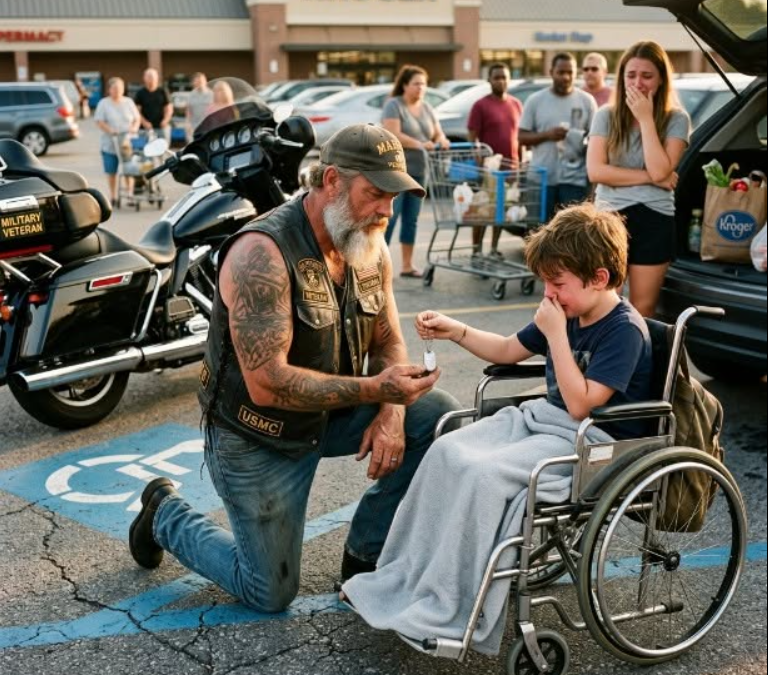
Massive Biker Parked Beside a Disabled Boy at Walmart and Everyone Expected Trouble—But They Didn’t Know the Silver Dog Tag in the Child’s Hand Carried a Twelve-Year-Old Promise the Biker Had Never Forgiven Himself for Breaking.
Everyone in the Walmart parking lot saw a massive biker kneel beside a disabled boy and expected the worst.
Then the child raised a scratched Marine dog tag, and the biker’s face changed as if twelve years of grief had suddenly found him.
By sunset, the biker’s entire club would gather outside a struggling mother’s home—not to frighten her, but to finish the mission one fallen Marine had left behind.
The Walmart parking lot in Boise, Idaho, was loud in the ordinary way most parking lots are.
Shopping carts rattled over cracked pavement. Engines hummed as drivers circled for spaces that were never quite close enough to the entrance. Parents called after children who drifted too near the traffic lanes. Someone’s car alarm chirped twice and gave up.
Nobody expected anything memorable to happen there that afternoon.
Parking lots were places people passed through.
That was all.
Then my motorcycle arrived.
The sound came first, deep and heavy, rolling between the rows of parked cars like thunder that had decided to stay close to the ground. Heads turned automatically. A toddler pointed. A teenage boy lifted his phone. A woman in a minivan locked her doors with one quick click, then pretended she had done it for no reason.
I moved through the lot slowly, not weaving, not showing off, not revving for attention. I never had to. The bike announced enough for both of us.
It was black, old, and heavy enough to make the pavement tremble beneath it. Dust from the highway clung to the chrome. A small American flag was fixed near the back. On the left saddlebag was a faded patch that read IRON SENTINELS MC.
I parked beside a faded blue handicap marking and shut off the engine.
The last vibration faded beneath me.
For a few seconds, I sat there with both boots planted on the asphalt and my hands resting on the grips.
I had stopped for oil, water, and a pack of batteries.
That was all.
I needed to get back to my garage outside Nampa, where a transmission waited on the lift and three members of my club were pretending they knew how to repair it without me.
Then I felt someone watching me.
People looked at me all the time. Some were curious. Some were afraid. Some were judgmental. Others seemed almost disappointed when I didn’t behave like the villain they had already invented.
This felt different.
Certain.
Steady.
I turned.
A boy sat near the blue-painted space in a small electric wheelchair.
He looked about nine years old. He was thin and pale, with a gray blanket covering his legs despite the warm afternoon. His hands rested on the chair’s arm supports, fingers curled tightly. A backpack hung from the rear handles. One wheel casing had been repaired with silver tape, and the joystick looked worn smooth from use.
The boy wasn’t staring at my motorcycle.
He was staring at me.
Several steps away, a woman loaded groceries into an old silver sedan. She had one hand braced against the trunk and the other sorting bags so the bread would not be crushed. Her hair was pulled into a loose knot. Her jeans were faded. A small coffee stain marked the bottom of her shirt.
She looked tired in the way single mothers often look tired—not sleepy, but stretched thin by too many calculations.
She didn’t notice her son turning away from her.
The boy lifted one hand.
Something silver dangled from his fingers.
I looked at it.
And the entire parking lot seemed to narrow.
A dog tag.
Old.
Scratched.
Dulled by years of being touched.
One corner was nicked, and the rubber silencer around the chain had cracked with age.
My first thought was impossible.
My second was no.
My third was Daniel.
I stepped forward before I realized I had moved.
The boy’s hand trembled, but he didn’t lower the tag.
People nearby slowed. A woman halfway into her car paused with a grocery bag in her hand. A teenager lowered his phone but kept recording. A man beside the cart return stopped and stared.
I didn’t see them.
I saw only the silver tag.
I lowered myself to one knee on the pavement.
THE NEXT PART CONTINUES BELOW 👇 Switch from “Most Relevant” to “All Comments” so you don’t miss the rest of the story.
PART2:
For a man my size, it wasn’t graceful. My knees complained, my vest creaked, and the asphalt cut through my jeans. But I needed to be eye level with the boy.
The tag swung between us.
My voice came out rough.
“Where did you get that?”
The boy clutched it tighter.
Tears slid down his cheeks, but he didn’t look away.
“Mom said you’d recognize it.”
My chest went cold.
“What’s your name, kid?”
“Logan.”
“Logan what?”
He swallowed.
“Logan Carter.”
The name hit me like a door opening inside a house I had spent twelve years trying to burn down.
For one violent second, I wasn’t kneeling outside a Walmart in Boise.
I was back in the desert, crouched behind the burned shell of a convoy truck while rounds snapped through sand and metal. My mouth tasted like dust and blood. My left ear rang so badly the world had become half silent.
Daniel Carter was beside me, one hand pressed against his side, the other gripping the front of my vest.
“If the sand takes me,” he had rasped, “you find what’s mine.”
“Shut up,” I told him. “You’re not dying.”
Daniel smiled through bloody teeth.
“You guard the perimeter.”
“Daniel—”
“Promise me.”
I had promised.
Then Daniel had died anyway.
Now his dog tag hung from the trembling hand of a child in a Walmart parking lot.
I blinked hard.
“What did you say?”
The boy stared at me.
“You promised him you’d find me.”
Type “yes” and tap “Like” to unlock the next part and full ending below. Hope you enjoy the ST0RY 👇🏻
PART3:
Before I could answer, a woman’s voice cut across the parking lot.
“Logan!”
The mother slammed the trunk shut and ran toward us.
When I looked up and saw her face, my heart nearly stopped.
Emily Carter.
Twelve years older.
Thinner.
Harder around the eyes.
Still carrying the same grief I had once watched destroy her on a porch in Ohio when I stood in front of her wearing dress blues, holding a folded flag in my hands and Daniel’s dog tag in my pocket.
She reached the wheelchair and grabbed both handles, pulling Logan backward instinctively.
“Griff?” she breathed.
My name in her voice sounded like a ghost learning to speak.
I stood slowly.
The parking lot watched.
“Emily.”
For several seconds, neither of us moved.
The years between us were not empty.
They were packed full of everything that had never been said.
Daniel’s funeral.
The folded flag.
The dog tag.
The promise.
The months afterward when I had called once, then twice, then stopped because her house phone had been disconnected and my own mind had started folding inward under the weight of what I had carried home from war.
Emily’s eyes moved over me.
The vest.
The beard.
The bike.
The scar through my eyebrow.
The enormous man I had become and the broken one she remembered standing on her porch.
“I didn’t know,” I said.
My voice cracked on the last word.
Her hand tightened around Logan’s wheelchair.
“Didn’t know what?”
I looked at the boy.
“That Daniel had a son.”
Emily flinched.
“He didn’t know either.”
The words were quiet, but they hit harder than shouting.
I stared at her.
“I found out two weeks after the funeral,” she continued. “I was sick all the time. I thought it was grief. Then the doctor told me I was pregnant.”
The parking lot noise seemed too loud now. Too ordinary for a truth like that.
“Why didn’t you tell me?”
Her expression tightened.
“I tried.”
I looked at her.
“Your number changed. Your unit said you were out. Somebody told me you’d gone west. Somebody else said you didn’t want to be found.”
That last one was true.
After Daniel died, I had come home carrying too many ghosts. I lasted six months in uniform before breaking in ways the paperwork called adjustment difficulties and the men around me called nothing because men at war learn silence before healing.
I bought the motorcycle with money I should have spent on therapy.
Then I rode.
Nevada.
Arizona.
Montana.
Texas.
Road after road.
Cheap motels.
Fistfights I barely remembered.
Garages that paid cash.
Veterans who understood without asking questions.
Eventually, the Iron Sentinels found me—or I found them, depending on which version sounded less pathetic. They were mostly former military men, mechanics, widowers, truckers, and misfits who believed road wind could sand down grief if you stayed moving long enough.
It helped.
Not enough.
Nothing ever did.
“I failed you,” I said.
Emily looked away.
Logan spoke quietly.
“Mom said you were lost too.”
I looked down at him.
His face was too serious for nine.
Children who spend too much time in hospitals learn to read adults like weather.
“She said soldiers sometimes come home, but part of them keeps fighting.”
I could not speak.
Emily wiped quickly beneath one eye.
“Logan, honey, we should go.”
“No,” he said.
She blinked.
“Logan.”
“No, Mom. We found him.”
I looked at Emily.
“You were looking for me?”
Logan nodded.
“I asked about the name on the picture.”
“What picture?”
Emily’s face softened despite the pain.
“He has one of Daniel with you. From deployment. You both look ridiculous.”
A broken sound escaped me.
It might have been a laugh.
Daniel had always looked ridiculous on purpose.
“He said if I ever saw the man with the big beard and scary eyes, I should show him the tag,” Logan said.
Emily gave me a sad smile.
“I may have described you more dramatically than necessary.”
“No,” Logan said. “It worked.”
I knelt again.
“Logan, I’m sorry.”
The boy frowned.
“For what?”
“For not finding you sooner.”
He thought about that.
“Did you stop looking?”
I closed my eyes.
The truthful answer hurt.
“Yes.”
Emily inhaled sharply.
I opened my eyes and looked directly at him.
“I did. I stopped because I was hurting, and because I was a coward about that hurt. That doesn’t mean I stopped loving your dad. It means I failed the mission.”
Logan looked down at the dog tag.
Then back at me.
“Can you start again?”
The question was so simple it nearly knocked me backward.
Can you start again?
Not, Can you fix everything?
Not, Why weren’t you there?
Not, Can you bring my father back?
Just start again.
I nodded once.
“Yes.”
Emily whispered my name.
I stood.
“No more moving alone,” I said. “No more broken chair held together with tape. No more pretending everything’s fine in a Walmart parking lot while your eyes look like you haven’t slept in five years.”
Her pride flared.
“You don’t get to show up after twelve years and judge how I survived.”
The words struck clean.
I accepted them.
“You’re right.”
That seemed to surprise her.
“I’m not judging,” I continued. “I’m asking permission to help.”
Emily looked toward the old sedan.
The groceries.
The wheelchair.
The curious strangers pretending not to stare.
Then she looked at Logan, whose eyes had never left me.
“You can’t just fix us,” she said.
“No.”
“You can’t ride in with a motorcycle club and make twelve years disappear.”
“No.”
“You can’t replace Daniel.”
My voice broke.
“I would never try.”
The anger in her face cracked.
For a moment, she looked exactly as she had on that Ohio porch—young, shattered, holding a folded flag like it was the last piece of gravity in the world.
I touched the dog tag and then gently looped it back around Logan’s neck.
The metal rested against his shirt.
“I can keep the promise from here,” I said.
Logan reached out and placed his small fingers against the rough leather of my vest.
“You came back,” he whispered.
I leaned forward until my forehead touched his.
“The perimeter is secure, kiddo,” I whispered. “I’m home.”
That was when Emily broke.
Not loudly.
Not dramatically.
She covered her mouth with one hand, turned away, and cried like someone who had spent a decade holding up a roof with her shoulders and had finally heard another beam slide into place.
I didn’t touch her.
Not yet.
I simply stood nearby, guarding the moment from the parking lot.
The teenager who had been filming lowered his phone.
The woman with the grocery bag wiped under one eye.
A man by the cart return pretended to check his receipt.
Life, embarrassed by its own tenderness, began moving again.
I helped Emily load the last bags into the trunk. I noticed details because men trained to survive notice details even while grieving.
The rear tire was low.
One taillight was cracked.
The trunk latch had been repaired with wire.
The wheelchair ramp folded into the back seat manually, and it was far too heavy for Emily’s thin arms.
When she lifted it, she winced.
I stepped forward.
“Let me.”
“I can do it.”
“I know.”
That made her pause.
I lifted the ramp carefully without making a show of how easy it was for me. Emily helped Logan transfer into the car with practiced movements built from necessity and exhaustion.
I watched the wheelchair.
“Battery holding charge?”
“Mostly.”
“That means no.”
“It means mostly.”
“The controller is worn.”
“Insurance denied the replacement twice.”
“Chair supplier?”
“Don’t start.”
“I haven’t started.”
“You have the face of a man starting.”
Logan smiled from the back seat.
“He does.”
I pointed at him.
“You stay out of this, Carter.”
The boy’s smile grew.
Carter.
He liked hearing it from me.
Emily closed the car door.
“I don’t even know where to begin.”
I looked at the old sedan, then at the boy, then at the dog tag.
“Dinner.”
She blinked.
“What?”
“You, Logan, and me. Somewhere with actual food. Public place. Your choice. We talk. You decide what help looks like. Nothing happens without your say.”
Her suspicion softened slightly.
“Dinner?”
“I know. Radical concept.”
Logan looked up at his mother.
“Can we?”
Emily hesitated.
“I have groceries.”
“Good,” I said. “They’ll still be groceries in two hours.”
Despite herself, she almost smiled.
“Fine. But I’m driving my car.”
“I’d be worried if you tried to put Logan on the bike.”
Logan’s eyes lit up.
“Could I ride someday?”
Emily and I answered together.
“No.”
For the first time that day, Logan laughed.
It was not a small laugh.
It was bright, startled, almost rusty from underuse.
I felt it hit somewhere behind my ribs.
Daniel had laughed like that once.
Not the same.
Never the same.
But close enough to hurt and heal at once.
We met at a diner two blocks away.
I chose a corner booth where Logan’s wheelchair fit comfortably at the end and Emily could see the door, because I recognized the habit in her.
She sat with her back to the wall.
So did I.
Old grief and old training had similar furniture preferences.
The waitress looked at me, then Emily, then Logan.
“You folks need a minute?”
“Yes,” Emily said.
“No,” Logan said. “I know what I want.”
Emily gave him a look.
He looked innocent.
I leaned forward.
“What are you getting?”
“Pancakes.”
“It’s four in the afternoon.”
“So?”
I nodded solemnly.
“Strong argument.”
Emily shook her head, but her mouth twitched.
We ordered pancakes for Logan, coffee for Emily, coffee for me, and food because I announced that no serious conversation should happen without fries.
For a few minutes, we spoke only about ordinary things.
Logan’s school.
Emily’s work processing medical billing claims from home.
The fact that I owned a garage called Sentinel Custom & Repair.
The fact that I had three dogs, none of whom understood personal space.
The fact that Logan loved space documentaries, hated peas, and could identify motorcycles by sound better than most adults.
“Harley,” he said when one rumbled past the window.
I listened.
“Make?”
Logan tilted his head.
“Older Softail?”
I stared at him.
Emily smiled into her coffee.
“He watches videos.”
“That’s not watching videos,” I said. “That’s diagnosis.”
Logan sat straighter.
“You build bikes?”
“Sometimes.”
“Could you build one with hand controls?”
Emily’s face changed.
“Logan.”
“What? I’m asking.”
I looked at the boy carefully.
“I could.”
His eyes widened.
“Really?”
“Could and should are not always the same animal. But yes, machines can be adapted.”
Logan looked down at his hands.
“I like machines because they don’t feel sorry for you.”
Emily went still.
I understood that sentence better than I wanted to.
“No,” I said softly. “They don’t.”
The pancakes arrived.
Logan ate like a child trying not to look too hungry.
Emily noticed me noticing and looked ashamed.
I hated that.
“You said Daniel didn’t know,” I said quietly.
Emily wrapped both hands around her coffee.
“He left for deployment. We were trying to have a baby, but it had been hard. I thought it hadn’t happened again. Then the notification came. Then the funeral. Then two weeks later, I got sick in the grocery store and found out Logan was there.”
Logan was focused on his pancakes, but I suspected he was listening.
“Daniel would have lost his mind,” I said.
Emily smiled through pain.
“He wanted to be a dad so badly.”
“He talked about it all the time.”
“He did?”
“All the time. He drove us crazy. Said he was going to teach his kid to throw a baseball, change oil, read maps, and never trust a man who wore dress shoes with jeans.”
Logan looked up.
“Why?”
“Because your father was opinionated.”
Emily laughed softly.
“He was.”
I looked at the dog tag.
“The last night, he said, ‘Find what’s mine.’ I thought he meant you. The house. His parents’ graves. The things he already had.”
Emily’s eyes filled.
“He meant Logan too. He just didn’t know it yet.”
I nodded.
“I should have kept looking.”
“Yes,” she said.
The truth sat between us.
Then she added, “But I should have asked for help sooner.”
“You were trying.”
“I was drowning.”
I looked at Logan’s chair.
“What does he need?”
Emily immediately straightened.
“Griff—”
“What does he need, Em? Not what insurance approves. Not what you can stretch until next month. What does he need?”
She looked down.
The list lived inside her. Mothers of medically complex children carried lists the way soldiers carried maps.
“New chair battery,” she said finally. “Controller replacement. Seat cushion because he’s getting pressure sores. A ramp that doesn’t destroy my back. Physical therapy we had to cut down. A van would help, but that’s not realistic.”
“What else?”
She swallowed.
“A specialist in Seattle thinks there’s a procedure that could reduce his pain and slow some complications. Insurance calls it nonessential.”
Logan’s fork slowed.
I saw it.
“How much?”
Emily gave me a look.
“Too much.”
“That’s not a number.”
“It’s not your burden.”
“No,” I said. “It’s my mission.”
Her eyes flashed.
“We are not a mission.”
I nodded.
“Fair. Bad word.”
I leaned back.
“Then call it family.”
Emily looked away.
That word was worse.
Not because it was wrong.
Because it was true enough to be dangerous.
After dinner, I did not offer money.
Not yet.
I had learned enough from broken men and proud widows to know that help offered too quickly could feel like being shoved. Instead, I asked for her number, gave her mine, and wrote down the garage address.
“No pressure,” I said.
Emily took the card.
“You always say that right before becoming pressure?”
“Yes.”
Logan laughed.
Before they left, I knelt beside him in the parking lot.
“Can I see it one more time?”
Logan lifted the dog tag.
I touched it with two fingers.
“Your dad was the best man I knew.”
“Better than you?”
I smiled sadly.
“Way better.”
“Mom says he was stubborn.”
“Also way better at that.”
“Did he save your life?”
I looked at Emily, then back at Logan.
“More than once.”
“How?”
“Some stories need garage chairs and root beer.”
Logan’s eyes lit.
“So I can come to your garage?”
“If your mom says yes.”
He looked at Emily.
Emily sighed.
“We’ll see.”
I nodded.
“That’s mom language for maybe.”
Logan whispered, “Good.”
They drove away in the old sedan.
I stood beside my motorcycle and watched until the taillights disappeared into traffic.
Then I took out my phone.
The first call went to Elias Boone, president of the Iron Sentinels.
He answered on the third ring.
“If this is about the transmission, we made it worse.”
“I found Daniel Carter’s son,” I said.
Silence.
The kind that changes men.
Then Elias said, “Where are you?”
“Boise.”
“Is the kid safe?”
“Not safe enough.”
Another silence.
Then his voice hardened into purpose.
“Perimeter?”
I looked down the road where Emily and Logan had gone.
“Not secure.”
“Send the address.”
By the next evening, fourteen motorcycles rolled into the lot outside Sentinel Custom & Repair.
They came from Boise, Nampa, Meridian, Caldwell, Twin Falls, and one from farther north ridden by a man everyone called Preacher because he had once been a chaplain and still possessed the unsettling ability to make men tell the truth.
The Iron Sentinels were not an outlaw club.
We weren’t saints either.
We were veterans, mechanics, truckers, welders, former cops, former medics, widowers, divorced fathers, grandfathers, and men who had made enough mistakes to develop strong opinions about second chances.
Our vests scared people who judged too quickly.
Our yearly charity ride paid for prosthetics, ramps, therapy dogs, medical transport, and funeral expenses for veterans’ families who learned how expensive sacrifice could become after the flags were folded.
Daniel’s picture hung inside my garage.
It wasn’t large or shrine-like.
It was simply framed above the tool board: Daniel in desert cammies, sunburned, grinning, one arm around my neck like he was trying to choke me affectionately.
The men gathered beneath it.
I told the story once.
No embellishment.
Walmart.
Dog tag.
Logan.
Wheelchair.
Emily.
The promise.
When I finished, nobody spoke for a long time.
Elias stood at the center of the garage, white beard braided, hands resting on his belt.
“He had a son,” he said.
I nodded.
“A boy in a broken chair holding his tag.”
Preacher removed his glasses and rubbed them with a cloth.
“Lord have mercy.”
Tank, the club treasurer, a massive man with accountant glasses and a tattoo of a bulldog wearing a helmet, opened a notebook.
“What do they need?”
I handed him the list Emily had reluctantly texted after I promised not to do anything without asking.
Tank read silently.
His face changed.
“Insurance denied the Seattle consult twice?”
“Yes.”
“Bastards.”
“Language,” Preacher said automatically.
Tank looked at him.
“Accurate language.”
Preacher considered.
“Proceed.”
A younger rider named Jax leaned against the workbench.
“We doing a fundraiser?”
Elias looked at Daniel’s photograph.
“We’re doing more than that.”
I said, “Careful. Emily’s proud.”
“Good,” Elias replied. “Pride keeps people alive when help doesn’t come. We’re not taking it from her.”
Tank nodded.
“We build around it.”
That became the rule.
Build around Emily’s dignity.
Not over it.
Not through it.
Around it.
The next morning, I called Emily.
She didn’t answer.
I waited two hours and called again.
She texted: Working.
I replied: Understood. Can Logan visit the garage Saturday? No ambush. Just bikes and dogs.
Three dots appeared.
Disappeared.
Appeared again.
Emily: Are your dogs friendly?
Me: Too friendly. One lacks emotional boundaries.
Emily: That sounds like you.
I stared at the phone.
Then laughed so loudly one of the dogs barked.
Saturday came with bright sun and a wind that smelled faintly of sage.
Emily drove into the gravel lot outside Sentinel Custom & Repair at 10:03 a.m. I knew because I had been watching the road since 9:15 and pretending not to.
Logan’s face appeared in the passenger window first.
Wide eyes.
Then the chair ramp situation began.
Emily opened the rear door, braced herself, and reached for the heavy manual ramp.
I started forward.
Then stopped.
Permission.
I waited until she looked at me.
“Can I help?”
She hesitated.
Then nodded.
I lifted the ramp out and set it in place.
“Thank you,” she said.
“Anytime.”
The club had prepared carefully.
No crowd at first.
No roaring engines.
No overwhelming formation.
Just me, Elias, Preacher, and Tank standing near the garage doors while three dogs lost their minds behind a temporary gate.
Logan rolled forward, staring at everything.
The lifts.
The bikes.
The tools.
The welding bay.
The paint booth.
The smell of oil and metal.
The framed photographs.
The enormous men trying very hard not to look like they were trying hard.
Elias stepped forward first.
“You must be Logan Carter.”
Logan nodded.
“I’m Elias. Your dad once saved me from eating spoiled chicken in Kuwait.”
Logan blinked.
“That’s a story?”
“It was almost a tragedy.”
Preacher crouched slightly.
“I’m Preacher.”
“Are you a real preacher?”
“Depends who you ask.”
Tank waved.
“I’m Tank.”
Logan looked him up and down.
“That makes sense.”
Tank laughed so hard the dogs barked again.
The dogs were released one at a time.
First came Rosie, a pit mix with a white patch over one eye and the manners of a bowling ball.
Then Duke, a shepherd with a gray muzzle.
Then Beans, a short-legged mutt shaped like a loaf of bread with ambition.
Beans immediately climbed onto Logan’s footplate and sat as if he had been assigned there.
Emily covered her mouth.
“Beans,” I said. “Personal space.”
Logan laughed.
“He’s fine.”
Beans licked his hand.
Logan laughed harder.
The sound moved through the garage like sunlight.
The men looked away because most of them were suddenly busy not crying.
I gave Logan the tour.
I showed him the lift, the tire changer, the welding bay, and the old Harley I had been rebuilding for three years because finishing it would require admitting I cared.
Logan asked precise questions.
I answered every one seriously.
Emily stood near the door with her arms folded, watching.
Elias walked over and stopped beside her.
“He looks like Daniel,” he said.
She nodded.
“It hurts sometimes.”
“I bet.”
“He has his laugh.”
“That definitely hurts.”
She looked at him.
“You knew Daniel well?”
Elias smiled.
“Well enough to know he was terrible at poker and worse at pretending he wasn’t scared.”
Emily’s eyes softened.
“People only tell me the heroic parts.”
“The heroic parts are true,” Elias said. “But they’re not the whole man. Whole men matter more.”
Emily looked at Logan listening to me explain torque.
“He needs whole stories.”
“He’ll get them here.”
She swallowed.
“I don’t know how to do this.”
“Let people help?”
She nodded.
Elias leaned against the wall.
“None of us do. That’s why we turn it into a project and pretend it’s not emotional.”
Despite herself, she smiled.
“That sounds accurate.”
Tank joined them with a clipboard.
Emily’s smile vanished.
“What is that?”
“Nothing scary,” Tank said.
“Men with clipboards always say that.”
“I’m an accountant. The clipboard is practically my emotional support animal.”
Elias snorted.
Tank continued carefully.
“Griff gave us a list. We’d like to discuss options. You approve or reject each one.”
Emily’s face closed.
“I didn’t ask for a committee.”
“No, ma’am,” Tank said. “You asked for nothing. That appears to have been part of the problem.”
Her eyes flashed.
I looked over from the lift, alerted by his tone.
Tank held up one hand.
“I mean no disrespect. What I mean is that systems make mothers ask for help like they’re begging for luxury. We don’t do that. We solve mechanical, medical, and logistical problems. This is all three.”
Emily stared at him.
“Logistical problems?”
“Chair battery. Ramp. Vehicle. Appointment travel. Home access. Insurance appeal. Medical documentation.”
She looked overwhelmed.
Preacher stepped closer.
“Nobody moves faster than you allow.”
Emily looked at Logan.
He was smiling at something I had said.
Really smiling.
The kind of smile that made his whole face look like childhood was trying to reclaim territory.
“What’s first?” she asked.
I let out a breath I had not realized I was holding.
First was the wheelchair.
One of the Iron Sentinels, a quiet man named Abel Ward, had a younger sister who worked in adaptive mobility equipment. By Monday, Abel had arranged an evaluation.
By Wednesday, Emily had three estimates, two funding options, and one very angry mobility advocate named Denise who looked at insurance denials the way some people looked at personal insults.
Denise reviewed Logan’s file at the garage while Emily sat beside her.
“This denial is garbage,” Denise said.
Emily blinked.
“Excuse me?”
“Garbage. They coded this as convenience equipment. This is medically necessary mobility support.”
“I appealed.”
“Alone?”
“Yes.”
Denise shook her head.
“That’s how they get you. They bury exhausted parents in language, then call it process.”
Emily’s eyes filled.
Denise softened.
“I’m going to help you bury them back.”
By Friday, the appeal had been resubmitted with clinical documentation, a mechanical safety assessment, photographs, letters from Logan’s doctor, physical therapist, and an intimidatingly polite attorney who rode with the Sentinels on weekends and wore a helmet decorated with tiny pink skulls because her granddaughter had chosen them.
Second was the car.
The old sedan died two weeks later in the parking lot of Logan’s physical therapy clinic.
Steam rose from under the hood.
Emily stood beside it in the rain, one hand on her forehead, while Logan sat quietly in the passenger seat trying not to look scared.
She called me before she could talk herself out of it.
I arrived with a tow truck driven by Jax and a thermos of hot chocolate because Beans had apparently taught me emotional awareness.
I opened the hood.
Looked.
Closed it.
Emily crossed her arms.
“How bad?”
“Do you want mechanic truth or gentle truth?”
“Mechanic.”
“This car has been negotiating with death for months and just lost.”
She laughed, then immediately started crying.
“I can’t do this.”
I stood beside her in the rain.
“You’re doing it right now.”
“No. I’m standing in a parking lot with a dead car and a child who needs more than I can give him.”
“Em.”
She wiped her face angrily.
“I hate this. I hate that you’re here and I’m grateful. I hate that I need help. I hate that Daniel isn’t here. I hate that Logan has to be brave about things kids shouldn’t even know exist.”
My face tightened.
The rain ran down my beard.
“I hate it too.”
She looked at me.
“I know you do.”
That was the first time she said it like forgiveness might someday become possible.
The Sentinels found a used wheelchair-accessible van in Twin Falls.
Good engine.
Clean title.
Lift system needing work.
The seller, a retired school transportation mechanic, cut the price in half when he learned about Logan and Daniel. The club covered the rest through our charity fund, though Tank structured it as a community grant in Emily’s name so she wouldn’t feel bought.
Emily argued for three days.
Then Logan sat in the van for the first time, rolled safely into place without Emily lifting anything, and whispered, “Mom, your back won’t hurt.”
That ended the argument.
Emily cried in the driver’s seat.
I stood outside pretending to inspect the tires.
Third was the apartment.
Emily and Logan lived on the second floor of a building with an elevator that worked when it felt respected, which was not often. The doorways were too narrow. The bathroom was dangerous. The landlord had promised repairs six times and delivered none.
I saw the apartment once and went very quiet.
Emily noticed.
“Don’t.”
“I didn’t say anything.”
“You have a murder face.”
“I’m thinking.”
“About murder?”
“About code violations.”
“Same face.”
Preacher and the attorney handled the landlord.
Politely at first.
Then legally.
Then with the kind of calm paperwork that makes negligent men discover morality through fear.
Within a month, Emily and Logan moved into a small single-story house near the garage.
Two bedrooms.
A ramp.
Wider doorways.
A roll-in shower.
A tiny backyard where Beans immediately dug a hole and looked proud of himself.
Emily stood in the empty living room on moving day and touched the wall.
Logan rolled in circles because he could.
No tight corners.
No scraping doorframes.
No elevator.
No stairs.
No second-floor emergencies.
Just space.
Emily looked at me.
“I don’t know what to say.”
I shrugged.
“Say the ramp angle is good.”
She laughed through tears.
“The ramp angle is good.”
“Strong review.”
Then she hugged me.
It was quick and unexpected.
Her forehead pressed briefly against my chest.
I froze, then carefully placed one arm around her shoulders.
Not too tight.
Not claiming.
Just there.
She stepped back, embarrassed.
“Sorry.”
“No.”
My voice was rough.
“Don’t be.”
The club became part of their life slowly, then all at once.
On Tuesdays, Logan went to the garage after school for what Emily called “mechanical education.”
I called it “keeping the kid busy.”
Emily called it “being adopted by emotionally stunted bikers with tools.”
I taught Logan how engines worked.
Tank taught him spreadsheets because every machine eventually became an invoice.
Preacher taught him chess.
Elias taught him how to tell when men were lying, though Emily objected until Elias said, “Ma’am, with respect, he’s going to need it.”
The dogs taught him nothing useful and gave him enormous amounts of joy.
Logan’s wheelchair was upgraded three months after the appeal.
Custom seating.
Better battery.
Smooth controls.
A frame that didn’t rattle like a shopping cart.
The first time he used it, he sped across the garage floor so quickly Emily shouted, “Logan Carter!”
I shouted, “Controlled speed!”
Logan shouted back, “I am controlling it!”
He clipped a trash can.
Beans barked approvingly.
Fourth was the Seattle specialist.
The insurance company had denied the consultation twice, saying the procedure was “nonessential.”
Denise appealed.
Dr. Patel wrote a letter so precise and furious it sounded like a legal indictment.
The attorney added another letter.
Tank attached financial documentation.
Preacher mailed the entire packet in a red envelope labeled FINAL OPPORTUNITY TO STOP BEING RIDICULOUS.
No one ever admitted who wrote that.
The denial was reversed three weeks later.
The procedure was not a miracle.
Emily made sure everyone understood that.
It would not make Logan walk.
It would not erase his pain.
It would not turn life into a before-and-after story with music swelling at the end.
But it could help.
Less pain.
Fewer complications.
Better quality of life.
For Emily, that was enough to feel terrifying.
Hope returned dressed as paperwork, surgery schedules, travel plans, risk forms, and hotel arrangements near the hospital.
The night before the Seattle trip, I found Logan in the garage staring at Daniel’s picture.
“You nervous?” I asked.
He didn’t look away.
“Yes.”
“Good.”
“Good?”
“Nervous means your brain is paying attention.”
“Were you nervous before missions?”
“All the time.”
“Really?”
“Kid, anybody who says they were never scared is either lying or too stupid to be useful.”
Logan smiled faintly.
“Was my dad scared?”
I walked closer and leaned against the workbench.
“Sometimes.”
“Did he say?”
“No. He made jokes.”
“What kind?”
I sighed.
“He once told us that if he became famous, he wanted his action figure to come with realistic bad-decision accessories.”
Logan laughed.
“Mom says he was ridiculous.”
“He was.”
I grew quiet.
“Before he died, he wasn’t thinking about medals or glory. People say those things when they don’t know what else to say. He was thinking about home. About your mom. About making sure what he loved was protected.”
Logan touched the dog tag.
“Me too, even if he didn’t know?”
“Especially you.”
I crouched in front of him.
“Your father would have been so proud of you he’d make everyone tired hearing about it.”
The boy’s eyes filled.
“Do you think he would like me?”
The question nearly broke me.
I placed both hands on the arms of his chair.
“Logan, he would have loved you so fiercely you’d have needed a private room just to escape his stories.”
Logan cried then.
Quietly.
I stayed.
No speeches.
No fixing.
Just perimeter.
The Seattle trip lasted nine days.
The Iron Sentinels organized everything with military precision and biker chaos.
Tank managed expenses.
Preacher coordinated meals.
Elias drove the support van.
I drove the second vehicle because Emily admitted she was too anxious to sleep unless I was behind the wheel.
The surgery went well.
Recovery was hard.
Logan cried from pain the second night and apologized for crying.
Emily nearly lost her mind.
I stepped into the hallway and hit the vending machine hard enough to make a nurse glare at me.
Preacher found me there.
“You breaking hospital equipment for Jesus?”
I leaned both hands against the wall.
“He said sorry.”
“Logan?”
“He’s nine and apologized for hurting.”
Preacher’s face softened.
“Children with pain learn strange manners.”
“I hate it.”
“Yes.”
“I want Daniel here.”
“Yes.”
“I don’t know how to do this.”
Preacher placed a hand on my shoulder.
“Then do the next right thing badly until you get better.”
I laughed once, bitterly.
“That your sermon?”
“That’s the short version. The long version has scripture and less vending-machine assault.”
I returned to the room.
Logan was asleep.
Emily sat beside the bed, eyes red, one hand resting near his wrist.
I stood in the doorway.
“She okay?” Emily whispered.
“He.”
She blinked, exhausted.
“What?”
“You said she.”
Emily looked at Logan.
“I don’t even know what words are anymore.”
I pulled a chair near hers.
“You should sleep.”
“So should you.”
“Perimeter.”
She looked at me for a long moment.
Then she reached over and took my hand.
Not dramatically.
Just her fingers around mine.
“Thank you for coming back,” she whispered.
I closed my hand around hers carefully.
“I’m sorry I left.”
“I know.”
“I should have—”
“I know.”
We sat together through the hospital night, listening to machines beep and Logan breathe.
Healing did not arrive like lightning.
It arrived like paperwork approved after months.
Like ramps built.
Like physical therapy sessions.
Like Emily sleeping six uninterrupted hours for the first time in years because I took Logan to the garage.
Like Logan laughing with bikers over root beer.
Like me learning which medications went where.
Like Emily slowly removing the emergency bag from beside the door because she no longer felt one bad elevator away from disaster.
Like the dog tag remaining around Logan’s neck—not as a relic of absence anymore, but as a bridge.
On Daniel’s birthday, we drove to a hill outside town where the sky opened wide over Idaho.
Emily brought a small cake.
Logan brought a drawing of Daniel on a motorcycle, even though no one was certain Daniel had ever ridden one well.
I brought two bottles of root beer and one bottle of the terrible cheap beer Daniel used to claim tasted like freedom and poor decisions.
We sat beneath the fading sun.
Emily told Logan how his father proposed in a laundromat because the ring had fallen behind a dryer and Daniel decided that meant fate had chosen the location.
I told him how Daniel once tried to cut his own hair before inspection and had to be saved by a corpsman with clippers and no mercy.
Logan laughed until he coughed.
Then he grew quiet.
“I wish I knew him.”
Emily touched his hair.
“I know.”
I looked toward the horizon.
“He knew you in the way people know hope before it arrives.”
Logan leaned against his chair.
“Is that true?”
Emily looked at me.
I nodded.
“Yeah, kid. It is.”
After that, Daniel became easier to speak about.
Not less painful.
Just less fragile.
His name entered ordinary rooms again.
Daniel would hate these fries.
Daniel would love this dog.
Daniel would have bought the wrong size wrench and blamed the store.
Daniel would be proud.
That last one mattered most.
Two years after the Walmart parking lot, Logan entered middle school.
The first week, a boy mocked his wheelchair.
Not loudly.
Just enough.
Logan came home quiet.
Emily noticed first.
I noticed second because Logan didn’t ask to go to the garage, and that was a warning flare.
“What happened?” I asked that evening.
“Nothing.”
“Try again.”
He stared at the floor.
“A kid said I get special treatment because I don’t have to walk.”
Emily closed her eyes.
I felt old anger rise.
Then I saw Logan watching me, learning what men do with anger.
So I sat down.
“That kid is wrong.”
“I know.”
“Do you?”
He shrugged.
“Sometimes I feel like everybody has to do extra because of me.”
Emily knelt in front of him.
“No.”
“But you do.”
“Because I’m your mother.”
“Griff does.”
I leaned forward.
“Because I’m your perimeter.”
“The Sentinels do.”
“Because they’re nosy and emotionally overcommitted.”
Logan almost smiled.
I softened my voice.
“Listen to me. Needing access is not special treatment. It’s the world catching up to what should have already been built. A ramp isn’t a gift. A working chair isn’t a luxury. Help isn’t proof you’re a burden.”
Logan’s eyes filled.
“What if he says it again?”
“You tell him the truth.”
“What truth?”
“That you’re not getting an advantage. You’re getting a path.”
Emily looked at me with tears in her eyes.
The next day, Logan told the boy exactly that.
The boy still acted stupid for two weeks.
Then Logan helped him with a science project involving motors, and childhood did what adulthood often fails to do.
It made room for change.
They became friends by winter.
I pretended not to be impressed.
By the time Logan was fourteen, he could diagnose engine sounds from across the garage, run basic bookkeeping reports for Tank, beat Preacher at chess one game out of five, and argue with me about adaptive motorcycle design using language so technical Emily accused both of us of inventing half of it.
He grew taller.
His face sharpened.
Daniel’s eyes remained.
So did Daniel’s stubborn chin.
He still wore the dog tag, though now on a stronger stainless-steel chain I had made for him.
For a school project, Logan built a model of an adaptive motorcycle control system.
It won first place at the district science fair.
At the state fair, a judge asked kindly but foolishly, “Is this inspired by your disability?”
Logan said, “It’s inspired by bad design.”
Standing behind him, I nearly injured myself trying not to laugh.
Emily whispered, “That’s your fault.”
“Probably.”
Logan received a scholarship to a summer engineering program.
Emily cried in the kitchen when the acceptance email came.
“Mom,” Logan said. “It’s only three weeks.”
She cried harder.
I took one look at her and said, “I’ll go check the perimeter,” then left because even after all those years, I was still learning when mothers needed space to fall apart from joy.
Life grew.
Not perfect.
Never perfect.
Pain still came. Medical bills still arrived. Insurance still found creative ways to be useless. Emily still had nights when grief opened old rooms inside her. I still woke from dreams with my fists clenched and Daniel’s name in my mouth.
Logan still endured surgeries, appointments, inaccessible buildings, ignorant comments, and the exhausting labor of being brave when he wanted to be ordinary.
But we endured together now.
That changed everything.
On Logan’s sixteenth birthday, the Iron Sentinels filled the garage.
Balloons hung from tool cabinets. A cake shaped like a motorcycle sat on the counter, leaning slightly because Jax had transported it badly and blamed road conditions.
Emily had made enough food for thirty people and still worried it wasn’t enough.
The dogs wore bandanas.
Beans wore his backward and refused correction.
I rolled something beneath a black tarp into the center of the garage.
Logan stared.
“What is that?”
I looked innocent.
“A lawn mower.”
“It is not shaped like a lawn mower.”
“Modern design.”
Emily stood beside me, smiling too hard.
Logan looked suspicious.
“Mom?”
“Don’t ask me. I only signed six safety forms.”
I pulled off the tarp.
Under it was not a motorcycle.
Not exactly.
It was a custom three-wheel adaptive electric road machine, low and stable, built with hand controls, safety restraints, a transfer system, and enough attitude in the matte-black frame to make every teenager in the room forget how to blink.
Logan stared.
Nobody spoke.
I cleared my throat.
“It’s not street-cleared yet. Training first. Parking lot only until you prove you’re not a menace to society. Speed governed. Your mom has override access. Tank has the insurance paperwork. Preacher blessed it, which probably voided the warranty.”
Logan’s eyes filled.
“You built this?”
“The club built it.”
“You designed parts of it,” Emily said softly.
Logan touched the frame.
His hand trembled.
“It’s mine?”
I swallowed.
“Yeah, kiddo. It’s yours.”
Logan covered his face.
Emily went to him first.
I stood back, letting mother and son have the first moment.
Then Logan reached for me.
I stepped in and hugged him carefully, though he was big enough now to hug back with force.
“Thank you,” he whispered.
I closed my eyes.
“Happy birthday.”
“I’m not a kid.”
“I have boots older than your company.”
“You don’t have a company.”
“I have a garage.”
“That’s not the same.”
“It has paperwork.”
“It has three dogs.”
“Exactly. A company.”
He laughed against my shoulder.
That evening, after the party, Logan took the machine around the empty lot behind the garage.
Slow.
Careful.
Then less slow.
Emily stood with both hands over her mouth.
I stood beside her, holding the remote override, thumb ready.
“He’s okay,” I said.
“I know.”
“You look like you might throw up.”
“I might.”
“Want me to stop him?”
“No.”
Logan turned smoothly at the far end of the lot and came back beneath the orange sunset, laughing into the wind.
Emily leaned against me.
“He looks free.”
I watched Daniel’s son roll toward us with joy written across his face.
“Yeah,” I whispered. “He does.”
Years later, Logan Carter became an engineer.
No one who knew him was surprised.
He specialized in adaptive mobility design, then founded a company that built affordable modifications for wheelchairs, vehicles, motorcycles, shop tools, and homes.
His first workshop opened beside Sentinel Custom & Repair, connected by a wide doorway I cut into the wall myself.
Above Logan’s shop hung a sign:
CARTER ACCESS ENGINEERING
BUILT FOR THE ROAD AHEAD
Inside were three framed objects.
His father’s dog tag.
A photograph of Emily on moving day, standing in the accessible house with tears on her face.
And a picture of me kneeling in the Walmart parking lot.
A teenager had taken the photograph and eventually sent it anonymously with a note:
I thought I was filming something scary. I filmed something sacred instead.
Logan kept the note too.
On opening day, the parking lot filled with motorcycles, wheelchairs, veterans, families, doctors, mechanics, local reporters, and children trying every adaptive device Logan would allow them near.
Emily stood near the front, older now, stronger, her hair streaked with silver.
I stood beside her in the same leather vest from the day we met again, though my beard was whiter and my knees were less cooperative.
Logan rolled to the microphone.
He looked at the crowd.
Then at me.
Then at his mother.
“My dad died before he knew I existed,” he began.
The crowd quieted.
“But he left me something anyway. Not just a dog tag. Not just a name. He left me people.”
Emily’s eyes filled.
“For a long time, my mom carried everything alone. Pain. Bills. Appointments. Broken equipment. Broken promises. Then one day in a Walmart parking lot, I saw a biker from an old photograph and held up my father’s tag.”
Soft laughter moved through the crowd.
“I thought I had found a man who knew my dad. I didn’t know I was finding the edge of a whole family.”
I looked down.
Logan continued.
“People talk about accessibility like it’s charity. It isn’t. It’s engineering. It’s justice. It’s respect made practical. A ramp says you expected me. A working chair says my life matters outside emergencies. A modified vehicle says my mother’s body should not be the equipment that makes my freedom possible.”
Several people clapped.
Logan waited.
“This company exists because people stopped feeling sorry for me and started building with me. My mother. Griff. The Iron Sentinels. Doctors who fought. Mechanics who listened. Friends who learned. And a father whose last promise became the first perimeter I ever knew.”
He touched the dog tag hanging against his shirt.
“So that’s what we build here. Perimeters. Not walls. Circles of protection wide enough for people to live inside with dignity.”
When the applause came, it rolled like thunder.
I did not clap at first.
I couldn’t move.
Daniel should have seen this.
The thought came, as it always did during beautiful moments.
Emily reached for my hand.
“He does,” she whispered.
I closed my eyes.
For once, I let myself believe her.
That night, after everyone left, Logan and I sat in the garage between the old bikes and the new adaptive machines.
Beans was gone by then, buried beneath the cottonwood behind the shop with a marker that said:
PERSONAL SPACE ENFORCEMENT UNIT.
Rosie and Duke were gone too.
New dogs slept near the office because the Sentinels believed grief should always leave room for paws.
I held a bottle of root beer.
Logan had one too.
“You did good today,” I said.
“You always say that when you’re trying not to cry.”
“I’m dehydrated.”
“Sure.”
We sat quietly.
Then Logan asked, “Did you ever forgive yourself?”
I looked at him.
“For not finding us?”
“For all of it.”
The garage hummed softly.
Old lights.
Old tools.
Old ghosts.
“No,” I said honestly.
Logan looked down.
“But I stopped making guilt the only way I remembered him.”
“How?”
I looked at Daniel’s photograph.
“By showing up after I failed. Again and again. Until showing up became stronger than leaving.”
Logan nodded slowly.
“I’m glad you started again.”
My throat tightened.
“Me too, kiddo.”
“I’m not a kid.”
“You are to me.”
“I run a company.”
“I have boots older than your company.”
Logan laughed.
Daniel’s laugh echoed faintly inside it.
Years continued their merciless and generous work.
Emily and I never had a simple love story.
It was not romance born in a parking lot and tied with a bow.
It was slower.
Built from trust, grief, arguments, hospital coffee, garage dinners, shared paperwork, late-night phone calls, Logan’s victories, Logan’s setbacks, Daniel’s memory, and the difficult honesty of two people who loved the same dead man in different ways.
Somewhere along the way, I started staying for dinner.
Then holidays.
Then ordinary Tuesdays.
Then Emily began keeping my coffee brand in her kitchen and pretending it was because Logan liked it, which fooled no one.
Years after Walmart, when Logan was already grown, Emily and I married in the backyard of the accessible house.
It was a small ceremony.
No white dress because Emily said she had earned color.
No tuxedo because I threatened to flee.
The Iron Sentinels lined the street with motorcycles, but they did not rev them until after the vows because Preacher threatened eternal consequences.
Logan rolled his mother down the ramp and gave her away.
At the altar, he looked at me and said, “You’re late.”
Everyone laughed.
I wiped my eyes.
“I know.”
Logan held out his hand.
“But you came back.”
I took it.
“I did.”
Emily smiled at both of us.
Daniel’s dog tag was wrapped around her bouquet.
Not because she had failed to move on.
Because love that is real does not get replaced.
It makes room.
Much later, when my beard turned fully white and my hands began to ache in the cold, I spent more time sitting in the garage than working in it.
Logan took over most operations at both shops.
Emily managed the foundation we had created for military families with disabled children.
The Iron Sentinels had grown older, softer in the middle, louder in memory, but we still rode every year for the families of those who had fallen and those who came home carrying wars inside their bodies.
The Walmart where it all began was remodeled.
The handicap spaces were repainted.
The cart returns were replaced.
Nobody entering the lot would know that a boy once sat there holding a dog tag while a biker knelt on the asphalt and met the promise that would save him too.
But I knew.
Every year on the anniversary, Logan and I went there.
Not for ceremony.
For root beer.
We parked in the same area, or as close as we could manage, and sat for a few minutes.
One year, Logan brought his young daughter, Dani.
She was six, fierce, and unimpressed by sentiment unless snacks were involved.
“Why are we sitting in a parking lot?” she asked.
Logan smiled.
“Because this is where Grandpa Griff found us.”
She looked at me.
“You lost?”
I laughed.
“Yes.”
Dani considered that.
“And Daddy found you?”
I looked at Logan.
Then at the blue-painted space.
“Yes,” I said softly. “He did.”
The story did not end there, because stories of real kindness rarely do.
It traveled.
Through Logan’s company, which made equipment affordable for families who had spent too long hearing no.
Through Emily’s foundation, which taught mothers they were not selfish for needing help.
Through the Iron Sentinels, who turned grief into ramps, hospital rides, repaired vans, legal referrals, and birthday cakes shaped badly like motorcycles.
Through me, because I finally learned that guarding the perimeter did not mean keeping danger away forever.
It meant staying.
It meant watching.
It meant showing up when the first attempt failed, and the second, and the twelfth.
It meant understanding that promises made to the dead are kept by caring for the living.
And it traveled through Logan, who never forgot what it felt like to be a boy in a wheelchair holding his father’s dog tag up to a stranger who looked like thunder and turned out to be shelter.
When people asked him why he built adaptive machines, he gave different answers depending on the day.
Sometimes technical.
Sometimes funny.
Sometimes political.
But when children asked, he told the truth.
“Because the world is full of places that forgot to expect us,” he said. “So we build our way in.”
And when they asked about the dog tag he still wore, now resting against the collar of a grown man who had turned pain into purpose, he would touch it gently and smile.
“This belonged to my dad,” he said. “And one day, it helped me find my family.”
People still tell the story wrong.
They say a scary biker rode into a Walmart parking lot and found the son of his dead Marine brother.
That is true.
But it is only the headline.
The real story is about a widow who kept going when going was all she had left.
A boy who carried his father’s name like a map.
A biker who had mistaken running for survival until a child asked if he could start again.
A brotherhood that learned purpose could sound like motorcycles pulling up outside a small house—not to intimidate, but to unload groceries, fix ramps, fight insurance companies, and make sure no mother had to lift the world alone.
And a dead Marine named Daniel Carter, whose final promise crossed twelve years, three states, a broken wheelchair, a Walmart parking lot, and one silver dog tag to bring his people home to one another.
On my last ride, many years after that day, the Iron Sentinels rode behind me in a long, rumbling line.
Emily rode in the support van with the windows down, silver hair blowing around her face.
Logan rode beside her in an adaptive vehicle he had designed himself, his daughter laughing in the passenger seat.
We drove beyond Boise, where the road opened wide and the sky looked large enough to hold every name we carried.
At the overlook, I shut off my engine.
The silence after motorcycles always feels sacred if you have enough ghosts.
I took Daniel’s old photograph from my vest pocket.
The one of the two of us grinning like young men who didn’t yet understand how expensive promises could become.
I looked at it for a long time.
Then Logan rolled up beside me.
“You okay?”
I smiled.
Old.
Tired.
Whole enough.
“Perimeter’s secure,” I said.
Logan touched the dog tag.
“Yeah,” he answered. “It is.”
And for once, the words did not sound like a mission still unfinished.
They sounded like home