The Three Children Who Stopped Crying
The lunch rush at Maple & Main was usually loud enough to make thinking difficult.
Plates clattered against the counter. Coffee cups knocked together. Orders were shouted from the kitchen while families talked over one another beneath the slow-moving ceiling fans.
I had worked there long enough to tune most of it out.
Then, at 1:17 on a rainy Thursday afternoon, the entire restaurant seemed to hold its breath.
I looked toward the entrance and immediately understood why.
Grant Hollowell had just walked inside.
In Cedar Grove, Kentucky, almost everyone knew his name. He owned several construction companies, half a dozen commercial properties, and enough influence that people lowered their voices whenever they mentioned him.
He was tall, sharply dressed, and surrounded by three men who looked as though smiling had never been part of their job description.
But none of that was what caught my attention.
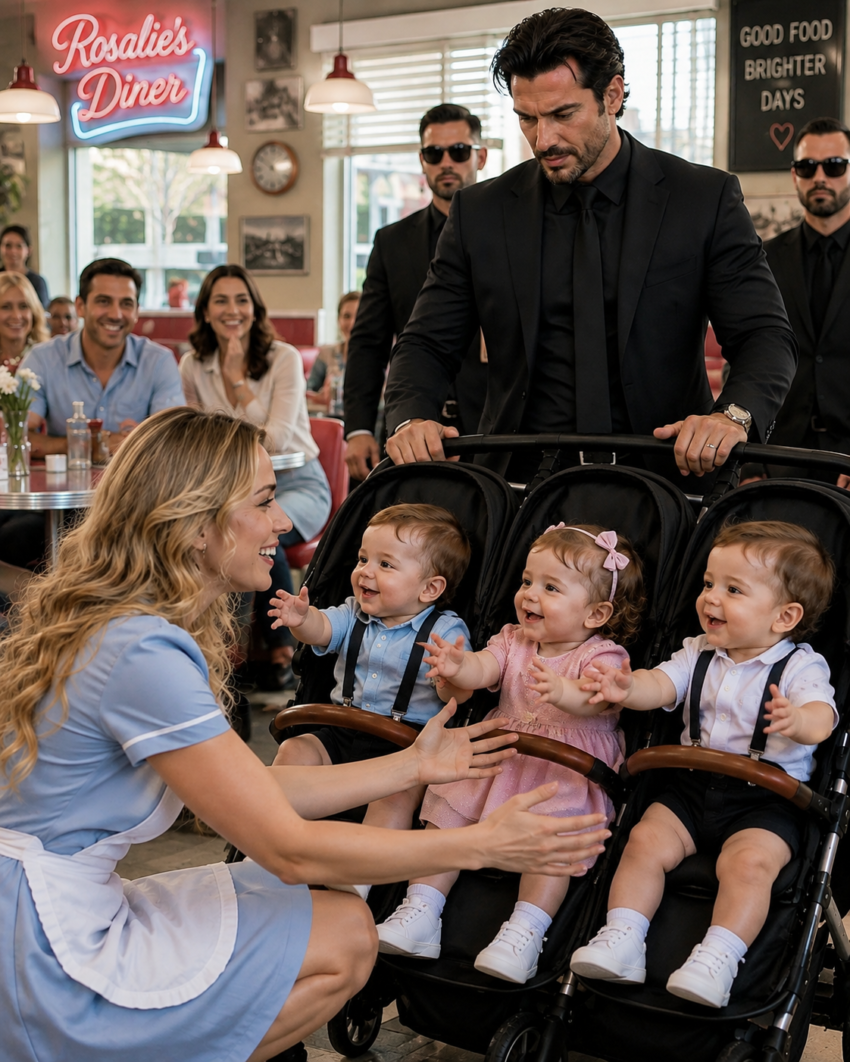
It was the enormous triple stroller being pushed beside him.
Three toddlers were inside.
Two boys.
One girl.
All three were crying so hard that their little faces had turned pink.
I stared for half a second too long before forcing myself to look away.
There were certain things I had trained myself not to notice.
Babies were one of them.
Fourteen months earlier, I had entered Briarwood Regional Hospital believing I would leave with three children.
Instead, I left carrying a folder of documents and a grief so heavy I could barely stand beneath it.
My triplets had arrived during an emergency delivery.
When I woke hours later, a nurse named Patricia Langley sat beside my bed, held my hand, and gently explained that none of them had made it.
I had never been allowed to hold them.
For more than a year, I survived by not asking myself why.
A Table Nobody Wanted
My name is Tessa Whitmore, and at thirty-one years old, I had learned that bills continue arriving even when your life falls apart.
That was why I worked double shifts at Maple & Main.
My manager, Russell Pike, appeared beside the kitchen window and pushed three menus against my chest.
“Table twelve.”
I glanced toward Grant Hollowell.
“Can someone else take it?”
Russell rolled his eyes.
“Everyone else suddenly has something important to do, so congratulations. He’s yours.”
I wanted to argue, but I needed the paycheck.
I straightened my apron, picked up three plastic cups for the children, and walked toward the table.
The closer I came, the stranger I felt.
The toddlers were probably a year and a half old.
That matched the age my children would have been.
I told myself it meant nothing.
Thousands of children were the same age.
Then one of the boys looked directly at me.
He had thick brown curls that bent slightly above his ears.
So did his brother.
The little girl had the same curls, only longer.
And all three had hazel eyes.
My hazel eyes.
I nearly dropped the cups.
Grant noticed.
“Are you all right?”
“I’m fine.”
I placed the cups on the table and tried to focus on my job.
One of the boys knocked a stuffed fox onto the floor.
I bent down and picked it up.
For reasons I still cannot explain, I smiled at him.
“You dropped your friend.”
The boy stopped crying.
Not gradually.
Immediately.
His brother became quiet next.
Then the little girl turned toward me.
Her lower lip trembled as she studied my face with an expression that made something deep inside my chest hurt.
She stretched both arms toward me.
“Mama.”
I forgot how to breathe.
The restaurant seemed to disappear.
The first boy reached toward me too.
“Mama.”
Then his brother repeated it.
“Mama.”
Three voices.
One word.
My hands began shaking.
Grant Hollowell Stands Up
Grant pushed back his chair slowly.
Around us, conversations had stopped.
His expression was not angry exactly.
It was suspicious.
“What did you say to them?”
“Nothing.”
“They don’t do this.”
“I’ve never met them before.”
He looked from the children to me.
The little girl continued reaching toward my apron.
Something about her face pulled at memories I had spent fourteen months trying to bury.
During my pregnancy, I had imagined one of my babies getting my eyes.
I remembered joking that all three would probably inherit my unruly hair.
Now three children with my eyes and curls were sitting less than three feet away from me.
Grant turned toward one of the men standing nearby.
“Miles, find out who she is.”
My stomach dropped.
“Excuse me?”
“Her name, address, employment records, whatever you can legally obtain quickly.”
I stepped backward.
“You can’t just investigate me because your children said one word.”
Before Grant could answer, Russell came rushing over.
I expected him to defend me.
Instead, he laughed nervously.
“Mr. Hollowell, please don’t misunderstand. Tessa has been through a difficult time.”
I froze.
Russell continued.
“She lost three babies last year. She gets emotional around children sometimes.”
My face burned.
“Russell.”
He ignored me.
“We’ve tried to be understanding because everyone felt terrible for her.”
Grant’s expression became colder with every word.
Finally, he looked at Russell.
“Do you normally explain your employees’ private pain to strangers?”
Russell stopped smiling.
“I was only trying to help.”
“You weren’t helping her.”
I could not stay there another second.
I turned, walked through the kitchen, pushed open the back door, and stepped into the rain.
One More Thing Taken From Me
I stood beneath the narrow awning behind the restaurant and pressed both hands against the brick wall.
Three children.
Two boys and a girl.
Exactly like mine.
It was impossible.
It had to be.
The back door opened.
Russell stepped outside.
For one hopeful second, I thought he had come to apologize.
Instead, he crossed his arms.
“You need to go home.”
I stared at him.
“Fine.”
“No, Tessa. I mean permanently.”
The words took a moment to register.
“You’re firing me?”
“You caused a scene in front of one of the most important customers we’ve ever had.”
I almost laughed.
“I caused a scene?”
“I’m tired of making allowances because of what happened last year.”
Something inside me finally hardened.
For fourteen months, people had spoken to me gently, awkwardly, or impatiently.
I had accepted all of it because I barely had enough energy to get through each day.
Not this time.
“My children were never an inconvenience, Russell. And grieving them was never an excuse.”
He shook his head and walked inside.
I stood in the rain wondering how I would pay next month’s rent.
Then the back door opened again.
Grant Hollowell stepped outside.
He was holding the little girl.
Mama, Again
She rested against his chest, no longer crying.
Grant stopped beneath the awning several feet away from me.
Neither of us spoke.
Then the little girl saw me.
Her entire face changed.
She leaned toward me so suddenly that Grant had to adjust his hold.
I stepped closer.
She reached out and placed one tiny palm against my cheek.
My eyes filled before I could stop them.
“Mama.”
This time, I did not tell myself it was coincidence.
Grant was no longer watching her.
He was watching me.
Then one of his men hurried through the door carrying a phone.
“Grant, we found something.”
Grant shifted the child against his shoulder.
“What?”
The man looked uncomfortable.
“Hospital records.”
I felt the ground disappear beneath me.
The Records That Should Not Have Existed
The man introduced himself as Miles Dean and showed Grant the screen.
I could see my own name.
Tessa Whitmore.
Briarwood Regional Hospital.
Emergency delivery.
Triplets.
My pulse pounded in my ears.
Miles scrolled lower.
“The hospital recorded all three infants as lost shortly after delivery.”
I closed my eyes.
“I already know that.”
Grant did not answer.
Miles continued.
“But those records were amended seventy-two hours later.”
I opened my eyes.
“What does amended mean?”
He looked at me carefully.
“The original infant status reports were withdrawn.”
I stared at him.
“Why would anyone withdraw them?”
Miles turned the screen.
Three additional files appeared.
Infant A.
Infant B.
Infant C.
Two male newborns.
One female newborn.
All transferred from Briarwood Regional during the same night I had been recovering from surgery.
Grant read the destination twice.
Then the color left his face.
“Hollowell Family Pediatric Trust.”
Miles nodded.
My voice barely worked.
“What is that?”
Grant looked at me.
“A medical charity established by my grandfather.”
The little girl was still holding the collar of my uniform.
I suddenly felt dizzy.
“Where did you get these children?”
Grant looked toward the restaurant window, where the two boys were sitting with one of his security men.
Then he answered.
“My younger sister brought them to me.”
The Story Grant Had Believed
Her name was Valerie Hollowell.
According to Grant, Valerie had appeared at his house fourteen months earlier with three newborn babies.
She claimed their mother was a young woman who had experienced severe complications and that no safe relatives were available.
Valerie said the children needed temporary protection while the family foundation handled the paperwork.
Days became weeks.
Weeks became months.
No relative ever appeared.
Grant eventually became their legal guardian.
He had named them Owen, Caleb, and Sadie.
He loved them.
That much was obvious from the way he held Sadie and constantly checked through the restaurant window toward the boys.
But something in his story did not make sense.
“Why didn’t you meet their mother?”
His jaw tightened.
“Valerie told me she was gone before I became involved.”
My stomach turned.
“And where is Valerie now?”
Grant looked at Miles.
Miles answered.
“Nobody has been able to reach her for almost five months.”
I looked at Sadie.
Her small fingers curled around mine.
I wanted to believe she was mine.
I was terrified to believe it.
“I want a DNA test.”
Grant answered without hesitation.
“So do I.”
A Signature I Never Wrote
Miles had found another document.
This one carried my name.
It stated that I had voluntarily released three infants to a private guardianship program due to emotional and financial hardship.
At the bottom was a signature.
Tessa Whitmore.
I stared at it.
“That’s not mine.”
Grant studied my face.
“You’re certain?”
I turned toward him.
“I signed dozens of forms that week. I know how I sign my own name.”
Below the signature was the name of a witness.
Patricia Langley.
The nurse who had been sitting beside me when I woke.
The woman who had brushed my hair away from my forehead and told me I needed to rest.
The woman who had repeatedly whispered that she was sorry.
Grant pulled out his phone.
“Find Patricia Langley.”
Miles did not move.
Grant looked at him.
“What?”
Miles lowered his voice.
“She passed away earlier this year.”
Rain tapped steadily against the metal awning.
For several seconds, nobody spoke.
I felt as though every answer had opened the door to another question.
Then Miles swiped to one final image.
“There’s more.”
The Woman Beside My Bed
It was a security photograph from the hospital parking level.
The image quality was poor, but the timestamp was clear.
2:43 a.m.
The night my children were born.
Patricia Langley was walking toward a service exit.
Beside her was another woman.
Three infant carriers rested on a transport cart between them.
Grant stared at the second woman.
His expression changed instantly.
“Valerie.”
My knees nearly gave out.
Because I knew her too.
Not her name.
Not then.
But I remembered her face.
Hours before my emergency procedure, while nurses moved quickly around my hospital bed, a woman I had never seen before had stepped into my room.
She had introduced herself as someone helping coordinate paperwork for families with complicated deliveries.
I had been frightened, exhausted, and overwhelmed.
She told me not to worry.
She said the hospital would take care of everything.
Then she touched my arm and smiled.
It was Valerie Hollowell.
“She was in my room.”
Grant looked at me.
“What?”
“Your sister. She was standing beside my hospital bed before they took me away.”
Grant went silent.
Sadie reached for me again.
This time, I took her into my arms.
She settled against me almost immediately.
I closed my eyes as her head rested beneath my chin.
For fourteen months, I had imagined what holding one of my children might have felt like.
I had dreamed about their weight.
Their warmth.
The way their hair might smell after a bath.
Now I was standing behind a diner where I no longer worked, holding a little girl who might have been taken from me before I was ever allowed to know her.
Grant looked through the rain toward the parking lot.
When he finally spoke, his voice had changed.
“We’re going to find out exactly what happened.”
I looked at him.
“And if they’re mine?”
He glanced at Sadie, then toward the two boys inside.
Pain crossed his face.
For the first time, Grant Hollowell did not look powerful.
He looked like a man realizing that the children he loved might belong to a mother who had spent fourteen months believing she had lost them forever.
“Then you should have been given the chance to be their mother from the beginning.”
I tightened my arms around Sadie.
“I don’t want to take them away from someone they love.”
Grant looked surprised.
I continued.
“But I won’t disappear from their lives either.”
He nodded slowly.
“Then whatever the truth is, we handle it carefully.”
The First Answer
The DNA results came back four days later.
I sat in a private office beside Grant while Miles placed the sealed report on the table.
My hands were trembling too badly to open it.
Grant noticed.
“Do you want me to?”
I shook my head.
“No. I need to do this.”
I opened the envelope.
The first page blurred through my tears.
Then I found the line that mattered.
Probability of biological maternity: greater than 99.9 percent.
I covered my mouth.
Owen was mine.
Caleb was mine.
Sadie was mine.
All three.
I had not imagined their eyes.
I had not imagined the way they reached toward me.
For fourteen months, my children had been alive.
I lowered my head and cried in a way I had not cried since the hospital.
Grant sat silently beside me.
After a while, I noticed his hand resting on the report.
He was staring at the same sentence.
He had raised those children from infancy.
They called him Uncle Grant.
They ran toward him when they were frightened.
The truth had restored something to me while threatening to change everything for him.
I reached across the table.
“They love you.”
Grant looked at me.
“And they deserve you.”
“They shouldn’t have to lose one person to get another.”
He stared at me for several seconds.
Then he nodded.
“Agreed.”
What Came Next
The investigation did not end with the DNA test.
More irregular documents surfaced.
Several records had been altered.
Money had moved through accounts connected to people around the family foundation.
Valerie remained difficult to locate, although investigators eventually learned she had left Kentucky months earlier.
I stopped trying to understand everything at once.
My children needed something simpler.
They needed breakfast.
Clean pajamas.
Favorite songs.
Bedtime routines.
Someone to remember that Owen hated peas, Caleb refused to sleep without his stuffed fox, and Sadie insisted on carrying two socks everywhere even when she was not wearing them.
Grant already knew those things.
Slowly, I learned them too.
The first time all three children spent an afternoon in my apartment, I sat on the floor surrounded by blocks and tiny plastic animals while my heart struggled to understand that this was real.
Sadie climbed into my lap.
Owen brought me a book.
Caleb placed his stuffed fox beside me as if introducing us formally.
Then he pointed at me.
“Mama Tessa.”
I cried again.
Not because I was sad.
Because for the first time in fourteen months, grief was no longer the only thing living inside me.
There was anger.
There were questions.
There was a long road ahead.
But there was also hope.
And there were three small voices calling me from the next room.
Sometimes the truth arrives in the most unexpected place, and even when it changes everything we thought we understood, facing it can become the first step toward rebuilding a life that once seemed impossible to repair.
Grief can teach a person how to survive one day at a time, but survival does not mean giving up the right to ask questions when something deep inside the heart says that the story is incomplete.
A person’s pain should never become gossip, entertainment, or a reason to treat them as weak, because we rarely know how much courage it took for them simply to get out of bed that morning.
Family is not defined only by biology, because love can grow through everyday care, sleepless nights, scraped knees, bedtime stories, and thousands of quiet moments that no official document could ever fully measure.
At the same time, loving someone does not give us the right to erase another person’s place in their life, and real love sometimes requires making room rather than fighting to possess what matters most.
Powerful people, respected institutions, and official paperwork can still be wrong, which is why compassion, careful questions, and the courage to examine uncomfortable facts remain deeply important.
When life gives back something we believed was gone forever, joy may arrive mixed with fear, anger, confusion, and sadness, and we should allow ourselves to feel all of those emotions without believing they cancel one another out.
Children should never be forced to carry the consequences of adult mistakes, because their greatest need is not to know who won an argument but to feel secure in the love of the people who genuinely care for them.
Healing does not always mean returning to the person we were before something painful happened; sometimes it means becoming someone new who can remember the past without allowing it to control every future decision.
And perhaps the most important lesson is that when truth finally opens a door we thought had been permanently closed, we should walk through it with courage, kindness, and enough wisdom to protect the people waiting on the other side