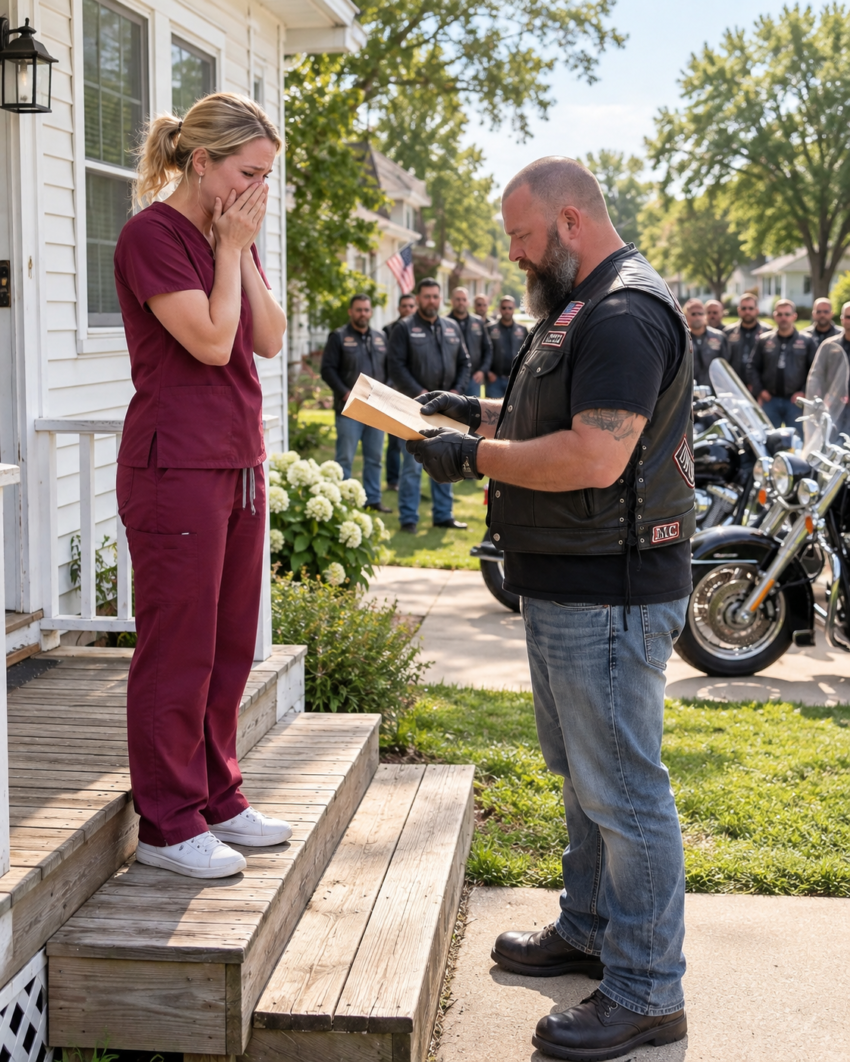
The Morning They Erased Twenty-Five Years
At fifty-six, Marlene Whitaker believed there were two places in the world where she knew exactly who she was: her small house outside Dayton, Ohio, and the pediatric floor of Northwood Regional Hospital.
For twenty-five years, Marlene had been the nurse parents searched for when they were frightened.
She remembered which children hated grape-flavored medicine, which ones needed their stuffed animals positioned beside the pillow, and which exhausted parents simply needed someone to sit beside them for five quiet minutes.
She was not important in the way executives were important.
Her name was not on a building.
She had never appeared in a hospital advertisement.
But children remembered her.
That Wednesday afternoon, Marlene had just finished helping an eight-year-old boy calm down before a difficult procedure when a message appeared on her workstation.
ADMINISTRATION. CONFERENCE ROOM 4. IMMEDIATELY.
She assumed it concerned staffing.
Instead, when she entered the room, she found Human Resources director Meredith Sloan sitting beside an unfamiliar hospital attorney.
A sealed folder rested between them.
Meredith did not invite her to sit.
“Marlene, Northwood is ending your employment effective today.”
For several seconds, Marlene genuinely believed she had misheard her.
“Ending my employment?”
Meredith nodded.
“A family raised concerns regarding professional boundaries. Leadership reviewed the situation and decided separation was appropriate.”
Marlene stared at her.
“What family? What did I supposedly do?”
“I can’t discuss confidential details.”
Marlene’s confusion slowly turned into disbelief.
She had received an excellent annual review six weeks earlier.
She had trained half the nurses on her shift.
Two months ago, management had asked her to mentor new hires.
“Then how am I supposed to respond to an accusation I’m not allowed to see?”
The attorney finally looked up.
Meredith closed the folder.
“You may file a formal appeal. However, while that process is underway, you cannot return to the property. I would also advise you to think carefully about how publicly you challenge this decision if you expect professional references from Northwood.”
There it was.
Not quite a threat.
But close enough that Marlene understood.
Stay quiet.
Leave gracefully.
Don’t make powerful people uncomfortable.
Twenty minutes later, a security officer escorted her to her locker.
Her coworkers barely looked at her. One nurse she had trained twelve years earlier whispered, “I’m sorry,” before quickly walking away.
Her name had already disappeared from the assignment board.
Marlene packed her stethoscope, two framed photographs, a ceramic mug painted by a former patient, and the ridiculous sunflower-print shoes children always complimented.
She carried twenty-five years out through the employee entrance in one cardboard box.
Only when she reached her car did she finally cry.
One Terrible Decision That Felt Like Freedom
Marlene’s old Subaru had been making a grinding noise for weeks, and that afternoon it refused to start at all.
Normally, she would have called a coworker.
Now she couldn’t bring herself to do it.
She took a rideshare to the downtown transit terminal and bought a bus ticket to Fairmont, where her younger sister had offered to let her stay for a few days.
The standard ticket was inexpensive.
Then Marlene noticed an upgraded section on the overnight coach—wide reclining seats, extra legroom, quieter surroundings.
It cost far more than she should spend.
She checked her banking app.
Six hundred and twelve dollars.
Rent was approaching.
Her car needed repairs.
She had no paycheck coming.
Buying the upgraded ticket made absolutely no financial sense.
Marlene stared at the screen for several seconds.
For twenty-five years, every extra dollar had gone somewhere sensible.
Home repairs.
Groceries.
Family emergencies.
Someone else’s birthday.
Someone else’s need.
That day, after being escorted from the hospital as though decades of loyalty meant nothing, she suddenly felt exhausted from always being sensible.
“Upgrade it,” she told the clerk.
The clerk glanced at the price.
“You sure?”
Marlene gave a tired smile.
“No. But do it anyway.”
Seat 3A felt almost embarrassingly luxurious.
She put the cardboard box beside her feet, leaned her head back, and closed her eyes.
For the first time all day, nobody was asking anything from her.
She had exactly fifty-three peaceful minutes.
Then she heard an argument behind the divider.
The Stranger in Row Twelve
Marlene opened her eyes when she heard the driver say, “Sir, I’m trying to help you, but you have to be able to sit safely.”
She stood and looked toward the rear.
A tall man in his early sixties was struggling beside a standard coach seat.
He wore jeans, heavy boots, and a weathered motorcycle vest covered with patches from different states.
But that was not what Marlene noticed first.
She noticed how carefully he moved.
Old scar tissue covered part of his neck and disappeared beneath his sleeves. His left hand had limited movement, and bending his upper body appeared painfully difficult.
A few passengers watched.
Some tried not to.
The man noticed both.
“I said I’ll manage,” he muttered.
He tried again.
The cramped seat forced his shoulders inward, and his face tightened.
Marlene knew that expression.
She had seen people use pride to hide discomfort thousands of times.
She stepped into the aisle.
“Would a wider seat help?”
The man turned sharply.
“Ma’am, I’m okay.”
“I didn’t ask whether you’re okay.”
That surprised him.
Marlene pointed toward the upgraded section.
“I asked whether a wider seat would help.”
He hesitated.
“Probably.”
“Then take mine.”
The man stared at her.
“Absolutely not.”
“Why?”
“Because you paid for it.”
“Correct.”
“And I’m not taking it.”
Marlene almost smiled.
Under different circumstances, she might have liked his stubbornness.
“I spent twenty-five years arguing with frightened children and exhausted parents,” she said. “You are not going to out-stubborn me.”
A few passengers smiled.
The man did not.
“I don’t need anyone feeling sorry for me.”
Marlene’s expression softened.
“Good, because I don’t feel sorry for you.”
That finally made him look directly at her.
“I had the worst morning I’ve had in years,” she continued. “Right now, I need to know I’m still the person I was when I woke up. So please take the seat and let me have that.”
His expression changed.
Not dramatically.
Just enough.
The defensiveness disappeared.
“You’re serious?”
“Completely Several minutes later, the driver changed their seat assignments.
Marlene carried her cardboard box into coach.
Before she left, the stranger said quietly, “My name is Russell Cade.”
“Marlene Whitaker.”
He offered his stiffened hand.
She took it gently.
“Thank you, Marlene.”
She smiled.
“Get comfortable, Russell.”
The Story Behind the Scars
The bus stopped at a service plaza outside Springfield about an hour later.
Marlene was buying the cheapest coffee available when Russell approached her.
He moved slowly but seemed far more comfortable than before.
“Can I sit with you?”
“Of course.”
They chose a table near the window.
For several minutes, neither said much.
Then Russell looked down at his hands.
“Garage fire,” he said.
Marlene waited.
“Almost two years ago. I restored motorcycles with my brother. Something electrical went wrong.”
He paused.
“My wife was inside the office when it happened.”
Marlene immediately understood there was more to the sentence.
Russell stared through the window.
“She didn’t make it out.”
Marlene’s hand tightened around her coffee cup.
“I’m very sorry.”
He nodded.
“Afterward, I stopped riding. Stopped seeing people. My club brothers kept showing up anyway.”
A faint smile crossed his face.
“They’re annoying like that.”
Marlene smiled back.
Russell looked at the cardboard box beside her chair.
“What’s your story?”
She considered lying.
Instead she said, “I was fired this morning.”
His eyebrows rose.
“From nursing?”
“Pediatrics. Twenty-five years.”
“What happened?”
“I’m still trying to figure that out.”
She explained the mysterious complaint, the closed-door meeting, and the warning about references.
Russell listened without interrupting.
When she finished, his jaw tightened.
“Sounds like somebody wanted you gone before you could ask questions.”
Marlene shrugged.
“Maybe. Or maybe I’m just an older nurse who became expensive to keep.”
Russell reached inside his vest and removed a small card.
There was no dramatic emblem, only the name of a motorcycle association called Iron Harbor Riders and a phone number.
On the back, he slowly wrote something.
Then he handed it to her.
CALL IF YOU NEED A HAND.
Marlene shook her head.
“Russell, you don’t owe me anything.”
“I know.”
“Then why give me this?”
He looked directly at her.
“Because everybody else on that bus looked at what happened to me. You looked at me.”
Marlene had no answer.
Russell pushed the card gently toward her.
“There’s a difference.”
She slipped it into her purse.
The Phone Call She Nearly Ignored
The following morning, Marlene woke at 5:40 out of habit.
For one wonderful second, she thought she was late for work.
Then reality returned.
She spent the morning submitting applications.
By noon, two hospitals had already requested references from Northwood.
At 1:17 p.m., her phone rang.
Unknown number.
She ignored it.
It rang again.
Then a third time.
Finally, Marlene answered.
“Hello?”
“Marlene Whitaker?”
“Yes.”
“My name is Beau Lawson. Russell Cade is a close friend of mine.”
Marlene sat straighter.
“Is Russell okay?”
“He’s fine. Actually, better than fine. He told us what happened yesterday.”
Marlene closed her eyes.
“Please tell him he doesn’t owe me anything.”
Beau chuckled.
“He already told us you’d say that.”
He asked whether she could meet him at a neighborhood diner that afternoon.
Marlene almost refused.
Then she remembered Russell’s card.
At three o’clock, she walked into Hattie’s Grill and discovered seven people waiting—not an intimidating crowd, just men and women of different ages wearing the same Iron Harbor patch Russell had worn.
Beau stood.
“Marlene?”
She nodded.
He pulled out a chair.
“Please sit.”
After coffee arrived, Beau asked a simple question.
“What would help you most right now?”
Marlene laughed nervously.
“Unless one of you owns a hospital, probably nothing.”
A woman across the table smiled.
“You’d be surprised what people do for work.”
For the first time since being fired, Marlene explained everything without protecting Northwood, Meredith Sloan, or her own pride.
When she finished, Beau said, “Would you mind if we helped you find out what actually happened?”
Marlene frowned.
“How?”
“Legally,” he said immediately. “Public records, professional contacts, people who understand hospital administration. Nothing more.”
Marlene studied him.
“Why would you do all that for a stranger?”
Beau’s answer was immediate.
“Because Russell isn’t a stranger to us.”
What the Complaint Was Hiding
Three days later, Marlene received a call from an attorney recommended by one of Russell’s friends.
What he had discovered changed everything.
There had been no formal complaint from a patient’s family.
The paperwork used to justify Marlene’s dismissal had been internally created after she repeatedly questioned unusual reductions in a pediatric assistance program.
Marlene suddenly remembered.
For months, she had noticed families being told that transportation vouchers, meal assistance, and emergency lodging support were unavailable even though the program had recently received a large donation.
She had asked Meredith about it twice.
The second time, Meredith had told her to “stay focused on nursing.”
Marlene had forgotten the conversation.
Meredith apparently had not.
An independent review was already underway. Financial discrepancies had been reported to the hospital board, and several administrators were being questioned about where charitable funds had gone.
No dramatic confrontation was necessary.
The records spoke for themselves.Two days later, Northwood’s chief executive called Marlene personally.
“Ms. Whitaker, our internal process failed you.”
Marlene stood silently in her sister’s kitchen.
“That’s a very polite way to describe it.”
There was a pause.
“You’re right.”
The executive apologized again and asked her to attend an emergency board meeting.
Marlene agreed on one condition.
“I don’t want a private apology.”
“Excuse me?”
“You damaged my reputation in front of people I worked beside for twenty-five years. If you want to correct it, correct it where they can hear you.”
This time, the silence lasted longer.
“That’s fair.”
Ninety-Seven Engines Outside Her House
The morning before the board meeting, Marlene returned home.
At 8:03, she heard a low rumble outside.
She opened the curtains.
Motorcycles stretched along both sides of the street.
Not chaotic.
Not threatening.
Simply present.
Russell stood near the front.
Marlene rushed outside.
“What are you doing here?”
Russell smiled.
“Making sure you don’t walk into tomorrow alone.”
Beau stepped forward carrying a folder.
Inside were letters of recommendation from parents, former coworkers, physicians, nonprofit directors, and people Marlene had helped over the years.
There were dozens of them.
One came from the mother of a child Marlene had cared for fourteen years earlier.
Another came from a physician she had trained when he was a resident.
Marlene covered her mouth.
“How did you find these people?”
Russell grinned.
“Turns out nurses leave a trail.”
Marlene looked confused.
“A trail?”
“Of people who remember them.”
She started crying.
Russell waited.
Then he handed her one final envelope.
Inside was enough money to cover her car repair and several weeks of basic expenses.
Marlene immediately shook her head.
“No. I can’t accept this.”
“Then don’t accept it as charity.”
Russell pointed toward the envelope.
“Accept it as time. Time to make your next decision without fear making it for you.”
That sentence broke the last of her resistance.
“Why are you doing so much?” she whispered.
Russell’s eyes grew serious.
“Because yesterday morning I was considering canceling the rest of my trip and going home. I was tired of being stared at. Tired of needing accommodations. Tired of feeling like every room had to make space for what happened to me.”
He paused.
“Then you gave up the nicest thing you had that day so I wouldn’t have to feel ashamed for needing it.”
Marlene wiped her face.
Russell smiled gently.
“Sometimes people don’t need saving. They just need proof they still belong in the world.”
The Hospital Had to Say Her Name Again
The following afternoon, Marlene walked through Northwood Regional Hospital’s main entrance.
This time, no security officer followed her.
Several nurses waited in the lobby.
So did physicians, parents, and members of the hospital board.
The chief executive approached a microphone.
“Twenty-five years of service should have earned Marlene Whitaker our trust and our protection. Instead, our process failed her. We apologize publicly and without qualification.”
Marlene looked around.
Several former coworkers were crying.
The executive continued.
Her termination was officially reversed.
Her record would be corrected.
She would receive lost wages.
Then came the offer she had not expected.
“We would like Ms. Whitaker to return as associate director of pediatric patient care, with responsibility for family-support programs and nursing advocacy.”
The room erupted in applause.
Marlene did not answer immediately.
She thought about the cardboard box.
The bus.
Russell struggling in that narrow seat.
The diner.
The letters.
Then she stepped toward the microphone.
“I’ll come back,” she said, “but things have to change.”
The room became quiet.
“No employee should be afraid to ask where patient resources are going. No nurse should lose a career because asking a reasonable question makes someone uncomfortable. And no family should be told help doesn’t exist when people donated that help specifically for them.”
The board chair nodded.
“Agreed.”
Marlene smiled for the first time since her dismissal.
“Then I’ll be here Monday.”
The Seat That Became Something Bigger
Three months later, Marlene received a call from Russell.
“I’ve got an idea,” he said.
He wanted Iron Harbor Riders to establish a travel-assistance program for patients who needed accessible transportation to appointments, rehabilitation programs, and specialized treatment.
Marlene loved it immediately.
Together with a local nonprofit and Northwood’s newly reorganized family-support office, they created the Open Road Comfort Fund.
The first person they helped was a seventeen-year-old recovering from major orthopedic surgery whose mother could not afford an accessible ride to a specialist two hours away.
Marlene arranged the transportation herself.
After the appointment, she sat at her desk and stared at the confirmation email.
A comfortable seat.
That was where all of this had started.
Not with money.
Not with influence.
Not with ninety-seven motorcycles.
Just one exhausted woman who had lost almost everything she thought defined her and still decided that another person’s discomfort mattered.
That evening, Russell called again.
“You know what’s funny?”
“What?”
“You thought you were giving me your seat.”
Marlene laughed.
“I was.”
“No,” Russell said softly. “You were reminding both of us who we still were.”
Marlene looked through the hospital window at the evening sky.
For years, she had believed kindness was something you gave away.
Now she understood something different.
Sometimes kindness leaves your hands, travels farther than you can see, touches people whose names you may never know, and eventually finds its way home.
Ten Messages to Carry With You
Losing the position you worked years to earn can make you question your value, but a title is only one small part of your life, while the character you built through thousands of unseen choices belongs to you wherever you go.
When someone with authority tries to make you afraid of asking reasonable questions, remember that silence may protect a comfortable system, but respectful courage can protect the people that system was supposed to serve.
Kindness does not become meaningless simply because nobody witnesses it, because some of the most important things we ever do happen when there is no audience, no reward, and no guarantee that anyone will remember.
Never underestimate the power of allowing another person to keep their dignity, because people often remember how you made them feel long after they have forgotten what you said or what you gave them.
There will be seasons when you are the person helping everyone else and seasons when you are the one who needs help, and accepting support with grace does not erase the strength you showed when others depended on you.
A painful ending can convince you that everything before it was wasted, but years of honesty, compassion, and service continue living inside the people whose lives were made easier because you were there.
Sometimes the person who changes your future will not arrive looking like the person you expected, because meaningful connections rarely ask permission before crossing the boundaries we build around our assumptions.
If life leaves you with very little, protect the part of yourself that still notices other people, because losing money, status, or certainty is difficult, but losing your compassion can cost you something much harder to rebuild.
The good you offer the world may never return in the same form, from the same person, or at the moment you desperately want it, yet that does not mean it disappeared after leaving your hands.
And when you begin to believe that one ordinary person cannot make a meaningful difference, remember that sometimes an entire new chapter can begin with something as simple as noticing that a stranger needs a better seat.