The Question No Nine-Year-Old Should Have to Answer
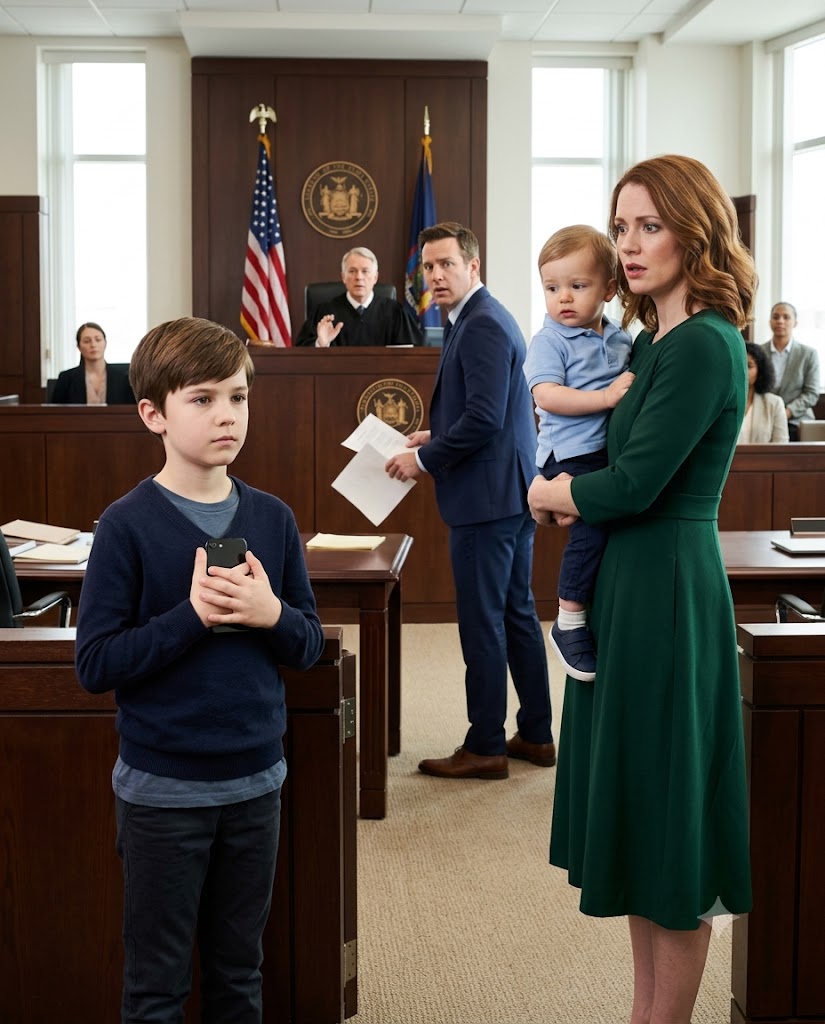
When Judge Evelyn Mercer asked nine-year-old Nolan Avery which parent he wanted to live with, nobody in the Madison family courtroom expected the boy to reach inside his jacket.
His mother, Laurel Avery, stopped breathing for a moment.
Across the aisle, her husband, Graham, suddenly lost the confident expression he had worn all morning.
Nolan did not answer the judge’s question.
Instead, he pulled a small black object from his inside pocket and held it tightly between both hands.
“Your Honor,” he said, his voice trembling, “I think you should hear this before I answer.”
Graham’s face went pale.
Laurel stared at her son.
She had no idea what he was holding.
But Graham clearly did.
And in that instant, Laurel realized her nine-year-old son knew something she didn’t.
The Man Who Arrived Certain He Would Win
That morning had begun with rain tapping against the courthouse windows.
Laurel had arrived wearing a simple ivory blouse, charcoal trousers, and the only pair of heels she still owned from her years working in an insurance office.
Graham looked as if he were arriving for an important business meeting.
At forty-three, he was a successful commercial real estate developer whose name appeared on several buildings around Dane County.
His attorney had prepared everything.
Financial statements.
Photographs of Graham’s five-bedroom home.
Information about private schools.
Retirement accounts.
Insurance policies.
Even photographs of the boys’ bedrooms at his new house.
The message was obvious.
Graham had money.
Laurel didn’t.
Since their sons were born, Laurel had spent years moving between part-time jobs because someone needed to be available for school pickups, sick days, dentist appointments, parent conferences, soccer practices, and everything else that came with raising two children.
Now that sacrifice was being presented as evidence against her.
Graham’s attorney stood.
“Mr. Avery can provide Nolan and Parker with exceptional stability, educational opportunities, and long-term financial security.”
Then she glanced toward Laurel.
“Mrs. Avery’s employment history, however, has been inconsistent.”
Laurel lowered her eyes.
Inconsistent.
That was one way to describe spending nine years building your life around two children.
Two Different Versions of the Same Marriage
Graham spoke calmly when it was his turn.
“I don’t want to criticize Laurel,” he began.
Laurel almost laughed.
That sentence usually meant the opposite.
“She loves our children. I’ve never denied that. But love isn’t always enough. Children need structure. They need consistency.”
He paused carefully.
“I worry that the pressure of raising them alone may simply be too much for her.”
Laurel’s attorney touched her arm beneath the table, silently reminding her not to react.
Graham continued.
“I’m only asking the court to consider what’s best for Nolan and Parker.”
Laurel looked toward the boys.
Nolan sat straight-backed in a navy jacket that was slightly too large for him.
His younger twin, Parker, sat beside him, twisting the sleeve of his gray sweater between his fingers.
They were only nine.
Yet during the last several months, they had begun watching adults the way adults watched storm clouds.
Always wondering what was coming next.
The Question That Changed Everything
Judge Mercer eventually closed the folder in front of her.
Then she looked directly at the boys.
Her voice softened.
“Nolan. Parker. I know today has been difficult.”
Parker immediately looked at the floor.
Nolan didn’t.
“Nobody here expects either of you to solve your parents’ problems,” the judge continued. “But I do need to understand where you feel comfortable and secure.”
She paused.
“Can either of you tell me where you would prefer to live?”
Laurel felt something twist inside her chest.
She hated that her children had to hear the question at all.
Parker moved closer to Nolan.
Then Nolan stood.
He looked first at Laurel.
Then at Graham.
Something passed across Graham’s face.
Not anger.
Warning.
Nolan noticed it too.
But instead of sitting down, he reached inside his jacket.
The Secret Laurel Didn’t Know About
Nolan removed a small digital voice recorder.
For several seconds, nobody spoke.
Laurel recognized it.
She had bought it two years earlier when Nolan became fascinated with interviewing people for a school history project.
He had used it to record his grandfather talking about growing up on a dairy farm.
After that project, Laurel assumed the recorder had disappeared into a drawer.
Apparently, it hadn’t.
Graham shifted abruptly in his chair.
His attorney leaned toward him.
Judge Mercer looked at Nolan.
“What is on that device?”
Nolan swallowed.
“Something Dad said to us.”
Graham stood halfway from his chair.
“Your Honor, I have no idea what he’s talking about.”
The judge raised one hand.
“Please sit down, Mr. Avery.”
Graham obeyed.
But Laurel saw something she had rarely seen during their twelve-year marriage.
Fear.
What Happened Three Nights Earlier
Judge Mercer asked Nolan to explain.
The boy gripped the recorder.
“Dad picked us up Tuesday after school.”
Parker stared at his shoes.
“He took us to dinner, and afterward we went to his house.”Nolan paused.
“Then he started practicing questions with us.”
The judge leaned forward.
“What kind of questions?”
“Questions you might ask us today.”
The courtroom became completely still.
Nolan continued.
“He kept telling us what answers we were supposed to give.”
Laurel turned toward Graham.
He wouldn’t look at her.
“What answers?” Judge Mercer asked.
Nolan took a breath.
“That Mom cries all the time. That she forgets things. That we’re scared when we’re with her.”
Laurel’s eyes filled immediately.
None of it was true.
But Nolan wasn’t finished.
“Parker told him he didn’t want to say those things.”
Beside him, Parker’s lower lip trembled.
“Dad got really upset.”
The Words That Frightened Two Children
Judge Mercer asked the court officer to take the recorder from Nolan.
Before handing it over, Nolan said something that made Laurel’s heart ache.
“I turned it on because I thought maybe someday somebody wouldn’t believe us.”
Laurel covered her mouth.
A nine-year-old child should never have needed to think that way.
The officer connected the device to the courtroom audio system.
There was static.
Then children’s voices.
Graham’s voice followed.
Calm at first.
He was telling the boys how important the hearing would be.
Then Nolan could be heard saying:
“But I want to stay with Mom too.”
Silence followed.
Then Graham’s recorded voice changed.
“Listen carefully. If you make this difficult, your mother is going to lose much more than this case.”
Laurel froze.
The recording continued.
“She can’t afford that house without help. She can’t afford lawyers forever. So when the judge asks where you belong, you already know the correct answer.”
Parker’s tiny recorded voice came next.
“I don’t want Mom to lose her house.”
Graham replied:
“Then don’t create problems for her.”
One More Piece of Evidence
The recording stopped.
Nobody moved.
Graham’s attorney immediately objected, questioning the context and whether the recording should be considered.
Judge Mercer listened carefully but did not immediately rule.
Then Parker suddenly stood.
Everyone turned toward him.
Unlike Nolan, Parker wasn’t carrying electronics.
He pulled a folded piece of paper from his backpack.
“I have something too.”
Laurel stared at him.
“Parker?”
He walked toward the court officer and handed over the paper.
It was a note from his elementary school counselor.
Two days after the conversation at Graham’s house, Parker had become upset during class.
His teacher sent him to the counselor.
There, without Laurel present, Parker described being told what he was expected to say in court.
The counselor had documented the conversation and contacted the appropriate family support professionals.
The recorder was no longer standing alone.
The Story Began to Fall Apart
Judge Mercer called a recess.
For twenty-five minutes, Laurel sat in the hallway between her sons.
She didn’t ask why they had hidden everything from her.
She didn’t ask what Graham had said after the recorder stopped.
She simply held their hands.
Finally, Nolan whispered:
“Mom, are you mad?”
Laurel turned toward him.
“Why would I be mad?”
“Because I didn’t tell you.”
Laurel’s eyes filled again.
“Sweetheart, I wish you had never been put in a position where you thought you had to protect me.”
Nolan stared down at his shoes.
“I thought if Dad knew you knew, he’d find the recorder.”
That answer hurt more than anything Laurel had heard inside the courtroom.
She pulled both boys close.
“From now on, the adults handle the adult problems. You two get to be kids.”
Parker finally began crying against her shoulder.
Nolan held himself together for another few seconds.
Then he did too.
Money Could Not Rewrite What the Boys Had Heard
When court resumed, Graham looked different.
His expensive suit was unchanged.
His documents were still neatly stacked.
His attorney remained beside him.
But the certainty was gone.
Judge Mercer announced temporary arrangements designed to keep the boys in a stable environment while the new information was reviewed.
For the time being, Nolan and Parker would remain primarily with Laurel.
Graham’s contact with them would occur under structured conditions until professionals could evaluate the situation more fully.
This was not the dramatic ending Laurel had imagined.
There was no cheering.
No triumphant speech.
Just relief.
Outside the courthouse, the rain had stopped.
Nolan looked up at his mother.
“Does this mean we’re going home with you?”
Laurel crouched until they were eye to eye.
“Yes.”
Parker immediately wrapped his arms around her neck.Nolan remained still.
“And Dad can’t make us say things?”
Laurel shook her head.
“Nobody gets to tell you what your truth is.”
The Six Months That Followed
The case didn’t end that afternoon.
Real life rarely wraps itself neatly around one dramatic moment.
There were interviews.
School records.
Parenting evaluations.
Financial disclosures.
Messages between Laurel and Graham were reviewed.
Teachers spoke about the boys’ behavior.
Counselors documented what the children had told them independently.
Slowly, a larger pattern emerged.
Graham had frequently used financial pressure to control family decisions.
During the marriage, he had reminded Laurel that nearly everything belonged to him because he earned more.
After their separation, those same habits had followed them into the custody dispute.
Laurel also began rebuilding her own life.
She accepted a full-time position with a regional insurance company and moved with the boys into a modest three-bedroom townhouse outside Madison.
It didn’t have a marble kitchen.
There was no home theater.
The backyard was barely large enough for a picnic table.
But Nolan and Parker laughed there.
That mattered more.
The Final Hearing
Six months later, Laurel returned to the same courthouse.
Graham arrived in another perfectly tailored suit.
But this time, no mountain of financial documents could control the story.
Judge Mercer had reviewed everything.
When she announced the final parenting arrangement, Laurel closed her eyes for a moment.
She would receive primary legal and physical custody.
Graham would have limited structured parenting time, with future changes dependent on professional recommendations and his willingness to follow the court’s guidelines.
Judge Mercer looked directly at both parents.
“Children are not witnesses to be coached, assets to be negotiated over, or tools for winning disagreements between adults.”
Then she looked toward Nolan and Parker.
“They deserve permission to love both parents without being frightened of the consequences.”
Laurel never forgot those words.
Neither did Nolan.
The Little Black Recorder Came Home
Several weeks later, the recorder was returned with other materials from the case.
Laurel placed it on the kitchen counter.
She intended to put it in a drawer and forget about it.
Nolan saw it first.
“Can I have that?”
Laurel hesitated.
“Why?”
He picked it up carefully.
“Because it helped people believe us.”
Laurel sat beside him.
“People believed you because you told the truth, Nolan. The recorder only helped them hear it.”
He thought about that.
“Can I still keep it?”
She smiled gently.
“Yes.”
That evening, Nolan placed the recorder inside a small wooden box where he kept baseball cards, birthday notes, old photographs, and a smooth stone Parker had given him after a family camping trip.
A few days later, Laurel found the box open while putting away clean laundry.
The recorder had been wrapped in blue construction paper.
Nolan had written something across it in careful handwriting:
“This helped me tell the truth when I was scared.”
Laurel sat on the edge of his bed for a long time.
Then she folded the paper back around the recorder and returned it exactly where she found it.
What Laurel Finally Understood
For years, Laurel had believed protecting her children meant hiding every difficult truth from them.
She had smiled when she was worried.
Stayed silent when arguments became uncomfortable.
Changed the subject whenever the boys asked why their father spoke to her a certain way.
She thought silence would preserve their childhood.
But children often notice far more than adults realize.
Nolan had noticed.
Parker had noticed.
And when Laurel couldn’t yet find the courage to explain what was happening, her children had quietly begun carrying pieces of the burden themselves.
That realization changed the way she parented.
She didn’t tell them every adult problem.
She didn’t turn them against their father.
But she stopped pretending everything was perfect.
When something was difficult, she acknowledged it gently.
When they were frightened, she listened.
And when they asked questions, she answered honestly in ways children could understand.
Months later, Nolan came home from school carrying a poster he had made for an assignment about courage.
At the top, he had written:
“Courage doesn’t mean you’re not scared.”
Underneath, he had drawn a tiny black recorder.
Laurel smiled.
“Where did you learn that?”
Nolan shrugged with the casual confidence only children possess.
“I figured it out.”
Laurel hugged him.
Because sometimes the smallest person in a room carries the truth everyone else is afraid to say aloud.
And sometimes courage isn’t loud.
Sometimes it is a nine-year-old boy standing inside an enormous courtroom, reaching into his jacket pocket with shaking fingers and deciding that fear will not choose his words for him.
A child’s courage should never be measured by how much adult pressure they can endure, but when children finally speak honestly about what frightens them, the adults around them have a responsibility to listen with patience rather than forcing them to carry the burden alone.
Money can provide beautiful houses, excellent schools, comfortable vacations, and countless opportunities, but it can never replace the feeling of being able to speak freely inside your own home without worrying about what will happen afterward.
The strongest parent is not necessarily the one with the largest bank account or the most impressive lifestyle, but often the one who creates a home where children know that their feelings matter and their voices will be heard.
Children may not understand legal arguments, financial disagreements, or complicated relationships between adults, but they understand fear, kindness, honesty, and safety with remarkable clarity.
Sometimes a person stays silent because they believe silence will protect the people they love, only to discover that healing begins when someone finally has enough courage to bring the truth into the light.
No child should ever feel responsible for rescuing a parent from an adult conflict, because children deserve the freedom to learn, laugh, make mistakes, play, and grow without carrying problems that belong to grown-ups.
Real courage does not always arrive with confidence; sometimes it arrives with shaking hands, a trembling voice, and one simple decision to tell the truth even when remaining silent would feel easier.
Winning a family disagreement should never matter more than protecting the emotional well-being of the children caught in the middle, because childhood memories can remain long after courtrooms, documents, and arguments have disappeared.
A peaceful home is not necessarily the biggest, richest, or most impressive place a child can live; sometimes it is simply the place where a child can walk through the door, breathe freely, and know that nobody will ask them to pretend.
Years from now, Nolan may forget the expensive suits, the courtroom furniture, and many details of that rainy morning, but he will remember the moment he discovered that his voice mattered—and that telling the truth could change the direction of his life.