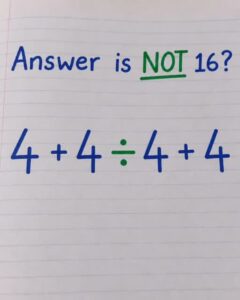
You will see a simple math question written on lined paper.
It looks like something you learned in elementary school.
The question is: what is 4 + 4 ÷ 4 + 4?
It seems very easy at first.
If you don’t use the correct rules, you will get a wrong answer.
Did you immediately think the answer is 16?
Well, the top of the page tells you something important.
It says: “Answer is NOT 16?”
So, if you got 16, it is wrong, and we need to find out why.
The person who made this puzzle wants you to rethink your approach.
They know it’s a very common mistake.
The reason you might get 16 is by just reading the numbers left to right.
If you do 4 + 4, you get 8.
Then, if you take that 8 and divide by 4, you get 2.
Finally, if you take that 2 and add 4, you get 6.
Wait, that’s not 16. What’s going on?
Let’s re-read the mistake pattern. Some people do: (4+4) ÷ (4+4).
That would be 8 ÷ 8, which is 1.
Others do (4+4) ÷ 4 + 4. That is 8 ÷ 4 + 4.
Which is 2 + 4, giving you 6.
If people just treat division like another addition: 4 + 4 + 4 + 4 = 16.
This is why the image specifically says “NOT 16?”.
It is a warning against a lazy or incorrect approach.
To solve this correctly, we must use the rules of math.
These rules are called the “order of operations.”
This is also known by an acronym, like PEMDAS (Parentheses, Exponents, Multiplication and Division, Addition and Subtraction) or BODMAS (Brackets, Orders, Division and Multiplication, Addition and Subtraction).
This rule tells us what to do first, second, third, and so on.
The rule says that Division and Multiplication are more powerful and must be done before Addition and Subtraction.
Think of it like a higher rank in an army.
So, let’s look at the problem again with this new, powerful rule.
The problem is: 4 + 4 ÷ 4 + 4.
According to the rules, we cannot just go from left to right.
We must find the division problem first.
The division part is 4 ÷ 4.
What is 4 divided by 4?
It is simply 1.
Now, we replace 4 ÷ 4 in our problem with the number 1.
Our problem is simplified to: 4 + 1 + 4.
Now we have only additions, so we can go from left to right.
First, do 4 + 1, which is 5.
Finally, take that 5 and add the last 4.
5 + 4 equals 9.
So, the correct, logical, and mathematical answer is 9.
The image was right to question the “16”.
It is a clever little trick to make you pause and remember your school lessons.
Did you get it right on the second try?
I hope you enjoyed this quick mental challenge!