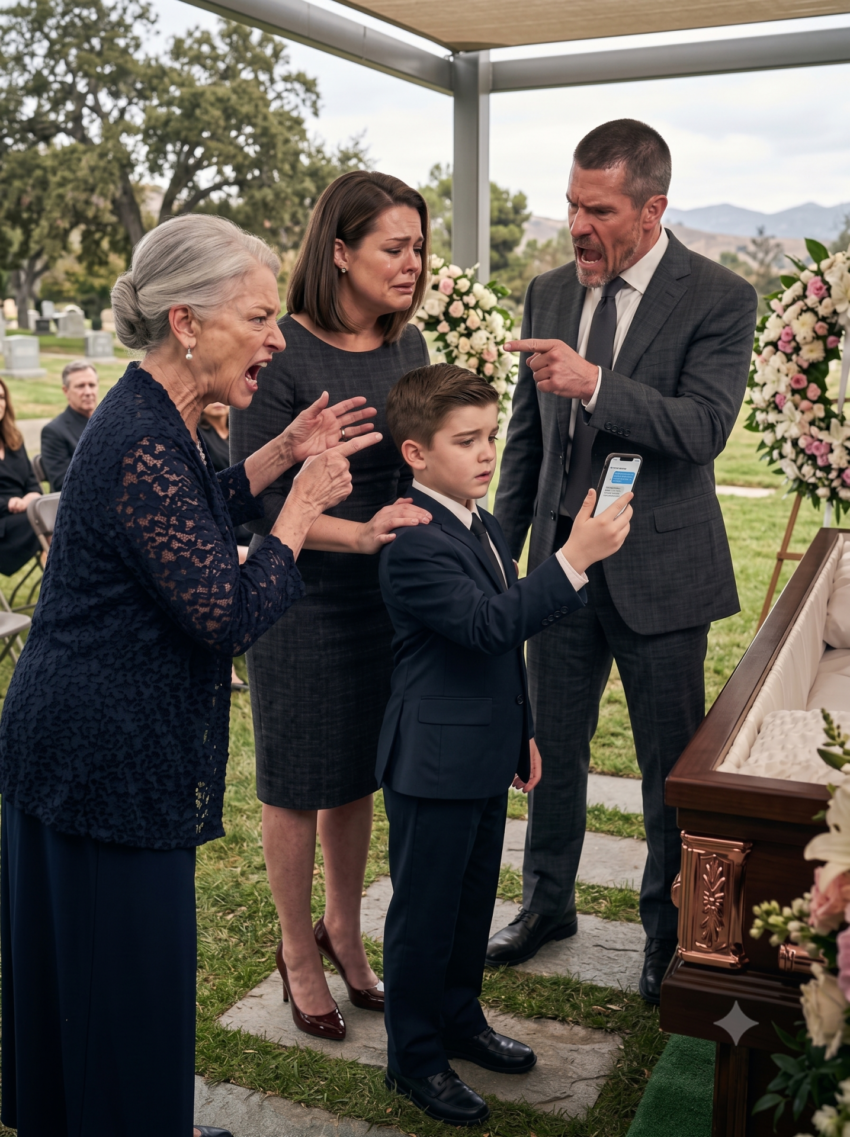
THE FUNERAL MY MOTHER-IN-LAW TURNED INTO A TRIAL
My mother-in-law waited until my husband’s casket was six feet away from me before she told everyone in the chapel that Daniel was better off dead than married to me.
“At least he doesn’t have to spend the rest of his life cleaning up the humiliation Elena brought into this family,” Vivian said, pressing a folded white handkerchief beneath one eye.
The chapel became so quiet that I could hear the faint hum of the air-conditioning above us. Daniel lay in a polished mahogany casket wearing the navy tie I had bought him for our anniversary dinner three weeks before the accident, while I sat in the front pew with our eight-year-old son beside me and listened to his mother turn his funeral into my public trial.
Noah’s small hand tightened around mine.
Across the aisle, Daniel’s younger brother, Grant, stood with one hand resting on the back of Vivian’s chair. His expression was carefully solemn, but he kept glancing toward me with the controlled patience of someone waiting for an unpleasant formality to end.
That bothered me more than Vivian’s words.
So did the black phone resting facedown in Noah’s lap.
It had belonged to Daniel.
The police had returned it with his wallet and wedding ring after the accident, and Noah had carried it around the house for four days without turning it on. That morning, however, I had seen the screen glowing while he sat alone on the stairs in his funeral suit.
When I asked what he was doing, he had only said, “Dad left something.”
I had assumed he meant photographs.
I should have asked another question.
Instead, I had been too busy trying to survive my husband’s funeral.
Vivian continued speaking as though she had been invited to give evidence rather than a eulogy.
“Daniel spent the last year trying to protect everyone from Elena’s financial decisions,” she said. “He was embarrassed to admit how bad things had become, but those of us closest to him knew.”
Aunt Marlene lowered her eyes.
Two cousins exchanged a look.
Someone behind me whispered, “I heard it was hundreds of thousands.”
Vivian heard it too. She let the silence stretch before continuing.
“Loans were taken out. Documents were signed. Money disappeared from the company. Daniel kept trying to fix things quietly because that was who my son was. Loyal to the end, even when loyalty was destroying him.”
I felt Noah shift beside me.
“Mom?”
“It’s okay,” I murmured, although nothing about that room was okay.
The ugliest part was that Vivian’s story contained enough truth to sound convincing.
There had been loans.
There were documents bearing my signature.
And nearly half a million dollars had disappeared from accounts connected to Mercer Industrial Supply, the company Daniel’s father had founded thirty-two years earlier.
But the signatures were not mine.
Daniel had discovered that six weeks before his death.
The first time he showed me one, we had been standing in our kitchen after Noah went to bed. Daniel placed a loan document beside my coffee and asked whether I remembered signing it.
I did not.
Then I looked at the signature.
It was close enough to mine that I understood why a bank employee might accept it, but whoever had copied my handwriting always made the same mistake. I crossed the second stroke of the E in Elena slightly upward. The signature on that page crossed downward.
Daniel had stared at it for a long time.
“There are more,” he said.
“How many?”
He rubbed his thumb along the edge of the paper.
“Enough that I don’t want you calling anybody yet.”
I had hated that answer.
“Daniel, if somebody is using my name—”
“I know. Give me a few days. I need to know where the money went before anyone realizes I’m looking.”
He had already begun tracing payments through a vendor I had never heard of, something called Westbridge Consulting.
I wanted him to call the bank immediately.
Daniel asked me to trust him.
I did.
Nine days later, his SUV went through a guardrail on a rain-slicked county road.
Now his mother was using those same forged documents to accuse me.
Grant stepped forward as Vivian returned to her seat.
“Nobody wants this to become uglier than it already is,” he said, looking directly at me. “We’re burying my brother today. We can deal with the financial situation privately afterward.”
Privately.
That word told me exactly what he expected.
I remembered the meeting Grant had requested two days after Daniel died. He had arrived at my house with a leather folder and a sympathy casserole his wife had clearly bought from a grocery store.
For twenty minutes, he had talked about grief.
Then he slid three documents across my dining table.
One would have given him temporary authority over several company accounts. Another would have allowed him to represent Daniel’s voting shares until the estate was settled.
I had not signed either.
“Elena, this company has employees who need paychecks,” he had said patiently. “You don’t know the business well enough to handle this right now.”
“Neither did you when Daniel brought you in twelve years ago.”
His face tightened for half a second.
“That’s different.”
“I’m sure it feels different to you.”
I had returned the papers unsigned.
That was the first decision I made after Daniel died that did not involve funeral flowers, casseroles, or choosing a suit for my husband to be buried in.
It was also the first time I saw Grant become afraid.
Now, standing in the chapel, he looked confident again.
“Daniel would want the company protected,” he continued. “Mom and I intend to make sure that happens.”
Vivian nodded.
“And Noah’s future,” she added. “Whatever Elena has done, my grandson should not pay for it.”
My son turned his head.
For the first time all morning, he looked directly at his grandmother.
“Grandma?”
Vivian’s expression softened immediately.
“Yes, sweetheart?”
Noah lifted Daniel’s phone from his lap.
“Do you want me to play the recording Dad made about you last week?”
Vivian’s handkerchief stopped halfway to her face.
Grant moved before anyone else did.
“Noah, give me the phone.”
Noah pulled it against his chest.
“Dad said not to.”
I stared at him.
“Noah, what recording?”
His eyes filled, but his voice remained steady.
“The one Dad told me to keep if something happened.”
Grant stepped into the aisle.
“He’s eight years old, Elena. He doesn’t understand what he’s talking about.”
That was when I stood.
I had spent forty minutes allowing Vivian to insult me because I refused to scream across my husband’s casket. I had let relatives stare. I had let Grant perform concern.
But he was not taking anything from my son.
“Don’t touch him.”
Grant stopped.
Vivian rose more slowly.
“Noah, sweetheart, your father was under enormous stress. Whatever he recorded, this is neither the time nor the place.”
Noah looked at her, then down at the phone.
“He said you might say that too.”
A murmur moved through the chapel.
Grant’s face changed.
Not dramatically. He did not shout or lunge for the phone.
He simply went still.
That frightened me more.
I crouched beside Noah.
“Did Dad tell you what was on it?”
He shook his head.
“He said if Grandma started saying you stole money, I should give it to you.”
He held the phone toward me.
I did not take it immediately.
Daniel had put this in the hands of our eight-year-old son.
For one painful second, I was angry with him for that.
Then Noah whispered, “Mom, he made me promise.”
I took the phone.
There was one audio file open on the screen.
DANIEL — IF YOU NEED THIS.
I looked toward the casket.
Then I pressed play.
DANIEL’S VOICE CAME BACK INTO THE ROOM
For three seconds, there was only static.
Then my dead husband spoke.
“Elena, if you’re hearing this, I’m sorry.”
My knees nearly gave out.
It was Daniel exactly as I remembered him—not ceremonial, not dramatic, just tired and slightly hoarse, as though he had recorded the message late at night.
Noah grabbed my hand.
The entire chapel listened.
“I’m recording this because I found something in the company records that I can’t explain away anymore. Elena did not take out the loans connected to Westbridge Consulting. She did not authorize those transfers, and she did not sign the documents that have her name on them.”
Someone behind Vivian inhaled sharply.
Grant stepped toward me.
“Turn that off.”
I did not.
Daniel continued.
“I compared the original paperwork with Elena’s banking records and the copies she signed in front of me over the years. The signatures on the Westbridge documents were copied.”
Vivian shook her head.
“Daniel was confused.”
The recording continued before anyone could respond.
“And Mom, if Elena is playing this because you’ve accused her publicly, then you did exactly what I was afraid you would do.”
Vivian sat down.
Noah’s fingers closed harder around mine.
Daniel’s voice remained calm.
“You blamed my wife for something you knew she didn’t do.”
Grant reached for the phone.
I moved it behind me.
“Try it.”
He stopped when several relatives turned toward him.
Daniel went on.
“Grant created Westbridge Consulting eighteen months ago. I found the registration. I found the mailing address. I found the account receiving company funds.”
Grant’s face had lost all color.
“This is insane,” he said. “Anybody can record something and make accusations.”
But Daniel had anticipated that too.
“I have copies of the loan applications, transfer confirmations, company emails, and the registration documents connecting Grant to Westbridge. I backed everything up outside the company system.”
Vivian turned toward her younger son.
For the first time, I saw uncertainty in her face.
Not surprise.
Uncertainty.
There was a difference.
Daniel’s next sentence explained it.
“Mom knew.”
Vivian closed her eyes.
The room seemed to contract around her.
“She told me Grant was only borrowing money temporarily and would put it back before the annual audit. She asked me not to destroy my brother’s life over a mistake.”
Aunt Marlene stood from the second row.
“Vivian?”
Vivian did not answer.
The recording continued.
“It wasn’t a mistake. Four hundred eighty thousand dollars moved through Westbridge. When I confronted Grant, he told me the company owed him after years of being treated like my assistant. When I told Mom I was reporting it, she said Elena would be easier for people to believe because her name was already on the loan documents.”
Grant finally raised his voice.
“He was angry when he made this. You have no context.”
I looked at him.
“Then give us the context.”
He opened his mouth.
Nothing came out.
For years, Grant had been good at explanations. He could make an unpaid invoice sound like a misunderstanding and a missed deadline sound like someone else’s communication failure.
But Daniel had left him no comfortable version of this story.
The chapel doors opened behind us.
Several people turned.
A gray-haired man in a charcoal suit stepped inside carrying a slim leather briefcase.
I recognized him immediately.
Martin Hale had been Daniel’s personal attorney for eleven years.
Grant recognized him too.
And whatever hope remained on his face disappeared.
PART 2
THE ONE THING DANIEL HAD NOT LEFT ON HIS PHONE
Martin did not march dramatically toward the front. He paused beside the last pew, removed his glasses, and looked at the casket before approaching me.
“Elena, I’m sorry to interrupt.”
I almost laughed at the absurdity of the sentence.
“I think the funeral was interrupted before you got here.”
His eyes moved toward Daniel’s phone.
“You found the recording.”
“Noah did.”
Martin looked down at my son, and something passed across his face that I could not read.
“Daniel hoped you wouldn’t need it.”
Grant pushed through the aisle.
“Martin, whatever Daniel sent you, this is not the place to discuss company business.”
Martin regarded him quietly.
“You’re correct. I came to pay my respects.”
Grant relaxed slightly.
Then Martin added, “But since you appear to be leaving, you should know the bank has already been instructed to suspend your authorization on the company accounts pending its fraud review.”
Grant stopped.
“You can’t do that.”
“I didn’t.”
Martin glanced toward the casket.
“Daniel did.”
The sentence moved through the chapel more effectively than shouting could have.
Martin explained only what mattered. Daniel had delivered copies of the suspicious loan records and Westbridge transfers to his office before the accident. He had also signed a written instruction directing Martin to forward them to the bank’s fraud department if Daniel became incapacitated or died before resolving the matter himself.
That instruction had been carried out that morning.
Grant’s signing authority had been suspended.
His company email access had been preserved and restricted.
The bank had begun reviewing the disputed transactions.
Nothing had been proven in court. No one was being marched out in handcuffs.
But Grant could no longer touch the money.
That was enough.
“This is my company too,” Grant said.
Martin shook his head.
“You own a minority interest. You were an officer because Daniel appointed you. Those are not the same thing.”
Vivian finally found her voice.
“Martin, Daniel would never have wanted his brother humiliated at his funeral.”
Martin looked at her for several seconds.
“I suspect Daniel would have preferred not to have his widow accused of fraud at it either.”
Vivian flinched.
I should have felt triumphant.
Instead, I looked down at the phone in my hand and wished desperately that none of us had needed it.
Noah tugged my sleeve.
“Is Dad done talking?”
The audio file was still running.
I pressed play again.
Daniel’s voice returned.
“There’s something else.”
Grant turned toward the exit.
Martin did not stop him.
Neither did I.
But Grant had taken only three steps when Daniel said:
“I changed my estate documents.”
Grant stopped anyway.
WHAT DANIEL ACTUALLY LEFT BEHIND
Daniel explained that he had updated his will after discovering the forged documents, not because he expected to die, but because he no longer trusted the informal arrangements our family had relied upon for years.
Martin confirmed the rest.
Our house and Daniel’s personal assets passed to me.
A separate trust had been established for Noah.
Most importantly, Daniel’s controlling shares in Mercer Industrial Supply passed to me under the terms of his estate plan.
Grant stared at Martin.
“Elena doesn’t even work there.”
“Correct,” Martin said.
“She knows nothing about running a manufacturing company.”
I almost answered.
Then I remembered something Daniel had said during our last argument about the forged paperwork.
I had told him I was tired of being treated as though understanding money required sitting behind a desk at Mercer Industrial.
Daniel had looked at me and said, “Owning something and operating it are two different jobs. Don’t let anybody confuse them when it benefits them.”
At the time, I thought he was reassuring me.
Now I understood that he had been preparing me.
I looked at Grant.
“I don’t need to run the company tomorrow.”
He gave a short, humorless laugh.
“You think owning Daniel’s shares makes you qualified?”
“No. It makes me the owner of Daniel’s shares.”
Martin glanced at me, and I knew from his expression that Daniel had probably said almost the same thing to him.
Grant looked around the chapel, perhaps expecting somebody to rescue him from the humiliation.
Nobody did.
Vivian approached me instead.
Her face had changed completely. The grieving mother who had stood before the congregation and condemned me was gone. What remained was an older woman who had suddenly discovered that the future she expected to control no longer belonged to her.
“Elena, we need to talk privately.”
“You had that option before the funeral.”
“I was angry.”
“You accused me of crimes.”
She lowered her voice.
“Because I was trying to protect both of my sons.”
That stopped me.
Not because it persuaded me.
Because I believed she believed it.
For years, Vivian had solved Grant’s problems by calling them family problems. When he lost money, Daniel helped him. When he missed work, someone covered for him. When he borrowed, Vivian called it sharing. When he failed, she called it pressure.
And when Daniel finally refused to protect him, she had decided the threat was not Grant’s behavior.
It was me.
“You were protecting one son from the consequences of what he did,” I said. “And asking the other one to pay for it.”
Her mouth trembled.
“Daniel was going to destroy this family.”
I looked toward his casket.
“No. He was going to stop lying for it.”
Vivian stared at me for a long moment before asking the question that revealed what she had actually been afraid of all morning.
“What happens to me now?”
Three days earlier, I might have started solving that problem automatically.
I would have thought about where she would live, whether Grant could support her, what Daniel would have wanted, and how to make everything less painful for everyone else.
That had been my role in this family for sixteen years.
Smooth things over.
Absorb the insult.
Pay the forgotten bill.
Invite the difficult relative.
Explain what someone “really meant.”
Keep the peace.
But there was my husband in a casket because life had ended without asking any of us whether we were ready, and there was our son clutching my hand because the adults around him had nearly turned his father’s funeral into a battle over money.
I was done making other people’s choices easier to survive.
“I don’t know,” I told Vivian. “And for the first time, Vivian, it isn’t my responsibility.”
THE PART OF THE RECORDING THAT WASN’T ABOUT MONEY
Noah pulled on my hand again.
“Mom, there’s more.”
I looked at the screen.
The recording still had two minutes left.
I nearly turned it off.
We had heard enough evidence. Enough accusations. Enough family secrets.
But Noah whispered, “Dad said there was something for me.”
So I pressed play.
Daniel took a long breath on the recording.
When he spoke again, his voice sounded different.
Softer.
“Buddy, if you’re hearing this, I need you to listen to me carefully.”
Noah covered his mouth.
I crouched beside him.
“You are not the man of the house.”
Several people began crying.
Daniel continued.
“People say that to boys when their dads die because they think it sounds strong. I don’t want anybody saying it to you. You’re eight. Your job is to be eight.”
Noah pressed his forehead against my shoulder.
“You don’t protect Mom from grown-up problems. You don’t fix money. You don’t fix Grandma. You don’t fix Uncle Grant. You go to school, complain about vegetables, play baseball badly until you get better, and leave your socks everywhere like you already do.”
A laugh escaped me through tears.
Noah did too.
“Mom takes care of you. You take care of Mom by letting her be your mom. That’s enough.”
I closed my eyes.
Suddenly I understood why Daniel had trusted Noah with the phone.
Not because he wanted an eight-year-old boy carrying evidence against his uncle.
Daniel had known me.
He knew that if he gave the phone directly to me and told me it contained something that could destroy his mother and brother, I might hesitate.
I might wait.
I might try to protect Noah from conflict by protecting everyone else from consequences.
But if Noah brought it to me himself, I would listen.
Daniel had found one final way to make sure I stopped carrying his family for him.
Then his voice addressed me.
“Elena, I’m sorry I didn’t tell you everything sooner.”
My throat tightened.
“I thought if I could fix this quietly, I could protect you and keep my family together. That was arrogant. You deserved the truth when I found it.”
Vivian turned away.
Daniel continued.
“If Mom has made you defend yourself in front of people who already decided what they wanted to believe, don’t spend the next year trying to win them back. The people who love you will ask questions. The people who want a villain will find one no matter what you say.”
I looked across the chapel at the relatives who had whispered behind me.
Several lowered their eyes.
“I love you. I believe you. Take care of Noah. Take care of yourself. And please don’t waste whatever life gives you after me explaining yourself to people who chose the lie because it was more convenient.”
The recording ended.
No dramatic music followed.
No final accusation.
The screen simply returned to the list of files.
I stared at Daniel’s name until the letters blurred.
Then I locked the phone.
WHAT HAPPENED AFTER EVERYONE WENT HOME
The apologies began before we left the chapel.
Aunt Marlene came first.
She touched my arm and said, “Elena, I should have called you before believing any of this.”
I nodded.
I did not tell her it was fine.
It was not fine.
One cousin apologized for repeating something Grant had told him about the loans. Another admitted Vivian had been discussing my supposed financial problems for weeks.
I listened.
I thanked them when appropriate.
I forgave no one on command.
Grant left through a side door before the burial.
Vivian remained until the end but did not approach Noah again.
At the cemetery, I stood beside my husband’s grave with our son and watched the casket disappear beneath the earth. The phone remained in my purse, suddenly heavier than any object that small had a right to be.
Three weeks later, the bank’s fraud review confirmed that the disputed signatures did not match my verified signatures on file. The company’s outside accountant found additional transactions involving Westbridge, and Grant resigned from every operational position at Mercer Industrial while the financial investigation continued.
There was no theatrical arrest.
No television reporters.
No spectacular collapse.
He simply lost access to the thing he had believed he could quietly take.
Control.
I kept Daniel’s management team in place and hired an independent controller to review authorization procedures. No single Mercer family member would ever again be able to move significant company money without a second approval.
Martin asked whether I intended to become involved in daily operations.
“Eventually, enough to understand what I own,” I told him. “But I’m not pretending I can do Daniel’s job because I inherited his shares.”
He smiled.
“He would have liked that answer.”
Vivian hired an attorney.
She challenged nothing successfully.
I did not prevent Noah from speaking to her forever, but I made one rule clear: any future relationship with him would happen slowly, with boundaries, and never through me pretending the funeral had not happened.
She was never invited into my house again.
That consequence mattered more than anything else.
For sixteen years, Vivian had walked through our front door without knocking because Daniel always said, “That’s just Mom.”
After the funeral, I changed the lock.
Not because she had a key.
Because I wanted the door to belong to me again.
“MY HOME”
Several months later, on Daniel’s birthday, Noah asked if we could go to Miller’s Burger Shack.
It was not elegant. The booths were cracked red vinyl, the fries were too salty, and the same neon milkshake sign had buzzed in the front window since Daniel and I were twenty-seven.
It was also where we had our first date.
Daniel had spent forty minutes pretending he understood baseball because a game was playing above the bar.
I discovered three dates later that he did not know what an RBI was.
Noah ordered Daniel’s usual cheeseburger with extra pickles.
While we waited, he asked for his father’s phone.
We had gone through most of it together by then. Photographs. Notes. Terrible screenshots. A grocery list from two years earlier that included “milk, coffee, Noah cereal, something green so Elena thinks I tried.”
Noah laughed every time he read that one.
He scrolled through the photographs until he stopped.
“Mom.”
He turned the screen toward me.
The picture had been taken on a flight home from Florida the previous summer. I was asleep with my head on Daniel’s shoulder, my hair falling across half my face. Daniel was looking into the camera with the faint smile he always wore when he thought he was getting away with photographing me without permission.
I had never seen it.
Beneath the photograph, Daniel had typed two words.
My home.
For a while, neither Noah nor I said anything.
The waitress brought our burgers and asked whether we needed ketchup. Noah said yes. I said no. She walked away without knowing that the ordinary little phone between us had once exposed a half-million-dollar betrayal in front of an entire family.
Now it was only showing me a photograph.
Noah looked at Daniel’s face on the screen.
“Do you think we’re going to be okay?”
I reached across the table and took his hand.
I could have promised him nothing bad would happen again.
I could have told him his father was watching us.
I could have given him one of those answers adults give children because uncertainty frightens us almost as much as it frightens them.
Instead, I squeezed his fingers.
“Yeah, buddy. I think we are.”
He nodded and stole one of my fries.
I let him.
Then I looked at the photograph one more time before locking the phone and setting it beside Daniel’s empty place at the table.
Vivian had intended to use my husband’s funeral to bury my reputation with him.
Instead, she gave Daniel one final room full of people who needed to hear him.
His voice did not bury the wife he loved.
It buried the lie his family had built around her.
And months later, when the same phone lay between Noah and me in a cracked red booth, I finally understood that Daniel’s last word on our marriage had never been about money, signatures, shares, or evidence.
It had been there in that photograph all along.
My home.