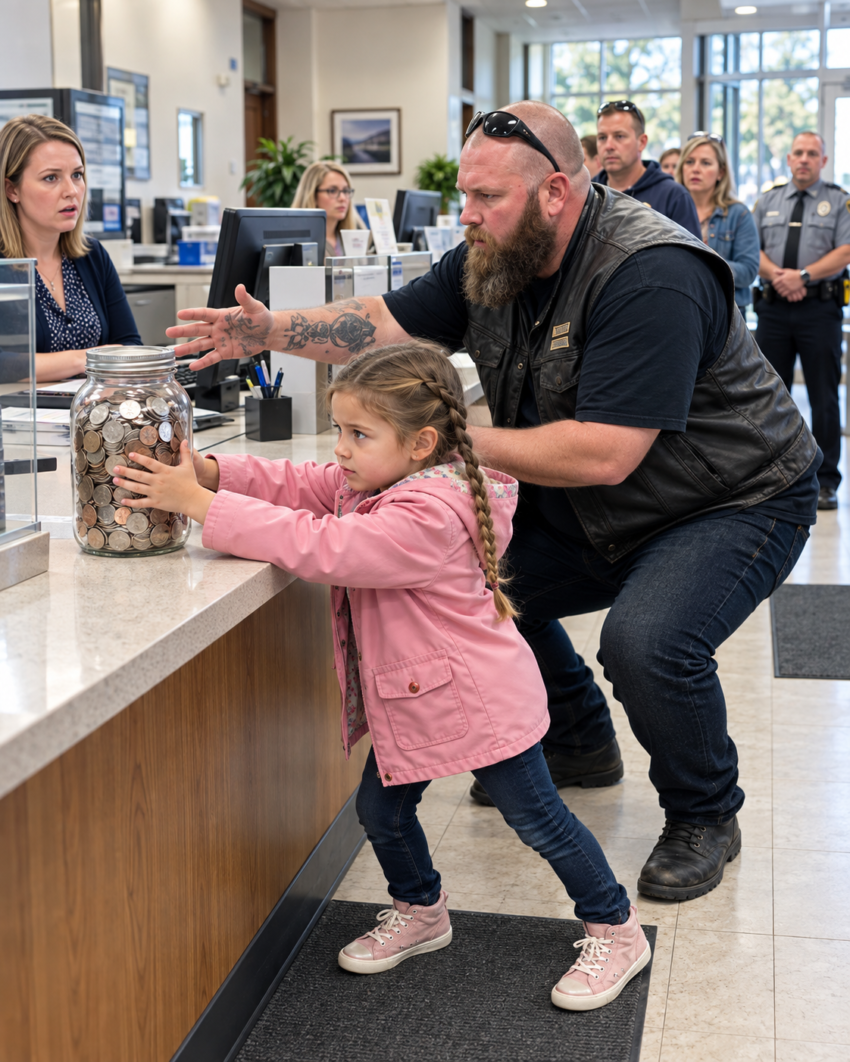
The Little Girl With the Coin Jar
At 10:17 on a rainy Tuesday morning, nine-year-old Maisie Calder walked into First Harbor Bank in Cedar Falls, Iowa, carrying a glass jar against her chest.
The jar was heavy enough that she needed both arms.
Inside were quarters, dimes, nickels, pennies, and a few crumpled dollar bills she had been saving since she was five.
On the lid, a strip of masking tape carried three words written in purple marker:
FOR DAD’S LEGS.
Teller Brooke Larkin noticed her immediately.
Maisie’s sneakers were wet. Her pale yellow raincoat was too thin for the weather, and there was no adult standing behind her.
Brooke stepped around the counter.
“Sweetheart, are you here with someone?”
Maisie shook her head.
“I came by myself.”
That answer changed everything.
Brooke guided her into a chair and asked where her parents were.
Her mother was working.
Her father was home.
“He can’t walk very well anymore,” Maisie explained. “I want to open a savings account so he can get fixed.”
Brooke swallowed.
“How much do you have?”
Maisie knew the exact number.
“Sixty-two dollars and seventeen cents.”
It was everything she owned.
The Man Who Heard Her Father’s Name
A large man standing near the customer-service desk turned when he heard the conversation.
His name was Wade Mercer.
At fifty-four, Wade had gray running through his beard and the weathered face of someone who had spent decades riding motorcycles through Midwestern winters.
The leather vest over his denim shirt belonged to a local motorcycle club called the Black River Riders.
Wade had come to the bank for an ordinary deposit.
Now he wasn’t moving.
“What’s your dad’s name?”
Maisie looked toward Brooke before answering.
“Evan Calder.”
Wade’s expression changed.
“What does your dad do?”
“He welds things. Well… he used to.”
Wade slowly removed his sunglasses.
“Calder Fabrication?”
Maisie nodded.
Wade remembered.
Four years earlier, a severe windstorm had torn part of the roof from the Black River Riders’ clubhouse. Contractors had quoted them amounts they couldn’t afford.
Then a welder named Evan Calder had appeared.
He brought equipment, steel, and two coworkers.
For nearly three weeks, Evan repaired the structure after finishing his regular shifts.
When Wade asked for the bill, Evan refused.
“Someone helped my family once,” he had said. “Call us even.”
Wade had never understood what he meant.
Until now.
What Happened to Evan
Maisie’s mother, Caroline, arrived twenty minutes later, terrified and breathless.
She rushed into the office and wrapped both arms around her daughter.
“Maisie! You cannot disappear like that. Do you understand how scared I was?”
Then she saw the jar.
Her anger disappeared.
“Oh, honey.”
Maisie lowered her eyes.
“I heard you and Dad talking last night.”
Caroline closed her eyes.
Evan had been injured eight months earlier while working at an industrial plant.
The accident had left him with serious damage around his lower spine. He could still move his legs, but standing had become increasingly difficult.
His specialist believed a particular procedure offered his strongest chance of improving.
His insurance company disagreed.
Twice.
The second rejection had arrived four days earlier.
Caroline had thought Maisie was asleep when she and Evan discussed the cost.
She wasn’t.
“Dad said we don’t have enough money,” Maisie whispered. “So I brought mine.”
Wade stared at the little jar.
Sixty-two dollars and seventeen cents couldn’t solve the problem.
But something about it made walking away impossible.
An Old Favor Finally Explained
When Wade learned Evan’s address, he asked Caroline if he could visit.
That afternoon, three motorcycles stopped outside a modest brick house on the edge of Cedar Falls.
Evan was resting in a hospital-style bed temporarily set up in the living room.
When he saw Wade, recognition appeared immediately.
“The clubhouse roof.”
Wade nodded.
“Still holding.”
Evan gave a weak smile.
“Good.”
Maisie placed her jar beside him.
Evan’s face fell.
“Maisie, no.”
“It’s for you.”
“That money is yours.”
“I don’t need anything.”
Evan reached for his daughter.
“You’re nine years old. You’re supposed to want things.”
Maisie climbed carefully beside him.
“I want you to walk with me again.”
For several seconds, nobody spoke.
Then Wade asked the question he had carried for four years.
“Why did you repair our roof for free?”
Evan looked at Caroline.
She answered.
Nine years earlier, when Caroline was expecting Maisie, a powerful storm trapped the couple on a flooded county road.
Their car stalled.
Cell service disappeared.
Then several motorcyclists came through the storm with a support truck behind them.
One of the riders helped get Caroline to the truck while another cleared debris from the road.
They reached Mercy Valley Medical Center less than an hour before Maisie was born.
The man who had driven the truck was a Black River Rider named Dean “Hawk” Talbot.
Hawk had passed away the previous year.Evan had never forgotten him.
When he later saw a news photograph showing storm damage at the Riders’ clubhouse, he recognized the patch.
So he repaired their roof.
No invoice.
No explanation.
Wade looked toward Maisie.
One favor had traveled nine years before returning to the same family.
The First Fight
Wade did not promise to pay for Evan’s treatment.
The amount was far beyond what the motorcycle club could raise alone.
Instead, he called attorney Natalie Kerr, who had previously helped one of their members through a complicated insurance dispute.
Natalie studied Evan’s rejection letters.
Something bothered her.
The language sounded generic.
She requested an expedited review supported by documentation from two specialists.
The request was rejected again.
Nearly the same wording.
Natalie placed both letters side by side.
“They’re using a template.”
Wade frowned.
“What does that mean?”
“It means I’m not convinced anyone properly reviewed his individual case.”
Meanwhile, the Riders organized a community fundraiser.
Contractors Evan had worked with donated.
Former coworkers contributed.
Neighbors arrived with twenty-dollar bills.
In less than two weeks, they raised more than $45,000.
It was enough to keep the possibility of treatment alive.
But not enough to solve everything.
The Victory That Wasn’t a Victory
Seven weeks later, an independent review overturned the insurer’s decision.
Caroline cried when Natalie called.
Maisie jumped around the living room.
Even Evan allowed himself to believe the nightmare might finally be ending.
Then the hospital called.
The main procedure had been authorized.
The specialized implant had not.
Neither had the rehabilitation program his medical team recommended afterward.
Without those pieces, the procedure could not move forward as planned.
Evan stared at the wall after hearing the news.
“Enough.”
Caroline turned toward him.
“What?”
“Everyone has done enough.”
Wade stood near the doorway.
“We’re not finished.”
“You should be.”
Evan pointed toward himself.
“I repaired a roof, Wade. I didn’t earn an army.”
Wade looked across the room.
Maisie’s coin jar sat on a shelf.
“Your daughter walked across town carrying everything she owned because she thought sixty-two dollars could save her father.”
Evan’s jaw tightened.
“Don’t bring her into this.”
“She’s already in it.”
Wade lowered his voice.
“When a nine-year-old thinks she has to solve a problem every adult system around her failed to solve, it stops being only your problem.”
Thirty-Nine Other Families
Natalie began searching for cases using language similar to Evan’s rejection letter.
She found one.
Then another.
Then seven.
Eventually, she found thirty-nine additional families.
A warehouse worker.
A truck driver.
A carpenter.
A machine operator.
A roofer.
Different injuries.
Different physicians.
Different recommended treatments.
But several rejection letters contained strikingly similar language.
Natalie assembled the records.
Wade and the Riders helped families organize documents, dates, medical recommendations, and correspondence.
Then a former claims employee contacted Natalie.
She had seen a local story about Maisie and her jar.
What she shared changed the case.
According to her sworn statement and supporting documents, staff had been under heavy pressure to process large numbers of expensive claims quickly, and standardized language was frequently used.
Evan’s case appeared to have been processed in minutes.
Natalie stared at the timeline.
Maisie had spent longer counting the coins in her jar.
The Case Becomes Bigger Than One Father
The dispute expanded to include all forty workers.
The families alleged that their claims had not received adequate individual review.
The insurer disputed the allegations and denied wrongdoing.
Attention grew quickly.
That created another problem.
Some reports focused less on the families and more on the motorcycle club.
Old photographs of Riders appeared online.
Their leather vests became part of the story.
Wade realized exactly what was happening.
At the next club meeting, several members wanted to ride to the insurer’s regional headquarters.
Wade refused.
He removed his vest and placed it on the table.
Then he placed Maisie’s coin jar beside it.
“Which one belongs at the center of this story?”
Nobody answered.
Wade tapped the glass.
“This.”
From then on, the Riders stopped speaking publicly about the dispute.
They drove families to appointments.
They built wheelchair ramps.
They delivered groceries.They helped organize paperwork.
Natalie handled the case.
Nobody Gets Left Behind
Nine months after Maisie first entered the bank, settlement discussions began.
The insurer offered to cover Evan’s procedure, implant, rehabilitation, and certain related expenses.
It was everything his family had originally wanted.
Evan refused.
Caroline stared at him.
“Evan, this could be our chance.”
He nodded.
“I know.”
Then he looked at the files Natalie had collected.
Thirty-nine other families.
“What happens to them?”
Natalie understood.
“We keep negotiating.”
Evan reached for Caroline’s hand.
“Then we keep negotiating.”
Weeks later, an agreement was reached covering qualifying medically necessary care and certain expenses for the group, while also establishing additional independent review procedures.
The company did not admit wrongdoing.
For Evan, that mattered less than what happened next.
His procedure was finally scheduled.
Six Hours Behind Hospital Doors
The operation lasted approximately six hours.
Caroline waited in the hospital.
So did Maisie.
And so did members of the Black River Riders.
Maisie kept her jar underneath her chair.
“Why did you bring that?” Wade asked.
“For luck.”
He smiled.
“Good reason.”
When the surgeon finally appeared, everyone stood.
The procedure had gone according to plan.
Recovery, however, would take time.
Nobody could guarantee exactly how much strength Evan would regain.
Maisie looked up at the doctor.
“Will my dad walk again?”
The physician crouched to her level.
“We gave him a much better chance.”
Maisie thought about that.
Then she smiled.
“A chance is enough to start.”
The First Step
Recovery was slow.
At first, Evan learned to sit upright without assistance.
Then he practiced transferring from his bed to a chair.
Later came the parallel bars.
Three seconds standing.
Then eight.
Then fifteen.
Some days he improved.
Other days felt like he had gone backward.
Maisie attended whenever she could.
Four months after the procedure, Evan stood between the parallel bars while a therapist supported him.
He moved his left foot.
Then his right.
One step.
Maisie covered her mouth.
Evan took another.
His eyes filled.
“Dad!”
He looked toward his daughter.
“I’m coming, kiddo.”
It was only a few feet.
To Maisie, it might as well have been a mile.
The Jar That Was Never Spent
One year later, Evan entered the Black River Riders’ clubhouse using forearm crutches.
Above him stood the roof he had repaired years earlier.
Beside the main beam was a small glass display case.
Inside sat Maisie’s jar.
Every coin remained.
$62.17.
Not one cent had paid for treatment.
Maisie looked confused.
“Why didn’t you spend it?”
Evan smiled.
“Because it was never really about the money.”
“Then what was it?”
He looked toward Wade.
Then toward the roof.
“It was you knocking on a door and reminding people to open it.”
Beside the jar, Wade placed Hawk Talbot’s old red bandana.
One man had helped a young couple through a storm.
Years later, that couple’s husband had repaired a roof.
Years after that, their daughter carried a jar of coins into a bank.
None of them had planned what followed.
Yet forty families eventually stood beneath that same roof.
Maisie had arrived believing sixty-two dollars could help her father walk again.
She had been wrong about the price.
But she had been right about something much more important.
Sometimes you do not need enough to finish something.
You only need enough to begin.
A small act of kindness may seem forgotten for years, but kindness has a remarkable way of traveling through different lives until one day it returns to a door nobody expected it to find.
The value of a gift should never be measured only by the number written beside it, because sixty-two dollars given with a child’s entire heart can sometimes move more people than a fortune offered without compassion.
Families do not always need someone powerful enough to solve every problem; sometimes they simply need one person willing to listen carefully, believe them, and refuse to walk away when the situation becomes difficult.
Helping someone without expecting repayment does not make the kindness disappear, because the person who receives it may carry that memory for years and eventually pass it forward when another family needs help.
Maisie could not pay for her father’s treatment, but her courage reminded the adults around her that doing something small is often more powerful than standing still because the entire problem feels too large.
Real strength is not always loud or dramatic; sometimes it looks like a father learning to take one painful step, a mother refusing to surrender hope, or a little girl carrying a heavy jar through the rain.
A community becomes meaningful when people stop asking what they are required to do and begin asking what they are capable of doing for someone who has run out of options.
The best way to honor someone who once helped you is not simply to repay that person, but to keep their kindness moving forward until it reaches people they may never meet.
Life rarely gives us the power to fix everything at once, but it often gives us the opportunity to knock on one door, make one phone call, take one step, or speak one sentence that starts something much bigger.
Never underestimate a small beginning, because sometimes all it takes to change dozens of lives is one child, one jar, sixty-two dollars and seventeen cents, and a group of people willing to say, “We are not leaving anyone behind.”