PART 1 — THE LETTER BESIDE MY COFFEE
My mother-in-law was standing in my kitchen with one manicured finger pressed against the promotion letter when she told me to divorce her son.
“If you take that job, Claire, then you might as well end the marriage now.”
The rain had been falling since before dawn, streaking the windows of our Portland house and turning the backyard gray. Ten minutes earlier, I had been sitting across from my husband, Ethan, trying to tell him that after eleven years of working my way through the same company, I had been offered the position of senior director in our Seattle office.
The salary was almost double what I had earned when we married. The package included stock options, relocation assistance and enough of an increase that we could finally rebuild the savings we had spent years dipping into whenever Ethan’s mother had another emergency.
I had imagined Ethan asking about the office or laughing because I had spent the previous week insisting I had probably blown the final interview.
Instead, before I could finish explaining the offer, our front door opened.
Linda walked in wearing a cream trench coat.
She had her own key.
I had never given it to her.
That should have bothered me more than it did, but by then there were so many things about Linda that I had trained myself to classify as easier to tolerate than confront.
She placed her purse on the kitchen table, glanced at the letter beside my coffee and read enough to understand what it was.
“Seattle?” she asked.
“Yes. They want me to start next month.”
Linda didn’t congratulate me. She didn’t ask whether I was excited or what the position involved. Instead, she turned toward Ethan.
“You’re not moving.”
I looked at my husband. “Did you call her?”
Ethan rubbed the side of his coffee mug without answering.
That was answer enough.
Linda pulled out a chair as though she had been invited to participate in a family meeting.
“My son isn’t moving two hundred miles away from me because your company waved a bigger paycheck in front of you.”
“It’s not just a bigger paycheck.”
“It’s a job.”
“It’s my career.”
Linda gave me the small, patient smile she used whenever she wanted to make disagreement look childish.
“Then decline it and wait for another opportunity here.”
I had spent eleven years waiting for opportunities. Ethan knew that. He had watched me work weekends, take certification courses at night and cover responsibilities above my title because I believed eventually someone would notice.
Someone finally had.
“I’m not declining it.”
Linda’s smile disappeared.
She tapped the promotion letter.
“Then divorce my son.”
For a few seconds, the only sound in the kitchen was the rain.
I waited for Ethan to say something so obvious that it shouldn’t have required courage.
Mom, you don’t get to decide whether my wife stays married to me.
He kept looking at the table.
“Ethan?”
He finally lifted his eyes.
“Mom needs me here.”
I almost laughed, although there was nothing funny about it.
For seven years, Mom needs me had functioned like a third vow in our marriage. Linda needed Ethan to check her garage door because it made a strange noise. She needed us to cancel a weekend at the coast because she was lonely after an argument with her sister. She needed help with a credit card balance, then a transmission repair, then a dental bill she swore insurance would reimburse.
The reimbursements rarely appeared.
The loans were almost never repaid.
And somehow every emergency Linda had eventually became something Ethan and I were expected to solve together.
“I need you too,” I said.
Linda leaned toward me, bringing the heavy floral scent of her perfume across the table.
“You are temporary, Claire. I am permanent.”
I looked at Ethan again.
This was his chance.
Instead of defending me, he exhaled and said, “Maybe you should go if you want it that badly.”
Something inside me became extraordinarily quiet.
Not broken.
Finished.
I picked up the promotion letter, slid it into the brown leather folder I carried to important meetings and placed the folder inside my work bag.
Linda mistook my silence for surrender.
“Once you calm down, you’ll realize a title isn’t worth destroying a family.”
I looked at her.
“You’re probably right about one thing.”
Her expression sharpened.
“What’s that?”
“I need to think about what this family is worth to me.”
That night I packed one suitcase.
Ethan hovered in the bedroom doorway while I folded enough clothes for several days and packed my laptop, medication and toiletries. He kept talking as though the right explanation might return us to the argument he preferred.
“You’re being dramatic.”
I zipped a side compartment.
“Mom didn’t mean it literally.”
I packed my charger.
“You could take the job and commute for a while. We don’t have to decide everything tonight.”
When I turned our wedding photograph facedown on the dresser, he finally stopped.
“Are you really leaving?”
“You told me to go.”
“I didn’t mean divorce.”
I looked at him then.
“But you let her mean it.”
For the first time that day, Ethan looked frightened.
Not angry.
Not irritated.
Frightened.
I spent the next week with a friend, went to work, accepted the promotion and started researching apartments near Seattle. Ethan sent long messages about compromise, but every compromise required me to absorb the inconvenience.
I could commute.
I could rent a small place in Seattle during the week and return to Portland every weekend.
I could delay the start date.
I could ask whether the company would let me work remotely.
He never once suggested that he could look for work in Seattle.
Then Linda texted me.
Don’t throw away seven years because you’re suddenly impressed with yourself.
I read it twice.
Then I saved it.
By the end of the second week, Ethan had retained an attorney.
So did I.
The divorce moved faster than I expected, partly because we had no children and partly because Ethan wanted it finished before my relocation.
At mediation, Linda sat outside the conference room behind a glass wall, checking her phone and occasionally looking in at us as if she were supervising the transaction.
Ethan wanted the Portland house.
I let him have it in exchange for his share of other marital assets.
He wanted most of the furniture.
Fine.
I wanted my retirement account, my personal savings, my vested and future employment stock grants, and one clause preserving each spouse’s separate inherited and trust-held assets.
His attorney paused.
“There’s a family trust?”
“Yes,” my attorney said. “It has been disclosed.”
Ethan leaned back.
“It’s sentimental stuff. Old jewelry, investments, maybe some land nobody wants.”
I looked across the table at him.
“Then you won’t mind the clause.”
He laughed.
“Claire, I’m not trying to steal your grandmother’s jewelry.”
His attorney began reading the language more carefully, but Ethan was impatient.
He wanted the house.
He wanted the process over.
Most of all, I think he wanted to prove that my decision to leave had not unsettled him nearly as much as it had.
The clause was mutual. Anything inherited, gifted or held through a family trust remained separate, whether already distributed or distributed later.
His attorney explained it.
My attorney explained it.
Ethan signed.
I signed.
Through the glass, Linda smiled.
Three weeks later, the judge finalized our divorce.
That evening, an unknown number texted me.
I hear you bought a house. Don’t embarrass Ethan by living somewhere cheap just to prove a point.
I recognized Linda’s punctuation before I recognized the number.
I saved that message too.
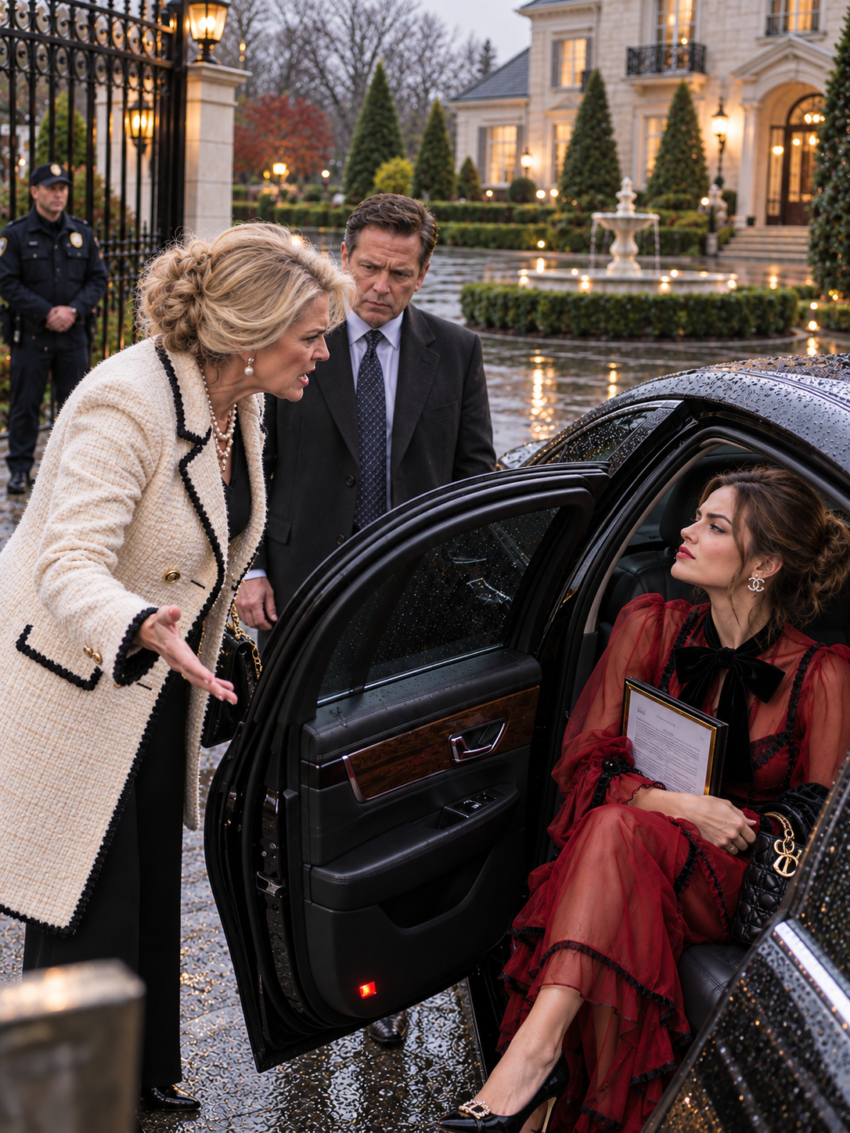
The following morning, I drove north through the mist toward Briar Ridge Estates outside Seattle.
The road narrowed between cedar trees before reaching a private stone entrance with tall iron gates.
Linda was already there.
Of course she was.
She stood beside her car in a black coat, red lipstick bright against the gray morning, arguing through the window of the security booth.
“You don’t understand. My former daughter-in-law lives here. I’m family.”
The guard checked his screen.
“You’re not on the access list, ma’am.”
Linda turned when she heard my car.
Her irritation immediately became satisfaction.
She stepped away from the booth and folded her arms.
“So this is it?” she called. “You rent some guesthouse behind a fancy gate and suddenly you’re too important to answer your phone?”
I lowered my window.
“I never said I rented anything.”
Her smile faltered.
The guard stepped out.
“Good morning, Ms. Bennett. Welcome home.”
The iron gates began to open.
Beyond them, a long private drive disappeared between rows of cedar trees.
Linda looked past me.
Then at the guard.
“Which house is hers?”
The guard hesitated.
I reached into the passenger seat and lifted the same brown leather folder Ethan had watched me carry into our divorce meeting.
Linda’s gaze dropped to the embossed seal on the front.
THE BENNETT FAMILY TRUST.
Then the guard answered.
“Ma’am, there isn’t another house on that parcel.”
For once, Linda had nothing to say.
PART 2 — THE DOCUMENT HE NEVER BOTHERED TO READ
The first page inside the leather folder was the deed.
I didn’t hand it to Linda. I simply turned it enough for her to see the owner line.
THE BENNETT FAMILY TRUST.
Her face tightened.
“That’s impossible.”
A dark SUV stopped behind her car before I could answer.
Ethan climbed out.
He had apparently received the same information Linda had, because he walked toward us with the expression of a man expecting an argument rather than a surprise.
Then he looked through the gates.
Briar Ridge stood on a wooded rise at the end of the drive, pale stone framed by tall windows and dark cedar beams. My grandmother had never liked flashy things, and the house reflected that: large without being ostentatious, private without trying to announce what it cost.
Ethan stared at it.
Then at me.
Linda recovered first.
“Whatever game you’re playing, Ethan is entitled to half.”
I looked at my former husband.
“Is that what you told her?”
His jaw tightened.
The guard glanced toward me.
“Ms. Bennett, your attorney is waiting at the main house.”
Ethan’s expression changed immediately.
“Attorney?”
The house had surprised him.
That word frightened him.
I closed the folder.
The deed was only the first page.
Behind it was the trust amendment covered by the clause Ethan had signed during our divorce. Behind that was another document bearing a signature he would recognize immediately.
His own.
Six months before our marriage ended, Linda had called us after midnight crying about her condo. She had refinanced twice, fallen behind on the mortgage and received a notice from the lender that she insisted she didn’t understand.
Ethan panicked.
I had contacted the administrator of my grandmother’s trust and arranged a short-term loan so Linda could bring the mortgage current.
The trust required documentation.
Ethan signed it.
Linda signed it.
Both documents stated that the money came from the Bennett Family Trust, that neither borrower acquired any ownership interest in trust property, and that Linda was required to repay the loan according to an attached schedule.
At the time, Ethan had barely glanced at the paperwork.
“Just tell me where to sign.”
I remembered those words clearly.
Now I opened the folder enough for him to see the signature.
He went still.
“Claire, what’s that?”
“Something you signed.”
Linda reached toward my sleeve.
The guard stepped between us.
I put the folder back inside the car.
“You’ll need to move your vehicle away from the entrance,” the guard told Linda.
“I’m going with her.”
“No, ma’am.”
Linda pointed at me.
“I’m her family.”
I met her eyes.
“No. You’re not.”
I expected saying it to feel cruel.
It didn’t.
It felt accurate.
I drove through the gates and watched them close behind me.
My attorney, Naomi Chen, was waiting in the library with two coffees and a stack of documents spread across the walnut table.
She had handled matters involving the trust after my grandmother died and reviewed every page of my divorce settlement.
“You showed them the deed?”
“The first page.”
Naomi smiled faintly.
“Restraint. I admire it.”
I sat down, more tired than triumphant.
Briar Ridge had belonged to my grandmother’s trust for years. My grandparents had built a small manufacturing company, sold it decades earlier and placed much of what remained into a trust for their children and grandchildren.
It wasn’t a secret fortune I could casually spend.
The trust paid for education, maintained several family assets and made conservative investments. My grandmother’s philosophy was simple: money should create choices, not noise.
Briar Ridge had been her last major purchase.
Eight months before my marriage ended, she died.
An amendment to the trust gave me exclusive occupancy rights to the property and, after the administrative period, substantial authority over its future.
Ethan knew a family trust existed.
He simply never cared enough to understand it.
That distinction mattered.
I had not hidden assets during the divorce. Both attorneys had been told about the trust, and Ethan had explicitly released any claim to inherited or trust-held property in exchange for the same protection over his separate assets.
He had signed because he thought there was nothing valuable enough to investigate.
Naomi pushed another statement toward me.
“There’s something else we need to discuss.”
It concerned Linda’s loan.
She had made exactly two payments.
Then she stopped.
“The cure period ends Friday,” Naomi said. “The trustee has already sent three notices.”
I rubbed my forehead.
“What happens if she doesn’t pay?”
“Exactly what the agreement says. The trust follows its ordinary collection process.”
“No special treatment?”
Naomi shook her head.
“No punishment either.”
That mattered.
I didn’t want to invent consequences because Linda had insulted me.
I wanted her to encounter the consequences of documents she had already signed.
My phone buzzed repeatedly on the table.
Ethan.
Linda.
Ethan again.
I turned it facedown.
By noon, the calls stopped.
A message from Ethan appeared.
Can we talk without Mom?
I agreed to meet him the following morning at Naomi’s office.
He arrived alone.
That was unusual enough that I noticed immediately.
He looked exhausted and older than he had a month earlier. His wedding ring was gone, and although mine had been off for weeks, seeing his bare hand still produced a small ache I couldn’t entirely dismiss.
Seven years didn’t disappear because the last year had been bad.
Ethan sat opposite me.
“So the house is really yours?”
“The trust owns it. I have exclusive occupancy rights.”
“And eventually?”
“Eventually isn’t your concern anymore.”
He flinched.
For years I had softened every boundary with apologies.
I didn’t anymore.
Ethan glanced toward Naomi.
“Can the settlement be reopened?”
Naomi answered before I had to.
“You had independent counsel. The trust was disclosed. The release was mutual. If you believe your former attorney failed to advise you adequately, you may consult another attorney, but Claire will not renegotiate the settlement.”
He looked back at me.
“I didn’t know Briar Ridge was part of it.”
“You didn’t ask.”
“You made the trust sound small.”
“No. You decided it was small.”
He rubbed his forehead.
Then came the sentence I had expected.
“Mom thinks you hid it deliberately.”
I almost laughed.
“Your mother also thought I was temporary.”
His eyes lowered.
“I know.”
“No, Ethan. You heard her say it. Knowing would have required you to do something.”
The silence stretched between us.
Once, I would have rushed to fill it.
I let it remain.
Eventually he said, “I thought you’d cool off.”
I looked at him carefully.
“You thought I’d give up Seattle?”“I thought we’d figure something out.”
“You mean I would figure something out.”
He didn’t answer.
Naomi slid a photocopy across the table.
The loan acknowledgment.
Ethan saw his signature.
His face changed.
“Mom’s condo?”
“Yes.”
“She told me that was handled.”
“It was. With a loan.”
I watched him scan the page.
“She’s been paying this back?”
Naomi answered.
“She made two payments.”
Ethan looked up sharply.
“Two?”
“The trust administrator sent multiple notices after she stopped.”
His expression shifted from confusion to disbelief.
“She told me Claire barely helped. She said there was just a small gap.”
“I covered the amount she requested,” I said. “You signed the paperwork.”
He stared at his signature.
For the first time since our marriage ended, the anger on his face wasn’t directed toward me.
Before he could say more, Naomi’s assistant appeared at the door.
“Ms. Chen, there’s a woman at reception insisting there’s a family emergency.”
I didn’t need to ask who.
Linda entered less than a minute later carrying a thick envelope.
“You’re trying to take my home.”
Naomi stood.
“Mrs. Hayes, this is a private meeting.”
“I’m his mother.”
“Claire is my client.”
Linda slapped the envelope onto the table.
“These notices are harassment.”
Naomi opened the envelope and glanced through the pages.
“They’re notices required under the loan agreement you signed.”
Linda pointed toward me.
“She can forgive it.”
“I can’t unilaterally rewrite the trust.”
“You could ask.”
I held her gaze.
“I already did.”
Ethan turned toward me.
“What?”
“Last year. I asked the trustee to give her an extension because she told me you were under too much pressure at work and she didn’t want you worrying.”
Linda’s face changed.
It was slight, but Ethan saw it.
“You told me Claire refused to help you.”
Linda straightened.
“I was protecting you.”
“From what?”
She gestured toward me.
“From finding out exactly what kind of woman you married. She sat on all this money while we struggled.”
Naomi opened another file.
“Mrs. Hayes, the records show that Claire used marital funds for several of your expenses before the trust loan was ever issued.”
Linda went quiet.
Naomi turned the ledger toward Ethan.
Roof repair.
Car payment.
Credit card transfer.
Dental work.
Insurance deductible.
Not all of it had come from the trust.
Much of it came from the joint account Ethan and I had built paycheck by paycheck.
Ethan stared at the pages.
“Why didn’t you tell me the total?”
“I told you about every payment when it happened.”
“Not like this.”
“Because every time I questioned another expense, you told me your mother needed us.”
His mouth opened, then closed.
Linda stepped closer to him.
“She’s turning you against me.”
I stood and picked up my bag.
“No.”
Both of them looked at me.
“I’m leaving you with the paperwork.”
That was the difference I finally understood.
Linda needed Ethan to choose somebody.
For years, so had I.
I didn’t anymore.
The trust never took Linda’s condo.
Two days before the deadline, she refinanced through another lender and repaid the overdue balance. Ethan helped her organize the paperwork, but he didn’t call me for money.
That was enough.
Briar Ridge remained behind its iron gates.
Linda called the property office twice claiming her exclusion from the guest list was a clerical mistake.
It wasn’t.
My instruction to security remained simple: Linda Hayes was not authorized to enter unless I personally approved it.
I never did.
A month later, I started the Seattle job.
The first weeks were difficult in ways I welcomed. I had a new team, unfamiliar systems and responsibilities large enough that I sometimes drove home mentally replaying meetings.
But when my phone rang during the workday, I no longer braced for Linda’s latest emergency.
I bought groceries without wondering which unexpected bill might empty our joint account before Friday.
On Sundays, I slept until I woke naturally.
And gradually I learned the sound of rain against the roof of a house where nobody could walk through the front door simply because they believed they belonged there.
Several months later, Ethan asked to meet at a coffee shop halfway between Portland and Seattle.
He looked different.
Not transformed.
Not suddenly wiser.
Just quieter.
He told me he had started therapy and had begun setting boundaries with Linda after discovering several other bills she had concealed from him.
I listened without congratulating him for doing something he should have done years earlier.
Eventually he wrapped both hands around his coffee.
“I’m sorry.”
There had been a time when those two words would have been enough to make me stay.
Now they were enough only to hear.
“I kept expecting you to understand what I needed without making me say it,” he continued. “Whenever Mom was upset, I treated it like an emergency. Whenever you were upset, I acted like it was something you’d eventually get over.”
I looked down at my coffee.
It was probably the most accurate description of our marriage he had ever given me.
“I should have defended you that morning.”
“Yes.”
“I should have gone with you.”
I shook my head.
“No. You should have decided what you wanted before your mother decided it for you.”
He swallowed.
“Was there ever a chance after that morning?”
I thought of Linda’s finger pressing against the promotion letter.
I thought of Ethan staring into his coffee while his mother called me temporary.
Most of all, I remembered his voice.
Maybe you should go if you want it that badly.
“No,” I said. “Not after you made me choose between having a future and being your wife.”
Ethan nodded.
There was grief in his face.
I felt it too.
Leaving him had not erased every good year we shared. It simply meant the good years were no longer enough to purchase more bad ones.
When I reached Briar Ridge that evening, the iron gates began opening before my car came to a complete stop.
The guard lifted one hand.
“Welcome home, Ms. Bennett.”
Months earlier, Linda had stood at those same gates demanding to know which little house I was renting.
Now the road beyond them was quiet, wet from an afternoon shower, and entirely mine to travel without explaining myself to anyone.
Inside the house, I carried the brown leather folder into the library.
I opened the bottom drawer of my grandmother’s old desk and removed the deed.
For months, I had thought that document represented the moment my life changed.
It didn’t.
I placed it at the bottom of the drawer.
Then I took out the promotion letter Linda had tapped with one manicured finger that rainy Tuesday morning.
The paper was slightly bent at one corner from all the times I had carried it between Portland and Seattle.
I smoothed it once.
Then I placed it on top of the deed and closed the drawer.
Outside, the iron gates settled shut behind me.