THE SIGNATURE THAT SHOULD NEVER HAVE EXISTED
At exactly 10:00 on a gray Tuesday morning, my father leaned toward me across Courtroom 4B and smiled as though he had already won.
“Give it up, Claire,” he murmured. “You’ve embarrassed this family long enough wearing that uniform.”
Then his attorney placed a notarized document in front of the judge.
According to that single sheet of paper, I had voluntarily surrendered my rights to a family trust worth nearly $31 million.
My father believed it was checkmate.
What he did not know was that I recognized the name beneath the notary seal.
And the man whose signature appeared there could not possibly have signed it.
I knew because seven years earlier, on the exact date printed on that document, he had spent his final moments beside me thousands of miles from Virginia.
THE ENVELOPE AT MY DOOR
Two days earlier, I had been trimming overgrown azaleas outside my modest home near Virginia Beach when a cream-colored county envelope arrived.
I almost left it on the kitchen counter.
Then I saw the names.
Harlan and Judith Mercer versus Claire Mercer.
My parents were taking me to court.
I sat at my kitchen table while Ranger, my aging rescue dog, rested his head against my knee.
Twelve years had passed since I had shared a real conversation with either of my parents.
Our relationship had begun falling apart when I chose military service instead of the carefully planned life my father had designed for me.
Harlan Mercer had always imagined his only daughter attending an elite university, marrying into the right family, and eventually helping oversee the Mercer family’s investments.
Instead, I joined the military.
My mother sent me one message after training.
“Your father says you made your choice.”
I stared at those words for several minutes before deleting them.
From then on, I stopped trying to earn their approval.
I built my own life.
I worked in logistics, coordinated teams in difficult environments, learned to make decisions when hesitation could cost people everything, and discovered that respect earned through service meant far more to me than approval handed out because of a last name.
Years later, an overseas incident ended that chapter of my career.
I returned home with a reconstructed knee, a permanent limp, and memories I rarely discussed.
I also returned carrying a folded flag belonging to my closest friend, Lieutenant Nathan Hale.
Nathan had been more like a brother than a colleague.
There were days when I still expected my phone to light up with one of his terrible jokes.
It never did.
THE FARM MY GRANDFATHER LEFT ME
The only Mercer who had supported my decision was my grandfather, Arthur.
He never cared whether I wore an expensive dress or a service uniform.
Once, when my father criticized my choices at Thanksgiving, Grandpa Arthur simply looked at me and said:
“A good life isn’t the one other people planned for you. It’s the one you can respect when you’re alone with yourself.”
When he passed away, he left me his old coastal farm outside Chesapeake.
It was not glamorous.
The porch leaned slightly. The barn needed work. The roof demanded constant attention.
But I loved every acre.
For years, even while working overseas, I paid the property taxes, insurance, maintenance expenses, and contractor bills.
Now my parents claimed I had abandoned it.
According to their lawsuit, they had maintained the property for seven years and therefore deserved legal ownership.
That alone was absurd.
But the lawsuit mentioned something else: the Mercer Lantern Trust.
Thirty-one million dollars.
I had heard the name only once as a teenager, when my grandfather and father argued behind a closed office door.
I never knew the trust had anything to do with me.
Apparently, ownership of the farm determined who controlled it.
Suddenly, I understood why my father had resurfaced after twelve years.
This was never about a farmhouse.
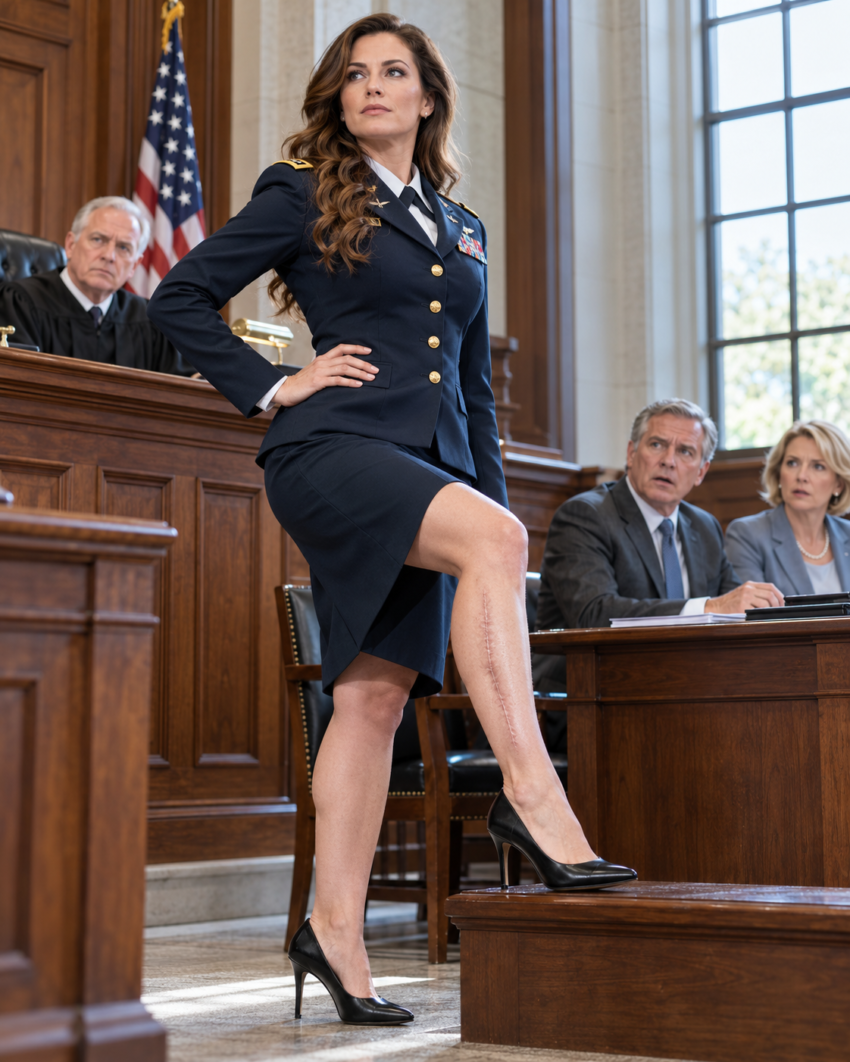
I WORE THE UNIFORM
On the morning of the hearing, I opened an old storage trunk at the foot of my bed.
Inside was my formal uniform.
For several minutes, I simply stared at it.
Then I put it on.
I carefully positioned every ribbon and insignia where it belonged.
I was not wearing it to impress my father.
I wore it because he had spent years treating my service as proof that I had disappointed him.
That morning, I wanted to walk into court as exactly the woman he had refused to accept.
When I entered Courtroom 4B, my father looked at me and laughed quietly.
My mother did not.
Judith sat beside him wearing a pale gray suit and the same pearl necklace I remembered from childhood. Her hands remained tightly folded in her lap.
She barely looked at me.
Judge Raymond Holloway reviewed several documents before raising his eyes.
“Commander Mercer, your parents claim they have been solely responsible for maintaining the disputed property for approximately seven years. Do you have documentation showing otherwise?”
I placed a thick folder on the table.
“Yes, Your Honor. Property taxes, insurance records, contractor invoices, bank transfers, and maintenance agreements going back more than a decade.”
My father’s attorney, Grant Pollard, stood before I could open the folder.
“Your Honor, none of that changes the central issue.”
He approached the bench carrying a single page.
My father smiled.
Pollard continued.
“We have a notarized quitclaim document signed by Commander Mercer herself, voluntarily transferring her interest in the property to her parents.”
For the first time that morning, my confidence wavered.
A court officer handed me a copy.
I looked down.
My name was there.
Claire Mercer.
The signature looked disturbingly close to mine.
Below it was an official-looking seal.
October 14, 2019.
My father leaned back in his chair.
“You can stop pretending now, Claire.”
I barely heard him.
My eyes were fixed on the name beside the seal.
Lieutenant Nathan Hale.
THE DATE THAT CHANGED EVERYTHING
Judge Holloway adjusted his glasses.
“Commander Mercer, are you saying this is not your signature?”
“I never signed this document.”
Pollard gave a small shrug.
“People sometimes forget paperwork they signed years ago.”
My father laughed.
“She remembers whatever is convenient.”
I looked again at the date.
October 14, 2019.
Suddenly, the courtroom disappeared around me.
I remembered dust.
A damaged vehicle.
Nathan beside me.
The watch on my wrist.
2:00 p.m.
I remembered holding his hand and telling him that his family would know how much he meant to everyone around him.
Then I looked at Judge Holloway.
“Your Honor, I don’t need a handwriting specialist to show you this document cannot be authentic.”
The judge leaned forward.
“Explain.”
I stood slowly.
My injured knee protested, but I ignored it.
“This document says it was notarized on October 14, 2019, by Lieutenant Nathan Hale.”
I pointed toward the seal.
“That day, Nathan and I were approximately eight thousand miles away from Virginia on an overseas assignment.”
My father’s smile disappeared.
Pollard looked down at his papers.
I continued.
“And by 2:00 that afternoon, Lieutenant Hale was no longer able to sign anything. I was beside him during his final moments.”
No one moved.
Judge Holloway stared at the document.
Then he looked at my father.
My father’s face had gone pale.
“That’s not possible,” he whispered.
I turned toward him.
For twelve years, I had imagined a hundred things I might say if I ever had the chance to confront him.
What came out was much simpler.
“You’re right, Dad. It isn’t possible.”
I raised the document.
“Which means someone created this afterward and used the name of a man who could never challenge it.”
The silence in the courtroom became almost unbearable.
MY MOTHER’S SECRET
Judge Holloway immediately ordered everyone connected to the case to remain inside the courtroom while the document was examined further.
My father’s attorney began speaking rapidly.
My father demanded to know what was happening.
Through all of it, my mother remained strangely calm.
Then, while attention shifted toward the judge, she walked past me.
Her fingers closed around my hand.
Something cold dropped into my palm.
A brass key.
Judith leaned close enough that only I could hear her.
“Commonwealth Federal. Safe-deposit box 402.”
I stared at her.
“Mom?”
Her expression remained still.
“Go there before your father realizes what has happened.”
I closed my fingers around the key.
“What’s inside?”
For the first time, my mother’s eyes met mine directly.
There was fear there, but something else too.
Determination.
“The reason your grandfather really created the trust.”
Then she stepped away and instantly became the nervous, silent wife everyone expected her to be.
That was when I understood something unsettling.
My mother had been hiding behind that role for years.
BOX 402
Later that day, after receiving permission to leave, I went directly to Commonwealth Federal.
The manager led me into a private room.
Box 402 was heavier than I expected.
Inside were three folders, an encrypted drive, several photographs, and a letter written in my grandfather’s unmistakable handwriting.
Claire,
If you are reading this, then someone has tried to take control of the Lantern Trust.
The money was never intended to enrich the Mercer family.
It was created to protect people who served beside us and the families who carried the cost afterward.
My hands began shaking.
The next folder contained financial records.
Transfers.
Shell organizations.
Accounts I did not recognize.
And then I found my father’s name.
At first, I assumed he had been stealing from the trust.
The truth was more complicated.
Years earlier, he had discovered that a former business partner, Malcolm Reeve, was quietly using parts of the Mercer financial network for unauthorized operations.
My father had tried to confront him.
Reeve responded by gaining leverage over our family.
Suddenly, pieces of my childhood began rearranging themselves.
My father’s paranoia.
My mother’s silence.
Grandpa’s secretive meetings.
My father’s obsession with controlling everything I did.
None of it excused the way he treated me.
But it suggested another story had been unfolding beneath the one I knew.
THE MAN BEHIND THE MONEY
The investigation moved quickly after authorities examined the contents of Box 402.
My mother finally told me the rest.
For years, she had quietly collected evidence while pretending not to understand my father’s business dealings.
Nathan had discovered irregularities during an unrelated logistics review overseas.
That was why his name had been useful to whoever created the false document: his old authorization records could be copied, and he was no longer around to object.
But whoever manufactured the document made one devastating mistake.
They chose the wrong date.
My father had agreed to use the forged paperwork because Reeve convinced him that taking control of the trust was the only way to keep our family protected.
He had been willing to betray me to save himself.
That truth hurt more than the lawsuit.
When I finally confronted him privately, he could not look me in the eye.
“I thought I could fix everything once I controlled the trust,” he said.
“By taking it from me?”
“By keeping Reeve away from you.”
I shook my head.
“You don’t protect your daughter by destroying her life before someone else can.”
He closed his eyes.
For once, my father had no answer.
THE CHOICE HE FINALLY MADE
The following weeks changed everything.
My father agreed to cooperate with investigators and turn over years of records he had hidden.
Reeve’s network began unraveling.
Accounts were frozen. Documents surfaced. Former associates started talking.
My mother provided the records she had spent years protecting.
And my father finally admitted the truth publicly.
The farm belonged to me.
The quitclaim document was false.
The Lantern Trust had been created by my grandfather for a purpose far greater than any of us.
My relationship with my father never magically repaired itself.
Real life rarely gives people such clean endings.
There were too many years between us.
Too many cruel words.
Too much silence.
But before our final conversation, he said something I had waited almost my entire adult life to hear.
“I was wrong about you, Claire.”
I looked at him.
“About the uniform?”
He shook his head.
“About who you became without me.”
SIX MONTHS LATER
By spring, the azaleas were blooming again.
I stood on the restored porch of my grandfather’s farm while warm Atlantic air moved across the fields.
The sagging boards had been replaced. The house had been repainted. The barn had been renovated.
Above the entrance hung a simple bronze sign:
THE HALE-MERCER FOUNDATION.
The $31 million Lantern Trust now funded legal assistance, counseling, temporary housing, career support, and family services for veterans and the loved ones of service members who never came home.
My mother walked onto the porch carrying two cups of coffee.
She had changed during those six months.
Or perhaps I was finally seeing the woman she had always been.
She handed me a cup.
“Your grandfather would have loved this.”
I looked across the lawn.
Ranger was slowly chasing a tennis ball thrown by a young veteran visiting the foundation with his family.
“Nathan would have complained that we used his name.”
Mom smiled.
“And secretly loved every second of it.”
I laughed.
For once, remembering Nathan did not feel like reopening an old wound.
It felt like remembering a friend.
I reached beneath my collar and touched the small brass key hanging from a silver chain around my neck.
For most of my life, I thought inheritance meant property.
Then I thought it meant $31 million.
I had been wrong both times.
The real inheritance my grandfather left me was a responsibility.
Nathan left me an example of loyalty.
My mother taught me that courage can exist quietly for years before anyone notices it.
Even my father left me something valuable: the understanding that love without respect can become another form of control, and that forgiveness does not require pretending the past never happened.
I looked at the restored farmhouse, the families walking across the property, and the new sign shining above the door.
For twelve years, I had believed my family rejected me because I had chosen the wrong life.
Now I understood that choosing my own life had been the decision that eventually allowed me to save what mattered most.
The forged signature was supposed to take away my inheritance.
Instead, it revealed what my inheritance had been meant to become all along.
Sometimes the moment designed to humiliate you becomes the very moment that exposes the truth, because patience, preparation, and facts can speak far louder than the people who underestimated you.
Family ties may explain why we keep hoping for someone’s approval, but they should never require us to surrender our dignity, identity, or the life we have worked honestly to build.
A person can spend years being treated like the disappointment of a family and still discover that the qualities others criticized were exactly the qualities needed when everything finally fell apart.
Real courage is not always loud or dramatic; sometimes it looks like keeping records, protecting evidence, waiting for the right moment, and refusing to abandon the truth even when remaining silent would be easier.
Money can reveal people’s motives, but what we choose to do with money reveals our character, and a fortune used to rebuild lives can become far more valuable than a fortune kept behind locked doors.
Forgiveness does not mean rewriting the past or pretending painful choices never happened; it can simply mean refusing to let someone else’s mistakes decide how you live the rest of your life.
The people who truly respect us may not always be the ones who share our name, because loyalty is proven through actions, especially during the moments when standing beside someone comes with a personal cost.
Being underestimated can hurt, especially when it comes from your own family, but you do not need everyone to understand your path before you are allowed to believe that the path is worth walking.
Some inheritances arrive as houses, accounts, or legal documents, while the most important ones arrive as principles, responsibilities, memories, and the opportunity to leave something meaningful for people we may never meet.
When life finally gives you the chance to answer those who doubted you, the strongest response is not revenge but building something so worthwhile that their judgment no longer has the power to define your future.