PART2:
The driver’s window cracked open just enough for smoke to curl out. A cigarette ember glowed red in the darkness before flicking to the street. The van did not park. It did not leave. It crawled.
Leo felt his stomach drop.
Not hunger this time.
Memory.
His stepfather’s truck used to move like that.
A green Ford with one busted taillight and a dent over the left wheel. It would roll slowly past the park when Leo was eleven and hiding near the basketball courts, engine rumbling, headlights sliding over trees and benches. Leo had learned early that some vehicles did not simply drive.
They searched.
They chose.
They warned.
He shifted closer to the line of motorcycles parked along the curb.
Harleys, mostly. Big ones. Chrome polished bright enough to catch every flash of neon. They stood angled like a row of steel animals, leather saddlebags, black tanks, silver pipes still ticking with heat. Their owners were inside Max’s, drinking, laughing, playing cards, arguing about engines, talking over music as if volume was a language.
The biggest bike belonged to Hammer.
Everybody knew Hammer, even people who pretended not to.
His real name was Everett Maddox, but nobody called him that except the county court system and his mother before she died. To the city, he was Hammer, president of the local Hells Angels chapter, a man built like an old oak stump with a gray-streaked beard, tattooed hands, and a voice that could quiet a room without rising.
People crossed streets to avoid him.
Restaurant managers gave him tables fast.
Police watched him with the exhausted hostility of men who had never managed to make him afraid.
Leo had never spoken to him.
Not really.
Once, Hammer had tossed him half a sandwich wrapped in paper and said, “Eat that before you fall over.”
Leo had said, “Thanks.”
Hammer had grunted.
That was the entire relationship.
But Leo noticed things. He noticed everything.
He knew Hammer tipped the waitress named Janie more than the bill. He knew Hammer never let the younger bikers harass women outside the bar. He knew Hammer had once stood in the rain fixing a stranger’s dead battery while pretending to be annoyed the whole time.
And he knew Hammer had a daughter.
Riley.
Five years old, maybe six. Tiny, loud, fearless in the way only deeply loved children can be. She came to Max’s sometimes early in the evening before the real drinking started, usually with her mother, Marla, a dark-haired woman with tired eyes and a laugh that made Hammer’s whole face change.
Riley loved the bikes.
She loved the helmets.
She loved climbing onto Hammer’s parked Harley while he held her under the arms and said, “Easy, bug. That machine weighs more than a horse.”
“You don’t know any horses,” she always answered.
“I know bikes. Bikes are metal horses.”
“That’s stupid.”
“Probably.”
Leo watched them the way starving people watch bakery windows.
Not with jealousy exactly.
With ache.
Inside the doorway now, Riley was wearing a helmet too big for her head. The black shell wobbled whenever she moved, visor flipping up and down as she danced in place. Hammer stood in front of her in his leather cut, the winged skull patch across his back glowing white beneath the bar lights.
“Riley,” Marla called, stepping out behind them with her jacket half-zipped. “Keep the strap on.”
“It’s choking me!”
“It’s not choking you. It’s touching your chin.”
“My chin hates it.”
Hammer crouched and adjusted the strap with hands that looked too scarred and heavy for such gentleness.
“Your chin can file a complaint,” he said.
Riley giggled.
That sound cut through Leo harder than the cold.
Bright.
Safe.
Alive.
The van stopped.
Everything in Leo went sharp.
The side door slid open with a metallic rasp.
For half a second, nobody understood.
Not the bikers by the door.
Not Marla.
Not Hammer.
Not Riley, whose helmet visor dropped over her eyes at the worst possible moment.
But Leo saw the shape inside the van.
A black sleeve.
A hand.
The barrel of a gun catching the neon.
His body moved before fear could stop it.
“Get down!” Leo screamed.
His voice cracked, raw from cold and disuse.
Hammer turned.
Too slow.
Not because he was weak.
Because no father expects death to aim at his little girl in front of his own bar.
Leo dropped the broom and ran.
He did not run away.
He ran between.
The first shot shattered the night.
Then the second.
Then the third.
Then the world became light and thunder and screaming.
Leo hit Marla first, slamming his shoulder into her side, knocking her backward toward the doorway. With his other arm, he swept Riley down hard against the concrete, folding himself over her small body as bullets tore through the air where her helmet had been a heartbeat before.
Something punched into Leo’s chest.
Then his shoulder.
Then his side.
It felt less like pain at first and more like being struck by invisible hammers.
His body jerked.
He heard glass explode behind him.
He heard someone roar.
He heard the van tires scream.
He smelled rubber, gunpowder, beer, and his own blood.
Then he was on the ground.
The pavement was cold against his cheek.
Riley was beneath him, crying but moving.
Alive.
That mattered.
That was all that mattered.
The van vanished down the street, engine howling into the dark.
For one frozen second, Max’s Roadhouse went silent.
Then the world came apart.
Marla screamed Riley’s name.
Bikers poured from the doorway.
Someone shouted for an ambulance.
Someone shouted for guns.
Someone shouted, “No! Hold! Kid’s down!”
Hammer dropped to his knees so hard the pavement should have cracked.
Riley crawled out from beneath Leo, sobbing, helmet crooked, tiny hands shaking.
“Daddy!”
Hammer grabbed her with one arm, pulled her against his chest, then reached for Leo with the other.
Leo tried to breathe.
His lungs did not want to.
The night above him blurred.
Neon bent into long watery streaks.
Hammer’s face appeared over him, huge and terrified.
Not angry.
Terrified.
That frightened Leo more than the blood.
“Kid,” Hammer growled. “Look at me.”
Leo blinked.
His mouth tasted like pennies.
“Is… she okay?” he whispered.
Hammer’s face twisted.
“She’s safe,” he said. “You saved her.”
Leo tried to nod, but pain flashed white through his body.
“Good.”
“No,” Hammer barked. “Don’t you do that. Don’t you close your eyes like that.”
Marla knelt beside them, Riley clutched in her arms. Her face was streaked with tears. She looked at Leo as if she were seeing him for the first time.
Because she was.
Everyone was.
The boy who swept outside.
The boy who slept near the alley.
The boy people stepped around.
Bleeding in the street because he had chosen in one second what most adults spend a lifetime claiming they would do.
“Stay with me,” Hammer said.
Leo’s eyes fluttered.
“I’m cold,” he whispered.
Hammer ripped off his leather vest and pressed it over Leo’s chest where blood was spreading too fast.
“Then take my heat,” he said. “Take all of it.”
A biker named Preacher dropped beside him with a towel from the bar. Another, Bones, was already on the phone with dispatch, voice shaking despite his size.
“Multiple gunshot wounds. Male victim. Seventeen maybe. He’s breathing. Send trauma. Send everyone.”
Leo heard sirens far away.
Or imagined them.
He saw Riley again.
Her little face peered over Marla’s shoulder, eyes huge behind tears.
“I’m sorry,” she sobbed.
Leo wanted to tell her not to be.
He wanted to say he had been sorry his whole life for things that were not his fault, and he did not want her learning that language this young.
But his mouth would not work right.
So he lifted two fingers from the pavement.
A tiny wave.
Riley cried harder.
Hammer leaned close.
“What’s your name?”
Leo’s throat moved.
“Leo.”
“Leo what?”
For one absurd second, Leo almost laughed.
He had not used his last name in months.
Last names belonged to school records, social workers, missing-person reports nobody looked at, and adults who asked where you came from but never where you could go.
“Just Leo,” he whispered.
Hammer’s eyes darkened.
“All right, Just Leo,” he said. “You listen to me. You do not die on my pavement.”
Leo closed his eyes.
Hammer slapped the ground beside his head.
“Hey!”
Leo opened them again.
“Good,” Hammer said. “Stay mad at me if you have to. But stay.”
The ambulance arrived in a scream of brakes and flashing red light.
Paramedics pushed through the bikers, and for once, the bikers moved without argument. Hammer kept one hand on Leo’s shoulder until a paramedic said, “Sir, we need room.”
Hammer looked like he might refuse.
Marla touched his arm.
“Everett.”
His real name.
That reached him.
He let go.
But only physically.
As they loaded Leo onto the stretcher, Hammer stood and turned toward the men around him.
Nobody spoke.
Their faces were pale beneath beards and tattoos.
Some had blood on their hands.
Leo’s blood.
Hammer’s voice came low.
“Bikes up.”
Preacher stared. “Hospital?”
“Hospitals have traffic.”
Hammer looked toward the ambulance.
“My kid gets there first.”
Within minutes, the street shook.
Engines roared awake one after another until the air itself seemed to vibrate. Harleys pulled into formation around the ambulance, not wild, not chaotic, but disciplined in a way that made bystanders step back. Two bikes moved ahead. Four behind. More on either side. At intersections, bikers blocked traffic long enough for the ambulance to pass through red lights without slowing.
Police sirens joined somewhere along the route, but nobody tried to stop them.
Maybe because they understood.
Maybe because even law has moments when it knows to get out of grief’s way.
Inside the ambulance, Leo drifted in and out.
A paramedic cut away his hoodie.
Another pressed gauze to his side.
Someone said, “Pressure’s dropping.”
Someone else said, “Stay with us, Leo.”
He wanted to ask how they knew his name.
Then he remembered Hammer.
The siren wailed above him.
Through the back windows, blurred by motion and pain, Leo saw headlights.
Dozens of them.
Following.
Guarding.
For him.
He thought that could not be right.
Then the darkness pulled him under.
St. Jude’s Trauma Center was not ready for what arrived.
They were ready for the patient, because dispatch had called ahead.
They were not ready for fifty motorcycles thundered into the emergency entrance like a storm with chrome teeth.
Nurses at the front desk froze.
Security guards reached for radios.
Patients in the waiting room stood.
The ambulance doors opened, and Leo came out surrounded by paramedics shouting numbers.
“Five gunshot wounds.”
“Two chest.”
“One shoulder.”
“Two abdominal.”
“Pressure unstable.”
“Possible lung involvement.”
“Trauma bay three.”
The stretcher vanished through double doors.
Hammer tried to follow.
A nurse half his size stepped in front of him.
“You can’t go back there.”
“My blood is on that kid.”
“I understand.”
“No, you don’t.”
Her eyes flashed.
“I understand better than you think. And if you want him alive, you will let my team work.”
For a moment, everyone held their breath.
Then Hammer stepped back.
It was the first time that night anyone saw him obey.
The waiting room filled with leather.
At first, people were afraid.
That was natural.
The Hells Angels did not usually arrive at hospitals in numbers unless something bad had happened or was about to. Mothers pulled children closer. A man with a broken wrist stood and quietly moved to the far side of the room. Security hovered near the doors, unsure whether they were witnessing support or threat.
But the bikers did not shout.
They did not intimidate nurses.
They did not break anything.
They stood.
They waited.
They prayed.
Preacher removed his cap and bowed his head. Bones paced in a tight line until a nurse told him to sit before he wore a trench into the floor. Hammer stood by the wall with Riley’s helmet in both hands, staring down at it as if it were a bomb that had failed to explode.
Marla sat in a chair holding Riley.
Riley did not cry anymore.
That worried everyone.
She simply stared at the double doors Leo had disappeared through, her small hands wrapped around Hammer’s old leather vest, which was stiff with blood.
After twenty minutes, a nurse named Denise approached.
“Is anyone here family?”
The question hung in the air.
Hammer looked at Marla.
Marla looked at the doors.
Then she stood.
“We are,” she said.
Denise hesitated.
“Legal family?”
“No,” Marla admitted. “But he saved my daughter.”
Denise’s face softened, then tightened with policy.
“We need information. Full name. Age. Medical history. Guardian contact.”
Nobody answered.
Because nobody knew.
That silence did more than any speech could have.
Fifty men had escorted Leo to the hospital.
Not one knew his last name.
Hammer looked around the room, and shame moved over his face like a shadow.
“He swept outside our bar for months,” he said quietly. “And I don’t know his last name.”
No one spoke.
Because none of them did.
Max arrived twenty minutes later, breathless, gray-faced, still wearing his apron from the bar.
“Leo,” he said. “He told me his name was Leo Carter once. I think. Maybe Carter. He didn’t like questions.”
Denise wrote it down.
“Date of birth?”
Max shook his head.
“Address?”
A bitter laugh escaped Hammer before he could stop it.
“He slept behind your dumpster half the time,” Bones muttered.
Max flinched.
Not because it was false.
Because it was true in front of witnesses.
The hospital contacted police. Police contacted youth services. Youth services dug through records. A last name surfaced: Leo Carver, not Carter. Seventeen years old. Reported missing eight months prior by a group home after he ran away. No active family placement. Mother deceased. Stepfather with prior abuse allegations. Case inactive but not closed.
Inactive.
The word made Hammer see red.
A kid could disappear into the city for eight months, sweeping outside bars for food, sleeping in alleys, and somewhere in a file drawer the system had marked him inactive.
At 3:11 a.m., the surgeon came out.
Dr. Lena Ortiz looked like she had aged five years in five hours. Her surgical cap was wrinkled in her hand. Her eyes moved across the waiting room full of bikers, then settled on Hammer and Marla.
“He’s alive,” she said.
Marla made a sound that was half sob, half prayer.
Hammer closed his eyes.
“But he is critical,” Dr. Ortiz continued. “We repaired internal bleeding. One bullet damaged his lung. Another narrowly missed major vessels. He lost a tremendous amount of blood. The next twenty-four hours are extremely important.”
“Whatever he needs,” Hammer said.
Dr. Ortiz looked at him.
“He needs blood. O-negative. The blood bank is low because of a highway pileup earlier tonight.”
Hammer did not hesitate.
“Take mine.”
“We need to type—”
“O-negative,” he said. “Take it.”
Preacher stepped forward.
“Mine too.”
Bones rolled up his sleeve.
“Check me.”
One by one, men raised their hands.
The nurse at the desk stared.
Thirty bikers lined the hallway outside the donation room before sunrise.
Some joked because fear needed somewhere to go.
Some sat silently.
Some looked at the floor as their blood flowed through tubes and into bags labeled for a boy they had ignored until he bled for one of theirs.
Hammer sat first.
Denise cleaned his arm.
“You know,” she said, “we cannot literally take all of it.”
Hammer did not smile.
“Take enough.”
She inserted the needle.
He stared at the ceiling.
“Does he have anybody?” she asked.
“He does now.”
Denise looked at him carefully.
“That is a big thing to say.”
Hammer turned his head.
“My daughter is breathing because that boy chose her over himself. There is nothing bigger I’m ever going to say.”
Leo did not wake the first day.
Or the second.
On the third morning, the city knew his name.
Not because police released it.
Because someone had filmed the attack from across the street.
The video was shaky, distant, chaotic, but clear enough.
The black van.
The side door.
The muzzle flashes.
Leo dropping the broom.
Leo running.
Not ducking.
Not hiding.
Running straight into the path of the gunfire.
The video spread before anyone could stop it.
LOCAL HOMELESS TEEN TAKES FIVE BULLETS SAVING BIKER’S DAUGHTER.
That was the first headline.
By noon, others followed.
INVISIBLE HERO.
STREET KID SAVES CHILD OUTSIDE NOTORIOUS BIKER BAR.
HELLS ANGELS STAND GUARD AT HOSPITAL FOR WOUNDED TEEN.
People who had never looked at Leo’s face now shared it with crying emojis.
People who had walked past him outside gas stations wrote posts about how the city needed to do better.
People who had called police about “loitering youth” asked where they could donate.
The hypocrisy of it might have made Leo laugh if he had been awake.
Hammer did not laugh.
He stood guard.
For three days, he slept only in ten-minute bursts in a hospital chair too small for him. Marla brought Riley home each night, but she returned every morning. Riley drew pictures in the waiting room: her family, bikes, a boy with a cape, a cat for reasons nobody understood.
Every picture had Leo in it.
Usually taller than he was.
Always smiling.
On the third afternoon, Leo opened his eyes.
The world was white first.
Ceiling tiles.
Light.
A steady beep beside him.
His throat hurt.
His body felt both heavy and distant, like it belonged to somebody else and had been dropped from a roof.
He tried to move.
Pain answered.
A chair scraped.
“Easy.”
Leo turned his head slowly.
Hammer sat beside the bed, beard untrimmed, eyes bloodshot, one huge hand wrapped around a paper coffee cup gone cold.
Leo blinked.
“You’re real,” he whispered.
Hammer huffed something almost like a laugh.
“Unfortunately.”
Leo’s gaze moved around the room.
Flowers.
Balloons.
Stuffed animals.
Cards taped to the wall.
A banner colored in crayon that read:
THANK YOU LEO.
His panic rose fast.
“Hospitals cost money,” he rasped.
Hammer leaned forward.
“First words out of your mouth, and they’re stupid.”
Leo tried to swallow.
“I can’t pay.”
“You’re not paying.”
“I don’t have insurance.”
“You don’t have a problem.”
Leo stared at him.
Hammer’s voice softened, though it still sounded like gravel.
“You took five bullets for my blood. So now you are blood.”
Leo did not understand.
Or maybe he understood too much.
His eyes filled before he could stop them.
“I didn’t know she was yours,” he whispered.
Hammer went still.
“What?”
“The little girl. I didn’t know whose kid. I just saw…”
He stopped because breathing hurt.
Hammer looked at him for a long time.
Then he reached out and placed his hand carefully on Leo’s uninjured forearm.
“You saw a child,” he said.
Leo looked away.
“I know what it feels like when nobody steps in.”
The room went quiet.
Hammer’s face changed.
Not pity.
Recognition.
“Who didn’t step in for you?”
Leo shut his eyes.
The question was too direct.
Too kind.
Too dangerous.
“Everybody,” he whispered.
Hammer said nothing.
Sometimes silence is the only decent response to the truth.
Later that day, Marla came in with Riley.
The little girl stood half-hidden behind her mother’s leg, suddenly shy in the hospital room. Her hair was in two messy braids. She carried a stuffed lion with a bandage wrapped around its middle.
Leo watched her carefully.
“Hi,” she whispered.
His lips twitched.
“Hi.”
“You got tubes.”
“Yeah.”
“Do they hurt?”
“Some.”
She came closer.
Hammer stiffened like he might stop her, but Marla touched his arm.
Riley placed the stuffed lion on the edge of Leo’s bed.
“He got hurt too,” she said. “But he’s brave.”
Leo looked at the lion.
Its stitched face was crooked. One button eye was slightly loose.
“Looks tougher than me,” he whispered.
Riley shook her head seriously.
“No. You’re the bravest.”
Leo looked at the ceiling fast, but a tear slid down toward his ear.
Riley noticed.
Children always do.
“Are you sad?”
Leo tried to answer.
Couldn’t.
Marla stepped closer.
“He’s allowed to be,” she said gently.
That broke something in him.
Allowed.
He had spent years surviving pain like it was a debt he owed quietly. Hunger. Cold. Bruises. Fear. Loneliness. Adults leaving. Adults hurting. Adults not believing. There had never been room for sad. Sad was dangerous. Sad slowed you down. Sad made people roll their eyes or tell you others had it worse.
Now a woman he had barely known stood beside his hospital bed and said he was allowed.
Leo turned his face away and cried silently.
Riley climbed carefully onto the chair beside the bed, not touching any tubes.
“It’s okay,” she whispered. “Daddy cries in the garage sometimes.”
Hammer made a strangled sound.
Marla covered her mouth.
Leo laughed, then groaned in pain.
Hammer pointed at Riley.
“Traitor.”
She smiled for the first time since the shooting.
The investigation moved quickly because the city wanted answers and because the Hells Angels wanted them faster.
The police did not appreciate the second kind of pressure.
Detective Aaron Vale took the case. He was a thin man in his fifties with tired eyes and the careful patience of somebody who had learned not to underestimate grief, bikers, or teenagers with trauma. He came to the hospital on the fourth day with a notebook and two uniforms standing outside the door.
Hammer did not leave.
Detective Vale looked at him.
“I need to speak with Leo.”
“You can speak with him.”
“Privately.”
Leo, pale against the pillows, looked from one man to the other.
Hammer started to argue, but Leo whispered, “He can stay.”
Vale studied him.
“You sure?”
Leo nodded.
The detective pulled up a chair.
“I’ll keep this short. Do you remember the van?”
Leo’s fingers tightened under the blanket.
“Yes.”
“Color?”
“Black. Older. Sliding door scratched near the handle.”
Vale wrote.
“Plate?”
Leo closed his eyes.
The memory came in fragments.
The first pass.
The cigarette.
The second pass.
A sticker on the bumper.
A dent.
A partial plate under road grime.
“Six,” he said. “Maybe G. Then seven. I think. There was tape on the left taillight.”
Vale looked up.
“That’s good.”
“The driver had a tattoo.”
Hammer’s head lifted.
Vale leaned forward.
“You saw the driver?”
“Window cracked. When he flicked the cigarette. On his hand.” Leo swallowed. “Snake. Or rope. Wrapped around a knife maybe.”
Vale’s expression changed slightly.
That meant something.
“What else?”
Leo hesitated.
“There were two men. Maybe three. The shooter had a ring.”
“A ring?”
“Big. Silver. Like a skull, but not the same as…” His eyes flicked to Hammer’s vest hanging over the chair. “Not your guys.”
Hammer’s jaw tightened.
Vale looked at him.
“You know someone with that ring?”
Hammer did not answer right away.
“Maybe.”
Detective Vale closed his notebook.
“Do not handle this yourself.”
Hammer smiled without humor.
“Detective, if I handled it myself, you wouldn’t be asking questions.”
Vale’s voice went cold.
“I’m serious.”
“So am I.”
Leo looked between them.
Fear rose in his chest, sharper than pain.
“If you fight them,” he whispered, “more people get hurt.”
Hammer looked at him.
Leo’s voice shook.
“I didn’t do all that so somebody else’s kid gets shot.”
The room fell silent.
Hammer stared at him.
Then, slowly, he nodded.
“All right,” he said. “Law gets first bite.”
Detective Vale looked surprised.
Hammer looked at Leo.
“Because he asked.”
The suspect was arrested three days later.
His name was Travis Kline, known on the street as Cutter. A low-level enforcer for a drug crew that had been feuding with a rival group over territory near the river district. He had a snake-and-knife tattoo on his right hand and drove a black van with tape over the left taillight.
The shooting had not been random.
It had been meant for Hammer.
Not officially, maybe. Not cleanly. Cutter claimed he only meant to scare the club, to send a message after an argument over a debt and a warehouse lease and old criminal nonsense Leo did not fully understand. But he had fired toward a doorway where a child stood.
The city did not care about his excuses.
Neither did the judge.
Neither did Hammer.
At the preliminary hearing, Leo testified by video from the hospital because he was too weak to appear in court. His voice trembled, but he did not look away from the camera.
“I saw the van twice,” he said. “The second time, the door opened. I saw the gun. I saw the little girl. I ran.”
The prosecutor asked, “Why?”
Leo blinked.
It seemed like the strangest question in the world.
“Because she was little,” he said. “Because somebody had to.”
In the courtroom, Marla wept.
Hammer stared straight ahead.
Even Detective Vale looked down.
Cutter took a plea months later when the evidence became too heavy and the public too unforgiving. Multiple charges. Long sentence. No heroic courtroom speech. No dramatic apology. Just a man in shackles finally smaller than the harm he had caused.
But justice in court was only one piece.
Leo still had nowhere to go.
That became clear during the discharge planning meeting.
A hospital social worker named Ms. Brenner sat with a laptop and kind eyes that looked permanently tired.
“He cannot be released to the street,” she said.
Hammer leaned forward.
“No kidding.”
“He is still a minor.”
“He’s seventeen.”
“Which is still legally a minor.”
“Then where was legal when he was sleeping behind a dumpster?”
The room went cold.
Ms. Brenner did not flinch.
“You are not wrong,” she said. “But I am the person here now, and I’m trying to make sure the next step doesn’t fail him too.”
That stopped Hammer.
Leo sat in a wheelchair near the window, thinner than ever under a hospital sweatshirt. He hated these meetings. He hated adults discussing him like a package with complicated shipping requirements.
Options were listed.
Emergency foster placement.
Group home.
Transitional youth shelter.
Medical foster care if available.
Each phrase landed on Leo like a door he had already been locked behind.
“No,” Hammer said.
Ms. Brenner sighed. “Mr. Maddox—”
“No.”
“You cannot simply declare—”
“I’m not declaring. I’m asking what it takes.”
She paused.
“To do what?”
“To take him home.”
Leo’s head snapped toward him.
Hammer did not look away from Ms. Brenner.
Marla reached for Hammer’s hand.
Ms. Brenner looked from Hammer to Marla to Leo.
“Kinship placement usually requires family connection.”
“He saved my daughter’s life.”
“That is not a legal family connection.”
“It should be.”
“I understand your feeling.”
Hammer leaned forward, voice low.
“No. You understand paperwork. I understand that kid bled on my hands and woke up worried about the bill. I understand he has nobody. I understand my house has an empty room. I understand my wife already put clean sheets on the bed even though she pretended she wasn’t sure yet.”
Marla’s eyes filled.
Hammer continued.
“So tell me what form makes common decency legal.”
Ms. Brenner’s expression shifted.
Not softened exactly.
Focused.
“It will require background checks. Home inspection. Temporary guardianship petition. Court approval. Medical care coordination. School enrollment. Because of your record—”
“I know my record.”
“It may be difficult.”
Hammer smiled grimly.
“Lady, difficult is just a slower kind of possible.”
For the first time, Ms. Brenner almost smiled.
“I’ll make calls.”
Leo stared at Hammer.
“You don’t have to do that,” he whispered.
Hammer finally looked at him.
“Yeah,” he said. “I do.”
Temporary placement took two weeks of paperwork, emergency hearings, interviews, inspections, and questions that made Hammer’s jaw ache.
Yes, he had a criminal record.
Yes, he had done prison time in his twenties for assault.
Yes, the club was controversial.
Yes, the house was safe.
Yes, the firearms were secured elsewhere.
Yes, Marla had no record.
Yes, Riley had her own room.
Yes, Leo would have his.
Yes, they understood medical appointments.
Yes, they understood therapy was not optional.
Yes, they understood school enrollment would be required.
Yes, Hammer understood that guardianship was not ownership.
That last one made him stare at the caseworker for a long moment.
“He’s not a bike,” he said. “He’s a boy.”
On discharge day, the hospital entrance was packed.
At first, Leo thought there had been an accident.
News vans lined the curb. Local residents stood behind barriers. Nurses gathered near windows. Bikers filled the parking lot, engines off, helmets tucked under arms. Someone had hung a banner across the railing.
WELCOME HOME, LEO.
He stopped in the wheelchair just inside the sliding doors.
“No,” he whispered.
Marla stood behind him with a bag of medications and discharge papers. Riley bounced beside her in pink sneakers, holding the stuffed lion.
Hammer crouched in front of Leo.
“You okay?”
Leo’s breathing turned shallow.
“They’re looking at me.”
“Yeah.”
“I don’t like it.”
“Want me to clear them out?”
Leo knew he meant it.
That almost made him smile.
“No.”
“You sure?”
Leo stared at the crowd.
For years, being seen had meant danger.
Adults saw him stealing food.
Store owners saw him loitering.
Police saw him sleeping where he shouldn’t.
His stepfather saw him as something to hit.
Now people saw him and clapped.
It was almost worse.
Because kindness felt unstable when you had lived too long without it.
Hammer stood and held out something folded over one arm.
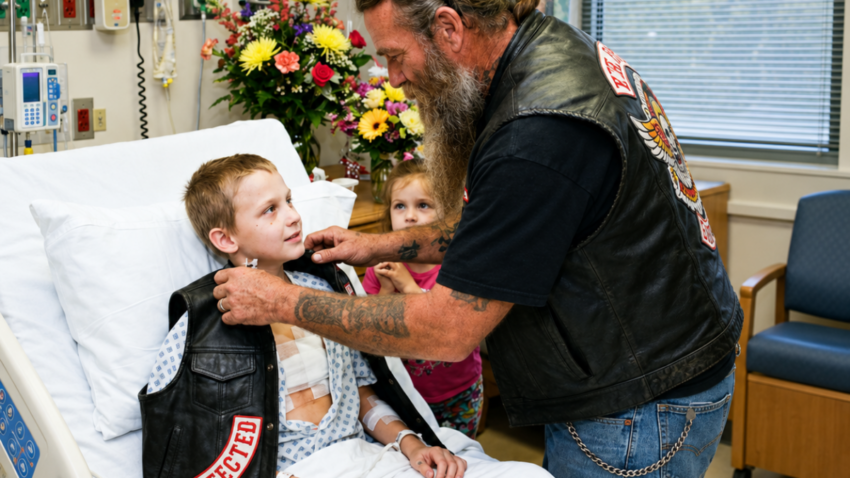
A vest.
Not a full club cut. Not the winged skull. Not membership. Hammer had made that very clear.
“This isn’t colors,” he said. “You don’t owe the club anything. You’re not being recruited. You’re not being used for some photo.”
Leo looked at the vest.
It was black denim, soft from washing. Over the heart was a patch stitched in white thread.
PROTECTED.
Leo’s mouth opened, but nothing came out.
Hammer’s voice thickened.
“You don’t have to wear it.”
Riley grabbed Leo’s hand.
“Wear it,” she whispered. “It makes you look important.”
Leo looked at Marla.
She nodded, tears in her eyes.
So Leo let Hammer place the vest over his shoulders.
It was too big.
It was warm from Hammer’s hands.
The sliding doors opened.
The sound hit first.
Applause.
Then voices.
“Leo!”
“Thank you!”
“You’re a hero!”
Leo flinched.
Hammer put one hand on the wheelchair handle and leaned down.
“Eyes on me if it’s too much.”
Leo did.
Hammer wheeled him forward.
Reporters surged, but the bikers shifted into a wall without touching anyone. Cameras flashed. Microphones lifted.
Hammer stopped at the curb.
He did not like cameras.
Everyone knew that.
But that day, he stepped forward because some things needed saying loud enough for a city to hear.
“This boy swept outside my bar for months,” Hammer said, voice booming over the crowd. “Most of you passed him. Some of you complained about him. Some of you called him trouble because it was easier than asking why a kid was sleeping outside.”
The crowd quieted.
Leo stared at his hands.
Hammer continued.
“When the bullets came, he didn’t ask whose kid Riley was. He didn’t ask if she deserved saving. He didn’t ask what she could give him back. He moved.”
His voice broke slightly.
“He moved when grown men froze.”
Nobody spoke.
Hammer turned and put his hand on Leo’s shoulder.
“From this day forward, Leo is family. Not because he took bullets. Because he should have had family before he had to prove he was worth one.”
Marla covered her mouth.
Detective Vale, standing near the edge of the crowd, looked down.
Hammer’s voice hardened.
“And hear me clear. This is not a charity story. Don’t clap today and step over the next Leo tomorrow. Don’t call him a hero so you don’t have to call him a child. Open your eyes before somebody bleeds.”
The video went viral by nightfall.
People argued, of course.
People always do.
Some called Hammer a criminal pretending to be noble.
Some called Leo a miracle.
Some called the whole thing a publicity stunt.
But others listened.
Really listened.
Donations flooded youth shelters.
The city council, embarrassed by national attention, fast-tracked funding for emergency beds that had been delayed for years. Churches opened overnight warming spaces. A retired teacher started a weekend meal program for homeless teens. A barber offered free haircuts. A dentist quietly contacted Ms. Brenner and said he would see Leo at no charge.
The city did not transform overnight.
Cities do not work that way.
But something had cracked.
And through the crack came light.
Hammer and Marla’s house sat on a quiet street lined with sycamore trees and old brick homes. It had a wide porch, a fenced backyard, and a garage full of motorcycle parts Riley was forbidden to touch and touched anyway.
Leo’s room was upstairs.
At first, he could not enter it.
He stood in the doorway staring at the bed, the dresser, the folded clothes, the desk by the window, the lamp shaped like a rocket because Riley had picked it out.
“This is mine?” he asked.
Marla stood behind him.
“Yes.”
“For how long?”
She did not say, As long as you behave.
She did not say, Until paperwork changes.
She did not say, We’ll see.
She said, “For as long as you need it.”
That was worse.
Leo sat on the edge of the bed and started shaking.
Marla lowered herself beside him carefully, leaving space.
“I don’t know how to do this,” he whispered.
“Do what?”
“Stay.”
She looked at him.
Then she said, “We’ll learn.”
The first weeks were hard.
Not sweet-hard.
Not movie-hard.
Hard.
Leo woke screaming from nightmares. He hid food under his mattress until ants found it. He flinched when Hammer came up the stairs too fast. He apologized for using towels, for eating too much cereal, for leaving lights on, for bleeding through bandages once, for existing in rooms.
Hammer struggled too.
He was good at protection.
Bad at softness.
When Leo refused dinner the third night because he thought he had eaten too much lunch, Hammer snapped, “You’re not in trouble for being hungry.”
Leo went white.
Marla pulled Hammer into the kitchen and hissed, “Volume.”
Hammer looked back into the dining room and saw Leo staring at his plate like it might be taken away.
Shame hit him hard.
He returned slowly, sat across from Leo, and set both hands flat on the table.
“I did that wrong,” he said.
Leo looked up, startled.
Hammer’s jaw worked.
“I get loud when I’m scared. That’s my problem. Not yours.”
Leo stared.
Adults did not usually apologize like that.
Not to him.
Hammer pushed the bread basket closer.
“You can eat. You can stop. Nobody’s counting.”
Leo took one roll.
Then another.
No one commented.
The first time Leo laughed in that house, Riley caused it.
She had decided he needed training in “family rules,” which she wrote in purple marker on construction paper.
RULE 1: No dying.
RULE 2: Knock on my door except if I yell come in.
RULE 3: Pancakes count as dinner if Mom says yes.
RULE 4: Daddy is not allowed to cut your hair.
RULE 5: If you are sad, you can sit by me but not on my dolls.
Leo read the list from the couch, one arm still in a sling.
“Rule one seems strict.”
Riley nodded solemnly.
“You broke it almost.”
“I’ll try not to.”
“Good.”
“Rule four sounds personal.”
She leaned close and whispered, “He made Uncle Bones look like an egg.”
Leo laughed.
It hurt his ribs.
He laughed anyway.
Hammer pretended offense from the kitchen.
“Bones requested that cut.”
“No, he didn’t,” Marla said.
Bones, who was at the table fixing Riley’s toy motorcycle, called out, “I did not.”
For the first time in years, Leo heard people arguing without fear underneath it.
Just noise.
Safe noise.
School came next.
That terrified him more than the shooting.
Leo had been out of school for almost a year. Before that, he had bounced through districts, group homes, and absences until transcripts looked like a map of failure drawn by adults. He expected teachers to look at him and see trouble, charity, danger, or paperwork.
Some did.
Some surprised him.
The principal of North Ridge High shook his hand and said, “We’re glad you’re here.”
Leo almost asked why.
His counselor, Ms. Nguyen, helped build a schedule that would let him catch up without drowning. English. Algebra support. History. Biology. Study hall. Therapy appointments twice a week.
The first day, Hammer wanted to walk him inside.
Leo said no.
Hammer looked hurt for half a second before hiding it.
Marla elbowed him.
“He’s seventeen, not seven.”
Riley raised her hand.
“I’ll walk him.”
“No,” everyone said at once.
Leo walked in alone.
But when he turned back from the front doors, Hammer’s truck was still parked across the street.
Hammer lifted one hand.
Leo pretended not to care.
He cared.
Of course he did.
By winter, Leo had gained weight. His scars remained, but his body strengthened. Physical therapy hurt. Counseling hurt worse. He learned that healing was not the opposite of pain. Sometimes it was pain with a purpose.
He told his therapist about his mother.
Her name had been Elena.
She used to sing while washing dishes. She smelled like vanilla lotion and laundry soap. She died when Leo was ten from an overdose everyone called accidental because that made the paperwork easier. After that came his stepfather, Ray, who believed boys were made better by fear and silence.
Leo ran the first time at twelve.
They brought him back.
He ran again at fourteen.
They brought him back again.
At sixteen, after Ray broke two of his ribs and told the social worker Leo was “dramatic,” Leo stopped waiting for adults to believe him.
He left for good.
The therapist asked him once, “What made you run toward Riley?”
Leo thought about that for a long time.
Then he said, “Because I knew what it felt like to wait for someone to.”
The therapist did not write for a moment.
Neither of them spoke.
In March, the city held a ceremony.
Leo hated the idea.
Hammer hated it more.
Marla said they were both going.
“It’s not about liking attention,” she said. “It’s about letting the city say thank you without making Riley relive it every time someone recognizes her at the grocery store.”
So Leo wore a button-down shirt Marla bought him and the black vest with PROTECTED over the heart. Hammer wore his cut. Riley wore a sparkly dress, combat boots, and a helmet she refused to leave at home because “it’s part of the story.”
The mayor gave a speech.
It was fine.
Polished.
Too long.
Then Leo was asked to speak.
He had planned to say nothing but thank you.
He stood at the microphone, looking out at rows of faces. City officials. Police. Reporters. Bikers. Nurses. Teachers. People from shelters. People from neighborhoods where Leo had slept invisible under stairwells and awnings.
His hands shook.
He looked at Hammer.
Hammer nodded once.
Leo leaned toward the microphone.
“I don’t know how to be a hero,” he said.
The room stilled.
“I was scared that night. I’m scared a lot. People keep saying I was brave, and maybe I was, but I don’t think brave means you’re not scared. I think it means something matters more for one second.”
He swallowed.
“Riley mattered.”
Marla’s eyes filled.
Riley waved at him.
Leo smiled faintly.
“I’m grateful for what people have done for me. The hospital. The donations. The house. The clothes. School. All of it. But I want to say something Hammer said first.”
He glanced toward the back of the room.
“Don’t wait until someone gets hurt to decide they’re worth seeing.”
Nobody moved.
Leo continued, voice stronger now.
“I was hungry before I was a headline. I was cold before I was brave. I was a kid before I was a story.”
The mayor looked down.
So did several people in the front row.
Leo took a breath.
“If you want to honor me, don’t call me special and ignore the next person sleeping outside. Learn their name. Ask what they need. Vote for shelters. Donate socks. Call the right people. Do something small before it has to become something big.”
He stepped back.
For one second, silence.
Then applause rose slowly, then thundered.
Not the empty kind.
The kind that sounded like shame turning into responsibility.
Hammer stood in the back, arms crossed, eyes wet.
Preacher leaned toward Bones and whispered, “President’s crying.”
Hammer snapped, “I can still hear you.”
Everyone near them laughed.
That summer, Leo turned eighteen.
They held the party in Hammer and Marla’s backyard.
There were folding tables, barbecue ribs, potato salad, a cake Riley helped decorate so heavily with blue frosting it stained everyone’s teeth. Half the motorcycle club showed up. So did Ms. Brenner, Detective Vale, Dr. Ortiz, Nurse Denise, Ms. Nguyen, and three kids from the youth shelter who had become Leo’s friends through a city outreach program he now volunteered with.
For the first time in his life, Leo had too many people singing happy birthday.
He stood frozen while they sang, overwhelmed by the sound of being celebrated.
When he blew out the candles, Riley shouted, “Did you wish to not die?”
“Riley,” Marla said.
“What? It’s a good wish.”
Leo laughed.
After cake, Hammer handed him an envelope.
Leo eyed it suspiciously.
“If this is a motorcycle, I’m not medically cleared.”
“It’s not a motorcycle.”
“Is it paperwork?”
Hammer smirked.
“Kind of.”
Leo opened it.
Inside was a key.
And a letter.
The letter stated that the small house near North Ridge High had been placed in a trust for Leo, managed with help from an attorney until he was twenty-five. The mortgage was paid. Utilities would be covered while he finished school and started college or trade training. There was a separate education fund, built from donations, rallies, club contributions, and one anonymous check large enough to make Hammer swear for ten full seconds.
Leo could not breathe.
“This is too much,” he whispered.
“No,” Marla said.
He looked at her.
She was crying.
“This is a beginning,” she said.
Leo turned to Hammer.
“I can’t pay this back.”
Hammer stepped closer.
“You don’t pay family back by handing them money. You live. You become whoever you were supposed to be before people got in the way. You help somebody else when it’s your turn. That’s it.”
Leo gripped the key until it hurt.
Riley tugged his sleeve.
“Your house has a room for me, right?”
“It has two bedrooms.”
“One can be mine.”
“No.”
“I saved you cake.”
“You ate my cake.”
“I saved you the idea of cake.”
Leo laughed so hard he had to sit down.
A year later, Leo graduated high school.
He walked across the stage with a small limp, a scholarship to study social work, and a crowd in the bleachers that looked like trouble until you saw the tears.
Hammer clapped so loudly the principal flinched.
Marla cried into three tissues.
Riley held a sign that read:
LEO IS MY HERO AND MY BROTHER BUT NOT THE BOSS OF ME.
When Leo looked out at them, he did not see rescue anymore.
He saw family.
Messy.
Loud.
Imperfect.
Chosen.
Real.
After the ceremony, a reporter asked him if he still considered himself the homeless boy who saved Riley Maddox.
Leo looked across the lawn.
Riley was trying to climb onto Hammer’s shoulders in her graduation dress even though it was not her graduation. Hammer pretended to resist and failed. Marla was telling Bones he could not light a cigar on school property. Preacher was praying over the potato salad someone had brought for reasons nobody understood.
Leo smiled.
“No,” he said.
The reporter leaned in.
“What do you consider yourself now?”
Leo touched the patch over his heart.
Protected.
Then he looked at the people waiting for him.
“A son,” he said.
And for once, the word did not feel borrowed.
It felt like home.
Years later, people in the city still told the story.
They told it at Max’s Roadhouse, where a framed photo of Leo and Riley hung near the entrance, right beside the broom Leo had dropped that night. Max had mounted it under glass with a small brass plate that read:
SOME PEOPLE CLEAN UP WHAT OTHERS REFUSE TO SEE.
They told it in shelters, where volunteers used Leo’s speech during training.
They told it in city council meetings when funding came up and someone tried to say the problem was too complicated.
They told it whenever a motorcycle convoy delivered winter coats to outreach centers, engines roaring like thunder down streets where children pressed their faces to windows and waved.
But Hammer told it differently.
He did not start with the bullets.
He did not start with the van.
He started with the broom.
“Kid was working,” he would say. “Hungry, cold, invisible, and still working. That’s what people forget.”
Then he would point to the photo behind the bar.
“Everybody wants to talk about the moment he jumped. I want to talk about all the days before, when he shouldn’t have had to be out there in the first place.”
Leo understood that now.
Heroism was not the clean, shining thing people wanted it to be.
Sometimes heroism was born from neglect. From absence. From knowing pain so intimately you recognize it before anyone else sees it coming.
He wished he had not needed to be brave.
He wished Riley had never heard gunshots.
He wished Hammer had not learned his name because of blood.
He wished the city had seen him before the video.
But wishes do not change the past.
Love can change what comes after.
On the anniversary of the shooting, Leo returned to Max’s alone before opening.
He was nineteen then, taller, stronger, still carrying scars beneath his shirt. The sidewalk had been repaired where bullets chipped the concrete. The neon signs were off in the morning light. The street looked ordinary in the way places do after surviving terrible things.
He stood where he had dropped the broom.
For a moment, he could hear it all again.
The van.
The door.
Riley laughing.
Gunfire.
Hammer’s voice ordering him not to die.
Then the front door opened.
Hammer stepped out holding two coffees.
“Figured you’d be here.”
Leo accepted one.
They stood in silence.
After a while, Leo said, “Do you ever think about what would’ve happened if I hadn’t been here?”
Hammer stared at the street.
“Every day.”
Leo nodded.
“Me too.”
Hammer looked at him.
“But you were,” he said. “And she is. And you are.”
Simple words.
Enough.
A car rolled by slowly.
Leo tensed before he could stop himself.
Hammer noticed.
He always noticed now.
“You good?”
Leo took a breath.
The car turned the corner and disappeared.
“Yeah,” he said. “I’m good.”
From inside the bar, someone started the jukebox early by mistake. A guitar riff spilled into the quiet morning.
Hammer snorted.
“Max is getting sentimental.”
“Max has always been sentimental.”
“He’ll deny that.”
“Obviously.”
They drank coffee on the sidewalk where everything had changed.
A few minutes later, Riley came running from around the corner, Marla behind her shouting not to cross without looking even though she was on the sidewalk. Riley was older now, taller, missing a front tooth, helmet under one arm because she had started riding dirt bikes in controlled environments Hammer called “supervised terror.”
She crashed into Leo’s side, careful of scars she still remembered.
“Happy not-dead day,” she said.
Leo laughed.
“That’s a terrible name.”
“I made you a card.”
“Is it also terrible?”
“It has glitter.”
“So yes.”
She handed it to him.
On the front, she had drawn three people.
A huge biker.
A little girl.
A tall boy in a vest.
Above them, in crooked purple letters, she had written:
MY FAMILY.
Leo opened the card.
Inside, it said:
You ran when everybody else froze. But now you don’t have to run anymore.
Leo stared at the words until they blurred.
Riley leaned against him.
“I spelled everything right,” she said proudly.
“You did.”
Hammer put a hand on Leo’s shoulder.
Marla touched his arm.
And there, in front of the bar where he had once swept for scraps, Leo stood surrounded by the impossible family he had never expected to live long enough to find.
The city had called him invisible.
The streets had called him disposable.
The system had called him inactive.
But a little girl called him brother.
A biker called him son.
And every morning after that, when the sun came up over the chrome bikes outside Max’s Roadhouse and lit the patch over Leo’s heart, it told the truth better than any headline ever could.
Protected.
Not because he had taken bullets.
Not because he had gone viral.
Not because the world finally decided he was useful.
Protected because he had always been worth protecting.