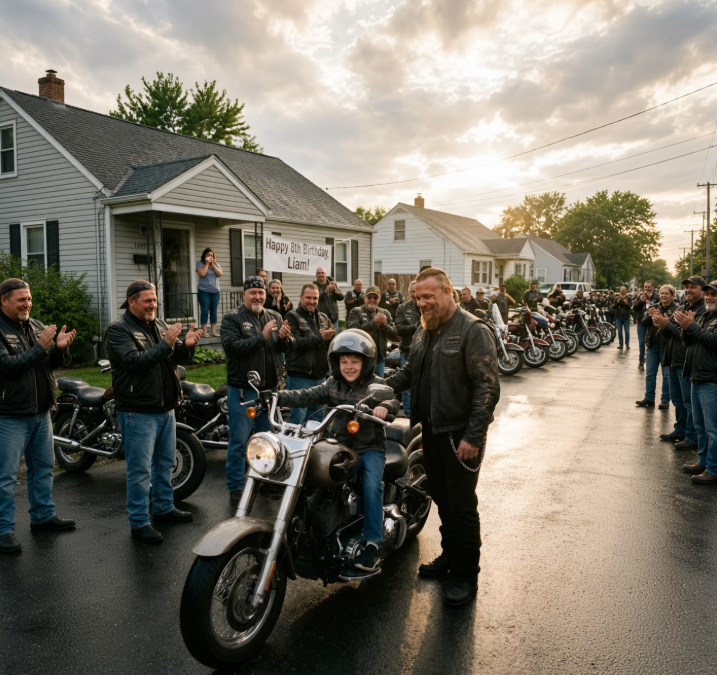
For Two Months, an 8-Year-Old Girl Left Paper Bags on the Same Biker’s Motorcycle Every Tuesday—Then One Night, He Followed Her Home and Heard Her Mother Say, “Please Don’t Leave.”
The little girl had been leaving a brown paper bag on my motorcycle every Tuesday for almost two months.
She never spoke to me, never waited for me, and always vanished before I could catch her.
But the night I finally followed her home, I learned she had not been feeding me—she had been trying to return a piece of my life I never knew was missing.
My name is Jack Mercer, and for most of my adult life, I believed a man could outrun almost anything if he kept enough highway behind him.
Pain.
Regret.
Old promises.
People he disappointed.
The sound of a woman’s voice saying his name like she still believed he would come back.
I was wrong about that.
The past does not chase you loudly.
It waits.
It learns your routines.
It finds the diner where you eat alone every Tuesday night, and then one evening, it sends an eight-year-old girl in a faded pink jacket to leave a peanut-butter sandwich on your motorcycle seat.
That was how Lily found me.
At first, I thought the whole thing was a prank.
I had been stopping at Rosie’s Diner every Tuesday for almost three years. Same time. Same booth. Same meal unless Rosie decided I looked too thin, which was ridiculous because I had not looked thin since 1989.
Rosie’s sat on the edge of town, just before the highway bent toward the old mill road. It was the kind of place with cracked red vinyl booths, coffee that tasted like it had a grudge, and a pie case near the register that had survived more marriages than I had.
I liked it because nobody bothered me there.
Most people noticed me when I walked into a room.
Gray beard.
Tattooed arms.
Old leather vest.
Heavy boots.
A motorcycle that announced itself before I ever turned the key off.
People had a way of deciding what kind of man I was before I opened my mouth.
Dangerous.
Angry.
Trouble.
The truth was quieter.
I was tired.
Not soft, exactly.
Just tired in the way men get when they have carried too many things for too long and never learned how to set any of them down.
So every Tuesday, I parked beneath the old streetlight outside Rosie’s, went inside, ordered meatloaf with mashed potatoes, drank two cups of black coffee, and left before eight.
That was my church.
My therapy.
My routine.
Then the paper bags started appearing.
The first one was sitting on my motorcycle seat when I came out of the diner on a chilly October evening.
Brown paper.
Folded twice at the top.
Neat.
Too neat to be trash.
I stopped beside the bike and looked around.
PART2:
The street was mostly empty. A couple of college kids were laughing near the laundromat. A pickup rolled past with one headlight out. Rosie was wiping down the front window from inside the diner.
Nobody looked guilty.
I picked up the bag carefully.
“Great,” I muttered. “If this is somebody’s idea of funny, they need better hobbies.”
Inside was a peanut-butter sandwich wrapped in wax paper, a red apple, and a small handwritten note.
Thank you.
That was all.
Two words.
Written in pencil.
Small letters.
Careful spacing.
A child’s hand.
I stood under that flickering streetlight for nearly a minute, holding that note between my fingers.
Thank you.
For what?
I had no idea.
I looked around again.
No one.
I put the sandwich back in the bag, tucked the note into my vest pocket, and rode home confused.
The following Tuesday, another bag appeared.
Same spot.
Same folded top.
Same peanut-butter sandwich.
Same apple.
Another note.
Thank you for being kind.
That bothered me more.
Kind was not a word people usually aimed at me.
Useful, maybe.
Scary, often.
Stubborn, definitely.
Kind?
PART3:
Not much.
I asked Rosie about it the third Tuesday.
She was refilling my coffee when I slid the note across the table.
“You know anything about this?”
She read it.
Her face changed just enough for me to notice.
Rosie had owned that diner for thirty-one years. She had seen addicts, pastors, runaway teens, truckers, cops, cheating husbands, grieving widows, and men like me who ordered coffee like it could fill the empty parts. She did not scare easy.
But that note made her uncomfortable.
“Where’d you get this?”
“On my bike.”
She looked toward the window.
“Again?”
I leaned back.
“So you do know something.”
“I know a little girl’s been coming around.”
“How little?”
“Eight, maybe. Pink jacket. Blonde hair. Skinny little thing.”
“Name?”
Rosie hesitated.
“Lily.”
“Lily what?”
“I don’t know.”
“Where are her parents?”
Rosie looked down at the coffee pot.
“I don’t know that either.”
“That’s a lot of not knowing.”
She gave me the kind of look only a woman who had fed half the town for three decades could give.
“Careful, Jack.”
“With what?”
“With sounding like a man who thinks every unanswered question is somebody else’s failure.”
That shut me up.
Rosie softened.
“She comes in sometimes. Never asks for anything. Just sits outside if the weather’s good. Sometimes I give her a cookie and pretend I made too many.”
“She alone?”
“Most times.”
I looked out at my bike under the streetlight.
“Why is she leaving me food?”
Rosie studied me.
“Maybe she thinks you need it.”
“I don’t.”
“Children don’t always give what people need. Sometimes they give what they understand.”
I did not know what to say to that.
For the next several weeks, I tried to catch Lily.
I ate faster.
Then slower.
I watched through the diner window.
I parked in different spots.
I even walked outside halfway through dinner once, hoping to catch her in the act.
Nothing.
She was fast.
Always gone before I reached the bike.
But the bags kept coming.
Sometimes there was a sandwich.
Sometimes a cookie.
Once, there was a tiny toy motorcycle, the kind sold in grocery store checkout aisles for impatient kids with exhausted parents.
The notes changed too.
Please don’t be angry.
You’re the only person who doesn’t look away.
I read that one five times.
Then ten.
You’re the only person who doesn’t look away.
It was strange because I had no memory of looking at her.
No memory of speaking to her.
No memory of doing anything that deserved sandwiches from a child.
Then one Tuesday, there was no note.
There was a photograph.
I stood beside my bike, the paper bag hanging from one hand, staring at the picture until the diner lights blurred around the edges.
It showed me.
Not posed.
Not aware.
The picture had been taken in the rain several months earlier.
I remembered the night as soon as I saw the truck.
An elderly man’s pickup had broken down near the bridge outside town. I had been riding home late when I saw him standing beside it in the rain, staring at a flat tire like it had personally betrayed him.
I stopped.
Changed the tire.
Refused his money.
Told him to get the spare replaced before he got himself killed.
Then I rode away and forgot about it.
Apparently, someone else had not.
In the photograph, I was crouched beside the truck with a tire iron in my hand. Rain blurred the edges. My bike sat in the background. The old man stood under an umbrella he was not using properly.
On the back, in the same careful child’s handwriting, were six words.
Mom said you were still good.
My chest tightened.
Mom?
What mother?
That night, I decided Lily was not disappearing again.
I paid my bill.
I walked outside.
I found the paper bag on my bike like always.
Then I did something I had not done in years.
I waited in the shadows.
I stood across the street near the closed barber shop, where the awning was low and the light did not reach my face. I felt ridiculous, a sixty-two-year-old man hiding from an eight-year-old girl, but there I was.
At 7:42, she appeared.
Faded pink jacket.
Brown paper bag clutched in both hands.
Thin legs.
Scuffed shoes.
Blonde hair tucked badly behind one ear.
She moved quickly, but not carelessly. She looked up and down the sidewalk. She checked the diner window. She walked toward my motorcycle like she had done it a hundred times.
Then she placed the bag on the seat.
Gently.
Almost respectfully.
For a second, she rested her fingertips against the leather.
Then she whispered something I could not hear and turned away.
I waited three seconds.
Four.
Five.
Then I followed.
I stayed far enough back that she would not notice me. She walked down Mill Street, cut across the little park with the broken fountain, passed the closed video store, and headed toward the older apartment buildings near Cedar Avenue.
The farther we went, the more careful I became.
I was not proud of following a child.
But I was more afraid of letting her disappear.
She stopped outside a three-story brick apartment building with rusted railings and a front door that stuck halfway open. One porch light buzzed. A bicycle frame with no wheels leaned against the stairs.
Lily climbed to the second floor.
She knocked on apartment 2B.
The door opened.
A woman stood there.
Early forties, maybe.
Dark hair pulled into a loose knot.
Tired eyes.
One hand gripping the edge of the door like she needed it to stay upright.
Lily held up the empty bag.
“Mom,” she said, “I brought him another one.”
The woman’s face changed.
“Who?”
Lily turned.
And pointed directly at me.
I froze at the bottom of the stairs.
The woman stepped out onto the landing.
For one second, neither of us moved.
Then her eyes filled with tears.
“Please,” she whispered. “Don’t leave.”
I looked at Lily.
Then at the woman.
Something moved through my chest.
Not recognition.
Not yet.
But the terrible feeling of a locked door inside me beginning to open.
The woman swallowed.
“My name is Sarah.”
I stared at her.
Sarah.
The name brushed against memory.
Not enough to place.
Enough to hurt.
She stepped aside.
“Please come in.”
I should have walked away.
A smarter man might have.
A man with fewer ghosts might have said, “I don’t know you,” then turned around and gone back to his quiet Tuesday night.
But Lily stood beside the door holding that empty paper bag against her chest, watching me like I was about to decide the rest of her life.
So I climbed the stairs.
The apartment was small and clean in the exhausted way places become clean when someone is trying hard with not enough money. An old couch sat against one wall. A tiny kitchen took up the other side of the room. Children’s drawings were taped around the window. A bookshelf leaned slightly under the weight of paperbacks and school folders.
There was a framed photograph on a shelf.
I saw it.
Then looked away.
Because the woman in the picture had a smile I had buried twenty years ago.
Sarah closed the door.
Lily stood by the couch.
For the first time since I had seen her, she looked unsure.
Sarah took a breath.
“You knew my sister.”
My mouth went dry.
“What?”
“My sister,” she said. “Emily.”
The room shrank around me.
Emily.
One name.
Five letters.
Twenty years gone in a second.
I sat down on the edge of the couch because my legs did not trust me anymore.
“I haven’t heard that name in a long time,” I said.
Sarah sat across from me.
“You remember her.”
I almost laughed.
Not because it was funny.
Because remember was too small a word.
I remembered Emily in flashes.
A blue car on the side of a frozen road.
A woman cursing at a tire iron.
Red cheeks from cold.
Black hair whipping around her face.
A laugh that arrived before permission.
A diner booth at midnight.
A hand in mine.
The first time she said my name like it mattered.
The last time I told her I would come back.
“I remember her,” I said quietly. “I just don’t understand what she has to do with Lily.”
Sarah looked at the little girl.
“Everything.”
Lily did not move.
My heart began to pound.
Sarah’s voice softened.
“Lily is Emily’s daughter.”
I stared at her.
For several seconds, the words made no sense.
Then they made too much.
“Emily had a daughter?”
“Yes.”
I looked at Lily.
She stood beside the shelf with her hands folded in front of her pink jacket.
“How old are you?” I asked.
“Eight.”
My voice came out rough.
“And Emily?”
Sarah lowered her eyes.
“She died seven years ago.”
Something inside me gave way.
Not loudly.
Not visibly, maybe.
But I felt it.
A beam breaking in an old house.
I leaned forward, elbows on my knees.
“What happened?”
“Cancer.”
I closed my eyes.
For years, when I let myself think of Emily, I imagined her alive somewhere. Married, maybe. Happy. Angry at me, probably. Sometimes I pictured her with kids. Sometimes I stopped myself before the thought finished.
I had never imagined she was gone.
Gone while I was riding highways.
Gone while I was pretending the past had politely agreed to stay behind me.
Gone while her daughter grew old enough to leave sandwiches on a motorcycle.
“I’m sorry,” I whispered.
Sarah nodded.
“I know.”
I looked at Lily again.
“Why didn’t anyone tell me?”
Sarah’s face tightened.
“We tried.”
I looked up.
“What do you mean?”
“Emily tried to find you.”
“No.”
The word came out too fast.
“She never contacted me.”
“She did,” Sarah said.
She stood and walked to a small cabinet beside the television. From the drawer, she took out an old envelope, yellowed at the edges.
“This was supposed to reach you.”
She placed it in my hands.
My name was written across the front.
Jack.
The handwriting hit harder than a fist.
Emily’s.
I had not seen it in twenty years.
My fingers tightened around the envelope.
“Why didn’t I get this?”
“Because she never sent it.”
“Why?”
Sarah’s eyes filled again.
“Because she became afraid.”
“Afraid of me?”
“No,” Sarah whispered. “Afraid that you had forgotten her.”
I looked down at the letter.
My hands, which had held handlebars through rain, tools through grease, and grief through clenched fists, shook so badly the paper trembled.
I unfolded it carefully.
Jack, I don’t know if you’ll ever read this.
That was the first line.
I stopped.
My chest hurt.
Sarah said nothing.
Lily came closer, but not too close.
I kept reading.
Emily wrote about the years after I left town. About how she discovered she was pregnant. About how she tried to find me but only found disconnected numbers, old addresses, rumors from people who did not know enough but spoke anyway.
I remembered leaving.
My father was dying then.
My family had collapsed into debt, anger, and hospital rooms. I had been twenty-six and stupid enough to think running from one pain would not create another.
I told Emily I would come back.
I meant it when I said it.
That was the most useless kind of truth.
One month became another.
Then one year became five.
By the time I thought of returning, I told myself she had moved on. I told myself finding her would reopen something better left closed. I told myself a lot of things that sounded reasonable because cowardice often wears the voice of maturity.
Emily’s letter stripped every excuse bare.
She wrote that Lily was born on a rainy Tuesday morning.
Tuesday.
I looked up at Lily.
She was watching me.
I looked back down and kept reading.
Emily wrote about Lily’s tiny fists, her stubborn chin, the way she stared whenever a motorcycle passed. She wrote that sometimes she wondered if Lily had inherited memories from someone she had never met.
Then I reached the final pages.
I never hated you.
That sentence stopped me.
I wanted to, sometimes, because it would have been easier. But I couldn’t hate the man who once stopped on a cold night just because he saw a woman standing beside a broken car.
I closed my eyes.
I remembered.
I had been twenty-four.
It was freezing.
I was riding home when I saw a young woman beside an old blue car on the shoulder. She was trying to change a flat tire but could not loosen one of the bolts. I almost kept riding.
Almost.
Then I saw her kick the tire and wipe tears off her face with the heel of her hand.
I stopped.
Changed the tire.
Gave her my jacket because she was shaking.
She asked my name.
I told her it did not matter.
She said it mattered to her.
That was Emily.
That was the beginning.
And I had forgotten the first miracle of my own life.
I looked up.
“That was Emily.”
Sarah nodded.
“Yes.”
“I didn’t know.”
“I know.”
“She told you?”
“She told me that story so many times I could recite it. She said you made her believe good men still existed.”
The words hurt because I had spent years proving myself unworthy of them.
I folded the letter carefully.
Then I noticed something else inside the envelope.
A photograph.
I pulled it out.
Emily stood beside my motorcycle.
My old Harley.
The same one I still rode.
She was younger than my memory had allowed her to stay. Smiling. Hair loose. One hand resting on the seat, exactly where Lily had been leaving those bags.
On the back was one sentence.
Someday, maybe she’ll find you.
I looked at Lily.
“Did your mother know I still had this bike?”
Lily shook her head.
“I don’t know.”
Sarah looked toward the motorcycle key hanging from my belt.
“Emily always remembered it.”
I smiled, though it hurt.
“She remembered everything.”
Sarah nodded.
“Especially the things you forgot.”
The room went quiet.
I looked at Lily.
“Why did you start leaving the bags?”
She looked at Sarah.
Sarah nodded.
Lily took a breath.
“Because I wanted you to remember.”
“Remember what?”
“The man Mom told me about.”
I tried to smile.
“I don’t think I understand.”
Lily looked down at her hands.
“Mom used to tell me sometimes people don’t know they’re important to someone else.”
I listened.
“She said you helped her when she was alone, and you didn’t ask for anything. She said you made her believe good people were real.”
Her voice trembled just a little.
“Before she died, she told me that if I ever found you, I should tell you she never forgot you.”
I looked away.
A tear rolled down my cheek before I could stop it.
I wiped it quickly, but Lily noticed.
“Are you sad?”
I nodded.
“Yes.”
“Because of Mom?”
“Yes.”
Lily thought about that.
“Mom said you would probably cry.”
A laugh broke out of me.
Small.
Broken.
Real.
“She knew me pretty well.”
Sarah smiled through tears.
“She always did.”
I looked at the photograph again.
“Why did she want you to find me?”
Sarah hesitated.
“Because she worried about Lily.”
I looked up.
“What do you mean?”
“After Emily died, Lily stayed with me. I did everything I could, but things became difficult.”
Her voice carried no self-pity.
That made it worse.
“I work nights at the nursing home. Sometimes doubles. Rent keeps going up. Childcare is expensive. My car barely runs. I’m not telling you this because I want anything from you.”
She glanced at Lily.
“Emily knew I didn’t have much. She was afraid that one day Lily would feel like she had no family left.”
My throat tightened.
“That’s why she wanted Lily to find me?”
Sarah nodded.
“Not because she expected you to raise her. Not because she wanted money. She wanted Lily to know she came from more love than loss.”
I looked at the little girl.
Something inside me shifted.
I had spent most of my life thinking family was something you were born into and then lost.
Now I was beginning to understand it could also be something that arrived carrying peanut-butter sandwiches in a brown paper bag.
Lily walked over to my motorcycle helmet sitting near the door.
“Can I ask you something?”
“Sure.”
“Why do you always sit alone at the diner?”
I smiled faintly.
“I guess I got used to it.”
“Don’t you get lonely?”
Sometimes children ask questions adults spend decades avoiding.
“Sometimes,” I said.
“Then you shouldn’t.”
“Why?”
“Because you have us now.”
Those words broke something in me.
Not the way grief breaks.
The way dawn breaks.
Slowly.
Painfully.
With light you are not ready for.
I looked at Sarah.
She was crying again.
“I’m sorry,” she whispered.
“For what?”
“For keeping you away from each other for so long.”
I shook my head.
“You didn’t.”
“Maybe not intentionally.”
She looked down.
“But I was angry with you for years.”
“You had every right.”
“No,” Sarah said quietly. “I didn’t know the whole story either.”
I looked at her.
“What changed?”
She pointed toward Lily.
“She found the photograph.”
“The one of me helping the old man?”
Sarah nodded.
“At her grandmother’s house. She asked who you were. I told her a little. Then she started asking questions.”
Lily’s chin lifted.
“A lot of questions.”
Sarah almost smiled.
“Too many questions.”
“Important questions,” Lily corrected.
“Relentless questions,” Sarah said.
I felt a smile tug at my mouth.
Lily continued, “Aunt Sarah had the box with Mom’s letters and pictures. I found the picture of your motorcycle. Then one day I saw it outside Rosie’s.”
“You recognized the bike?”
She nodded proudly.
“It has the silver eagle on the tank.”
I looked down.
Emily had always loved that eagle.
I had nearly sold the bike twice.
Couldn’t.
Did not know why.
Now I did.
“But why the food?” I asked.
Lily’s confidence faded a little.
“I didn’t know what else to do.”
Sarah brushed a hand over her hair.
“She wanted to thank you.”
“For what?”
“For being the reason her mother believed there were still good people in the world.”
I looked at Lily.
“Your mother sounds like she was a wonderful person.”
“She was.”
“I wish I could have known her longer.”
Lily smiled sadly.
“You did.”
I looked at her.
“What?”
She pointed at the photograph.
“You just forgot.”
That sentence stayed with me longer than almost anything else.
You just forgot.
Not cruel.
Not accusing.
A child’s clean truth.
That night, I stayed for dinner.
It was spaghetti from a jar, garlic bread slightly burned on the edges, and lemonade that tasted mostly like water. It was the best meal I had eaten in years.
Lily talked constantly.
About school.
Her favorite books.
A boy named Connor who picked his nose and denied it.
Her teacher, who assigned “too much writing.”
The pigeon outside her classroom window that she believed was “a spy.”
Sarah watched me carefully throughout the evening.
Not suspicious exactly.
Protective.
I respected that.
At one point, she noticed me looking at the framed photograph of Emily.
“You can keep it,” she said.
I looked at her.
“No.”
“She would have wanted you to.”
“I’ve already lost enough of what belonged to her.”
Sarah stood, took the frame, opened the back, and removed the photograph. Then she handed it to me.
“Then don’t lose this.”
I took it with both hands.
“Thank you.”
When I finally stood to leave, Lily ran to the door.
“Are you coming back?”
I looked at Sarah.
Then at Lily.
“Tuesday.”
Her face lit.
“Promise?”
I thought about every promise I had failed to keep.
Then I bent down until we were eye level.
“Promise.”
The following Tuesday, I arrived at Rosie’s before anyone else.
I parked my motorcycle beneath the same old streetlight.
But this time, I did not go inside alone.
I waited outside.
A few minutes later, Lily came running down the sidewalk with another brown paper bag.
When she saw me, she stopped.
Then grinned.
“You caught me.”
“I did.”
“Are you mad?”
“No.”
She held up the bag.
“I brought dinner.”
“What’s in there?”
“A sandwich.”
“Again?”
“And an apple.”
“You’ve been feeding me for two months.”
“I had to make sure you were healthy.”
I took the bag.
“Thank you.”
Then Lily reached into her jacket and pulled out a folded piece of paper.
“This is for you.”
I opened it.
It was a child’s drawing.
A motorcycle in the middle.
A little girl beside it.
A woman on the other side.
And behind them, a tall man with a gray beard.
At the top, Lily had written:
My Family.
I stared at it for a long time.
The streetlight hummed above us.
Rosie watched from the diner window, pretending she was not crying.
I folded the drawing carefully and placed it inside my wallet beside Emily’s photograph.
For the first time in decades, that old leather wallet began to feel full.
Not with money.
With people.
With memories.
With a life I had not known was waiting for me.
Over the next few months, I became part of Lily’s world.
Not all at once.
Children trust faster than adults, but I had done enough damage by absence that I refused to rush.
I fixed her bicycle when the chain broke.
Helped her build a crooked bookshelf for her room.
Attended her school play and sat in the back row wearing a leather vest among parents in sweaters and church shoes.
Watched a terrible animated movie because Lily insisted it was “emotionally important.”
I helped Sarah repair things around the apartment too.
A loose cabinet hinge.
A leaking sink.
A window that stuck halfway open.
An outlet that sparked when the toaster ran.
The first time I brought groceries, Sarah nearly refused them.
“This isn’t your responsibility,” she said.
“No,” I answered. “It’s my privilege.”
She looked at me for a long time.
Then stepped aside.
Slowly, the tension between us began to loosen.
Not disappear.
Some things take time.
Anger that has protected someone for years does not simply retire because the truth gets complicated.
One evening, after Lily fell asleep on the couch with a book open on her chest, Sarah asked the question she had been carrying.
“Do you ever wish Emily had told you?”
I looked at Lily.
Then at the photograph on the shelf.
“Every day.”
Sarah looked down.
“But?”
“But I don’t want to spend the rest of my life wishing I could change the past.”
I paused.
“I can’t give Emily back the years we lost.”
Sarah’s eyes filled.
I looked at Lily again.
“But I can make sure Lily doesn’t lose any more.”
Sarah whispered, “She needs you.”
I nodded.
“I need her too.”
That was the truth I had not expected.
I thought I was being asked to become useful.
I did not understand I was being rescued.
Years passed the way years do when you finally start living inside them instead of riding through them.
Tuesday became our night.
Sometimes we ate at Rosie’s.
Sometimes at Sarah’s apartment.
Sometimes Lily and I sat outside the diner on the curb sharing fries while she asked questions about everything I did not know how to explain.
“Did you love my mom?”
“Yes.”
“Were you scared of being a dad?”
“I didn’t know I was one.”
“If you knew, would you have come?”
The first time she asked that, I could not answer right away.
She watched me carefully.
I decided she deserved honesty.
“I hope so,” I said.
Her face fell a little.
“You don’t know?”
“I want to tell you yes. I want to tell you I would have done the right thing immediately. But I was young, and scared, and selfish in ways I didn’t understand.”
Lily looked down.
I continued.
“But I can tell you this. I wish I had known. And I wish I had been better before I had reasons to regret not being better.”
She thought about that.
Then nodded.
“Okay.”
“Okay?”
“Mom said honest answers are better than pretty ones.”
I smiled sadly.
“She was right.”
At ten, Lily asked if she could ride on my motorcycle.
Sarah said absolutely not.
I said absolutely not.
Lily called us both cowards.
At eleven, she asked again.
Sarah said no.
I said no.
Lily made a PowerPoint presentation titled Why Responsible Motorcycle Experiences Build Trust.
I still said no, but I respected the effort.
At twelve, I finally took her around the block.
Helmet.
Jacket.
Gloves.
A speed so slow that an elderly man walking a dachshund passed us on Cedar Avenue.
Lily screamed with joy anyway.
When we pulled back in, Sarah stood outside with both hands over her mouth, furious and crying and laughing all at once.
“You went seven miles an hour,” I said.
“That is not the point,” she snapped.
Lily hopped off the bike.
“It was amazing!”
Sarah pointed at me.
“You are in trouble.”
Lily pointed at me too.
“You are in trouble.”
I raised both hands.
“Worth it.”
For a long time, I kept Emily’s letter folded in my nightstand.
I read it only once a year.
On Lily’s birthday.
The first few times, it broke me.
Then it changed.
The grief stayed, but grief is not one thing forever. It moves. It settles into different rooms. Eventually, the letter stopped feeling like a punishment and began to feel like a bridge.
When Lily turned sixteen, she asked to read it.
I did not answer right away.
“It was written for you,” she said.
“It was written about you too.”
We sat at Sarah’s kitchen table, the same table where I had first eaten spaghetti with them years earlier.
Sarah sat with us.
Lily unfolded the letter carefully.
She read every word.
By the end, tears ran down her face, but she was smiling.
“She loved me so much,” she whispered.
Sarah reached for her hand.
“Yes.”
Lily looked at me.
“And she loved you.”
I looked away.
“I didn’t earn that.”
Lily’s voice softened.
“Maybe love isn’t always about earning.”
That sounded exactly like Emily.
So exactly that for a moment, I could not breathe.
Lily stood and hugged me.
She was almost as tall as Sarah by then.
Still, when she wrapped her arms around me, I felt the eight-year-old girl who had stood in front of my bike with a brown paper bag and a mission too big for her small hands.
“I’m glad I found you,” she said.
I closed my eyes.
“So am I, kid.”
She pulled back.
“You know I’m not really your little girl, right?”
I looked at her.
“You sure about that?”
Her mouth trembled.
Then she smiled.
“No.”
“Good.”
When Lily graduated high school, I sat between Sarah and Rosie in the gymnasium.
Rosie cried before the music even started.
Sarah cried when Lily’s name was called.
I cried when Lily walked across the stage and looked straight at us.
She had decorated her graduation cap with a tiny paper bag, a motorcycle, and the words:
You Found Me Too.
After the ceremony, Lily ran into my arms.
She was eighteen.
Too grown for some things.
Still not too grown to nearly knock me over.
“I did it,” she said.
“You did.”
“Mom would be proud?”
My throat tightened.
“More than proud.”
She nodded.
Then handed me an envelope.
Inside was a photograph.
Lily standing beside my motorcycle beneath the old streetlight at Rosie’s.
One hand on the seat.
The same place Emily’s hand had been.
The same place Lily had left the paper bags.
On the back, Lily had written:
Someday happened.
I kept that photograph behind Emily’s in my wallet.
Two women.
One I had loved and lost.
One who found me anyway.
Years later, when people asked how Lily and I met, she liked to tell the short version.
“I stalked his motorcycle with sandwiches until he followed me home.”
“That is not the version you should tell strangers,” Sarah would say.
“It’s accurate.”
“It sounds criminal.”
“It worked.”
I never argued.
Because she was right.
It worked.
The paper bags eventually stopped.
Not because Lily stopped caring.
Because she no longer needed to leave messages on my motorcycle.
She could knock on my door.
She could call.
She could walk into Rosie’s, slide into the booth across from me, steal half my fries, and tell me my beard needed trimming.
She could ask hard questions.
She could be angry.
She could miss Emily out loud.
She could laugh.
She could belong.
And so could I.
For twenty years, I believed the most important moments of my life were the ones I could remember clearly.
I was wrong.
Sometimes the moments that change everything are the ones you barely notice while they are happening.
A tire changed on a freezing night.
A jacket given to a stranger.
A motorcycle parked beneath an old streetlight.
A little girl carrying a paper bag down a sidewalk every Tuesday.
None of those moments felt important enough to mark.
But years later, they connected like pieces of a map I had been too lonely to unfold.
I thought Lily was thanking me for something I had done.
The truth was deeper.
She was bringing me a message from a woman I had loved and lost without ever knowing how much she had loved me back.
She was reminding me I had once mattered to someone.
She was proving that kindness does not always return in the shape you expect.
Sometimes it comes back years later in a faded pink jacket, carrying a peanut-butter sandwich, an apple, and a note that simply says:
Thank you.
And if you are lucky, truly lucky, you follow it home.
That was what Lily did.
She did not just find me.
She brought me back to the man her mother remembered.
She brought me back to Tuesday nights with people waiting.
She brought me back to a table with more than one plate.
She brought me back to the kind of love I thought I had missed forever.
The child who spent two months leaving sandwiches on my motorcycle unknowingly gave a lonely man the greatest gift of his life.