PART2:
For a moment, I thought he would refuse to answer.
Then he whispered, “Dinner.”
The word was so small I almost missed it.
Dinner.
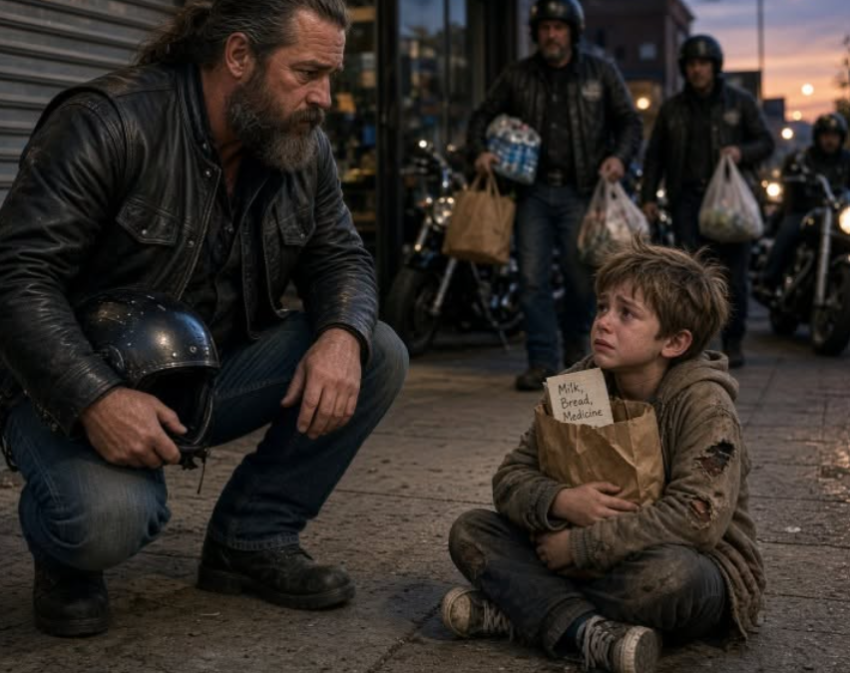
I looked at the bag.
It was too small for dinner.
Too light.
The top was folded over carefully, and one corner had darkened where something cold inside had made the paper damp. Sticking out of the folded edge was a torn piece of notebook paper.
A list.
Written in uneven pencil.
Milk.
Bread.
Soup.
Medicine.
Something inside my chest went quiet.
Not calm.
Quiet.
The way the world goes quiet right before something breaks.
“That all you got?” I asked softly.
The boy nodded.
“What’s your name?”
“Eli.”
“Eli what?”
“Eli Turner.”
His voice shook on his last name, as if even saying it cost energy.
I crouched down, but not too close.
“Where’s your mom, Eli?”
That was when his eyes filled.
He tried to stop it. I saw him try. His jaw tightened, his chin pulled in, and he blinked hard like a boy who had already decided crying would not solve anything.
But tears rose anyway.
“She’s home.”
“Is she sick?”
He nodded.
“How sick?”
He wiped his face with the back of his sleeve.
“She’s been coughing a lot. And she gets dizzy when she stands up. She said she just needs rest.”
“Did she send you here?”
Another nod.
“She gave me seven dollars,” he whispered. “She said to get bread and soup. But I got medicine too.”
He looked frightened then, like he had confessed to a crime.
“I didn’t steal it,” he added quickly. “I paid. I had some coins from my jar.”
I looked back at the bag.
Seven dollars.
Bread.
Soup.
Milk, maybe if it was small.
Medicine from a corner-store shelf, probably the cheapest kind.
A child’s attempt to fix a grown person’s illness with coins and courage.
“Did you eat today?” I asked.
He nodded too fast.
“Eli.”
His eyes dropped.
“A little.”
“What did you eat?”
He did not answer.
That was answer enough.
The grocery store had closed twenty minutes earlier. The street was going dark. This child had likely walked here alone, counted change at the register, bought what he could, and then sat outside trying to figure out how to carry fear home without dropping it.
I looked at the handwritten list again.
There was another line at the bottom, half hidden by the fold of the paper.
Rent – Friday.
It was written smaller than the rest.
As if his mother had not meant for him to notice.
But he had.
Of course he had.
Children always notice what adults try to hide most.
I stood up slowly.
“Wait here.”
His head snapped up.
Fear flashed across his face.
“Are you coming back?”
The question hit me harder than it should have.
Are you coming back?
Not Where are you going?
Not Why?
Are you coming back?
A child only asks that question like that if someone has left before.
I swallowed.
“Yeah, kid,” I said. “I promise.”
He looked at me for a long second, trying to decide whether my promise was worth anything.
Then he nodded once.
I walked back to my bike, pulled out my phone, and made the first call.
Not to 911.
Not yet.
I needed to understand what we were dealing with before I brought uniforms and sirens to a scared family already trying to survive on seven dollars and a paper bag.
I called Ghost.
His real name was Marcus Hale, but nobody used it except his wife when she was mad at him. He was president of our riding club, the River Saints, and the kind of man who could organize fifty bikers faster than most people could find their car keys.
He answered on the second ring.
“You dead?”
“Not yet.”
“Then why are you calling during dinner?”
“I found a kid.”
Silence.
Ghost’s tone changed immediately.
“What kind of found?”
“Little boy outside Miller’s Market. Alone. Mom’s sick. He bought bread, soup, and medicine with seven dollars and change.”
Another silence.
This one heavier.
“Where are you?”
“Main Street. Closed grocery.”
“What do you need?”
I looked back at Eli.
He was still sitting under the awning, holding the bag.
Everything, I thought.
Aloud, I said, “Food. Water. Blankets. Maybe someone with medical training. And I need it fast.”
Ghost did not ask another question.
“Stay there.”
The line went dead.
I made the second call to a woman named Rosa, who rode with us on weekends and worked as an emergency room nurse the rest of the time.
She answered with noise behind her—kids, television, a dog barking.
“Ray?”
“You home?”
“Yes.”
“I may need you.”
“What happened?”
I told her.
She said one word.
“Address?”
“Don’t have it yet.”
“Get it. I’m grabbing my kit.”
Then she hung up too.
That was the thing people did not understand about men and women in leather.
We might look rough. We might swear too much. We might have pasts that did not fit nicely into church bulletins. But when one of us said a child needed help, no one debated whether the child deserved it.
They moved.
I walked back to Eli.
He had not moved.
“Some friends are coming,” I said.
His eyes widened.
“Am I in trouble?”
“No.”
“My mom didn’t do anything wrong.”
“I know.”
“She just got sick.”
“I know.”
“We’re not bad people.”
That one nearly took my knees out from under me.
I crouched again.
“Eli, listen to me. I don’t think you’re bad people.”
He looked at me with wet eyes.
“Then why does everybody act like we are?”
I had no answer good enough for that.
Because poverty makes people cruel.
Because hunger embarrasses those who have enough.
Because adults would rather blame a mother than admit a system can break her.
Because children like you are expected to be invisible until someone needs a story to cry over.
I said the only thing I could.
“Some people don’t know how to see what’s right in front of them.”
He looked down at his bag.
“My mom says not to ask for help.”
“My dad used to say the same thing.”
“Did he need help?”
“All the time.”
“Did he ask?”
“Never.”
“Was that good?”
I shook my head.
“No, kid. It wasn’t.”
A few minutes later, engines echoed down Main Street.
Eli flinched.
“It’s okay,” I said.
But I understood why he was scared.
The sound grew quickly. One motorcycle. Then another. Then several more. The low, rolling thunder bounced between the closed storefronts and filled the empty street.
Headlights appeared at the corner.
Ghost came first on his black Indian Chief. Behind him rode Tank, Little Joe, Angel, two prospects, and three more Saints I recognized by their headlights before I saw their faces.
Rosa followed in her battered red pickup, hazard lights blinking.
They did not roar in dramatically.
Ghost knew better.
They rolled in slow, cut their engines, and climbed off quietly.
Eli stared like he had just watched a small army appear for him.
Ghost took one look at the boy, then at the paper bag, and his face changed.
He was a terrifying-looking man to strangers. Barrel chest. Shaved head. Beard braided at the chin. Tattoos up both sides of his neck. A scar over one eyebrow from a bar fight he regretted and a dog bite he did not.
But he had raised four daughters and could soften his voice better than anyone I knew.
“You must be Eli,” Ghost said.
Eli nodded.
“I’m Marcus. Folks call me Ghost, but that’s because they lack creativity.”
Eli blinked.
Little Joe, who was six-foot-six and called Little Joe for reasons no one remembered, held up four grocery bags.
“We brought some stuff.”
Eli looked at the bags.
Then at me.
“You said you were coming back.”
“I did.”
“You brought everybody.”
“Yeah,” I said. “I do that sometimes.”
Rosa stepped forward, medical bag slung over one shoulder.
“Can you take us to your mom, sweetheart?”
Eli pulled the paper bag closer.
“She doesn’t like strangers.”
“Most smart women don’t,” Ghost said.
That got the smallest flicker of a smile from Eli.
Then it vanished.
“She might be embarrassed.”
Rosa knelt in front of him.
“I’m a nurse. Sick people don’t have to be embarrassed around me.”
“She said not to call an ambulance because it costs too much.”
Rosa’s eyes met mine.
There it was.
The kind of sentence that tells you exactly how bad things have gotten.
“We won’t call one unless she needs it,” Rosa said carefully. “But I do need to see her.”
Eli hesitated.
Then nodded.
He stood up, and I saw how thin he was.
Not starving in the dramatic way people imagine.
Just quietly underfed.
Wrists too narrow. Shoulders too sharp. Hoodie hanging loose.
He led us away from Main Street.
We followed on foot at first, pushing the bikes slowly so we did not overwhelm the neighborhood. Rosa drove behind us with hazard lights on.
Eli’s house was six blocks away on a street where half the porch lights were out and every yard looked tired. The houses were small, close together, built decades earlier for families who had once believed steady work would be enough.
The Turner house sat near the end.
White paint peeling.
One porch step cracked.
A plastic chair overturned near the railing.
No car in the driveway.
One light on inside.
Eli stopped at the walkway.
“Please don’t scare her,” he said.
Ghost looked at the men behind him.
They all stepped back without needing to be told.
“Just me, Ray, and Rosa,” Ghost said.
Eli nodded.
He opened the door.
The house smelled like cold air, old carpet, and sickness.
Not filth.
That mattered.
Poverty and neglect are not the same thing, though people love confusing them.
The living room was clean but nearly empty. A couch with a blanket folded over one arm. A small television. A stack of school papers on the coffee table. A photograph on the wall of a woman, a man, and a much younger Eli smiling at a county fair.
“Mom?” Eli called.
A weak voice answered from the hallway.
“Baby?”
She sounded frightened.
Eli hurried toward the bedroom.
I stayed near the door until he looked back and waved us in.
His mother was lying on a mattress in a small bedroom with two blankets pulled up to her chest. She was younger than I expected. Early thirties maybe. Her face was pale, hair damp at the temples, lips dry. A trash can sat beside the bed with crumpled tissues inside. On the nightstand was a glass of water, half full, and a bottle of cheap cough medicine nearly empty.
When she saw us, she tried to sit up.
Immediately, dizziness took her.
Rosa moved fast.
“Don’t get up.”
The woman pulled Eli toward her with one weak arm.
“Who are they?”
“Mom, it’s okay,” Eli said quickly. “This is Ray. He helped me. They brought food. She’s a nurse.”
The woman looked at me.
Then Ghost.
Fear, shame, and exhaustion moved across her face in rapid turns.
“I’m sorry,” she whispered. “I don’t know what he told you.”
“He told us you were sick,” Rosa said. “That’s all I need to know right now.”
“I’m fine.”
“No, ma’am,” Rosa said gently. “You’re not.”
The woman’s eyes filled with tears.
“I don’t have insurance.”
“We’ll talk about that later.”
“I can’t go to the hospital.”
“We’ll talk about that later too.”
“I can’t leave him.”
Rosa sat on the edge of the bed.
“What’s your name?”
“Lena.”
“Lena, I’m going to check your temperature and blood pressure. I’m going to listen to your lungs. Nobody is taking your son anywhere. Nobody is judging you. But I need you to let me help.”
Lena closed her eyes.
For one moment, I thought she would refuse.
Then Eli pressed his face into her shoulder.
“Please, Mom.”
That broke her.
Not dramatically.
Just enough.
She nodded.
Rosa worked quietly.
Temperature high.
Pulse fast.
Breathing rough.
Possible pneumonia, maybe severe flu complications, dehydration for sure.
She asked questions.
How long sick?
How much water?
Any chest pain?
Any coughing blood?
Any medical history?
Lena answered between coughs.
Two weeks.
Getting worse.
Couldn’t miss more shifts at the laundry.
Got fired yesterday.
Rent due Friday.
No family nearby.
Eli’s father gone.
Of course.
There are only so many ways a family ends up alone in a cold house with soup and medicine in a paper bag.
Rosa stood and stepped into the hallway with me and Ghost.
“She needs urgent care tonight,” she said quietly. “Maybe ER. She’s dehydrated, fever’s high, lungs sound bad.”
“She refusing?”
“She’s terrified of the bill and leaving Eli.”
Ghost looked toward the bedroom.
“We handle Eli.”
I nodded.
Rosa looked at me.
“And the bill?”
Ghost’s jaw tightened.
“We handle what we can.”
That was when the rest of the Saints began unloading.
At first, Lena protested from the bedroom.
She tried to sit up twice.
Rosa shut that down both times with the authority of every nurse who has ever kept a stubborn patient alive through sheer tone.
Angel and Tank carried in groceries.
Milk.
Bread.
Eggs.
Rice.
Chicken.
Soup.
Fruit.
Peanut butter.
Cereal.
Bottled water.
Electrolyte drinks.
Frozen meals.
Toilet paper.
Laundry detergent.
A bag of dog food by mistake, because Little Joe panicked in the store and thought “families need dogs,” despite no evidence of a dog.
Eli saw the dog food and whispered, “We don’t have a dog.”
Little Joe looked devastated.
“We can return it.”
Eli touched the bag.
“Maybe the shelter needs it.”
Little Joe stared at him.
Then looked at me.
“Oh, this kid’s gonna wreck me.”
Blankets came next.
Then a space heater.
Then a pharmacy bag Rosa had packed with over-the-counter medicine, a thermometer, saline spray, fever reducers, and cough drops.
Ghost called his wife, Marie, who arrived twenty minutes later with two covered dishes, a school counselor’s instincts, and the ability to look at any chaotic room and immediately know what needed doing.
She found clean sheets in the hallway closet, changed the bed, and talked to Lena like they had known each other for years.
No pity.
That mattered.
Pity humiliates.
Respect steadies.
At some point, Rosa convinced Lena to go to urgent care.
The condition was simple: Eli came too.
“I don’t want him sitting in a waiting room all night,” Lena said.
Marie stepped forward.
“I’ll sit with him. Or Ray will. Or all of us will, if they let us. But you’re going.”
Lena looked at me.
I expected suspicion.
Instead, I saw something worse.
Defeat.
“I can’t pay for any of this,” she whispered.
Ghost said, “Nobody asked you to.”
“I don’t take charity.”
“Good,” he said. “This isn’t charity.”
She looked confused.
“It’s neighbors being late.”
That silenced her.
The urgent care doctor sent Lena to the hospital.
Pneumonia.
Dehydration.
Not yet life-threatening, but close enough that the doctor’s face got serious.
Eli sat in the waiting room beside me, his paper bag still on his lap even though it was empty now. Marie had folded it carefully and placed the handwritten list inside.
He did not cry until they took his mother back for fluids and treatment.
Then his face crumpled.
“I thought she was going to die,” he whispered.
I put one arm around his shoulders.
He leaned into me like he had been holding himself upright for weeks.
“I know.”
“I tried to help.”
“You did help.”
“I didn’t have enough money.”
“Kid, most grown men don’t have enough money for the people they love.”
He cried harder.
I let him.
Across the waiting room, Ghost stood with his arms crossed, staring at the floor. Anyone who did not know him would have thought he looked angry.
I knew better.
He was trying not to cry.
Lena stayed in the hospital three days.
In those three days, the River Saints learned everything.
Rent due.
Utilities behind.
No food assistance because paperwork had been delayed.
No car.
Eli walking to school and stores.
Lena fired for missing shifts while sick.
No local family.
A landlord who had already taped a warning notice to the door.
By the second day, Ghost had called every chapter we knew.
By the third, bikers from two counties had contributed money.
Not huge money from any one person.
Twenty here.
Fifty there.
A hundred from a shop owner who had once ridden with Ghost’s brother.
A month of rent from a retired Marine who said he had been helped once and still owed the world.
Marie contacted the school.
Rosa helped Lena apply for emergency medical assistance.
Angel found a local food pantry director.
Tank and Little Joe fixed the broken porch step and discovered the back door lock barely worked, so they fixed that too.
I spent most of my time with Eli.
He did homework in the hospital cafeteria while I drank terrible coffee and pretended not to notice when he watched every family that walked past.
On the second night, he asked me, “Do you have kids?”
The question came out of nowhere.
I stared into my coffee.
“I had a daughter.”
“Had?”
“She died.”
He went still.
“I’m sorry.”
“Me too.”
“How old was she?”
“Eight.”
He looked down at his math worksheet.
“That’s younger than me.”
“Yeah.”
“What was her name?”
“Lily.”
He nodded solemnly.
“I like that name.”
“She did too.”
“How did she die?”
A younger version of me would have shut the question down.
But children ask directly because adults have not yet trained them to decorate pain.
“Leukemia,” I said.
He frowned.
“Cancer?”
“Yeah.”
“Did you save her?”
The coffee cup shook in my hand.
“No.”
Eli looked at me.
“Did you try?”
“With everything I had.”
“Then maybe that counts.”
I turned away.
It took me a moment before I could speak.
“Yeah, kid,” I said roughly. “Maybe it does.”
When Lena came home, the house had changed.
Not into something fancy.
Nothing like that.
But safe.
Food in the kitchen.
Heat working.
Clean bedding.
Working locks.
Rent paid for three months.
Utility bills caught up.
A note from Gary at Miller’s Market saying there would be a grocery credit under her name for the next six months, and if she argued, he would “take it personally.”
Lena stood in the doorway and cried.
Not loudly.
She covered her mouth with one hand and tried to turn away, but Eli wrapped both arms around her waist.
“It’s okay, Mom,” he said. “They’re friends.”
Friends.
That word moved through me.
I had been called many things in my life.
Friend sounded harder to earn than most of them.
For two weeks, we checked in quietly.
No crowds.
No spectacle.
Marie visited with groceries.
Rosa checked Lena’s breathing.
Ghost helped connect her with a new job at a dry cleaner owned by a rider’s cousin.
I drove Eli to school twice when rain came down hard enough to flood the gutters.
He acted embarrassed the first time.
By the second, he asked if he could sit on the motorcycle while it was parked.
“No riding,” I said.
“Just sitting?”
“Helmet on.”
“I’m not moving.”
“Helmet.”
He rolled his eyes, which made him seem like a normal kid for the first time since I met him.
That was the moment I started to worry.
Because I cared.
Caring is dangerous when you have buried a child.
It wakes up rooms inside you that you locked for survival.
Eli began calling me when small things happened.
A good grade.
His mother eating a full dinner.
The landlord fixing a window after Ghost “politely introduced himself.”
A school project about community helpers where Eli asked if bikers counted.
“They count if they help the community,” I said.
“My teacher said yes.”
“Smart teacher.”
“She asked if you could come talk to the class.”
“No.”
“She said please.”
“No.”
“She said you could bring the motorcycle.”
“I’ll think about it.”
I went.
Of course I went.
Twenty-four fourth graders stared at me like I was either a superhero or a warning label. I told them about motorcycle safety, helmets, helping strangers carefully, and why you should call adults when someone is sick.
Eli beamed through the entire presentation.
At the end, one girl raised her hand and asked if I was scary.
I said, “Depends who you ask.”
She nodded thoughtfully.
“You look scary, but you talk like my grandpa.”
“That’s the nicest thing anyone’s said to me all week.”
Eli laughed so hard his teacher had to tell him to breathe.
By spring, Lena was stronger.
Still tired.
Still catching up.
But alive in a way she had not been that night in the bedroom. Color returned to her face. She gained weight. She smiled more easily. She still hated accepting help, but she had learned to call Marie before things became emergencies.
That was progress.
Then came the day everything almost fell apart.
Eli’s father returned.
His name was Travis Turner, and he arrived on a Thursday afternoon in a dented silver pickup, wearing sunglasses and a jacket that looked too new for a man who owed back child support.
I was not there when he came.
Thank God.
Maybe not thank God.
Maybe if I had been, what happened next would have happened sooner.
Lena told me later.
Travis knocked like he still owned the door.
When Lena opened it, he smiled the kind of smile that had probably once made her forgive him for smaller things.
“Heard you were sick,” he said.
She did not let him in.
“What do you want?”
“To see my son.”
Eli came into the hallway.
For a second, he looked six again.
Hope is cruel that way.
It can rise before memory stops it.
“Dad?”
Travis looked at him and spread his arms.
“There’s my boy.”
Eli took one step forward.
Lena placed a hand on his shoulder.
Not stopping him.
Reminding him.
Travis glanced around the house.
“Looks like you landed on your feet.”
“We had help.”
“Yeah, I heard.” His mouth twisted. “Whole town’s talking about bikers coming in and playing heroes.”
Lena’s face hardened.
“They helped when you didn’t.”
“There it is.”
He looked at Eli.
“You telling strangers our business now?”
Eli flinched.
That was what Lena noticed most.
Not the words.
The flinch.
She stepped between them.
“You need to leave.”
Travis laughed.
“I have rights.”
“You have absence.”
“I’m his father.”
“Then act like it from a distance until a court says otherwise.”
He left angry.
An hour later, Eli called me.
He tried to sound normal.
Failed.
“Ray?”
“What happened?”
“My dad came.”
I stood up so fast my chair hit the wall.
“Is he still there?”
“No.”
“You okay?”
A pause.
“I don’t know.”
I drove over.
I did not bring the club.
Not yet.
This was not a show of force problem.
This was a broken-heart problem.
Eli sat on the porch step, knees pulled to his chest, just like the night I found him outside the grocery store.
I sat beside him.
Neither of us spoke for a while.
Finally he said, “He looked different.”
“Your dad?”
“He looked like he wanted me to be happy to see him.”
“Were you?”
Eli stared at the cracked walkway.
“For one second.”
“That’s allowed.”
“He left.”
“I know.”
“He didn’t ask if Mom was okay.”
I said nothing.
“He asked why I told people our business.”
I looked at him then.
“You didn’t do anything wrong.”
“What if I did?”
“You were a kid trying to buy medicine.”
His eyes filled.
“I didn’t want everyone to know we were poor.”
“I know.”
“I just didn’t want Mom to die.”
I put a hand on his shoulder.
“That’s the only part that matters.”
Travis came back twice that month.
The second time, Ghost was there.
Travis took one look at the motorcycles in front of the house and decided he had another appointment.
The third time, he brought threats about custody.
Marie connected Lena with legal aid.
Rosa documented what she had seen during Lena’s illness.
The school counselor wrote a letter about Eli’s stability.
The River Saints did not threaten Travis.
They did something more effective.
They made sure Lena did not face him alone.
By summer, Travis stopped coming.
No dramatic confrontation.
No apology.
Just absence again.
But this time, Eli understood something he had not before.
A father leaving does not mean every man leaves.
Some come back.
Some keep promises.
Some bring groceries.
Some sit in hospital waiting rooms.
Some show up for school presentations with a helmet under one arm and answer questions from fourth graders.
Some become family without ever asking for the title.
The anniversary of the grocery store night arrived in late October.
I did not realize Eli remembered the exact date.
He did.
He called me that morning.
“Are you busy tonight?”
“Depends.”
“Can you come by after dinner?”
“You okay?”
“Yeah. I just want to show you something.”
When I arrived, the porch light was on. The repaired step held. The house smelled like chili. Lena looked healthier than I had ever seen her.
Eli met me at the door wearing a grin he tried and failed to hide.
On the kitchen table sat a brown paper bag.
Small.
Folded at the top.
For a moment, I could not breathe.
“What’s this?” I asked.
“Open it.”
Inside was a handwritten list.
Milk.
Bread.
Soup.
Medicine.
The same words.
But beneath them, Eli had added new ones.
Rent paid.
Mom healthy.
Friends came back.
I had to sit down.
Eli stood beside the table, suddenly nervous.
“It’s dumb.”
“No,” I said.
My voice barely worked.
“No, kid. It isn’t.”
Lena wiped her eyes at the sink.
Eli reached into the bag and pulled out a photograph.
It had been taken at his school’s community helper day.
Me standing beside my motorcycle, surrounded by children.
Eli had written on the back:
To Ray,
You said you’d come back.
You did.
I stared at those words for a long time.
Then I pulled Eli into my arms.
He hugged me back hard.
Not like the scared boy at the hospital.
Like a child who knew the person holding him would not vanish when the moment got difficult.
The next month, the River Saints held a food drive.
Not for Eli.
Because of him.
Ghost called it The Paper Bag Run.
Every rider had to bring one paper bag filled with groceries, medicine, hygiene supplies, or gift cards. No giant corporate banners. No politicians. No speeches about charity.
Just bags.
Hundreds of them.
The first year, forty-seven bikes showed up.
The second year, almost two hundred.
By the fifth year, the Paper Bag Run served families across three counties.
Eli rode in the support truck with Marie, keeping lists, checking addresses, making sure kids got snack bags and mothers got things they would never ask for themselves.
He grew taller.
His shoes fit.
His shoulders filled out.
His face lost the sharpness hunger had carved there.
Lena became one of the fiercest volunteers in the whole operation. She could spot a mother pretending she needed nothing from across a parking lot and would appear beside her with exactly the kind of help that did not feel like humiliation.
As for me, I stayed.
That is the simplest and hardest part of the story.
I stayed.
At birthdays.
School events.
Hospital checkups.
The day Eli made honor roll.
The day he got his first job bagging groceries at Miller’s Market, the same store where I had found him.
The day he turned sixteen and asked if I would teach him how to ride.
Lena said absolutely not.
Then she looked at me.
I said, “Absolutely not yet.”
Eli groaned.
Two years later, with his mother’s reluctant permission, he learned.
He was careful.
Respectful.
A little too serious at first.
The day he passed his motorcycle safety course, Ghost gave him an old leather jacket that had belonged to a Saint who passed away years before. Lena cried. Eli pretended not to. I did not bother pretending.
People sometimes ask me if I saved Eli Turner.
I always say no.
I stopped.
That was all.
I stopped my motorcycle outside a closed grocery store because a little boy was sitting alone with a paper bag in his arms.
Everything after that was a group effort.
Rosa saved his mother’s life by seeing how sick she really was.
Ghost mobilized the club.
Marie taught Lena that help did not have to come wrapped in judgment.
Tank fixed the step.
Little Joe accidentally bought dog food and started a shelter donation tradition that still makes no sense but helps a lot of dogs.
Lena saved herself by accepting help and rebuilding.
Eli saved more people than he will ever understand by turning one terrifying night into a run that now feeds families every year.
And me?
I think Eli saved the part of me I had buried with Lily.
For ten years, I believed the father in me had died because my daughter did.
I rode.
I kept moving.
I did not stay anywhere long enough for anyone to need me.
Then a little boy looked up at me outside a grocery store and asked, “Are you coming back?”
That question found the deepest wound in me and made it useful again.
Yes, kid.
I came back.
And I kept coming back.
Years later, when Eli graduated high school, he handed me a folded piece of paper before walking across the stage.
“Read it later,” he said.
I did.
In the parking lot.
It was a copy of the old grocery list.
Milk.
Bread.
Soup.
Medicine.
Under it, he had written:
Things I learned that night:
A paper bag can carry more than food.
A stranger can become family.
A promise can change a life.
And sometimes the person who stops is the reason someone else keeps going.
I sat on my bike and cried like a man who no longer cared who saw.
Eli went on to study social work.
No surprise there.
He said he wanted to help kids who were carrying adult problems in paper bags, backpacks, silence, and stomachaches.
Lena said he got that from me.
She was wrong.
He had it before I ever met him.
I only happened to be the first stranger lucky enough to see it.
The grocery store is gone now.
Miller retired, and the building became a pharmacy.
The awning is still there, though.
Every October, on the night of the Paper Bag Run, I ride past it before heading to the clubhouse.
I slow down.
Just for a second.
I can still see him there.
Small boy.
Dirty shoes.
Thin hoodie.
Paper bag clutched to his chest.
Trying to save his mother with seven dollars and a handwritten list.
And I can still hear the question that changed both of us.
Are you coming back?
The answer, after all these years, is still the same.
Yeah, kid.
View more