PART3:
That was one of the things people said about him after he died.
They meant it kindly.
Tyler once made me pull over on a two-lane road because he saw a turtle trying to cross. Another time, he came home with a pigeon wrapped in his hoodie because it had hit a storefront window downtown. When he was nine, he cried over a rabbit the neighbor’s dog killed, then got angry at himself for crying, then got angrier at me when I told him crying meant he had a good heart.
“Then why does it hurt?” he asked.
I never forgot that.
Afterward, there was a funeral.
Silence.
Divorce papers.
An empty house.
And the Shovelhead under a sheet, exactly where we had left it, one side still missing a cover, Tyler’s fingerprints probably still sealed somewhere under the dust.
“I’m good,” I repeated.
Hank nodded.
He knew better than to push.
He started walking away.
That was when I heard it.
At first, I could not place the sound.
Not an engine.
Not laughter.
Not boots on gravel.
It cut through hundreds of conversations like something sharp.
Running footsteps.
Fast.
Uneven.
Desperate.
I turned toward the highway.
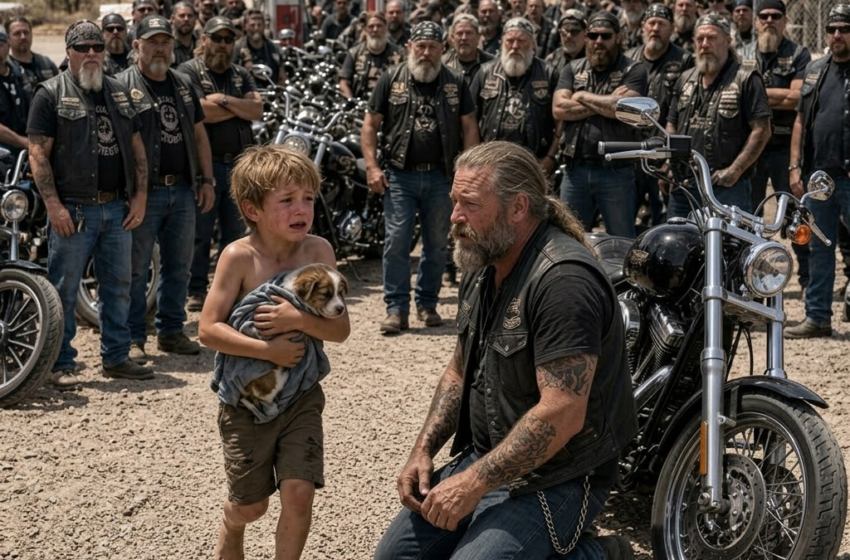
A boy was running across the gravel shoulder of I-40.
Straight toward us.
He could not have been more than seven.
Maybe eight.
Shirtless.
Barefoot.
Sandy-brown hair stuck to his forehead with sweat.
His shoulders were red from the sun.
His face was streaked with dust.
His feet struck gravel that had been baking under more than one hundred degrees of Arizona heat.
He should have been screaming from the pain.
Instead, he ran harder.
Something was pressed against his bare chest in both arms.
Wrapped in a faded blue T-shirt.
The shirt was dark with sweat.
And something else.
Blood.
He entered the motorcycle lot without slowing.
Five hundred riders turned almost together.
At first with curiosity.
Then concern.
Then that particular stillness you see when men who have witnessed emergencies understand they are looking at one.
The boy ran past Hank.
Past three closer riders.
Past the diner entrance.
Straight toward me.
To this day, I do not know why.
Maybe there was no reason.
Maybe children simply choose the nearest solid thing.
Maybe some part of him saw something in me I had forgotten existed.
He stopped three feet away.
His chest heaved.
His green eyes were wide with fear, but there was something else inside them.
Determination.
Far too much for a child his age.
“Please,” he said.
His voice cracked.
“She’s dying.”
He opened the shirt.
Inside was a puppy.
Tiny.
Brown and white.
No bigger than both my hands together.
Its fur was dirty and clumped. Its eyes were half closed. One hind leg had a raw wound along the side, covered with road dirt and dried blood. Its breathing came in fast, shallow bursts. It was too young to look that tired.
I crouched.
Then I looked at the boy’s feet.
The bottoms were torn and bleeding.
Gravel dust stuck to the blood.
The skin along his toes was blistered from hot pavement.
“Where did you come from?” I asked.
He pointed east.
Down Interstate 40.
Heat shimmer erased the horizon.
“Out there.”
“How far?”
“I don’t know.”
“What happened?”
“She was on the road.”
He swallowed.
“I think a truck hit her.”
I looked at the wound.
Maybe.
Maybe not.
“I picked her up,” he said.
He shifted the puppy closer to his chest.
“My mom’s back there too.”
Every instinct in me changed.
“What do you mean your mom’s back there?”
“Our car stopped.”
“How far?”
He looked down the highway.
“I walked a long time.”
Two miles.
Three maybe.
Could have been more.
A seven-year-old kid had crossed miles of Arizona highway barefoot in triple-digit heat while carrying an injured puppy.
“Can I see her?” I asked.
He pulled back.
Protective.
“You have to be careful.”
“I will.”
“She’s scared.”
“I know.”
“I mean it.”
“So do I.”
He studied me.
Not like a kid.
Like someone who had learned trust had consequences.
Then he slowly transferred the puppy into my hands.
The little animal weighed almost nothing.
“Doc!” I called.
My voice carried across the lot.
“Need you over here!”
Doc Wheeler appeared from the crowd immediately.
Nobody knew whether Doc was technically qualified to treat every emergency he got involved in.
Nobody cared.
He had spent twenty-two years as an Army medic.
He had stitched knife wounds.
Reset shoulders.
Stabilized compound fractures.
Treated heatstroke in three countries.
Talked one of our riders through a heart attack on the shoulder of I-10 while an ambulance was still twenty minutes away.
A puppy was new territory.
He dropped to one knee beside me and opened the medical kit he carried on every ride.
“What happened?”
“Road injury. Maybe vehicle. Kid carried her in.”
Doc checked the puppy gently.
The boy watched every movement.
“Laceration on the left rear leg,” Doc said. “Not deep enough to be catastrophic.”
“Truck?”
“Could be road rash. Could have been clipped. Hard to tell.”
He touched the puppy’s gums.
“Dehydrated. Malnourished too.”
The boy’s face tightened.
“Is she dying?”
Doc looked up.
People sometimes mistake kindness for lying.
Doc never did.
“She’s in trouble.”
The boy swallowed.
“But?”
“But you got her somewhere people can help.”
The boy nodded once.
That seemed enough.
Doc flushed the wound with saline while I looked at the child.
“What’s your name?”
“Caleb.”
“Caleb what?”
“Whitfield.”
“I’m Jake.”
He glanced at my vest.
“I know.”
That surprised me.
“How?”
“It says Jake.”
Right.
Sometimes children are smarter than grief.
I pointed toward Doc.
“That’s Doc Wheeler.”
“Is he a doctor?”
Doc answered without looking up.
“Today I am.”
Caleb considered that.
Then nodded as if the credentials were satisfactory.
“Your dog’s going to need a real veterinarian,” Doc said.
“She’s not my dog,” Caleb answered quickly.
Too quickly.
“I just found her.”
“Okay,” I said.
He looked at the puppy again.
I said, “You told me your mom’s with the car.”
His whole face changed.
For the first time, he looked seven.
“The car made a bad noise.”
“What kind?”
“I don’t know. Like… clunk clunk and then a hiss.”
“Smoke?”
“A lot.”
“And your mom?”
“She tried fixing it.”
“What happened?”
“She got dizzy.”
My stomach tightened.
“She sat down in the car.”
“How long ago?”
“I don’t know.”
“Was she awake when you left?”
Caleb hesitated.
That hesitation told me everything.
“She fell asleep.”
“In this heat?”
He nodded.
“I tried waking her up.”
“And she wouldn’t wake?”
His eyes filled, but the tears did not fall.
“She does that sometimes when she gets sick.”
“Caleb.”
He looked at me.
“What kind of sick?”
“She takes medicine.”
“For what?”
“I don’t know.”
“Does she have it with her?”
“We ran out.”
I found Hank across the gathering crowd.
He was already moving.
“Mother’s unconscious in a disabled car,” I told him. “Maybe three miles east.”
Hank was pulling out his phone before I finished.
“I’m calling 911.”
“I’ll ride back.”
“Take Colton and Dutch.”
“I’ll go too.”
The voice belonged to Peggy Sutter.
Peggy owned The Pines.
Fifty-eight.
Short gray hair.
Built like a fire hydrant.
Could insult a man so thoroughly he would apologize for being born.
She came out carrying an open water bottle.
Peggy had lived in Arizona thirty years and could spot dehydration from across a parking lot.
She crouched beside Caleb.
“Drink.”
He accepted the water.
Took two small sips.
Then held it toward the puppy.
“She needs it more.”
Nobody within hearing distance said anything.
I looked around.
Men who had ridden through storms, funerals, divorces, deployments, prison sentences, cancer treatments, accidents, and enough loss to fill cemeteries were staring at one barefoot child offering his water to a half-conscious dog.
Peggy’s expression changed.
Her voice softened.
“Doc has water for her, sweetheart.”
Caleb looked uncertain.
“This one is yours.”
He took another sip.
“All of it,” Peggy ordered.
“Yes, ma’am.”
I stood.
“Stay here with Doc.”
Caleb grabbed my vest.
“What about my mom?”
“I’m going to get her.”
“Promise?”
“Yes.”
I do not make promises lightly.
Not anymore.
But I made that one.
Three motorcycles pulled onto the shoulder of I-40.
Mine.
Colton’s.
Dutch’s.
Colton Ray was thirty-one, the youngest road mechanic in our chapter, skinny as fence wire and twice as hard to break. He could diagnose an engine by listening to it idle for ten seconds and had once rebuilt a carburetor in a motel parking lot using a pocketknife, a paper clip, and profanity.
Dutch Valdez was sixty-two, former tow operator, current professional pessimist, and the kind of man who carried enough tools in his saddlebags to rebuild half a highway if properly motivated.
We found the car near a faded mile marker less than ten minutes later.
Fifteen-year-old beige Honda Civic.
Pulled onto the gravel badly, like whoever drove it had used the last of their strength getting it off the road.
Hood open.
Steam gone now, but the metallic smell of overheated coolant still hung in the air.
The hazard lights were not blinking.
Battery was probably weak.
Or dead.
The back window was partly covered with a sunshade that had a cartoon dinosaur on it. A pair of small sneakers sat on the rear floorboard. One had a broken strap.
I approached the driver’s door.
A woman was slumped behind the wheel.
Early thirties.
Dark hair stuck to her face.
Skin too pale for Arizona summer.
One hand rested near the ignition.
The other was pressed against her abdomen.
I opened the door.
“Ma’am?”
Her eyes moved but did not open.
“Grace?”
Caleb had told me her name while Doc worked.
I touched her shoulder.
“Grace. Can you hear me?”
Her eyes opened.
Brown.
Unfocused.
“Caleb.”
Not a question.
A location check.
The first word out of a barely conscious woman’s mouth was her son’s name.
“He’s safe.”
Her eyes sharpened slightly.
“Where?”
“Gas station a few miles back.”
She tried to sit up.
Her arms shook.
“He—”
“He’s safe. He found help.”
She pressed one hand to her lower back.
The movement looked practiced.
Pain she knew too well.
“I need to go.”
“You need to stay still.”
“No ambulance.”
“Too late.”
Fear entered her face.
“Please. I can’t pay for one.”
I had heard that sentence before.
Not exactly those words.
But that fear.
Help costs money.
Money you do not have.
Therefore, pain becomes something you negotiate privately.
“You don’t need to worry about that right now.”
“You don’t understand.”
“Your seven-year-old son walked miles barefoot in this heat carrying an injured puppy because he couldn’t wake you.”
Her face collapsed.
I kept my voice low.
“He needs you alive more than he needs you worried about a bill.”
That did it.
Not me.
Caleb.
Parents will ignore death for themselves and fear it immediately for their children.
She let me help her from the car.
She weighed almost nothing.
Dutch pulled the chase truck around.
Colton helped get her into the air-conditioned cab.
I looked inside the Honda before closing it.
Pillow on the back seat.
Blanket folded beneath it.
Plastic bin of clothes.
Three cans of soup.
Crackers.
Jar of peanut butter.
Prescription bottles in a clear plastic bag.
Two empty.
One nearly empty.
A folded paper from a Phoenix free clinic.
A children’s workbook with half the pages finished.
A photograph tucked into the visor: Grace, younger and healthier, standing beside a man in a paramedic uniform with Caleb between them as a toddler, all three smiling into sunlight.
They were living in the car.
I shut the door quietly.
Some things feel indecent to witness even when nobody is hiding them.
As we drove back, Grace drifted in and out.
Every time she surfaced, the same word came.
“Caleb.”
“He’s safe,” I told her every time.
Once, she whispered, “He shouldn’t have walked.”
“No,” I said. “He shouldn’t have had to.”
Her eyes opened just enough to look at me.
I did not apologize for the truth.
When we returned to The Pines, the ambulance had not arrived yet.
Caleb sat on an overturned milk crate.
The puppy lay in his lap on a nest of shop towels.
Doc had cleaned and bandaged the leg.
The kid’s own feet were wrapped too.
He had not cried.
Not while running.
Not when Doc removed gravel from the cuts.
Not when his mother was gone.
He sat with his back straight and watched the road.
When he saw our bikes, he stood so fast the puppy shifted.
He instantly adjusted his arms so she would not be jostled.
“Mom!”
Grace stepped down from the truck with help.
Caleb started toward her.
She tried walking toward him.
Neither made it far.
Then the ambulance arrived.
The paramedics took over.
Dehydration.
Fever.
Low blood pressure.
History of kidney disease.
Medication she had stopped taking because she could no longer afford the prescription.
They started fluids.
Grace kept reaching toward Caleb.
Caleb kept trying to stand close enough to touch her but far enough not to block the paramedics.
He looked smaller then.
Not brave.
Not heroic.
Just a child who had been brave too long and now did not know how to stop.
I brought him a hamburger, fries, and milk from Peggy’s kitchen.
He looked at the food.
Then at the ambulance.
“Is Mom going to die?”
The question came without drama.
That scared me more.
“No.”
I sat on the concrete beside him.
“They’re helping her.”
“You don’t know.”
“No.”
He stared at me.
“Then why did you say no?”
Fair question.
“Because I don’t think she will.”
He accepted that answer.
Children know the difference between certainty and honesty.
“She’s been sick a long time,” he said.
“How long?”
“Since before we left Phoenix.”
“What happened there?”
He picked at one fry.
“She cleaned offices at night.”
I waited.
“But she got sick too much.”
“And lost the job?”
He nodded.
“Then we couldn’t pay.”
“How long have you been living in the car?”
His jaw tightened.
“We’re not homeless.”
The words were sharp.
Rehearsed.
A correction he had made before.
“I didn’t say you were.”
“Mom says we’re between places.”
“That sounds right.”
“We were going to Flagstaff.”
“Why?”
“She got a job.”
“Where?”
“A hotel.”
He looked toward the ambulance.
“Housekeeping.”
“So you were almost there.”
“Almost doesn’t count.”
Something about those words stopped me.
That flat exhaustion.
Too old for seven.
I had heard it before.
From myself after Tyler died.
The language of people who stopped expecting good things because expecting them hurt more.
Inside the ambulance, Grace’s voice rose.
“My son. Where is he?”
Caleb was up instantly.
“I’m here!”
The ambulance door opened.
Grace sat near the edge with an IV in her arm.
“Caleb.”
He crossed the distance in seconds.
The puppy remained against his chest.
Even while reaching for his mother.
Even in the middle of the thing he feared most.
He did not forget the weaker thing in his arms.
Grace pulled him in with one arm.
Then she noticed his feet.
The bandages.
The sunburn.
His bare shoulders.
“Where’s your shirt?”
Caleb looked down at the puppy.
“I used it for her.”
Grace stared.
“Baby…”
“She was hurt.”
“You walked out there without shoes?”
“I had shoes.”
“Where?”
“They broke.”
“You walked on the highway?”
“She was dying.”
“You could have gotten heatstroke.”
“Nobody stopped.”
Grace closed her eyes.
When she opened them, tears had gathered.
“You’re just like your father.”
The words came out broken.
“He could never walk past anything that was hurting either.”
Past tense.
Final.
I did not ask.
Some doors are not yours to open.
The paramedics convinced Grace to go to Flagstaff Medical Center.
Barely.
She kept saying Caleb had to come.
I stepped forward.
“I’ll stay with him personally.”
She studied me.
Not the vest.
Not the tattoos.
Me.
Then she looked at Caleb.
He was leaning against my leg.
I had not even noticed.
Children do that.
They lean on what feels stable.
“Okay,” Grace whispered.
The ambulance pulled away.
Caleb watched until it disappeared.
Then he looked up.
“She’s coming back?”
“Yes.”
“Promise?”
I looked at him.
At the sunburn.
Bandaged feet.
Tiny puppy.
Green eyes trying desperately not to become afraid.
Something shifted inside my chest.
A door I had welded shut three years earlier moved on its hinges.
“I promise.”
Hank called everyone together twenty minutes later.
Five hundred bikers formed a loose semicircle across the lot.
He stood on the bed of Colton’s pickup.
The sun behind him turned the crowd into silhouettes of leather and chrome.
“Listen up.”
He did not shout.
He never had to.
Silence moved through the lot.
“You’ve all heard some version of what happened today.”
He pointed toward Caleb.
The boy sat beside me with the puppy asleep in his arms.
“For those who haven’t, that kid walked somewhere around three miles down I-40 in more than a hundred degrees of heat.”
The men looked toward him.
“Barefoot.”
More silence.
“His mother was unconscious in a broken-down car.”
Hank paused.
“He found an injured puppy on the shoulder.”
Caleb lowered his eyes.
“He took off his shirt, wrapped her up, and carried her until he found help.”
Hank looked over the group.
“That kid had every reason to sit beside the car and wait for an adult.”
Nobody moved.
“He’s seven.”
A few riders looked down.
“Nobody would have blamed him.”
Hank let the silence build.
“But he heard something crying.”
He pointed toward the puppy.
“And decided that mattered.”
I watched faces change.
Hard men.
Old men.
Young men pretending to be hard.
Men whose vests carried memorial patches.
Men who had buried brothers.
Children.
Wives.
Parents.
Hank continued.
“We call ourselves Iron Angels.”
A few heads lifted.
“We ride six days through three states every year to raise money for families who lost somebody.”
His voice deepened.
“We say brotherhood means more than patches.”
He looked at Caleb.
“That boy doesn’t know our name.”
Caleb looked at me.
I almost smiled.
“He doesn’t know why we ride.”
Hank spread one hand.
“But today, he showed five hundred of us what an angel looks like.”
Nobody laughed.
Nobody needed to.
“That family is living in a car.”
The words landed hard.
“The mother has a job waiting in Flagstaff if she can reach it. The car is dead. She’s sick. She’s out of medication.”
Hank pointed toward Caleb again.
“The kid’s feet are cut open.”
He paused.
“And when Peggy gave him water, he tried to give it to the dog.”
Somewhere behind me, a man swore quietly.
Not angry.
Moved.
Hank said nothing else for several seconds.
He did not have to.
The silence that followed was not uncertainty.
It was decision.
Dutch raised his hand first.
“I’ll fix the Honda.”
Someone shouted, “What’s wrong with it?”
“Radiator system, probably hose or water pump.”
“I got parts in the chase trailer,” Colton said.
“I’ve got cash,” another voice called.
“So do I.”
“My sister runs a hotel in Flagstaff.”
“My cousin owns apartments.”
“I know a nephrologist.”
“I got gift cards.”
“Put me down for two hundred.”
“Five.”
“Three.”
“Call my wife. She does medical billing.”
“Call my daughter. She works at the shelter.”
“I got a spare pair of kids’ boots in the RV.”
The whole lot came alive.
Not cheering.
Working.
That was the thing outsiders rarely understood about men like these.
People saw tattoos.
Leather.
Motorcycles.
Noise.
They assumed chaos.
But give five hundred men a problem they can solve with tools, money, contacts, trucks, or stubbornness and suddenly you have an army.
Caleb tugged my vest.
“What are they doing?”
“Helping.”
“Why?”
“Because you asked.”
“I asked you.”
I looked down at him.
“Sometimes one person asking is enough.”
He looked at the crowd as if trying to understand the size of what he had started.
His eyes landed on Doc, who was now rigging a small hydration setup for the puppy using a plastic syringe, a towel, and the concentration of a man defusing a bomb.
“Is she going to live?” Caleb asked.
“She has a better chance now.”
“That’s not yes.”
“No.”
He nodded.
Honesty again.
Dutch and three mechanics rode to the Civic.
Two hours later, they returned with it running.
New radiator hose.
Flushed cooling system.
New belts.
Oil changed.
Battery tested.
Tires checked.
A cracked serpentine belt replaced with one from a parts run Colton somehow arranged through a cousin of a rider who knew a guy with a shop thirty miles away.
Dutch shrugged when I asked what he had done.
“We were already under the hood.”
Peggy sat beside Caleb with two bowls of vanilla ice cream.
The puppy had fallen asleep inside a cardboard box lined with towels.
“That little thing needs a name,” Peggy said.
Caleb shook his head.
“She’s not mine.”
Peggy looked at him.
Then at me.
Then back at him.
“Didn’t ask whose she was.”
Caleb considered the puppy.
“Ryder.”
“Ryder?”
He looked at the motorcycles.
“With a Y.”
Peggy nodded seriously.
“Obviously.”
By late afternoon, the emergency clinic in Flagstaff had agreed to see Ryder, fees covered through an anonymous donor who was not anonymous at all because Hank had terrible handwriting and left his card on the counter. Doc arranged transport. The vet said the leg wound was ugly but treatable. No broken spine. No internal bleeding they could detect. Dehydrated, malnourished, likely dumped or born stray, but alive.
Caleb listened to every update like a soldier receiving battlefield reports.
When Doc told him Ryder would need antibiotics, bandage changes, and rest, Caleb asked, “How much rest?”
Doc said, “A lot.”
Caleb nodded.
“I can do that.”
Grace called from the hospital at 6:15.
Her voice sounded stronger.
They wanted to keep her overnight.
Kidney function.
Medication adjustment.
Observation.
Caleb sat close enough to the speaker phone that his nose nearly touched it.
“Mom?”
“I’m okay, baby.”
“You sound tired.”
“I am.”
“Did you eat?”
Grace laughed weakly.
“You sound like me.”
“You tell me I have to eat.”
“I know.”
“Then you have to.”
“Yes, sir.”
I turned away.
Some family moments feel too private even when everyone is smiling.
Then Grace asked, “How’s the puppy?”
Caleb lit up.
“Her name is Ryder.”
A pause.
“Of course it is.”
“She’s better.”
“That’s good.”
“The car’s fixed,” I said.
Silence.
“What?”
“Running. Full tank.”
“I can’t pay—”
“You’re not paying.”
“Jake.”
“That’s the point.”
I heard her start crying.
Not loud.
Not broken.
The sound of someone who has carried too much weight alone and suddenly felt other hands under it.
That night, Hank took most of the club ahead to Williams.
The ride had a schedule.
Families waiting in California.
Events arranged.
Money to raise.
We rode for people who had already lost someone, and those people were expecting us.
But I stayed.
Nobody questioned it.
Neither did Doc, Dutch, Colton, Peggy, or about thirty riders who found sudden urgent reasons to remain at a gas station in the middle of nowhere.
Caleb fell asleep inside Colton’s truck with Ryder against his stomach.
I sat on the tailgate.
The parking lot had gone quiet.
Only thirty bikes remained.
My phone was in my hand before I knew why.
Tyler’s picture filled the screen.
Sixteen years old.
Grease on his cheek.
Standing beside the Shovelhead.
Smiling like life had never taught him what endings were.
Three years.
Eleven months.
I looked through the truck window.
Caleb slept curled around the puppy.
Small chest.
Smaller chest.
Breathing together.
I had spent years afraid that caring about another kid somehow betrayed my son.
As if grief were a room with one chair.
As if loving what remained meant replacing what was gone.
But looking at Caleb, I finally understood something.
He was not Tyler.
He never would be.
That was not the point.
My hands had spent three years doing nothing but gripping handlebars and carrying grief.
Maybe they still knew how to do something else.
“I see you, kid,” I whispered.
Caleb slept.
Maybe I was saying it to him.
Maybe Tyler.
Maybe myself.
Grace left the hospital the next morning.
New prescription.
Follow-up appointment.
A treatment plan.
Strict instructions.
And a hospital bill marked PAID.
Iron Angels Community Fund.
When she walked out holding Caleb’s hand, she stopped.
Her Honda waited at the curb.
Washed.
Vacuumed.
Running.
The warning light that had been glowing on the dashboard for months was gone.
Caleb carried Ryder in a real pet carrier Doc had acquired from somewhere.
I never asked where.
Doc could find anything if given enough time and coffee.
Grace approached the car slowly.
On the passenger seat sat a folder.
Inside:
A letter confirming a furnished apartment in Flagstaff with first and last month covered.
A printed email confirming her housekeeping position was still waiting.
A business card for a kidney specialist with an appointment written on the back.
A grocery gift card.
A gas card.
Three months of prescription assistance arranged through a community health program.
A temporary phone plan.
A list of food banks that did not require a permanent address.
A note from Peggy.
FOR THE ROAD.
Grace sat behind the wheel.
Pressed her forehead against it.
Her shoulders shook.
Caleb climbed into the back.
Ryder beside him.
“It’s okay, Mom.”
Grace looked back.
“They’re the good guys.”
I leaned against my Road King.
When she finally got herself together, she lowered the window.
“I don’t know how to thank you.”
“You don’t.”
“I have to.”
“No.”
She looked confused.
“Your son did something yesterday most adults wouldn’t have done.”
“He carried a puppy.”
“He carried a hurt animal three miles through the desert.”
She looked at Caleb in the mirror.
“No shoes.”
Her eyes filled again.
“No water.”
She closed them.
“And when he finally got water, he tried to give it away.”
I stepped closer.
“Grace, I don’t know everything that has happened to you.”
She looked down.
“I don’t need to.”
I nodded toward Caleb.
“But whatever you think you failed at, you raised that.”
Her mouth trembled.
“You raised a kid who takes the shirt off his own back for something weaker than he is.”
I swallowed.
“That’s not nothing.”
I thought of Tyler.
“That’s everything.”
Grace looked at me for a long time.
Not at the patches.
Not the tattoos.
Me.
“Five hundred men,” I said. “Your son ran into a gas station and gave five hundred strangers a reason to remember why they ride.”
Caleb pushed his face toward the open rear window.
“Jake?”
“Yeah?”
“Can Ryder be an Iron Angel?”
I laughed.
Really laughed.
Not the polite sound I had been making for three years.
The kind that starts somewhere in your chest and reminds you there is still space inside it.
“She can.”
“Really?”
“Newest member.”
“Can she have a vest?”
“I’ll have Doc make one.”
“A tiny vest.”
“The tiniest vest in Arizona.”
Grace started the car.
The engine turned over smoothly.
“Drive safe,” I said.
She nodded.
“And take your medicine.”
“Yes, Dad.”
I laughed again.
The Honda pulled away.
Caleb turned around in the back seat.
One hand rested on Ryder’s carrier.
The other waved through the glass.
I waved back.
And stayed waving long after the car turned the corner.
Some goodbyes take longer to finish.
I caught up with the club that afternoon.
Eighty miles down I-40, I stopped alone at another gas station.
Different sign.
Different pumps.
Same desert.
I shut off the bike and took out my phone.
There was one number I had not called in three years.
Linda Prescott.
Tyler’s mother.
My ex-wife.
I stared at her name.
Then pressed call.
One ring.
Two.
Three.
Four.
“Jake?”
Her voice nearly broke me.
“Hey, Linda.”
Silence.
“Are you okay?”
“I’m on the ride.”
“I know.”
“How?”
“Hank’s wife posted pictures.”
Of course.
“I wanted to tell you something.”
She waited.
“Yesterday a kid ran into a gas station carrying a puppy.”
“That sounds like the beginning of one of your stories.”
“Seven years old.”
I looked out at the highway.
“Barefoot.”
Linda went quiet.
“He walked miles.”
“Why?”
“The puppy was hurt.”
I rubbed my face.
“His mom was sick in a broken car.”
“Is she okay?”
“She will be.”
“And the boy?”
“He’s fine.”
I paused.
“Linda, he reminded me of Tyler.”
The silence changed.
Not hostile.
Tender.
Painful.
“Why?”
“Because Tyler would’ve stopped.”
She inhaled.
“Yes.”
“He would have been the first one off the bike.”
“Yes.”
“I keep thinking about how I’ve spent three years riding.”
My throat tightened.
“Like if I rode far enough, I could outrun the road that took him.”
“Jake…”
“I know.”
The words finally came.
“I know now.”
Traffic hissed on the interstate.
“The point of being strong isn’t just surviving.”
Linda said nothing.
“It’s showing up for the things that can’t survive without you.”
I looked down at Tyler’s name tattooed on my arm.
“He knew that.”
A long silence.
Then Linda whispered, “He would have loved that kid.”
“Yeah.”
“He would.”
“Thank you for calling.”
“Thank you for answering.”
I hung up.
Held the phone against my chest.
The way Caleb had held Ryder.
Carefully.
As if what I carried might break.
Or heal.
And I still could not tell which.
Six months later, I rode back into Flagstaff on a December morning carrying two boxes.
The Pinecrest Suites were nothing fancy.
Clean.
Affordable.
A little courtyard.
A few potted plants dying bravely in winter.
Apartment 214 sat on the second floor, near the stairs. There was a small wreath on the door, one of those dollar-store ones with glitter that got everywhere. A child’s drawing was taped beneath it: a brown-and-white dog with angel wings riding a motorcycle. The motorcycle had six wheels because Caleb believed more wheels meant safer.
I knocked.
The door opened.
Caleb stood there in socks.
He had grown.
Not much.
But enough that I noticed.
Behind him came Ryder.
The tiny injured puppy from the highway was now a bright-eyed brown-and-white mutt with oversized ears and a slight limp that gave her walk what Doc called “character.”
She recognized me before Caleb said anything.
Her tail went crazy.
“Jake!”
Caleb launched himself forward.
I barely had time to put down the boxes.
He hugged me.
I froze.
Only for a second.
Then hugged him back.
Grace stood behind him.
Healthy color had returned to her face.
She looked stronger.
Three months into the hotel job.
Specialist appointments kept.
Medication stable.
Food in the refrigerator.
Bills being paid.
Not perfect.
Real.
That mattered more.
“What are the boxes?” Caleb asked.
“Open them.”
He tore into the first.
Inside was a child-sized leather vest.
Black.
Silver angel patch.
Across the back:
HONORARY IRON ANGEL.
Caleb stared.
“No way.”
“There’s another one.”
He opened the smaller box.
Tiny black vest.
One patch.
RYDER
IRON ANGELS K9 DIVISION
Caleb screamed.
Ryder barked because she assumed screaming required participation.
Grace laughed.
The sound filled the apartment.
Caleb put on his vest.
Then Ryder’s.
The dog stood with the resigned dignity of an animal who had survived the highway only to become the victim of human fashion.
“Look, Mom!”
Grace took out her phone.
“We match!”
I stood beside the doorway watching.
Above the kitchen table hung a photograph.
Five hundred motorcycles at The Pines.
Peggy had taken it from the roof.
At the center of the crowd stood one tiny shirtless boy holding something against his chest.
Beneath the photograph was a piece of paper.
Caleb’s handwriting.
Uneven letters.
Careful.
I stepped closer.
Sometimes one person asking is enough.
I stared at it longer than I meant to.
Grace noticed.
“He remembers everything you said.”
“I should be more careful what I say.”
“No.”
She shook her head.
“I think maybe you said exactly what he needed.”
Caleb came running back.
“Jake, Ryder knows sit now.”
“Impressive.”
“And shake.”
“Advanced.”
“And she steals socks.”
“Criminal.”
“She only steals mine.”
“Targeted criminal activity.”
Caleb laughed.
For a moment, I heard another laugh beneath it.
Not the same.
Never the same.
Tyler’s.
And this time, instead of the memory cutting me open, it sat beside me.
That was new.
Later, while Caleb played with Ryder, Grace handed me coffee.
“I never told you what happened to his father.”
“You didn’t have to.”
“He was a paramedic.”
I looked at her.
“Killed by a drunk driver two years ago.”
My fingers tightened around the mug.
“Caleb was five.”
“I’m sorry.”
“He remembers strange things.”
She watched her son.
“How his dad tied his shoes. The cereal he liked. That he stopped for injured animals.”
A sad smile.
“Once he stopped traffic for a turtle.”
I laughed softly.
“Sounds familiar.”
Grace nodded.
“The day Caleb found Ryder, I think he thought his father would have stopped.”
My throat closed.
“So he did.”
“Yes.”
We stood quietly.
Then Grace said, “You know he talks about you.”
“I figured.”
“He thinks you’re the strongest man alive.”
“That is objectively false.”
“I know.”
She smiled.
“But I don’t correct him.”
I looked at Caleb.
He was lying on the floor.
Ryder had one paw on his chest.
“He doesn’t need another father.”
Grace’s eyes moved to mine.
“I know.”
“I’m not trying to—”
“I know, Jake.”
She let the silence settle.
“Sometimes a kid just needs another person who shows up.”
The words landed somewhere deep.
Tyler had taught me that without ever saying it.
Caleb reminded me.
Over the next few years, I saw them often.
Not every week.
Not enough to turn kindness into ownership.
Birthdays.
Christmas.
Club picnics.
Vet appointments when Grace had work.
A school fundraiser where Caleb insisted Ryder should be allowed to attend because she was “emotionally part of the family economy.”
The principal disagreed.
Ryder became unofficial mascot of the Flagstaff chapter.
Her tiny vest stopped fitting, so Doc made another.
Then another.
Caleb grew into his.
At ten, he joined us on charity events, helping at registration tables.
At twelve, he learned how to change motorcycle oil.
At thirteen, he corrected Dutch on a torque spec and nearly lost his life to a lecture.
At fourteen, he helped rebuild a carburetor.
At fifteen, he began collecting supplies for roadside emergency kits we handed out on summer rides: water, electrolyte packets, dog bowls, bandages, socks, sunscreen, and a list of emergency resources.
“Why dog bowls?” Hank asked.
Caleb looked at him like the answer was obvious.
“Because sometimes the one who needs water has paws.”
Hank never questioned the dog bowls again.
At sixteen, Caleb finally asked me about Tyler.
We were in my garage.
The old Shovelhead was still there.
But no longer under a sheet.
I had removed the cover the year before and spent two months only looking at it. Then cleaning around it. Then touching the seat. Then finding the box where Tyler had labeled parts in his sharp, impatient handwriting.
Caleb stood beside it.
“That was his?”
“Yeah.”
“Did you ever finish it?”
“No.”
“Why?”
I looked at the bike.
“Because finishing it felt wrong.”
“Why?”
“Because we were supposed to finish it together.”
Caleb nodded.
Then he said, “Maybe finishing it doesn’t mean you forgot that.”
I looked at him.
Kids grow.
Sometimes into the person who says the thing you spent years refusing to hear.
“You volunteering?”
He smiled.
“I was hoping you’d ask.”
It took us seven months.
We did not replace what Tyler had done.
We preserved it.
Every bolt he had installed stayed.
Every scratch.
Every imperfect choice.
Caleb did not try becoming him.
I never asked him to.
When we finally rolled the finished 1978 Shovelhead into the Arizona sunlight, Linda came.
That mattered.
She stood beside me.
We had learned to speak again over the years.
Not remarried.
Not repaired into something we no longer were.
But no longer strangers built from the wreckage of the same son.
She touched the seat.
“Tyler would complain you changed the pipes.”
“He had bad taste.”
“He got that from you.”
Caleb laughed from across the driveway.
Ryder barked.
Linda looked at him.
“That the boy?”
“Yeah.”
She walked over.
“Caleb?”
“Yes, ma’am.”
“I’m Linda.”
He knew immediately.
His face changed.
“Tyler’s mom.”
She nodded.
Caleb looked nervous.
Then said, “Jake talks about him.”
Linda glanced at me.
“He does?”
I swallowed.
“More now.”
She smiled.
“Good.”
That afternoon, we rode the Shovelhead for the first time.
Not far.
Just around the block.
I rode.
Caleb waited.
When I returned, I shut off the engine and listened to the metal ticking as it cooled.
The same sound motorcycles had made at The Pines years earlier.
The day a barefoot child ran through five hundred bikes carrying a dying puppy in his shirt.
That one moment had started a chain none of us could have seen.
Caleb saved Ryder.
Ryder brought Caleb to us.
Caleb’s courage brought five hundred men toward Grace.
Grace’s survival gave Caleb a home.
Caleb gave me a reason to call Linda.
Linda gave me back permission to say Tyler’s name.
And eventually, a motorcycle once frozen in grief rolled into sunlight again.
People like to believe life changes through big moments.
It does sometimes.
But more often, everything turns on something almost invisible.
A boy hearing a puppy cry.
A stranger choosing to stop.
A bottle of water offered away.
A mechanic saying, “I can fix that.”
A man making one phone call after three years.
One person asking.
One person answering.
One person showing up.
Years later, when Caleb turned eighteen, the Iron Angels held our annual charity ride at The Pines again.
Peggy still owned the place.
The sign still leaned.
The coffee was still terrible.
Five hundred motorcycles filled the lot.
Almost exactly like before.
The desert looked the same, though nothing ever is.
The sun came down hard on the chrome.
The pumps hummed.
The gravel crunched beneath boots.
Men who had been young that first day now carried more gray in their beards. Men who had been old moved more carefully. Some patches had been added. Some names had been stitched into memorial panels. Some riders were missing, their stories carried by those who remained.
Caleb arrived on a used Honda Rebel.
Grace hated it.
I helped him buy it.
Those facts created several unpleasant conversations.
Ryder rode in a secured side carrier wearing her Iron Angels vest.
She was older now.
Gray around the muzzle.
Still limped.
Still stole socks.
Hank climbed onto the same truck bed.
His head was still shaved.
His beard had gone gray.
“Listen up!”
The lot fell silent.
He pointed toward Caleb.
“Some of you old men remember that kid.”
Laughter.
Caleb covered his face.
“Seven years ago, he ran into this lot without shoes.”
Someone yelled, “Still can’t dress himself!”
More laughter.
Hank grinned.
“Carrying a hurt dog.”
The laughter softened.
“He didn’t know who we were.”
Hank looked over hundreds of riders.
“He only knew something needed help.”
He turned to Caleb.
“That day, we made him an honorary Iron Angel.”
Cheers.
Caleb looked embarrassed.
Ryder barked.
Hank lifted one hand.
“Today, the board voted unanimously.”
Caleb frowned.
I knew.
He did not.
Hank stepped down from the truck holding a new vest.
Full-sized.
Not honorary.
Caleb stopped breathing.
Across the back was the Iron Angels emblem.
Beneath it:
ROAD RELIEF COORDINATOR.
Not rider.
Not prospect.
We were not making a teenager into an outlaw fantasy.
We were giving a young man who had spent his life helping people a place in the club’s charity foundation.
He had already spent two years volunteering.
Organizing roadside kits.
Helping stranded families.
Building animal rescue partnerships with shelters along our routes.
The title simply made official what he had already become.
Hank held out the vest.
“Your father stopped for hurting things.”
Caleb’s face changed.
Grace covered her mouth.
Hank continued.
“You did too.”
Then he nodded toward me.
“And you reminded some of us old fools how.”
Caleb looked at me.
I could not speak.
He put on the vest.
Five hundred riders cheered.
Ryder barked again because nobody had explained that senior dogs do not need to shout at ceremonies.
Caleb crouched beside her.
Pressed his forehead against hers.
Then he stood and walked toward me.
“You knew?”
“Maybe.”
He hugged me.
This time I did not freeze at all.
Over his shoulder, I saw Grace crying.
Linda stood beside her.
Hank looked away pretending to check something on his phone.
Dutch openly cried because age had removed whatever dignity he once claimed.
And on my right forearm, Tyler’s name caught the desert sunlight.
For years, I believed honoring my son meant keeping the wound open.
Keeping his room untouched.
Keeping the motorcycle unfinished.
Keeping everyone far enough away that nobody could be mistaken for replacement.
I had been wrong.
The dead are not honored by making ourselves dead beside them.
Tyler had been sixteen.
Kind.
Reckless.
Impossible.
The kind of kid who absolutely would have stopped traffic for a turtle.
The kind who would have pulled over for a crying puppy.
The kind who might have looked at seven-year-old Caleb running barefoot through the Arizona heat and said exactly what I finally learned to say.
I see you.
That is what mattered.
Not saving everyone.
Nobody can.
Not fixing every broken thing.
Nobody does.
Showing up.
That is all.
Sometimes you ride three states to raise money for strangers.
Sometimes you turn a wrench under a broken Honda.
Sometimes you sit beside a frightened kid while his mother is in an ambulance.
Sometimes you carry a puppy.
And sometimes the smallest person in a parking lot full of enormous men reminds everybody there what strength was supposed to be for.
That afternoon, hundreds of engines started at once.
The sound rolled across Interstate 40 like thunder.
Caleb climbed onto his bike.
Ryder settled into her carrier.
Grace stood near the diner with one hand over her heart.
Linda stood beside me for a moment before I mounted up.
“You all right?” she asked.
I looked at Caleb.
At Ryder.
At the highway.
At the place where he had run in years before with bloody feet and a dying puppy wrapped in his shirt.
“I think I’m getting there,” I said.
Linda smiled sadly.
“That’s better than good.”
She was right.
I pulled alongside Caleb.
“You ready?”
He looked at me.
Then toward the highway.
Seven years earlier, he had arrived on that road with bleeding feet and nothing but fear behind him.
Now he wore boots.
A helmet.
A vest he had earned.
And beside him was the dog everyone thought would die before sunset.
“Ready,” he said.
Hank raised his fist.
Five hundred engines dropped into gear.
We pulled onto I-40 together.
And as the desert opened ahead of us, I looked at Caleb riding beside me and finally understood the lesson that had taken me years, a funeral, a divorce, five hundred bikers, one broken-down Honda, and a half-dead puppy to learn.
Strength was never about being the hardest man in the room.
It was never about surviving alone.
It was never about how much pain you could carry without asking for help.
Strength was seeing something small and frightened on the side of the road—
and stopping.
Because sometimes one person asking really is enough.